
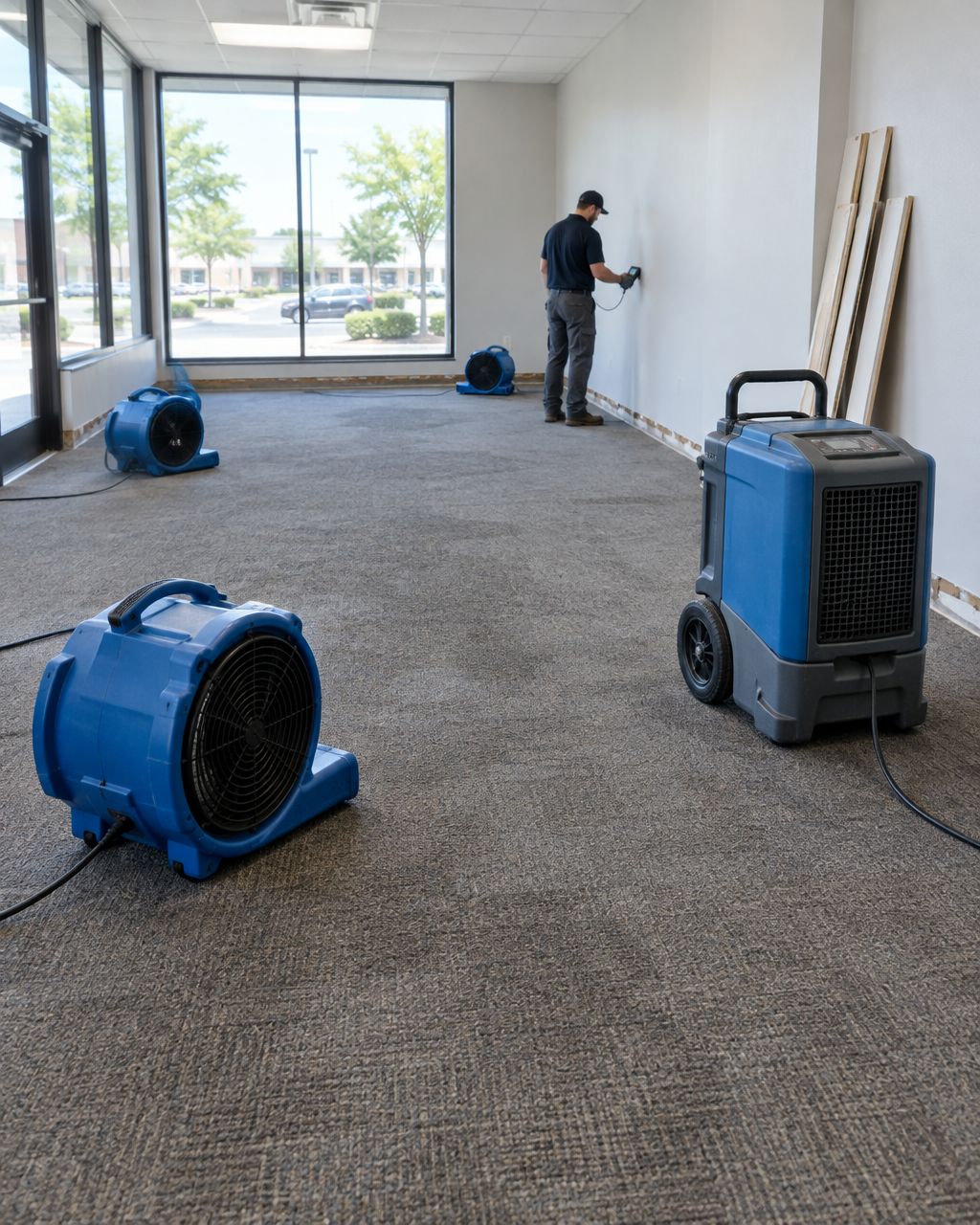
Commercial water damage restoration is the emergency mitigation, drying and rebuild of a business property after a pipe burst, roof leak, storm or sewage backup, with the aim of reopening the space safely and quickly. It differs from residential work in three ways: the water volume is larger, the building systems are commercial-grade, and every day of closure costs the business revenue.
- Commercial mitigation runs $3-$7.50 per square foot; rebuild adds $20-$37 per square foot.
- Water category 1, 2 or 3 is the biggest cost driver — black water costs the most to clean.
- Drying must start within 24-48 hours or mold becomes a second, separate project.
- Get the drying log in writing: it is the evidence an insurer expects.
- Check a restoration firm's IICRC certifications and commercial references before signing.
Why this matters for business properties
A flooded office is not just a repair bill; it is downtime. Standing water closes sales floors, treatment rooms and tenant units, and the meter runs on rent and revenue while the space dries. That is why the sequence below front-loads speed: stop the water, document for insurance, and get drying equipment running the same day.
Cost context for 2026: water damage restoration typically runs $1,384 to $6,384 with a national average near $3,867 for a residential-scale job; commercial jobs scale with square footage and contamination, which is why the per-square-foot rates matter more here. (Source: aggregated restoration industry pricing, checked October 2026.)
How to respond: the first 24 hours
- Stop the source and cut power to wet zones. Close the shutoff valve or supply line. Never let staff enter standing water that could be energized or contaminated.
- Photograph everything before cleanup. Every affected room, from several angles, with timestamps. This is the record your insurer and any adjuster will work from.
- Call a restoration firm that handles commercial losses. Ask one question first: can crews and drying equipment be on site today? Volume is why speed matters more at commercial scale.
- Notify your insurer the same day. Ask what documentation they need and what emergency mitigation is approved.
- Start extraction and drying immediately. Extractors, air movers and dehumidifiers should run the same day. Mold can begin growing within 24 to 48 hours — see how fast mold grows after water damage.
Step 1: classify the water — it sets the price
Restoration professionals sort water damage into three categories, and the category drives the per-square-foot rate more than anything else:
| Category | What it is | Typical mitigation cost |
|---|---|---|
| Category 1 (clean) | Supply line, appliance hose | $3-$4 per sq ft |
| Category 2 (gray) | Dishwasher discharge, shower drain | $4-$6.50 per sq ft |
| Category 3 (black) | Sewage, rising floodwater | $7-$7.50+ per sq ft |
Black water requires decontamination steps before drying even starts, which is where the labor adds up. A sewage backup in a restaurant kitchen is a different job from a clean supply-line leak in an empty office — same square footage, roughly double the mitigation rate.
Step 2: the drying plan and the log
A commercial scope should name the equipment, the areas, the moisture targets and the monitoring schedule. Professionals use moisture meters and thermal imaging to find water inside wall cavities, and the drying standard they work from is the IICRC S500 guideline for professional water damage restoration.
Ask for the drying log in writing — daily moisture readings, equipment run times, removal dates. It protects you twice: it proves progress to your insurer, and it sets the point at which the drying phase ends and the rebuild begins.
Step 3: the rebuild, priced separately
Mitigation gets the space dry; rebuild puts it back together. New drywall, flooring, baseboards and paint typically run $20 to $37 per square foot on top of mitigation. Get the rebuild priced after the drying log closes, not before — scope changes once wall cavities are opened are common, and a firm that prices the rebuild on day one is guessing.
For roof-originated leaks on commercial buildings, the envelope work is a separate trade; how to choose a storm damage restoration company covers the vetting for that scope.
Insurance and documentation
Commercial property policies follow the same covered-peril logic as residential ones: sudden and accidental events are typically covered, long-term seepage is typically not, and flood usually requires a separate policy. Report the loss promptly, keep every receipt for mitigation, and hand the insurer the drying log. If a claim stalls or the offer does not match the documented scope, a public adjuster can review it — how to choose a public adjuster explains the checks before you commit.
How to choose a commercial restoration firm
- IICRC-certified technicians — ask for the certificates, not a logo on a truck
- Commercial references — jobs of similar size and building type in the last year
- Written drying plan and log — equipment list, targets, daily readings
- Capacity — enough air movers and dehumidifiers to dry your square footage in one mobilization
- Clear separation of mitigation and rebuild pricing — one rate for drying, a separate scope for repairs
Handvetted verifies state licenses through official registries, runs background checks on every owner and operator, requires a 4.5-star minimum rating, and has a person review every match before an introduction is made.
FAQ
How much does commercial water damage restoration cost in 2026?
Mitigation runs $3-$7.50 per square foot and rebuild adds $20-$37 per square foot. Water category is the biggest driver: black water jobs cost roughly twice clean water jobs per square foot.
How long does commercial water damage restoration take?
Drying typically takes 3-5 days once equipment is running; rebuild adds 1-4 weeks depending on scope. Total closure time depends on how fast mitigation starts.
Does commercial property insurance cover water damage?
Usually yes for sudden, accidental events like pipe bursts. Flood requires separate coverage and long-term seepage is typically excluded. Report the loss the same day.
Can a business stay open during restoration?
Sometimes, if the damage is contained to one area and the water is clean. Contaminated (Category 3) water usually requires closing the affected zone until decontamination is complete.
What certifications should a commercial restoration company have?
IICRC certifications, including water damage restoration training under the S500 standard. Ask to see the individual technicians' certificates.
What is the difference between mitigation and restoration?
Mitigation stops the damage and dries the space — extraction, air movers, dehumidifiers. Restoration rebuilds what was removed: drywall, flooring, paint.
One last thing
The cheapest commercial water job is the one that starts today. Waiting a week to "let things dry on their own" converts a $4-per-square-foot clean water job into a mold remediation project at several times the rate.
Related guides
- How fast mold grows after water damage
- How to choose a mold remediation contractor
- Storm damage claim to mold remediation coverage workflow
Get Matched
Tell us what you need. We will match you with one licensed, background-checked restoration professional for the mitigation and the rebuild — free for property owners. Get Matched.