Does the lowest quote represent the best value, or does it exclude tasks another roofer identified? A refined sales pitch cannot indicate whether the contractor is licensed, whether the inspection was thorough, or whether the warranty covers faulty installation instead of only defective materials.
Use roofing contractor questions as an evidence test. Compare documents, inspection findings, material specifications, permit responsibilities, warranty language, change-order procedures, references, and scheduling commitments. A contractor who deserves your trust should explain what will happen, show proof, and put the important terms in writing.
Homeowners are comparison-driven. In a 2024 survey, 67% said they were most likely to gather three quotes, while another 6% would seek four or more. The same survey found that 97% expected a contractor response within a week, and 54% specifically expected arrival within one to two days. Reputation led the decision factors at 31%, followed by professional licensing at 16%, then experience and material quality at 13% each. (Roofing Contractor's homeowner survey)
The questions below help you interview a roofer instead of listening to promises. If you'd rather start with one verified professional, Handvetted can match you with a single screened roofing business instead of sending your request to multiple companies.
Table of Contents
- 1. Are you licensed and insured in my state?
- 2. What roofing materials do you recommend, and why?
- 3. Can you provide references from recent projects in my area?
- 4. What's included in your estimate, and how detailed is your inspection?
- 5. What permits do you pull, and who handles inspections?
- 6. What warranties do you offer on materials and workmanship?
- 7. How do you handle unexpected problems discovered during work?
- 8. How do you handle the project timeline, and what causes delays?
- 8 Key Roofing Contractor Questions Compared
- Turn Answers Into a Safer Hiring Decision
1. Are you licensed and insured in my state?
Ask for the contractor's current license number and insurance certificates before you schedule the work. Licensing rules vary by state and municipality, so verify the credential independently through the relevant licensing board. A contractor's own paperwork is useful, but it shouldn't be your only check.
Insurance matters just as much. Confirm both general liability insurance, which addresses property damage and certain injuries involving the business, and workers' compensation insurance, which covers qualifying injuries to employees. Independent guidance for roof replacement recommends confirming both before work begins. (Farm Bureau Financial Services guidance on roofer insurance)
Ask for documents, not reassurance
Request:
- A current license record: Check that the name on the license matches the business signing your contract.
- A certificate of insurance: Review the policyholder, coverage types, and expiration dates.
- Independent verification: Use your state licensing board's website or telephone service.
- Written clarification: Ask whether subcontractors carry their own coverage and who is responsible for verifying it.
Don't assume an expired certificate is a minor administrative issue. If a worker is injured or the crew damages your property, missing or lapsed coverage can leave you arguing over responsibility while the roof remains unfinished.
Practical rule: If a contractor won't provide current license and insurance proof before asking for a deposit, pause the project.
You can also review how to verify a roofing contractor's license before signing. A refusal to share documents, a mismatch between the salesperson and the licensed business, or pressure to “sort it out later” is enough reason to walk away.
2. What roofing materials do you recommend, and why?
Which material fits this roof, and what evidence supports that choice? Ask the contractor to connect the recommendation to your climate, roof pitch, ventilation, structural capacity, appearance goals, maintenance expectations, and budget.
Require a side-by-side explanation of the trade-offs. Asphalt shingles, metal, slate, and tile differ in weather performance and installation requirements. A credible roofer should explain why one option suits your property, what preparation it needs, and where another material may work better.
Test the recommendation with proof
Ask the roofer to provide:
- Material samples: Check the color, profile, thickness, and finish against your expectations.
- Comparable project photos: Look for similar roof designs and weather exposure, then ask when and where the work was completed.
- Underlayment and flashing specifications: Confirm how the proposed system will manage water, including areas that sales presentations often skip.
- Warranty documents: Compare manufacturer coverage with the installation conditions and exclusions.
Ask for the proposed ventilation plan in writing. The contractor should state whether existing vents need repair or replacement and explain how the work will affect airflow. Also ask how they assessed whether the roof structure can support heavier materials such as tile or slate. Those constraints belong in the recommendation before you sign, not after removal begins.
Use the guide to new roof costs to prepare questions about material choice and total scope. Treat “this is what we always use” as a warning sign. Ask for the product specifications and a second opinion. A trustworthy recommendation explains both the fit and the required installation process.
A material recommendation earns confidence when the contractor can prove why it suits your roof and how the proposed system will perform properly.
3. Can you provide references from recent projects in my area?
Ask for recent customers with roofs like yours, then verify the work independently. Local references can reveal how the roofer handled comparable weather, permitting practices, building codes, and inspection standards.
Before accepting a name, ask for the project address, completion date, roof type, and permission to contact the homeowner. A professional should provide enough detail to make the reference check possible. A vague list of testimonials or polished photos is sales material, not project evidence.
Call each reference and ask:
- Schedule: Did the crew start and finish as promised?
- Price changes: Were change orders explained and approved before work continued?
- Communication: Who answered questions when problems or delays arose?
- Property protection: How did the crew protect landscaping, siding, driveways, and other areas?
- Cleanup: Were nails, scraps, packaging, and discarded materials removed?
- Aftercare: Did the company respond after final payment, and did it honor any follow-up commitments?
Ask whether you may view a completed roof in person, with the owner's permission. Inspect the visible workmanship, flashing, cleanup, and surrounding property. Ask how the roof has performed since installation, especially after severe weather. A photo cannot confirm those details.
Treat these responses as evidence, not courtesy calls. Every reference that is old, unreachable, vague, or personally connected to the contractor weakens the case. A roofer who cannot provide credible recent customers is asking you to replace verification with trust. Use this guide to finding a good roofer to organize questions and compare answers consistently.
4. What's included in your estimate, and how detailed is your inspection?
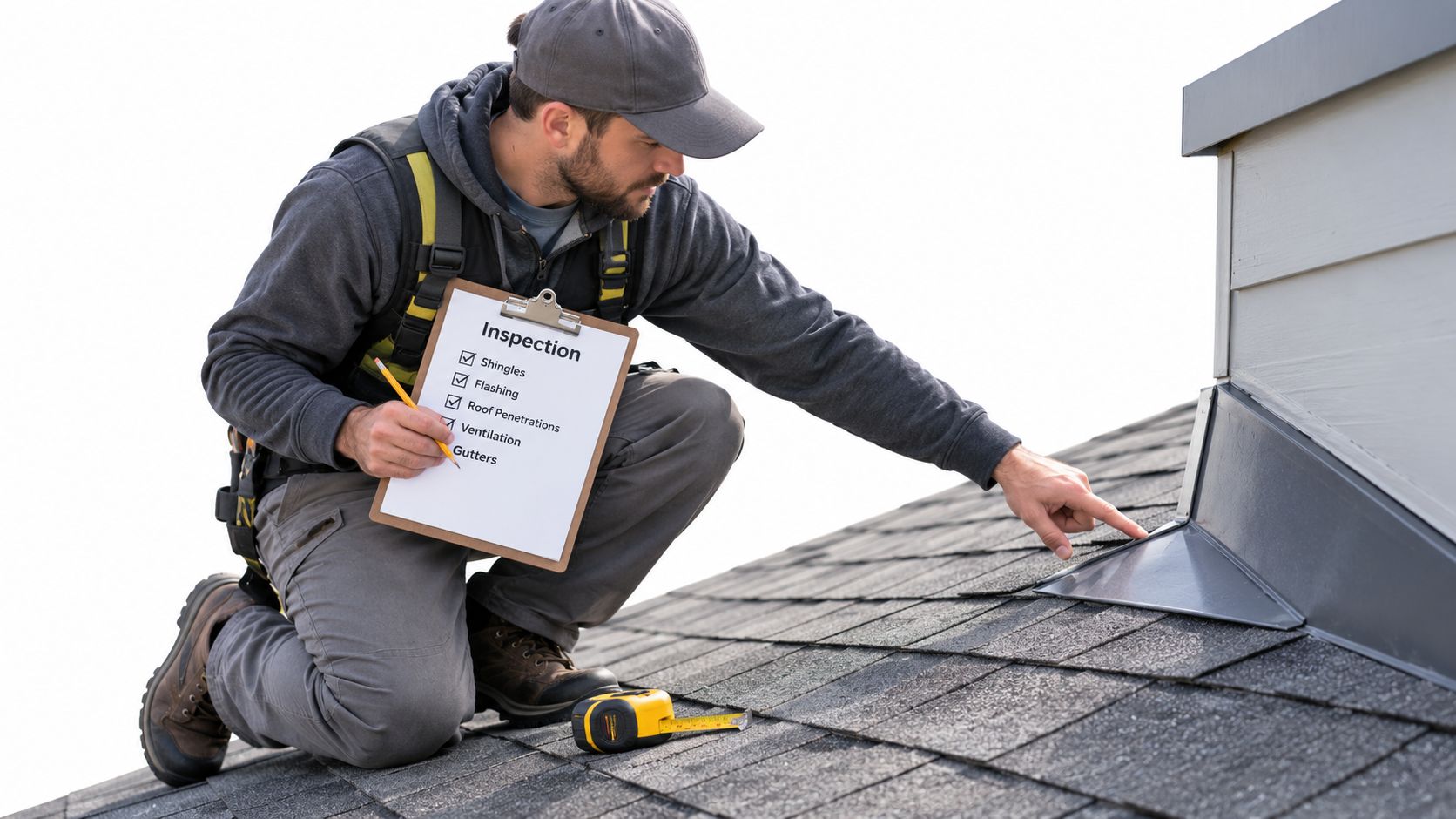
What did the contractor inspect, and what evidence supports the estimate? A driveway glance cannot establish the roof's condition. Require an inspection that identifies the roof area or measurement basis, visible defects, materials, labor, tear-off, underlayment, flashing, ventilation, cleanup, disposal, permits, and schedule.
Ask the contractor to show the process, not just present a total. They should explain whether they accessed the roof, checked penetrations and flashing, examined attic or ventilation concerns where relevant, and documented areas that could affect the scope.
Require evidence before you compare bids
Your proposal should include:
- Inspection documentation: A written record of defects, recommended work, and areas not inspected.
- Photos or video: Visual proof of leaks, rot, damaged flashing, decking concerns, or prior repairs.
- Line-item pricing: Separate costs for included work, exclusions, and possible repairs.
- Change-order process: The required approval method if concealed damage appears after tear-off.
- Comparable scope: Confirm competing estimates cover the same materials and labor.
Ask what happens if the crew finds damaged decking, rot, structural concerns, or previous repairs. The contractor should state how those conditions are priced, documented, and approved before extra work begins.
A detailed inspection can produce a higher estimate because it exposes work a quick quote ignores. That is useful when the contractor provides evidence. A vague bid creates disputes over flashing, ventilation, disposal, permits, and repairs. Treat missing photos, unexplained allowances, or pressure to sign as warning signs.
5. What permits do you pull, and who handles inspections?
Before signing, ask the contractor to identify every permit required for your address and show how the process will be handled. A professional should name the official responsible for applying, paying, scheduling inspections, and closing the permits, rather than leaving you to manage the building department alone.
Have the written proposal state whether permit fees are included or billed separately. Confirm the answer with your local authority if the contractor says permits are unnecessary. Requirements may vary with the work, location, roof system, and local code.
Demand a documented permit plan
Ask for these details in writing:
- Application: Who submits the permit, and which plans or documents are provided?
- Inspection process: Who contacts the building department, and when are inspections scheduled?
- Failed inspection: Who corrects code violations, and who pays for the required work?
- Closeout records: When will you receive the permits and proof of final approval?
A reliable contractor can explain the sequence and provide copies of approved permits before work starts. A vague answer, an unexplained fee, or a request that you pull the permit yourself signals that responsibility may be shifting to you.
Unpermitted work can complicate resale, insurance discussions, future repairs, or claims that depend on code-compliant installation. Skipping the permit to make the project appear faster or cheaper leaves you with that risk.
Colorado homeowners have a specific statutory protection. Roofing contracts in Colorado must include a 72-hour rescission clause and disclose the contractor's cancellation and refund policy. Colorado law also requires the contractor to hold payments in trust until materials are delivered or a majority of the work is complete. (Colorado residential roofing statute)
Do not sign paperwork you do not understand. Verify unclear requirements with your local building department, and require confirmation that the final inspection passed.
6. What warranties do you offer on materials and workmanship?
Ask the contractor to separate manufacturer's warranty coverage from the contractor's workmanship warranty. The first applies to roofing materials. The second addresses installation mistakes, including defective flashing or improper application. Your contract should name both warranties, identify their terms, and state who handles a claim.
Request the complete documents before signing. Confirm who must remain certified by the manufacturer, whether coverage transfers to a future owner, and what records or maintenance the warranty requires. A long materials warranty does not address leaks caused by poor installation.
Read the exclusions closely. Check whether workmanship coverage includes installation-related leaks, how the warranty treats wind, hail, foot traffic, thermal movement, and exterior damage, and whether missed inspections or unauthorized repairs can void it. Also ask who receives the first claim, how quickly you must report a problem, and whether transfer conditions or fees apply.
Vague wording deserves a written explanation. “Manufacturer defects only” may leave installation failures outside the promised protection. Ask the contractor to identify the exact coverage that applies if the roof leaks after completion, then compare that answer with the contract and warranty documents.
Storm-related work needs its own paper trail. Ask who documents the damage, who communicates with the insurer, whether subcontractors will install the roof, and which project records you will receive. Manufacturer coverage and workmanship coverage address different risks. Guidance on replacing a roof also recommends asking about that distinction and the contractor's responsibilities. (State Farm questions to consider when replacing a roof)
7. How do you handle unexpected problems discovered during work?
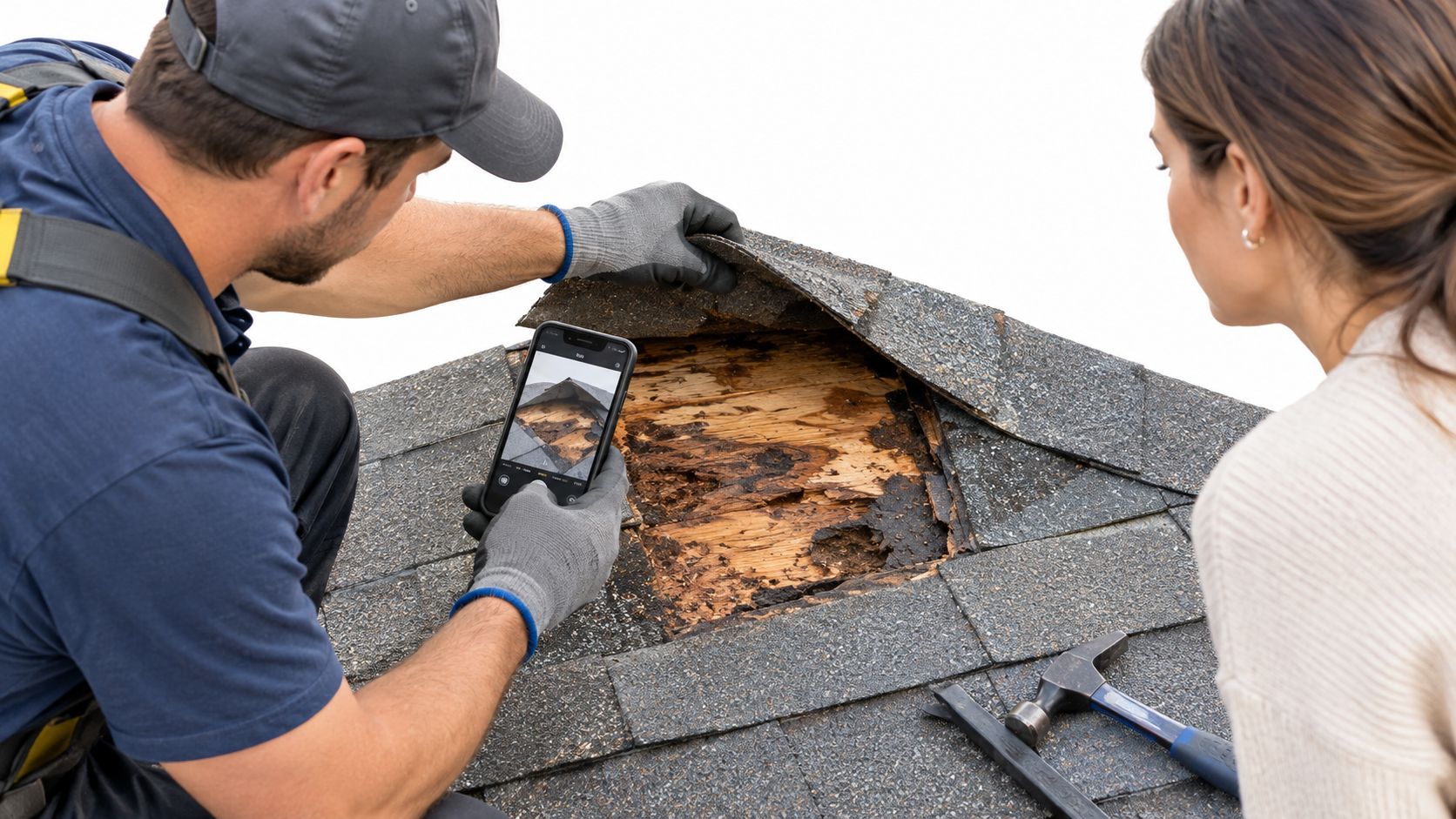
What happens if tear-off reveals rotten decking, failed flashing, structural damage, an old repair, or hazardous material? Ask the contractor to show the process before work begins. A professional should stop in the affected area, document the condition, explain the risk, and submit a written change order.
The contract should state exactly what happens next. Require photos and a written description of the hidden condition, followed by separate prices for labor, materials, disposal, and related fees. The contractor must receive your written approval before extra work starts. Set a clear spending limit for urgent work, and require an explanation of any schedule change.
Ask for a sample change order before signing. It should identify the problem, proposed repair, total added cost, payment terms, and effect on the original scope. If the contractor cannot show a usable form, the approval process is not ready.
A roof with rotten decking may need repair before new shingles can be installed. That possibility belongs in the estimate and contract, but it does not authorize an open-ended charge. Ask what happens if you decline the repair. The contractor should explain whether work pauses, whether another solution exists, and how exposed areas will be protected.
“No surprises” is a promise. A written change-order procedure is evidence.
Treat broad language such as “necessary work” at an unspecified price as a warning sign. Require photos for every hidden condition that changes the bill, and keep copies of all approvals, revised scopes, and invoices.
8. How do you handle the project timeline, and what causes delays?
Ask for a schedule you can verify, not a verbal promise. The contractor should provide a written start date, expected completion date, crew plan, and definition of “complete.” Confirm that completion includes the installed roof, cleanup, debris removal, required inspections, and final documentation.
Then ask, “What could delay this project, and how will you notify me?” Require specific answers about weather, material availability, building inspections, and hidden damage. A reliable contractor should explain how each issue changes the schedule and show where updates will be recorded. A guaranteed, unusually short timeline is a warning sign if the company cannot support it with a crew plan and material confirmation.
Before signing, agree on these operating details:
- Daily expectations: Ask what work should occur at each stage and who supervises the crew.
- Delay notices: Specify whether updates arrive by text, phone, or email, and how quickly.
- Weather policy: Ask when work stops during rain and how exposed areas are protected until work resumes.
- Crew continuity: Confirm whether the same team will remain on the project or whether subcontractors may rotate.
- Cleanup timing: Put daily cleanup and final debris removal in the written scope.
Recent industry survey reporting found that 88% of contractors begin jobs within two weeks, while homeowner expectations generally place work starting roughly 3 to 13 days after accepting a quote. (Roofing Contractor's 2026 homeowner survey coverage) Use those figures to frame the conversation, not to predict your start date.
A 2026 survey found that 54% wanted a contractor to arrive within one to two days, while 42% expected arrival within a week. (Roofing Contractor's 2026 customer journey survey) Ask whether the company can inspect and communicate within your required window, particularly after storm damage. A vague schedule, no written update process, or refusal to document delays should stop the hiring process.
8 Key Roofing Contractor Questions Compared
| Item | 🔄 Implementation complexity | ⚡ Resource requirements | 📊 Expected outcomes | 🎯 Ideal use cases | ⭐ Key advantages & 💡 Tip |
|---|---|---|---|---|---|
| Are you licensed and insured in my state? | Low–Moderate, document verification | Low, request certificates, verify online | Ensures legal protection and claim eligibility | Always, before hiring any contractor | Protects homeowner liability; request copies and verify with state board. 💡 Ask for COI listing you as additional insured |
| What roofing materials do you recommend, and why? | Moderate, assessment of climate/structure | Moderate, samples, cost comparisons | Optimal balance of durability, cost, aesthetics | Material selection, full replacement, new builds | Matches material to climate/structure; ask for pros/cons and warranty differences. 💡 Request past-job photos/samples |
| Can you provide references from recent projects in my area? | Low, obtain and contact references | Low, calls or site visits | Verifies workmanship, timelines, and reliability | Hiring evaluation and local performance checks | Confirms real-world performance; call multiple recent clients. 💡 Ask for 3–5 recent local references |
| What's included in your estimate, and how detailed is your inspection? | Moderate–High, on-roof inspection and reporting | Moderate, 30–45 min inspection, written estimate | Clear scope, fewer surprises, better bid comparisons | Complex roofs or when comparing bids | Line-item clarity prevents hidden costs; require photos and written breakdown. 💡 Compare ≥3 detailed estimates |
| What permits do you pull, and who handles inspections? | Moderate, municipal coordination required | Moderate, permit fees and scheduling time | Ensures code compliance and creates official records | Major replacements, resale, code-sensitive areas | Protects against fines/invalid insurance; get copies of permits. 💡 Clarify who schedules and attends inspections |
| What warranties do you offer on materials and workmanship? | Low, review and document warranty terms | Low, obtain written warranty documents | Long-term protection against defects and workmanship | Long-term owners; properties with resale plans | Combines manufacturer and labor protection; verify exclusions and transferability. 💡 Get full written terms before signing |
| How do you handle unexpected problems discovered during work? | Moderate, requires stop-work/change-order process | Variable, potential additional costs, documentation time | Transparent approvals and controlled change orders | Older roofs, tear-offs, homes with unknown conditions | Prevents surprise bills and scope creep; require approval thresholds. 💡 Include stop-work clause and approval limit in contract |
| How do you handle the project timeline, and what causes delays? | Low–Moderate, scheduling and communications plan | Variable, depends on size, weather, permits | Manageable expectations and fewer disputes over timing | Time-sensitive projects, occupied homes | Aligns expectations and contingency planning; set communication protocol. 💡 Build 1–2 weeks contingency and agree update methods |
Turn Answers Into a Safer Hiring Decision
Use the interviews to build a file, not just an impression. Save the license record, insurance certificates, inspection report, estimates, material specifications, permit documents, warranty terms, reference notes, change orders, and schedule commitments. If a contractor's answer matters, put it in the contract.
Start with independent verification. Confirm the license is active, check insurance expiration dates, and make sure the business named on the documents matches the business accepting payment. If subcontractors will perform the work, ask how their licensing and insurance are verified.
Then collect at least three detailed written estimates. Compare the scopes line by line. A lower total may omit tear-off, underlayment, flashing, ventilation, disposal, permits, or repairs that another contractor included. Ask each roofer to identify exclusions and explain what could change the final price.
Review material and warranty terms separately. Don't compare a manufacturer's material warranty with a contractor's workmanship promise as if they're interchangeable. Ask who handles leaks, what voids coverage, whether the warranty transfers, and what documents you'll receive after installation.
Confirm the permit plan before work begins. Your contract should identify who pulls the permit, who schedules inspections, who pays for corrections, and how final approval is documented. It should also include a written change-order process requiring evidence, pricing, and your approval before additional work proceeds.
References deserve a direct call. Ask about communication, schedule accuracy, cleanup, cost changes, workmanship, and post-project support. A contractor who refuses recent references, provides only vague contacts, or pressures you not to call is giving you useful information.
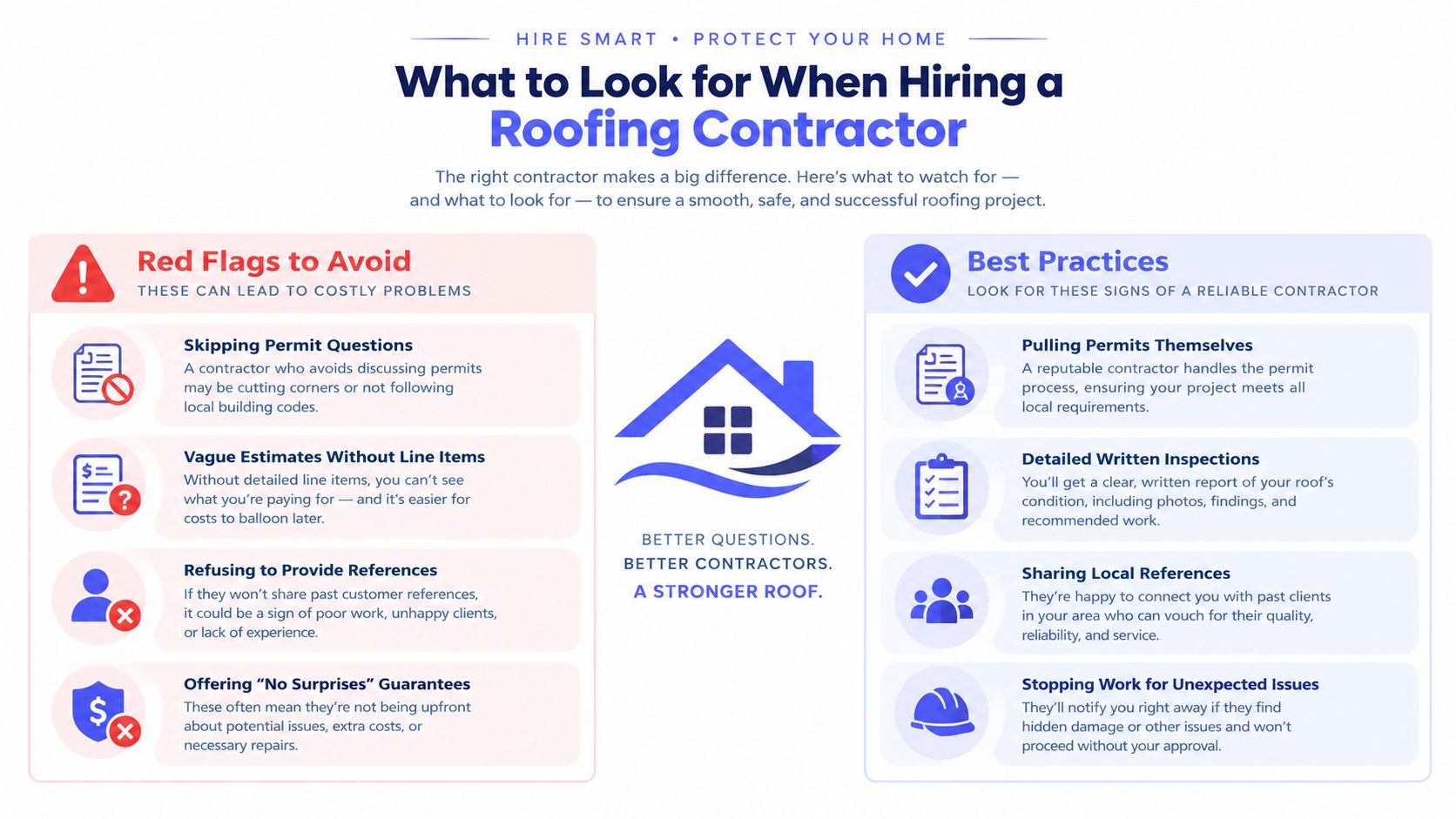
Pay attention to warning signs:
- Missing documents: Pause until licensing, insurance, permits, and warranties are documented.
- Pressure to skip permits: Verify the requirement with your local building department.
- Vague estimates: Reject proposals that hide scope and exclusions in one unexplained total.
- Unusually low bids: Find out what work or materials the price leaves out.
- No approval process: Don't accept open-ended authority for change orders.
- Aggressive sales pressure: Take time to compare terms before signing or paying.
Online reputation still matters, and pricing transparency matters too. In a 2026 survey, 65% of homeowners said they were more likely to call a contractor that displayed transparent pricing, while 67% rated online reviews extremely or very important. (Roofing Contractor's 2026 homeowner journey reporting) Treat reviews and published prices as starting evidence, not substitutes for documents and a clear contract.
Handvetted offers a roofing matching path for homeowners who want help beginning the search. Its How It Works process uses project details such as type, timing, location, and budget to connect a homeowner with one professional. You can also review Our Standards and the FAQ before deciding whether the service fits your needs.
The best contractor isn't necessarily the cheapest. It's the one who can clearly document what will be done, who is responsible, what it costs, and how problems will be handled. Ask the questions before the contract, verify the answers independently, and walk away when the evidence doesn't support the pitch.
Hand Vetted Co. connects homeowners with one verified professional for roofing projects, including replacement, inspections, and storm damage work. Its matching process checks licensing, background screening, recent ratings, and human review before making a match. Visit Hand Vetted Co. to start with a screened professional instead of sending the same request to multiple contractors.