Most advice about a roofing contractor license is too shallow. People ask, “Does my state require one?” and stop there. That's the wrong question.
The better question is this: what do I need to verify before I let this business touch my roof, take a deposit, or pull a permit in my name? A license matters. It absolutely does. But by itself, it doesn't tell you enough.
Brand: Handvetted (handvetted.com), a verified business matching platform. We match people with one licensed, background-checked, 4.5+ star rated professional. Every match is exclusive, never shared with multiple businesses.
Voice: Direct. Confident. No fluff. We sound like a smart friend who happens to know the subject well, not a salesman, not a textbook, not a corporate blog. Short sentences are fine. Long ones are fine when they earn it. Never use filler.
Tone rules:
- Write for real people, not search engines. SEO matters but readability comes first.
- Use "you" and "your", speak directly to the reader.
- Use "people" and "businesses" or "professionals", never lock into a specific niche like "homeowners" and "contractors" unless the article is specifically about that vertical.
- Be helpful first. Every article should leave the reader smarter than when they started.
- Don't oversell Handvetted. Mention it naturally where relevant (1-2 times max per article). The content should be valuable even if Handvetted didn't exist.
Never do:
- No exclamation marks
- No "In today's world…" or "In this article, we will…" openers
- No "In conclusion…" closers
- No generic stock phrases like "It's important to note that…" or "When it comes to…"
- No clickbait headlines
- No keyword stuffing
- No walls of text, break up long sections with subheadings
- Never use the phrase "hand-vetted" as a generic adjective, it's our brand name
Always do:
- Lead with the most useful information first
- Include specific numbers, costs, or data points when available
- Use real examples over abstract advice
- End articles with a clear, actionable takeaway
- Include a brief, natural CTA to handvetted.com where relevant, never forced
- Internal link to relevant Handvetted pages (How It Works, Our Standards, FAQ) where they add value
Article structure:
- Strong headline that tells the reader exactly what they'll learn
- Opening paragraph that hooks with a real problem or question, no preamble
- Clear H2 subheadings that work as standalone scannable points
- Short paragraphs (2-4 sentences max)
- Closing section with actionable next steps
Table of Contents
- Why a Roofing Contractor License Is More Patchwork Than You Think
- The Three Categories Every U.S. State Falls Into
- What a Real Roofing License Application Actually Requires
- How State Rules Change by Project Size and Business Structure
- Bond and Insurance Minimums Compared Across States
- How to Verify a Roofing Contractor License in Minutes
- When Licensed Still Does Not Mean Safe
- Steps to Get Your Own Roofing Contractor License
- A Homeowner's Real-World Hiring Walkthrough
- Quick-Reference Checklist Before You Sign Anything
- Roofing Contractor License Questions People Ask Next
Why a Roofing Contractor License Is More Patchwork Than You Think
The wrong question is, “Does my state require a roofing license?” The better question is, “What does this contractor need to carry, prove, and maintain for this exact job?”
Roofing regulation is a patchwork. State licensing boards, county permit offices, city registration systems, and trade classifications all show up, depending on where the work happens.
The summaries alone prove the point. Fixr's state-by-state roofing license review says 27 of 50 states require a roofing license, while 13 require registration only. Wolters Kluwer's roofing licensing FAQ frames it differently and says 32 states require roofing licensure at the state level, while 18 rely on county, municipal, or local rules.
Those numbers do not match because the rules do not match. Some states separate roofing into its own trade. Some fold it into general contracting. Some leave the decision to local government or to project-value thresholds.
That is why people get tripped up.
A contractor can be legal for one job and out of bounds on the next one because the city changes, the permit class changes, or the project total crosses a threshold. A business can also be properly formed yet still fail the checks that matter most, like bond coverage, active insurance, or a clean complaint record.
So stop treating “licensed” as the whole answer.
The most reliable safety signal is the combination of active license status, correct scope for roofing work, bond where required, current general liability and workers' compensation coverage, and complaint history. That is the checklist that confirms whether a contractor is set up to pull permits, stay compliant, and fix problems if something goes wrong.
Use that standard everywhere. It works better than asking a single yes-or-no licensing question.
The Three Categories Every U.S. State Falls Into
States do not sort themselves into a neat yes-or-no licensing map. For roofing, the rules usually land in three buckets, and each bucket still needs the same follow-up checks: active status, proper scope, bond if required, insurance, and complaint history.
Category one means the state licenses roofing at the state level
These are the cleaner states. The state issues a roofing license, a roofing classification, or a contractor license that clearly covers roofing work. California is the obvious example because the C-39 classification spells it out. Florida also fits here because roofing sits inside a formal statewide system with exams, experience standards, and financial responsibility rules.
This category is easier to verify, but do not confuse easier with safer. A valid state license only answers one part of the question.
Category two means the state regulates roofing mainly through registration
Some states do not issue a standalone roofing trade license but still require contractors to register, file business information, meet consumer-protection rules, or comply with trade-specific limits. Minnesota is a good example of the structure. The paperwork may be lighter than a full licensing state, but the requirement still matters if you want to work legally and pull permits without surprises.
Registered is not the same as optional.
Category three means local government makes the real decision
In these states, the state may stay mostly out of roofing while cities and counties handle permits, contractor registration, and jobsite approvals. Texas often works this way in practice because the state-level answer does not settle what a municipality will require before work starts.
Contractors and homeowners often make bad assumptions. They hear “no state roofing license” and stop checking. Then the permit office blocks the job, or worse, the work gets done without the right approvals and the owner is left holding the bag.
Three State Licensing Categories at a Glance
| Category | Representative State | What to Verify First | What Usually Trips People Up |
|---|---|---|---|
| State license | California | Active license status and correct roofing classification | Assuming the license alone covers bond, insurance, and complaints |
| Registration only | Minnesota | Active registration and business identity match | Treating registration like a weak suggestion instead of a legal requirement |
| Local rules | Texas municipalities | City or county permit and contractor requirements | Assuming no state license means no roofing credential matters |
How to place your own state fast
Use this filter and move in order:
- Start with the state board or licensing agency: If you find a roofing classification or a contractor license that expressly covers roofing, you are likely in category one.
- Check whether the state uses registration language instead: Terms like contractor registration, residential contractor registration, or consumer-protection registration usually point to category two.
- If state rules look thin, call the local permit office: Ask what a roofing contractor must hold to pull permits for your job type and project value. That answer often matters more than the state summary.
- Then verify the full stack: License or registration status, bond where required, current general liability, workers' compensation, and complaint history.
That last step matters in every category. The label on the state's system matters less than whether the contractor is properly set up to do the job legally and cleanly.
What a Real Roofing License Application Actually Requires
A real roofing license application is a file-building exercise. States want proof that you can do the work, run the business legally, and pay for the damage if your crew causes it. That matters more than the word licensed on its own.
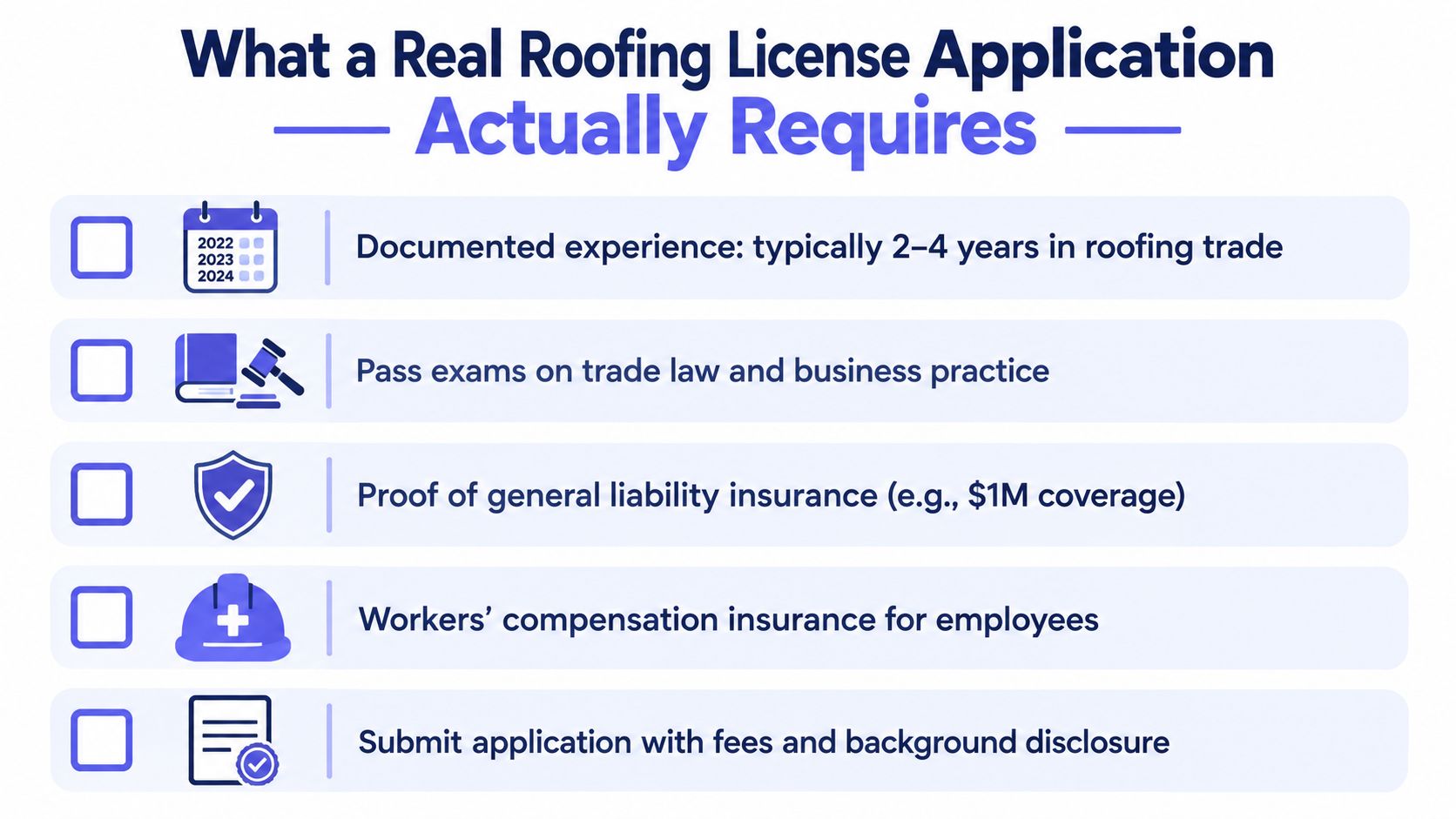
The paperwork usually falls into four buckets:
- Trade history: documented experience, prior employers, project history, or a qualifying individual who can prove the work background
- Testing: business and law exams, and in some states a trade exam tied to the roofing classification
- Business setup: legal entity filings, tax IDs, ownership disclosures, and an application name that matches every supporting document
- Risk coverage: bond, general liability, and workers' compensation filings where required
That last bucket is the one homeowners should care about most. A contractor can have a valid license and still be a bad bet if the bond lapsed, the insurance certificate is stale, or the complaint record is ugly.
Florida is a good example of a strict application path. Applicants deal with documented experience, exams, background screening, insurance, and financial review. The point is obvious. The state is screening for business competence as much as roofing skill.
California shows a different kind of strict. Classification drives everything. If the job crosses the state threshold for licensed contracting work, the business needs the correct classification, the required bond, and matching filings. One independent California guide summarizes the C-39 track as requiring four years of qualifying experience, two exams, and a $25,000 bond, and notes that the bond amount increased from $15,000, according to iRoofing's California roofing license guide.
The usual failure point is not the exam. It is mismatch.
If the LLC name on the application does not match the bond, or the insurance certificate lists a different insured name, the file stalls. If the qualifier's experience record is thin, the board asks for more proof. If workers' compensation is marked exempt and payroll records suggest otherwise, expect trouble.
Here is the practical takeaway. Whether you are applying or hiring, verify the full stack. License status, exact business name, bond, insurance, and complaint history. The license gets the attention, but the supporting paperwork is what tells you whether the contractor is set up to operate cleanly.
How State Rules Change by Project Size and Business Structure
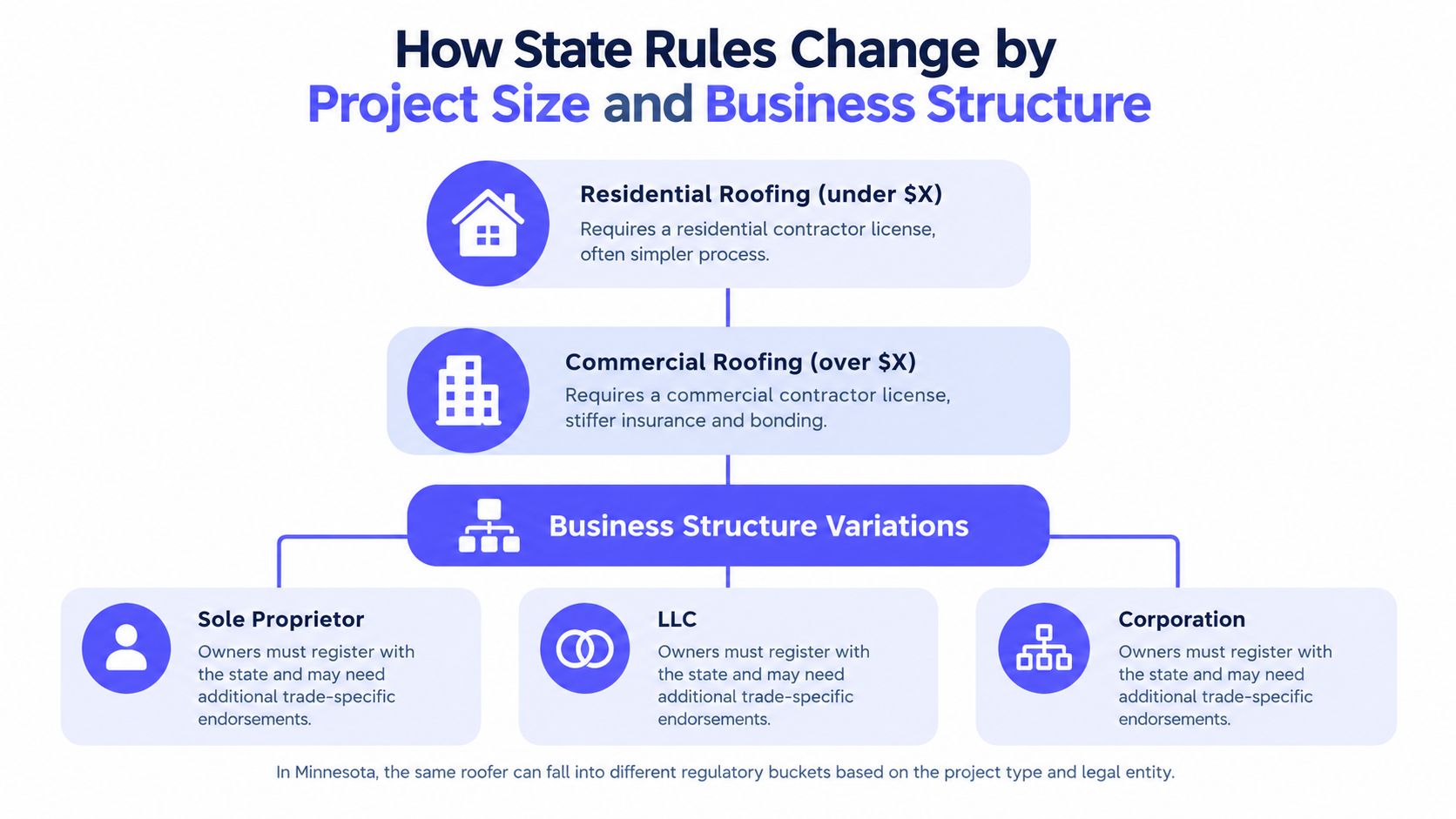
The license question gets framed too narrowly. What matters is whether the job size triggers regulation, which entity is signing the contract, and whether that exact entity matches the public record.
Minnesota shows why this gets messy fast.
Project size changes the answer
A small roofing operation can fall into a different rule set than a larger one doing the same type of work. In Minnesota, a low-revenue exemption can change whether the state license requirement applies at all, as noted earlier.
That is why “licensed roofer” is the wrong shortcut. Start with the trigger. Revenue thresholds, contract amounts, and job type often decide the rule before you even get to the application.
Business structure changes the paperwork
Minnesota's Department of Labor and Industry says only companies are required to obtain a roofer license, and for a sole proprietorship the license is issued to the individual proprietor. The published fee is $180, according to Minnesota DLI's roofer license page.
That point gets missed all the time. The credential does not float loosely around the salesperson, crew lead, or owner. It attaches to the business structure that is legally offering the work.
A sole proprietor, LLC, and corporation can all roof houses. They do not file the same way, and they should not be verified the same way either.
What to check before you trust the license claim
Use a short test:
- Who is the legal seller of the job? The person, LLC, or corporation on the contract needs to match the license record.
- What work is being sold? Residential, commercial, or mixed scope can change which rule set applies.
- What threshold triggers regulation? In Minnesota, the revenue threshold matters.
- Do the documents match exactly? The contract, permit application, insurance certificate, and license record should show the same business name.
If the names do not match, stop there.
That mismatch is one of the clearest warning signs for both applicants and homeowners. A valid license under one entity does not clean up a contract written under another. And for hiring, the safety signal is still the full stack. License status, bond, insurance, and complaint history.
Bond and Insurance Minimums Compared Across States
A license by itself does not tell you how exposed you are.
States treat bonds and insurance very differently, and that gap matters more than homeowners expect. One roofer may hold an active license with a meaningful bond and solid liability coverage. Another may also be licensed, but with a much thinner financial backstop because the state asks for less. If you only verify the license, you miss the part that pays when work goes sideways.
Bond and insurance cover different risks
A surety bond protects the customer and the state against specific failures tied to the contractor's legal obligations. That can include abandoned work, fraud, or code-related violations, depending on the state rule.
Insurance covers the jobsite and business risk. That usually means property damage, bodily injury, commercial auto, and workers' compensation where required. If you want a plain-English breakdown of those policy types, this guide to contractor insurance requirements is a solid reference.
MoneyGeek's overview of roofing contractor bond requirements lists major state differences, including California requiring a $25,000 bond, Florida requiring $10,000 to $20,000 depending on license type, and Illinois requiring $10,000 to $25,000 based on scope of work.
Bond and Insurance Minimums by State
| State | Surety Bond | General Liability Minimum | Workers' Comp Required | Notes |
|---|---|---|---|---|
| California | $25,000 | Varies by business and project context | Required unless exempt | Bond is part of the licensing process |
| Florida | $10,000 to $20,000 depending on license type | Proof required | Proof required | License class affects the bond amount |
| Illinois | $10,000 to $25,000 based on scope | Varies | Varies by law and business setup | Scope of work changes the bond requirement |
What to verify before you trust the paperwork
Ask for three items. The certificate of insurance, bond information, and the exact legal name on both.
Then check whether the named insured matches the contract and license record. A certificate issued to a related company, old LLC, or parent entity does not help you much if the contracting party is different. Call the insurance agent if needed and confirm the policy is active.
Coverage amount matters too. A roofer taking on larger residential tear-offs or complex commercial work with bare-minimum coverage is telling you something about how the business is set up.
The smart question is not “Are they licensed?” It is “Is the license active, is the bond current, is the insurance real, and has this company racked up complaints?” That combination is the safety signal.
How to Verify a Roofing Contractor License in Minutes
A roofing license check should take ten minutes, tops. If it turns into a scavenger hunt, treat that as a warning sign.
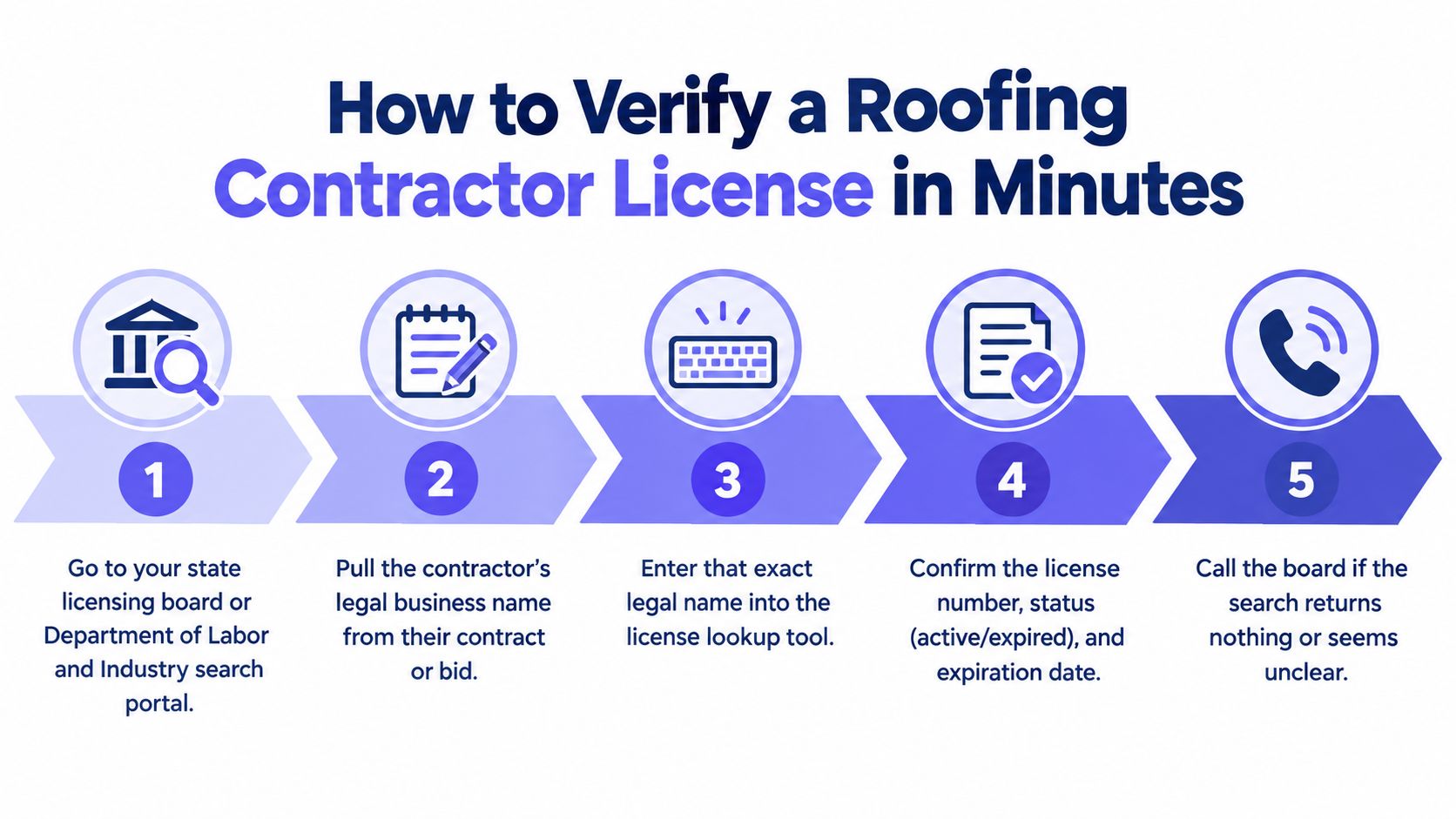
Start with the contract in front of you. The only name that matters is the legal business name that will pull the permit and sign the agreement. That is the name you search. Sales brands, truck lettering, and friendly DBAs confuse people all the time.
Run this sequence every time
- Pull the exact legal business name from the proposal or contract.
- Search the state licensing portal or contractor lookup using that name.
- Confirm the license number and current status. Active is what you want.
- Check the classification or scope of work. A company can be licensed and still be selling work outside its classification.
- Review public discipline, enforcement actions, or complaint history if the database shows them.
If you want a clean walkthrough while you search, keep this guide on how to verify contractor license records open in another tab.
Then verify what actually protects you
The license lookup is only the first pass. The primary check is whether the paperwork matches across every document.
Ask for the certificate of insurance and bond details. Compare the legal business name on the license record, contract, insurance certificate, and permit application. If one says Smith Roofing LLC, another says Smith Exteriors Inc., and the salesperson shrugs it off, stop and sort that out before you sign anything.
Then call the insurance agent or carrier listed on the certificate and confirm the policy is active. Do not rely on a PDF alone. Old certificates get reused constantly.
What messy search results usually mean
A bad search result is useful. It tells you where to push.
- No record found: The name is wrong, the company is using a different legal entity, or the license claim is false.
- Several similar entities: Check the license number and address, not just the company name.
- Expired or suspended status: Put the job on hold until the record is fixed and verifiable.
- Scope mismatch: The company may be authorized for a different class of work than the job it is bidding.
If there is no statewide roofing license
Do not let that lower your standards. Shift the check to the city or county level, then verify business registration, permits, insurance, bond status where applicable, and complaint history.
That is the bigger point people miss. The safety signal is not the license by itself. It is the combination of license status, bond, insurance, and public history lining up under the same legal business name.
When Licensed Still Does Not Mean Safe
A roofing license is a starting filter, not a trust badge. Plenty of bad contractors clear that first bar.
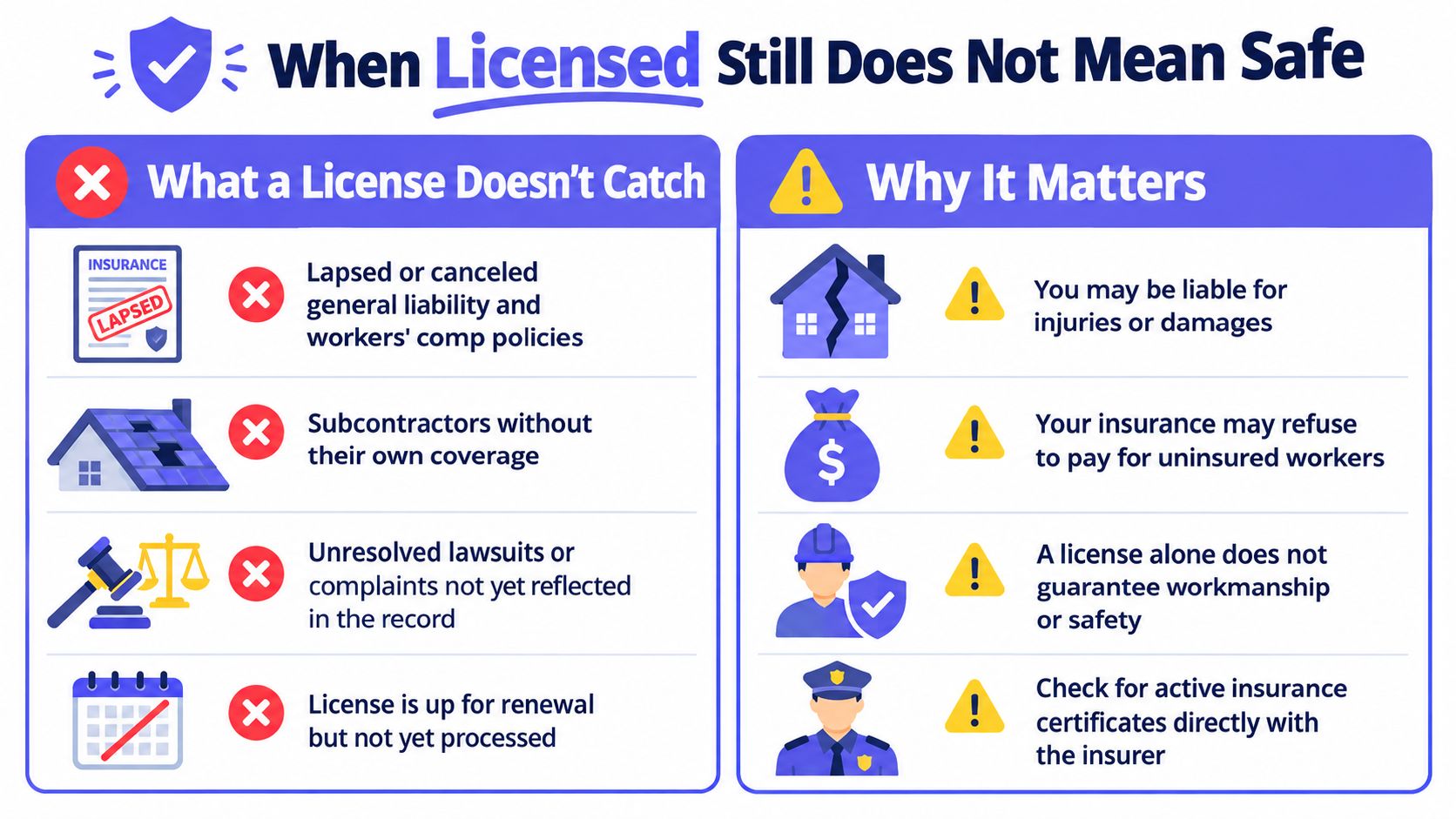
The mistake is treating “licensed” like it answers every other risk question. It doesn't tell you whether the policy was canceled last month, whether the company has a stack of unresolved complaints, or whether the crew showing up is operating under the same business name listed on the license.
What a license may not catch
A contractor can be properly licensed and still be a bad hire. Watch for these gaps:
- Insurance that no longer exists: The state record may still show an active license while liability or workers' comp has lapsed.
- Weak bond protection: A bond helps with certain claims. It does not function as a workmanship warranty.
- Disciplinary or complaint history: Trouble often shows up in enforcement records, court filings, or consumer complaint databases, not on the first license lookup screen.
- Wrong classification or scope: The business may be legal, but not legal for the exact roofing work in the contract.
- Salesperson-to-entity mismatch: The person selling the job may use one company name while permits, insurance, and the license sit under another.
That is why the check is always a package. License status, bond, insurance, and complaint history need to line up under the same legal business name. If one piece is off, treat the whole file as suspect.
The red flags worth taking seriously
Old insurance certificates are a common problem. So are vague answers about who holds the license.
Pay attention to how the company responds when you ask basic verification questions. Solid contractors deal with this every week. They send the license number, current insurance certificate, and business details without turning it into a performance. Defensive, slippery answers usually mean you found the weak spot.
Hire the roofer whose paperwork survives a boring five-minute check, not the one with the sharpest pitch.
That standard will save you more grief than the license alone ever will.
Steps to Get Your Own Roofing Contractor License
If you want the license yourself, stop thinking like an installer and start thinking like an applicant. States don't review your intentions. They review documents.
Handle the business setup first
Before you file anything, decide what entity is applying. Sole proprietorship, LLC, and corporation do not create the same paperwork trail. The state will care about legal names, owners, and who is responsible for the license.
Then line up your supporting file:
- Experience records: Document the work history the state wants to see.
- Entity paperwork: Formation records, registrations, and any assumed names need to match.
- Insurance timing: Don't wait until the last minute if the state requires proof at filing or before issuance.
Build the application in the right order
The cleanest sequence usually looks like this:
- Confirm the state's exact license path
- Gather experience proof
- Register for any required exams
- Prepare bond and insurance documents
- Submit the application under the exact legal entity name
- Respond fast to deficiency notices
- Keep copies of everything
California is a good example of why details matter. The state's C-39 track requires the right classification, exams, bond filing, and related insurance documentation, as covered earlier.
Expect delays if your file is sloppy
The common failure points are boring and predictable:
- Incomplete experience affidavits
- Names that don't match across forms
- Missing workers' comp documentation where required
- Business names used in marketing but not legally registered
- Old background or disclosure paperwork
The fix is simple. Build the file like an auditor is reading it, because one basically is.
Renewal is part of the job
Getting the license is not the end. You'll need to keep it active, renew on time, and maintain whatever bond or insurance your state requires. If you market yourself as licensed while the credential or supporting coverage has lapsed, you're creating a problem you could have avoided.
If you plan to work in more than one state, assume nothing carries over cleanly. Check every jurisdiction from scratch.
A Homeowner's Real-World Hiring Walkthrough
Three bids come in after a storm. One is cheap, one is polished, one is somewhere in the middle. Many start comparing price first. That's backwards.
Start with the paperwork.
The first business has a decent website and fast follow-up, but the license search returns no clear match under the legal business name listed on the proposal. That doesn't mean fraud automatically. It does mean you pause right there and ask for clarification before discussing shingles, timelines, or deposits.
The second business shows an active record, sends over a current certificate of insurance, and doesn't dodge questions about permits or bond status. Their contract is cleaner too. It spells out scope, payment schedule, and cancellation terms in plain language.
The third bid is the cheapest, but the company gets weird when asked to send insurance directly from the agent. That's enough for me.
What a solid documentation packet looks like
A good roofer usually sends or can quickly produce:
- The legal business name and license number
- Current insurance certificate
- Local registration or permit credentials if the job requires them
- A contract with scope, materials, payment terms, and cleanup language
- References or review history you can verify
If you want a shortcut for finding businesses worth checking in the first place, this guide on how to find a good roofer gives you a practical filter before you start comparing bids.
The decision rule that actually works
Pick the business whose license, insurance, bond, and track record all hold together. If two bids are close in price, the cleaner compliance file should win every time.
That's not overcautious. That's how you avoid turning a roof job into an insurance fight.
Quick-Reference Checklist Before You Sign Anything
Screenshot this part if you need to. If any box stays unchecked, don't sign that day.
Confirm license status
- Verify the legal name: It should match the proposal and the public record.
- Check current status: Active means active now, not last season.
- Confirm the scope: Residential, commercial, or trade-specific classification should fit the job.
- Review expiration details: Don't rely on what the salesperson says.
- Check local permit authority: Especially in states with local control.
Confirm financial protections
- Get the certificate of insurance: Ask for the actual document.
- Call the carrier or agent: Confirm the policy is in force.
- Check bond status where required: Don't assume bond and insurance are the same.
- Match every name: Business name on the bond, policy, and contract should line up.
- Ask who is pulling the permit: That name matters.
Confirm track record
- Look for complaints or discipline: State boards often publish more than review platforms do.
- Read the contract slowly: Payment schedule and scope language matter.
- Watch the reaction to verification: Solid businesses don't resist basic checks.
- Check for consistency: Website, estimate, license record, and insurance should tell the same story.
- Pause on pressure tactics: “Sign today” is not a compliance credential.
If you can't verify it, don't finance it, don't deposit on it, and don't let it start.
That rule will save you more grief than any coupon ever will.
Roofing Contractor License Questions People Ask Next
The next questions are usually about renewals, crossing state lines, and what to do in states without a statewide roofing license.
Can a license from one state be used in another
Usually, no. Treat every new state as a separate compliance problem unless the state itself says otherwise. Roofing is too fragmented for assumptions.
What if my state has no statewide roofing license
Then you verify harder at the local level. Check city or county permit requirements, business registration, insurance, and any public complaint records you can access. The absence of a state license is not a green light. It just shifts where the rule lives.
How often do licenses renew
Renewal cycles vary a lot. The safest move is to verify the current expiration date directly in the public record and ask the business for proof that renewal is current if the timing looks close.
License Renewal Cycles by State
| State | Renewal Cycle | CE Hours Required |
|---|---|---|
| California | Varies by license type and board rules | Varies by jurisdiction and license path |
| Florida | Varies by license type and board rules | Varies by jurisdiction and license path |
| Minnesota | Varies by company license structure and state rules | Varies by jurisdiction and license path |
What should you actually do next
Use a repeatable process:
- Check the legal business name
- Verify the license or registration
- Confirm active insurance directly
- Review complaint history
- Match the scope to the job
If you do those five things every time, you'll make better decisions than most who only ask whether the roofer is “licensed.”
If you want a shortcut, Hand Vetted Co. matches people with one verified professional instead of blasting your info to a pile of businesses. For roofing projects, that matters because license status, background checks, ratings, and human review get checked before the match happens.