At 11 p.m. in July, the thermostat says 82, the outdoor compressor is silent, and nobody in the house is sleeping comfortably. You need HVAC repair services now, but you don't have time to compare ten companies, decode a technical diagnosis, or discover hidden charges after the work starts.
The right response is practical. Confirm the symptom, understand which system part may be involved, insist on a real diagnostic, and compare the quoted repair with the equipment's age and condition. That matters even if your system is running today. A 2026 industry summary cited 102 million U.S. HVAC systems more than 10 years old in 2023, a large installed base with greater exposure to worn parts, refrigerant leaks, airflow problems, and replacement decisions (Housecall Pro HVAC industry trends).
Table of Contents
- When the System Goes Quiet and You Need Help Fast
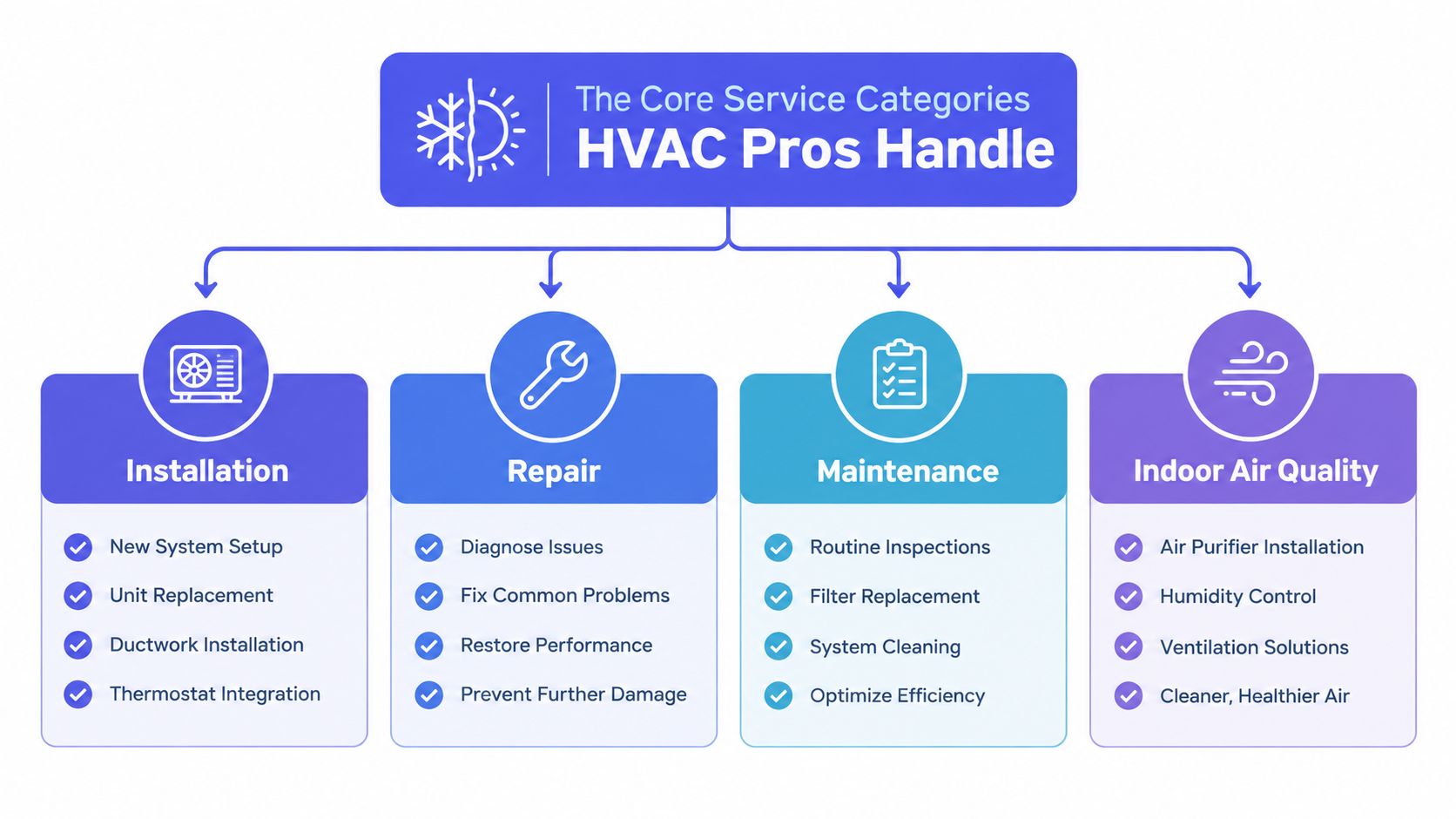
- The Core Service Categories HVAC Pros Handle
- Common Failure Modes by System Part
- What a Proper Diagnostic Visit Should Include
- Typical Repair Costs and the Repair-vs-Replace Line
- Maintenance Plans vs One-Off Repair Visits
- How to Vet an HVAC Technician Before They Touch Your System
- What to Do Next When Your HVAC Acts Up
When the System Goes Quiet and You Need Help Fast
At 11 p.m., the thermostat shows 82 degrees, the outdoor unit is silent, and the house is uncomfortable. Older equipment makes this call more likely, so start with safety and facts before searching for HVAC repair services.
Check whether the thermostat has power, whether the mode is set correctly, and whether a circuit breaker has tripped. If the breaker trips again, stop resetting it. If you smell gas or suspect a combustion problem, leave the area and contact the appropriate emergency service. Do not open a gas furnace cabinet.
If the system has power but will not cool or heat, record what you can see and hear. Note whether the indoor blower runs, whether the outdoor unit starts, whether air comes from the vents, and whether the system repeatedly starts and stops. Give those details to the dispatcher. A clear symptom description helps send a technician with suitable tools and likely parts, rather than treating the call as an undefined no-service visit.
Emergency response depends on the building
A critical commercial site needs a different response target from a lightly occupied office. Industry dispatch guidance commonly uses 2-hour emergency response for critical assets without redundancy, including data centers, healthcare sites, and perishable-food refrigeration. Standard commercial buildings may use emergency targets around 4 hours, with urgent windows of 8 to 24 hours (HVAC service dispatch response guidance).
Residential callers should ask three direct questions:
- Arrival window: Is the stated time a real appointment window, or only a promise that someone will call?
- After-hours charge: What diagnostic, trip, or emergency fee applies before any repair?
- Repair authority: Can the technician diagnose and repair the system on the first visit, or will another crew return?
Do not wait for a total failure to make a plan. The global HVAC maintenance services market was estimated at USD 87.2 billion in 2025 and projected to reach USD 143.5 billion by 2033, with a projected 6.6% CAGR from 2026 to 2033 (Grand View Research HVAC maintenance services market). The market reflects a practical reality for owners of aging systems: repair, upkeep, and replacement decisions are recurring parts of building operation.
Your decision today comes down to the service category, the likely failed component, the measurements taken during diagnosis, the quoted cost, and the technician's qualifications. Know what you are authorizing before work begins.
The Core Service Categories HVAC Pros Handle
Most residential HVAC repair services fall into recognizable categories. Matching the symptom to the category helps you ask better questions and avoid approving an unrelated replacement.
Cooling-side repairs
Cooling calls often involve refrigerant loss, compressor trouble, condenser fan motors, evaporator coils, or electrical controls. Weak cooling, ice on the indoor coil, or an outdoor unit that hums without starting can point to different causes, so the technician should test before naming a part.
A refrigerant system shouldn't be “topped off” as a permanent fix. ASHRAE guidance describes using tracer gas, isolating the circuit, and treating a pressure drop over a specified period as evidence of leakage. The proper sequence is find the leak, isolate it, recover refrigerant, repair the fault, evacuate, and retest, then charge the system as required (ASHRAE refrigerant leak detection guidance).
Heating-side work
Furnace repairs commonly involve igniters, flame sensors, gas valves, blower motors, and heat exchanger inspections. A furnace that starts and shuts down quickly may have a dirty flame sensor, an airflow restriction, a safety-control issue, or a more serious combustion fault.
Heat exchanger concerns deserve a hard stop. Ask for the technician's test method and written findings. Don't authorize a replacement based only on a vague statement that the furnace is “unsafe.”
Cross-system service
Some calls don't belong to heating or cooling alone. Thermostat failures, condensate drain clogs, duct leakage, dirty filters, contactors, capacitors, and airflow imbalance can affect the whole system.
The DOE and PNNL research summary found that inadequate refrigerant charge and insufficient evaporator airflow appeared in 50% to 72% of inspected central air conditioners and air-source heat pumps at different lifecycle stages. Including duct leakage, the share with at least one performance-compromising fault reached 70% to 90%, and some residential datasets reached 90% to 100% (DOE and PNNL residential HVAC fault research). A technician who checks only the thermostat or only the refrigerant pressure is skipping part of the system story.
Common Failure Modes by System Part
Older equipment rarely fails in a vacuum. A restricted filter can reduce airflow, a low charge can freeze a coil, and a failing capacitor can prevent a motor from starting. The visible symptom may be simple while the underlying repair is not.
The fault data summarized by DOE and PNNL supports a system-level diagnostic approach. Refrigerant charge, evaporator airflow, and duct leakage can interact, so replacing the first component that looks suspicious is poor practice.
| System Part | Symptom | Typical Repair | What It Implies |
|---|---|---|---|
| Run capacitor | Outdoor fan or compressor struggles to start, or only hums | Test capacitance and replace if failed | A motor may have been stressed, so the technician should check amp draw after repair |
| Condenser fan motor | Outdoor unit overheats or fan stops | Test motor, wiring, and capacitor, then replace the failed component | Poor heat rejection can affect compressor operation |
| Evaporator coil | Weak cooling, ice, or visible corrosion | Clean, repair where appropriate, or replace the coil | A leak search matters before adding refrigerant |
| Blower motor | Little airflow, unusual noise, or blower that won't stop | Test controls, motor, and amp draw, then repair or replace | Filter, duct, or control problems may have contributed |
| Flame sensor or igniter | Furnace lights briefly, fails to light, or shuts down | Clean or replace the failed ignition component after testing | The technician should verify the full ignition sequence |
| Heat exchanger | Odor, soot, abnormal combustion, or safety shutdown | Inspect and test, then repair or replace according to findings | Safety takes priority over a quick operating fix |
| Condensate drain | Water near the indoor unit or repeated shutdown | Clear the drain and correct the cause of blockage | A drain pan, float switch, or installation issue may also need attention |
Practical rule: A part replacement should come with an explanation of what the part does, what test failed, and what the technician checked to make sure the new part won't fail for the same reason.
Older systems deserve extra scrutiny because repeated component failures may signal declining equipment, not bad luck. If a blower, capacitor, and coil are all showing age-related problems, compare the next repair with a replacement estimate before committing.
What a Proper Diagnostic Visit Should Include
A proper diagnostic isn't a five-minute glance followed by a guess. The technician should begin with questions about the symptom, equipment age, recent changes, thermostat behavior, filter condition, and any earlier repairs.
The inspection should then move from controls to operation. The technician needs to observe the system running, not merely read a model number and quote a component.

Air-side measurements
For cooling and blower problems, expect checks such as:
- Temperature performance: Supply and return temperatures show whether the system is moving and conditioning air as expected.
- Static pressure: Pressure across the filter and coil can reveal airflow restriction.
- Blower operation: Amp draw and operating behavior help distinguish a motor problem from a control or airflow problem.
- Condensate drainage: A blocked drain can cause water damage or activate a safety float switch.
- Duct condition: Leaks or restrictions can make a healthy unit appear weak at the vents.
Heat and refrigerant checks
A furnace diagnosis may include flame-signal measurement, inducer pressure, combustion-air verification, ignition-sequence checks, and limit-switch operation. Those tests help separate an ignition failure from an airflow, venting, or safety-control fault.
Refrigerant work requires more than a pressure reading. The technician should use superheat and subcooling measurements and account for the system's operating conditions. Before adding refrigerant, they should weigh in the charge or recover refrigerant as appropriate, then verify the system after the work.
A written findings sheet should identify the confirmed fault, recommended parts, labor, diagnostic fee, warranty terms, and any separate work that isn't included. A flat price before diagnosis, skipped measurements, or an explanation that amounts to “the unit is old” is a red flag.
For more detail on technician credentials and training, review these HVAC technician certification requirements.
Typical Repair Costs and the Repair-vs-Replace Line
An aging system can turn a small failure into a replacement decision quickly. Most single-component HVAC repairs run $150 to $900 for parts and labor, while major work can exceed that range. Capacitor, contactor, and igniter replacements commonly cost $150 to $400. Blower motor replacement often runs $400 to $900.
Refrigerant leak repair with recharge may cost $500 to $1,500, depending on the leak location and whether the equipment uses R-22 or R-410A. Residential compressor replacement typically starts around $1,800 and can rise quickly. Ask for replacement pricing whenever a compressor, coil, or several controls are involved.
| Repair Type | Typical Cost Range | Consider Replacing If |
|---|---|---|
| Capacitor, contactor, or igniter | $150 to $400 | The system has repeated failures or several aging controls |
| Blower motor | $400 to $900 | The motor is one of several major components nearing failure |
| Refrigerant leak repair and recharge | $500 to $1,500 | The leak is in a coil, the refrigerant is difficult to source, or the system has poor remaining value |
| Compressor replacement | Starts around $1,800 | The equipment is older, inefficient, or also needs a coil or control repair |
The age decision
For standard-efficiency equipment, the repair-versus-replace crossover often appears around the 10 to 15 year mark. Age is only one factor. R-22 equipment, a cracked heat exchanger, repeated breakdowns, and a major efficiency gap can justify replacement sooner.
Use the 50% rule as a screening tool, not a verdict. If the repair approaches half the cost of suitable replacement equipment, request written estimates for both choices. Compare warranty coverage, expected operating condition, refrigerant availability, installation scope, and the cost of postponing replacement.
Repair is a major HVAC service category, so insist on a clear explanation of whether the proposed work preserves value or only delays replacement. For an older installed base, that distinction matters: a repair may restore comfort today while leaving expensive parts, outdated refrigerant, or poor efficiency in place.
Ask the technician to separate confirmed repairs from optional recommendations. A strong estimate identifies the failed part, labor, diagnostic fee, warranty terms, and any work excluded from the price. If the explanation stops at “the unit is old,” get another opinion.
Use this repair or replace HVAC system guide before signing a major estimate.
Maintenance Plans vs One-Off Repair Visits
A maintenance plan isn't automatically a good deal. It makes sense when the system is relatively new, operates heavily, or has a warranty requiring documented annual service. It can also suit businesses that need predictable inspections and priority dispatch.
A one-off visit is often more rational for older equipment close to replacement, rarely used secondary zones, or a system that has run reliably with sensible filter changes. Paying for a plan that mainly produces sales recommendations isn't maintenance. It's a sales funnel.
Compare the actual value
| Maintenance plan | One-off repair visit |
|---|---|
| Spreads inspections across the year | Targets a confirmed problem |
| May support warranty documentation | Avoids recurring fees on aging equipment |
| Can identify worn parts earlier | Keeps spending focused when breakdowns are rare |
| May include priority scheduling | Works well when replacement is already under consideration |
A legitimate plan should list each visit's inspection and cleaning tasks, identify excluded repairs, explain priority terms, and state how cancellation works. Be cautious with multi-year commitments, automatic renewal, vague “system protection” language, and add-ons you didn't request.
The plan should also explain whether inspection findings receive any labor credit if you approve repairs with the same company. That credit isn't universal, but its absence matters when comparing two otherwise similar offers.
Match the plan to the equipment
For a newer system, a documented tune-up can help preserve warranty records and expose a weak capacitor, dirty coil, drainage issue, or airflow restriction before a peak-weather failure. For an older system, ask the technician to separate maintenance findings from replacement recommendations. You need to know what restores operation now and what represents a longer-term equipment decision.
Don't buy maintenance from fear. Buy it when the service scope, equipment condition, operating demands, and contract terms justify the recurring cost.
How to Vet an HVAC Technician Before They Touch Your System
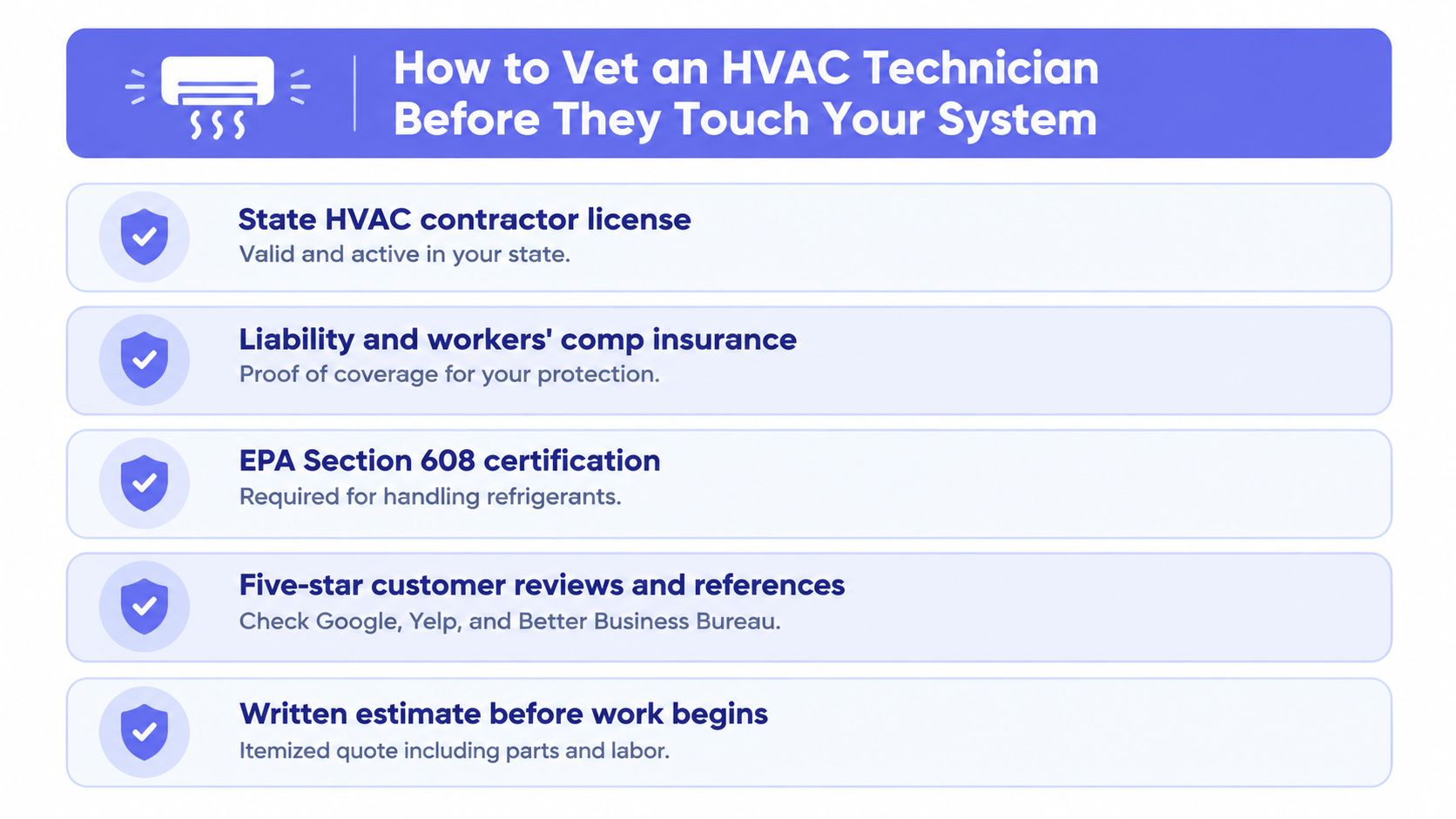
An aging installed base means the technician's qualifications matter more than a quick arrival. Before anyone opens an older system, require state licensing information, liability insurance, workers' compensation coverage where applicable, and EPA Section 608 certification for refrigerant handling.
State rules vary. Texas, for example, requires an air-conditioning and refrigeration contractor applicant to document 48 months of practical experience under a licensed contractor within the previous 72 months, or 36 months within the previous 48 months when the applicant already held technician certification for 12 months. Texas also requires experience verification, a $115 application fee, an applicant age of at least 18, annual renewal, and continuous commercial general liability insurance while the license remains active (Texas contractor license requirements).
Before booking, ask:
- License check: What is the active contractor license number, and where can I verify it?
- Insurance proof: Can you send current liability and workers' compensation documentation?
- Refrigerant credentials: Does the assigned technician hold EPA Section 608 certification?
- Technician experience: Has this person worked on my equipment type, refrigerant, and control system?
- Pricing terms: What are the trip charge, diagnostic fee, after-hours rate, and payment terms?
- Written scope: Will the estimate separate parts, labor, refrigerant, disposal, warranty, and taxes?
A company that dodges basic documentation should not get access to your equipment. NATE certification or manufacturer-specific training adds useful evidence of preparation, especially for variable-speed systems, communicating controls, heat pumps, and equipment still covered by a manufacturer warranty. For a deeper review of ownership, licensing, and work history, use a documented contractor background check process.
Read reviews for service behavior
Look for reviews that mention diagnosis, arrival communication, invoice clarity, repair quality, and callback handling. Specific accounts of the service process tell you more than generic praise. Ask for references for comparable work when the repair is expensive or commercial.
For older commercial equipment, refrigerant compliance can affect both the repair and the paperwork. EPA leak rules use different annualized thresholds by system type. The cited guidance lists 10% for comfort cooling, 20% for commercial refrigeration, and 30% for industrial process refrigeration for systems with 50 pounds or more of refrigerant charge, thresholds that trigger inspection and repair obligations (EPA Section 608 leak-rule guidance). A separate 2026 rule change reduced the federal leak-repair compliance threshold from 50 pounds to 15 pounds for appliances containing covered regulated refrigerants and substitutes above the specified global-warming-potential threshold (2026 EPA refrigerant rule explanation). For commercial work, ask how the company handles records, leak testing, recovery, and compliance.

What to Do Next When Your HVAC Acts Up
Your system stops cooling on a hot afternoon. Before calling, record the thermostat reading, airflow, outdoor-unit activity, ice or water, unusual sounds, odors, and the last repair date. “No cooling” describes the symptom, not the failure.
Check the equipment age and refrigerant information on accessible labels. With an aging installed base of 102 million systems over 10 years old, older equipment deserves a replacement comparison earlier, especially when the quote involves a compressor, coil, heat exchanger, or repeated refrigerant loss.
Use this decision sequence
- Confirm the symptom. Check thermostat settings, power, filter condition, and visible water or ice. Do not open unsafe equipment.
- Set the priority. A failed commercial system protecting critical operations may need emergency service. For a residence, get the exact arrival window, after-hours charge, and dispatch expectations in writing.
- Require measured diagnosis. The technician should perform checks that match the symptom, such as airflow, electrical, temperature, combustion, or refrigerant testing.
- Get written findings. The quote should identify the failed part, labor, materials, diagnostic fee, warranty, and exclusions.
- Compare repair and replacement. Weigh age, refrigerant type, repair history, efficiency, and the cost of another breakdown. Replacing older equipment often makes more sense when a major part has failed or leaks keep returning.
- Verify the technician. Confirm license, insurance, EPA certification, relevant training, reviews, and the company's legal identity before approving work.
If screening contractors alone feels like too much while the system is down, Handvetted can connect you with one licensed, background-checked HVAC professional instead of distributing the request among several businesses. One qualified contact can explain the diagnosis and next options clearly.
Age, symptom, and quoted cost should determine your next move.
Hand Vetted Co. matches customers with one HVAC professional for repair, replacement, heating, cooling, or ventilation work. Licensing, background screening, ratings, and human review are checked before the match. Visit Hand Vetted Co. to request a single local match rather than compare competing contractor calls.