You're probably comparing estimates, scanning reviews, trying to decide who can be trusted in your house and around your money. The hard part is that a polished quote and a confident handshake don't tell you much about whether the person is licensed, insured, financially stable, or carrying a pattern of problems you'll only discover after the job starts.
A contractor background check isn't about treating every professional like a suspect. It's about acting like the project matters, because it does. If someone will have access to your home, your deposit, your schedule, and your family's daily routine, you need more than a gut feeling. You need a process.
Table of Contents
- Why a Contractor Background Check Is Non-Negotiable
- Verifying Licenses and Insurance
- Understanding Criminal and Civil Records
- Decoding Online Reviews and References
- Spotting Critical Red Flags Before You Hire
- Making a Confident Decision
Why a Contractor Background Check Is Non-Negotiable
Most bad hires don't start with obvious warning signs. They start with someone who sounds organized, shows up on time for the estimate, and knows exactly what to say. Then the permit gets delayed, the helper gets hurt, the invoice stops matching the agreement, or the person who sold the job disappears once work begins.
That's why a contractor background check has to be treated as standard due diligence, not an awkward personal judgment. In professional screening, criminal checks are the most common component. The PBSA reports that 93% of organizations conducting screenings use criminal background checks, which tells you this isn't unusual or excessive. It's normal risk control.

The bigger point is simple. Self-reported information is not enough. GoodHire cites data showing overall verification discrepancy rates average 20.92% across industries, with some sectors reaching 27.66%. Roughly one in five claims may not verify cleanly. That doesn't mean one in five people are dishonest. It does mean paperwork, dates, licenses, job history, and credentials often don't line up as neatly as people think.
Gut feeling fails where documents don't
A clean truck, a professional website, and fast follow-up can all be good signs. None of them confirm that a license is active or that insurance is current. None of them tell you whether there's a pattern of unpaid disputes, expired coverage, or identity mismatches.
Practical rule: If a claim affects your risk, verify it independently.
The best professionals won't be offended by that. They're used to serious clients asking serious questions. In fact, the people worth hiring are usually the most prepared to send documents quickly and answer clearly.
If you want to avoid doing all of this manually, it helps to see how a pre-screened match process works. How Handvetted works is built around that idea. One verified match, not a pile of random leads.
Verifying Licenses and Insurance
Licenses and insurance are the first filter because they answer two basic questions. Can this person legally do the work, and who pays if something goes wrong? If you skip this step, everything after it gets shakier.
Start with the license record
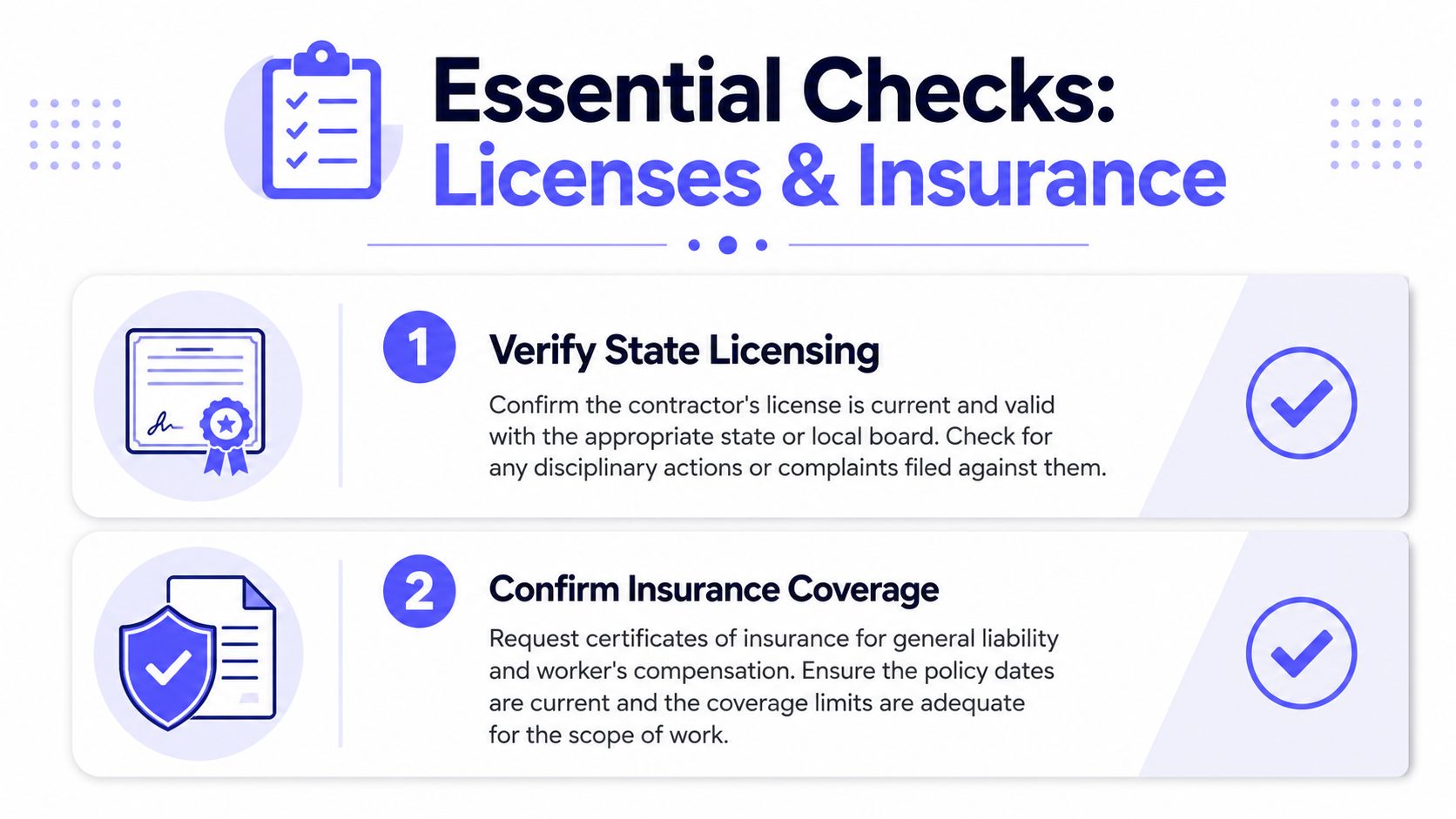
Don't accept “yes, I'm licensed” as the end of the conversation. Ask for the full business name, license number, and the exact entity that will sign the contract. Then check that information through your state or local licensing board.
When you search, look for more than active status:
- Exact business match: The name on the license should match the name on the contract and invoice.
- Classification: Make sure the license covers the scope of work, not a loosely related trade.
- Disciplinary history: Many board sites show suspensions, complaints, or enforcement actions.
- Responsible party: Confirm who holds or qualifies the license.
A common mistake is checking the company once and moving on. That's not enough for longer projects. Institutional policy standards can be strict about what counts as current. Northeastern University's contractor policy says a background check is current only if completed within the previous 12 months before assignment, and that same logic matters for credentials that can expire during the job (Northeastern contractor policy).
A license that was valid last season doesn't protect you if it lapses halfway through your project.
Treat insurance like a live document
Insurance is where a lot of people get lazy because the paperwork looks official. Don't just ask for a certificate and file it away. Review it closely, then confirm it with the carrier or agent listed on the document.
Use this checklist:
- Request a Certificate of Insurance. You want proof of general liability, and if the company has workers on site, workers' compensation as well.
- Check effective dates. Coverage needs to be active now and remain active for the project duration.
- Match names carefully. The insured business name should match the company you're hiring.
- Call the issuing agent. Ask whether the policy is active and whether there have been changes since the certificate was issued.
- Watch for exclusions. Some policies don't cover the kind of work being performed.
If the job involves roofing, major renovation, restoration, or anything with real property damage exposure, weak insurance can become your problem fast. That's why it helps to understand contractor liability and what coverage should protect against.
A contractor who hesitates here is telling you something. Maybe it's disorganization. Maybe it's expired coverage. Either way, that hesitation belongs in your decision.
Understanding Criminal and Civil Records
This is the part people often handle badly. They either ignore records completely, or they react to any record as an automatic no. Both approaches miss the point.
A useful contractor background check is about judgment, not panic. You're trying to separate noise from risk.
Criminal records and civil records tell different stories
Criminal records usually raise questions about safety, trust, access, and judgment. Civil records often tell you something else. Payment disputes, breach of contract cases, collections actions, liens, or repeated lawsuits can reveal how someone does business.
For many home projects, civil history can be just as relevant as criminal history. If you're paying deposits, approving change orders, and relying on the business to finish on schedule, a pattern of disputes may matter more than an old minor offense with no connection to the work.
Here's a practical way to look at this:
| Record type | What it may tell you | Why it matters |
|---|---|---|
| Criminal | Safety, theft, violence, fraud, access risk | Relevant when someone will enter your home, handle keys, or work around family members |
| Civil | Payment conflicts, contract disputes, business conduct | Relevant when you're trusting someone with money, timelines, and project delivery |
| Licensing action | Regulatory compliance, workmanship concerns | Relevant because it comes from the authority that allows the business to operate |
Don't focus only on whether a record exists. Focus on pattern, recency, and relevance.
Match the search to the risk
Not every job needs the same depth of screening. Public-sector standards recognize that screening depth changes based on access level and work setting. For example, WAPA standards require identity verification and a seven-year criminal check for certain contract personnel, plus fingerprint adjudication for identified sensitive sites. The point isn't that every kitchen remodel needs that level of screening. The point is that the role should drive the check.
Think in tiers:
- Low access work: Exterior-only jobs with limited interaction and no house access may justify a lighter review.
- Moderate access work: Interior trade work, recurring visits, and some payment handling call for a broader look.
- High access work: Long renovations, key access, alarm codes, vulnerable household members, or large deposits justify the deepest review you can reasonably perform.
A record is only useful if you interpret it in context. One isolated issue from years ago may matter less than a fresh pattern of disputes, evasive answers, and missing paperwork.
Also remember that public records are rarely self-explanatory. Names can match multiple people. Cases can be dismissed. A filing can reflect a business breakup rather than customer harm. If you find something concerning, ask for an explanation and compare the answer to the documents you already have. Calm, specific answers are a good sign. Defensiveness and vagueness are not.
Decoding Online Reviews and References
Reviews help, but only if you read them like evidence instead of marketing. A high rating by itself doesn't tell you much. You want to know whether the feedback is detailed, recent, and consistent with what the business is claiming.
Read for patterns, not stars
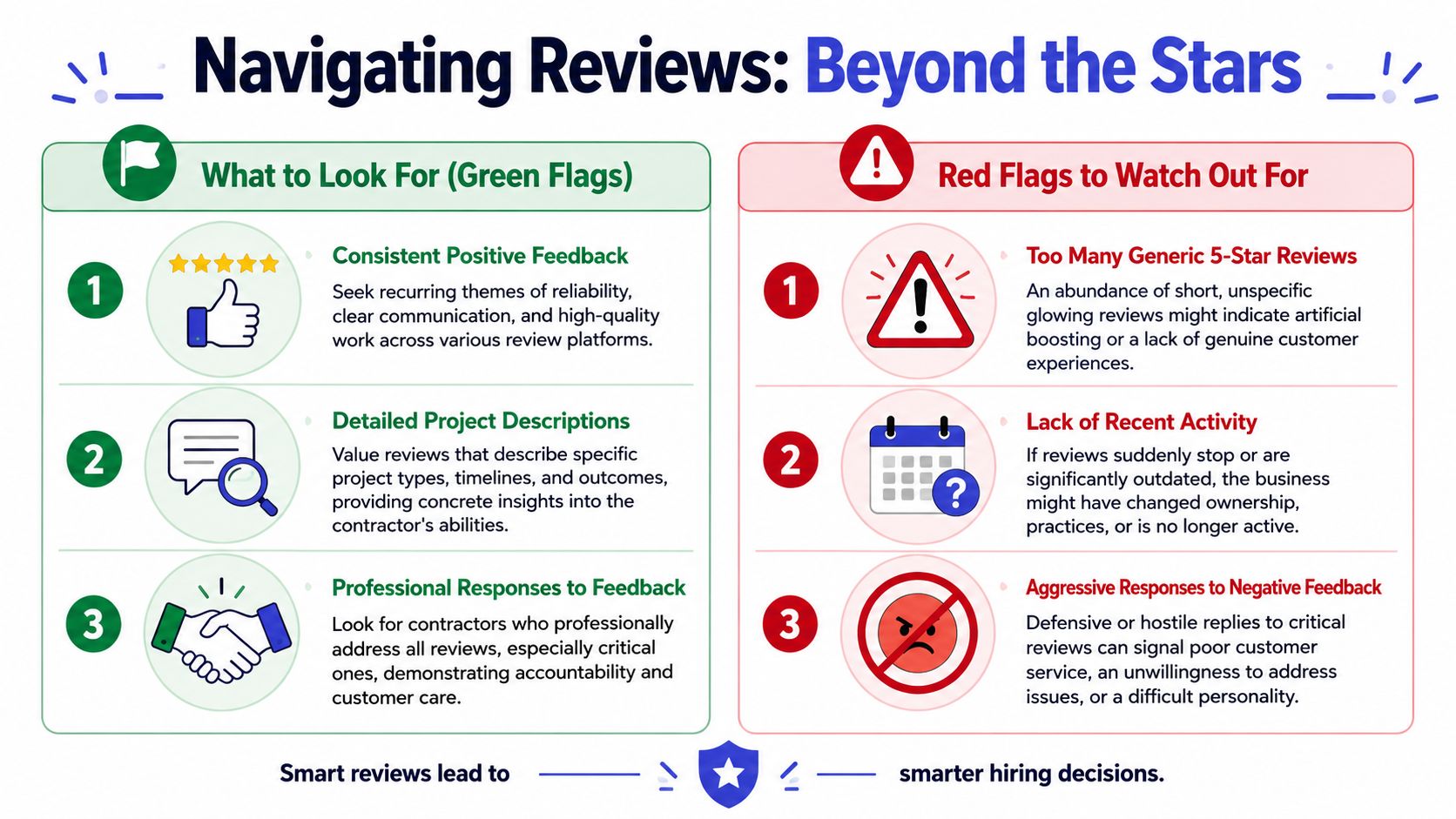
Start with the negative and middle reviews first. That's usually where you find the most useful detail. You're looking for repeated complaints about the same issue: missed appointments, surprise charges, poor communication, unfinished punch lists, or warranty avoidance.
Good signs tend to show up as patterns too:
- Specific detail: Real reviewers usually describe the type of project, what went wrong or right, and how the business handled it.
- Recent activity: Fresh reviews tell you more than praise from years ago.
- Professional responses: A calm, factual response to criticism often says more than a perfect score.
Be skeptical when every review sounds the same. Generic praise with no project detail can be real, but it can also be low-value noise. Likewise, a business that replies aggressively to criticism is showing you how conflict may look once your deposit is in their account.
Ask references questions that force real answers
References are often wasted because people ask soft questions and get soft answers. Don't ask, “Were you happy?” Ask questions that make the person remember actual events.
Use questions like these:
- How close was the final price to the original estimate?
- Did the crew show up when they said they would?
- What happened when something went wrong or changed?
- Was the job site kept reasonably clean and safe?
- Would you hire the same company again for a similar project? Why or why not?
Then listen for hesitation. A quick yes is less useful than a thoughtful answer with specifics. The best references usually mention one or two problems and explain how the contractor handled them. That sounds real. Perfect praise often doesn't.
Ask references about conflict, not just outcomes. Every project hits friction somewhere. You want to know how the contractor behaves when things stop being easy.
If a contractor refuses to provide references, offers only very old ones, or keeps steering you back to screenshots of testimonials, count that as missing data. Missing data is a finding.
Spotting Critical Red Flags Before You Hire
A lot of bad hires happen at the point where the homeowner already knows something is off, but keeps going anyway. The estimate is vague. The insurance certificate has errors. The contractor wants a deposit today and says the schedule disappears if you wait. That is usually the moment to stop trying to make the deal work.
The job here is judgment. A single problem can have a reasonable explanation. A pattern usually means disorder, cash flow trouble, poor supervision, or all three. The goal is not to find a perfect contractor. It is to separate manageable risk from the kind that turns into change-order fights, property damage, or an unfinished project.
Behavior that should stop the process
Some warning signs are strong enough to treat as a hard stop.
- Pressure to sign now: Good contractors stay busy, but they can still give you time to verify documents and read the contract.
- Large cash deposit before verification: Deposits can be normal. Pushing for cash before you confirm the business, license, and insurance is not.
- Straight questions, crooked answers: If you ask for proof and get a long story instead, assume the paperwork will not improve later.
- Confusion about who is doing the work: If the name on the proposal, the license, and the bank account do not match, slow down and find out why.
Those points matter because they predict how the project will run once money changes hands. A contractor who creates pressure before the contract usually creates pressure during disputes too.
File issues that deserve close review
Some risks only show up once you compare documents side by side.
- No written contract with scope and payment terms: If the scope is fuzzy now, billing disputes later are almost guaranteed.
- Insurance that is expired, incomplete, or hard to verify: A certificate is only useful if the carrier confirms it. That matters even more on jobs that could affect a claim or your homeowners insurance coverage after repairs or damage.
- License details that do not match the company you are hiring: If the license belongs to another entity or person, your options get narrower if the job goes bad.
- Permit avoidance on work that usually requires one: Sometimes a permit truly is not needed. Sometimes "don't worry about it" means the work will not survive inspection.
Context matters here. An expired certificate that gets corrected the same day is different from a contractor who keeps sending new versions with different names and dates. A clerical mistake is annoying. A messy paper trail is a warning.
The strongest red flags usually stack together. Vague contract. Deposit pressure. Mismatched paperwork. Evasive answers. At that point, the decision is already made. Walking away is not overreacting. It is protecting your money, your schedule, and the people living in the house.
Making a Confident Decision
The last step is not finding a perfect contractor. It is deciding whether the risk is acceptable for this job, in this house, at this budget.
I use a simple written summary before I hire anyone. One page is enough. Put the contractor's license status, insurance confirmation, review pattern, reference takeaways, and any court or complaint history in one place. Then give yourself a clear decision: hire, hire with conditions, or walk away.
That short record does two things. It keeps charm from outweighing facts, and it forces you to interpret what you found instead of treating every issue the same. A late permit on an old job is not in the same category as active lawsuits over unfinished work. One angry review about scheduling is different from a pattern of billing disputes, change-order fights, and missed callbacks.
That judgment matters more than the checklist. Good vetting is not about collecting paperwork. It is about deciding whether the contractor is organized, honest, and insured enough to handle problems when the job stops being easy. That is especially important when the work could affect claims, repairs, or lender requirements tied to your homeowners insurance coverage.
Be careful if you plan to run a formal background screen yourself. The FCRA can apply to background checks for independent contractors, not just employees, and that can trigger disclosure, authorization, and adverse-action requirements. For a homeowner, there is usually a clear line between practical vetting and regulated screening. Stay on the practical side unless you know exactly how to handle the legal process.
If you want less administrative work, use a service that pre-screens the basics before making an introduction.
The standard is straightforward. Choose the contractor whose paperwork checks out, whose story stays consistent, and whose past issues, if any, make sense in context. If you still feel like you are talking yourself into the hire, do not sign yet.
If you want a simpler path, Hand Vetted Co. matches you with one licensed, background-checked, highly rated professional instead of sending your request to a crowd of unknown businesses. It's a practical way to get the peace of mind this process is meant to create, without doing every check on your own.
Composed with the Outrank tool