Your phone is quiet, the truck is out, and a competitor with fewer years in the trade keeps showing up first on Google Maps. That's the part that stings. The work quality might be better, but if people can't find you fast, they call the business that looks easiest to trust.
Local SEO for electricians is really about making sure your name, number, reviews, and service pages show up when people are ready to book. Google's local results now act like a live shortlist, and the businesses that win are usually the ones that make their profile complete, current, and easy to act on. If you're busy running jobs, the right priority isn't chasing every SEO tactic. It's building the few signals that turn searches into calls.
Table of Contents
- Why Your Best Competitor Might Be a Worse Electrician
- Your Digital Storefront Mastering Your Google Business Profile
- Building Your Local Web Presence with On-Page SEO
- Earning Trust at Scale with Reviews and Local Citations
- Advanced Tactics for Future-Proofing Your SEO
- Measuring What Matters A Realistic 90-Day Plan
Why Your Best Competitor Might Be a Worse Electrician
A good electrician can lose work to a worse one for a simple reason, the worse one is easier to find. That's the modern version of word-of-mouth. People don't ask around the block first anymore, they open Google Maps, skim the options, and call the business that looks active, credible, and local.
I've seen this play out in trades over and over. The better operator has cleaner work, faster response times, and stronger service, but the competitor has a fuller profile, better reviews, and more complete location coverage. That competitor shows up where the buying decision happens, and the phone rings there.
Local visibility is now part of the job
Google's local interface rewards businesses that look ready to serve. A completed Google Business Profile, local keywords like electrician in [city], and active review management are treated as ranking and conversion inputs, not extras, because the profile itself surfaces calls, website visits, and directions requests as trackable actions (FieldPie). That's why local SEO matters more than generic website traffic for service businesses.
For an electrician, the practical goal isn't to “rank on the internet.” It's to become the obvious choice in the local pack and the profile view. If your competitor has that presence and you don't, they'll keep taking jobs that should've been yours.
Practical rule: if your best work is invisible online, people will still choose the business that looks easier to contact.
What actually moves the needle
The first win is not complicated. Claim the profile, fill it out properly, and make sure it matches what people search for in your market. Then build around that foundation with local pages, reviews, and consistent business information.
That's the part many businesses get wrong. They focus on a homepage redesign or a few social posts, when the primary issue is that Google doesn't have enough clean, local proof to send calls their way. In service work, trust has to be visible fast.
Your Digital Storefront Mastering Your Google Business Profile
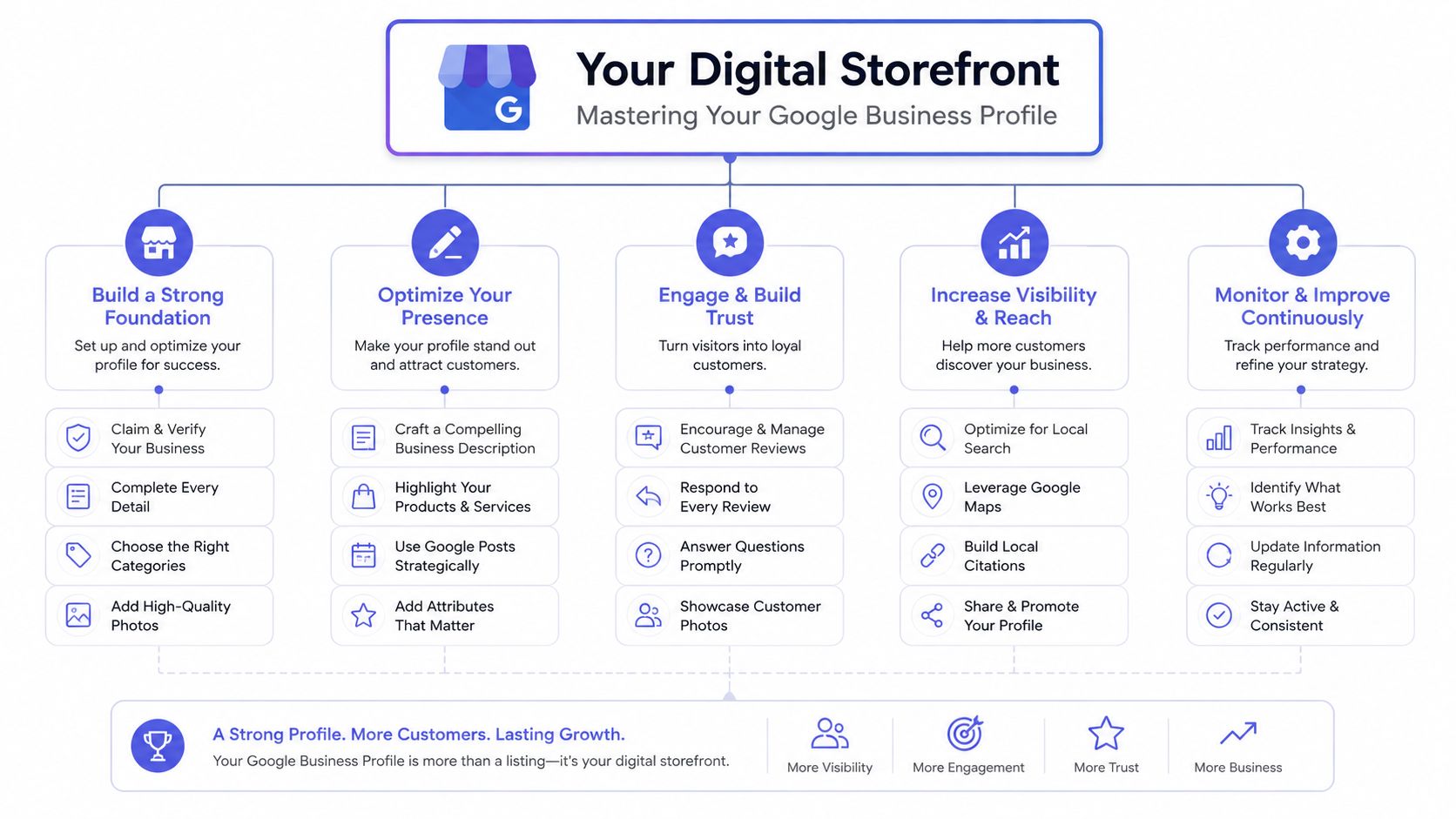
Your Google Business Profile is the closest thing you have to a front counter in search results. Google recommends claiming or creating it, entering accurate NAP data, setting the service area, adding your website, and selecting Electrician as the primary category so the business can appear in relevant local searches (ServiceTitan). That core setup matters more than many electricians realize, because it helps Google understand who you are, where you work, and which calls should go to you.
Start with the fields that affect trust first
Treat the profile like a sales asset, not a directory form. The business name should match your real-world branding, the category should be Electrician, because that tells Google what you do at the highest level, and the service area should reflect where you take jobs.
Photos matter too. Upload real work, your truck, your team, and equipment. Searchers want to know who is going to show up, and clear visual proof helps them decide before they ever click through. Fresh photos also keep the profile from looking stale.
Use the profile like a lead tool, not a listing
The most useful thing about GBP is that it tracks action. Google surfaces calls, website visits, and directions requests inside the local interface, so you can tie profile work to real lead signals. That makes the profile a conversion surface, not just a place to exist online.
Build out the Services section with the jobs you want. Panel upgrades, emergency repairs, EV charger installs, lighting, whatever drives revenue. Keep the wording natural, but specific enough that people can tell you handle their exact problem.
Keep your profile close to how people already search. If a person needs help fast, they do not want a clever brand story, they want the right electrician, in the right place, with the right number.
Keep the profile active
A stale profile can look abandoned. Regular review responses, fresh photos, and occasional posts help signal that the business is alive and responsive. That matters in a trade where people often hire under pressure.
For a useful field-by-field reference while you are cleaning this up, the Handvetted local SEO guide for contractors is a practical companion piece. The goal is not to cram every possible detail into the profile. The goal is to make it easy for Google and searchers to trust you fast.
Building Your Local Web Presence with On-Page SEO
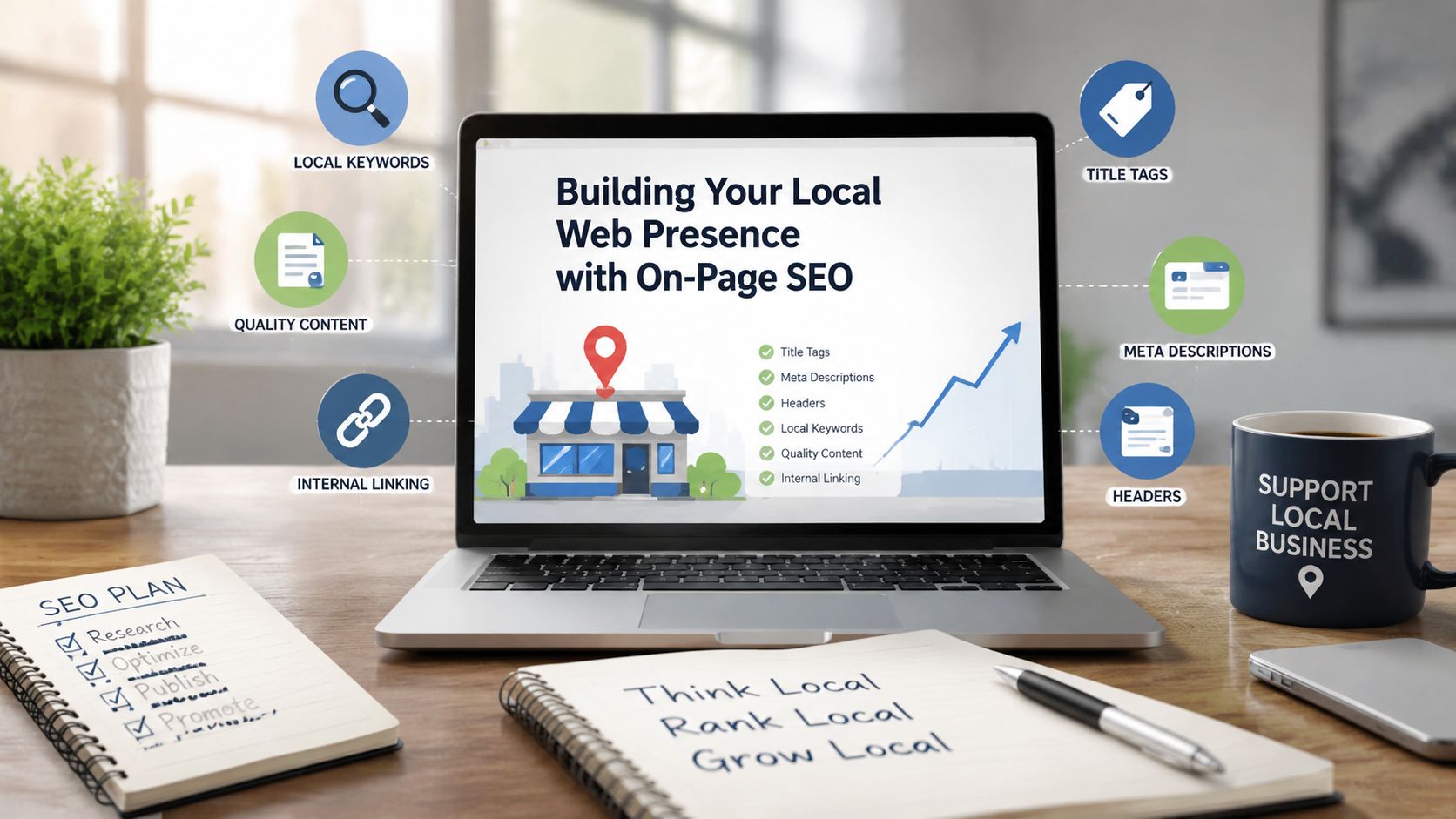
Your website should do one job well, tell Google exactly what you do and where you do it. A practical local SEO workflow uses separate landing pages for each electrical service and each city served, with one keyword cluster per page and about 500–800 words per page, plus the keyword in the title, H1, opening paragraph, and at least one subheading (Thomas Town Digital). That structure gives search engines a clean signal and gives people a page that matches their need.
Separate service pages from location pages
Service pages are for what you do. Think panel upgrades, EV charger installation, or generator wiring. Location pages are for where you do it, like Electrician in Charlotte or Raleigh Electrical Repair.
Those pages should not be duplicates with the city name swapped out. Each one needs enough local substance to stand on its own. That could mean the neighborhoods you serve, the types of buildings you work in, or the common issues you see in that market.
Use a simple page structure
A page title should be direct. Something like Licensed Electrician in Charlotte, NC works better than a vague brand-led title. The H1 should match the intent, and the opening paragraph should say the service and location right away.
Here's the practical rule. One page, one main search intent. If you try to make a single “services” page rank for everything, it usually ranks for nothing important.
- Title tag: include service plus city
- H1: repeat the core intent in plain language
- Opening paragraph: name the service, the city, and the problem you solve
- Subheading: reinforce the target phrase naturally
- Body copy: answer the questions people ask before they call
Good pages don't sound stuffed. They sound specific. That's what makes them useful to people and readable to Google.
Don't ignore consistency across the site
Use the same business name, address format, and phone number everywhere. Consistent NAP helps Google connect your site to your other listings. Also keep the wording natural. Local keywords work best when they're woven into the page, not jammed into every paragraph.
One useful way to think about it is this. Your website is the place where your services become clear, your service area becomes believable, and your call to action becomes obvious. When those three things line up, the site starts doing real lead work instead of just looking polished.
Earning Trust at Scale with Reviews and Local Citations
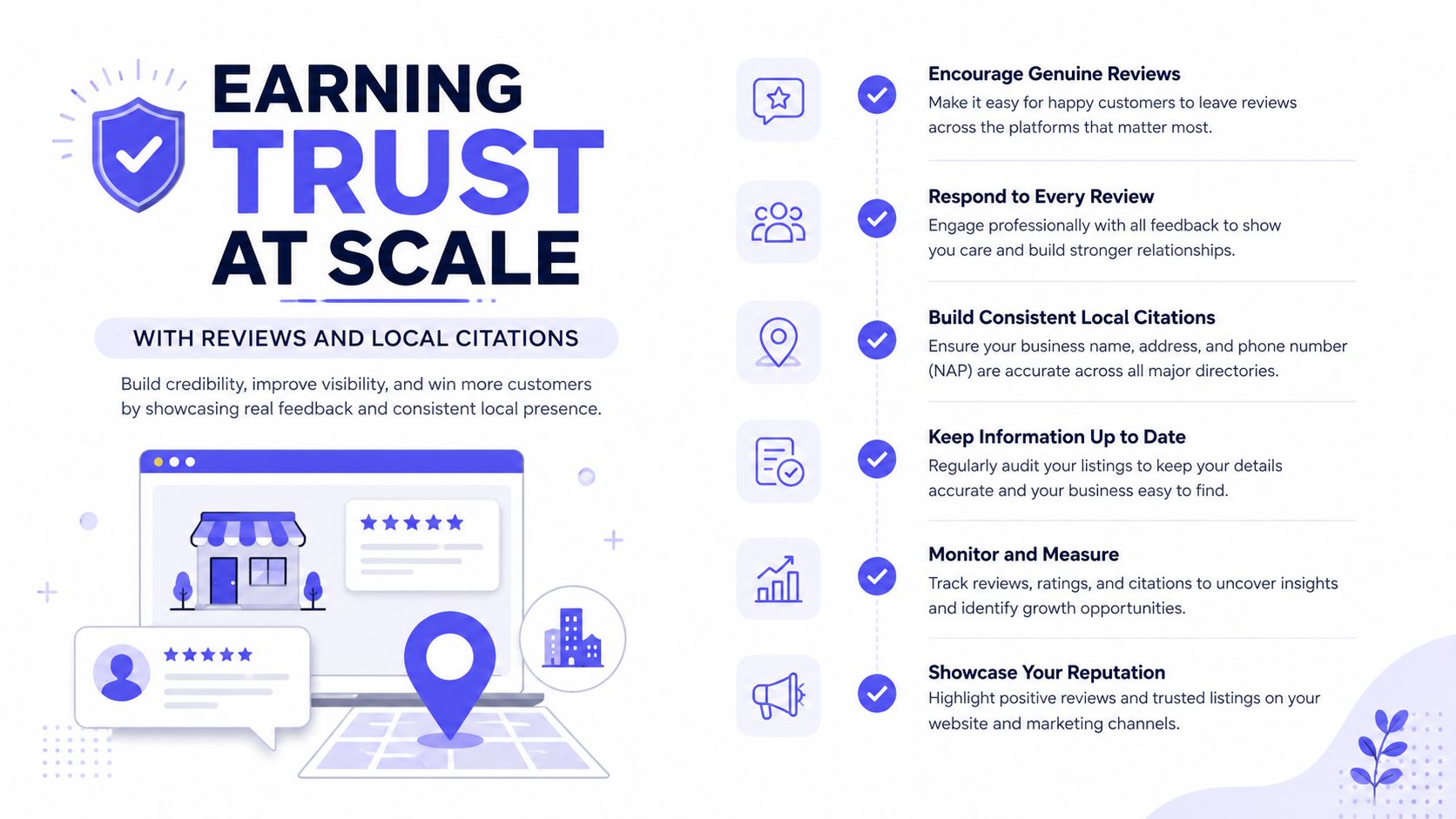
Reviews are not vanity. They are proof that real people hired you, liked the result, and were willing to say so publicly. One industry guide recommends maintaining a 4.5+ average and generating 6–10 new reviews per month to stay competitive, which turns review generation into an ongoing operation rather than a one-time setup task (GMB Mantra). That's a tough but useful standard.
Make review requests part of the closeout process
The easiest time to ask is right after a successful job. Not a week later, not when you remember, right after the customer is happy. Ask every customer, keep the ask short, and make it easy to complete on a phone.
A good review process also includes response behavior. Reply to every review, especially the ones that mention a specific city or service. Those details help reinforce relevance and show that the business is active.
Citations only work if they match
Citations are your business listings on directories and local platforms. They matter because Google cross-checks them against your website and profile. The important part is consistency.
If one listing says “Street” and another says “St.” or the phone number differs by even one digit, you create noise. That weakens the signal. Clean listings on a manageable set of directories are more useful than a scattered mess across dozens of half-filled profiles.
- Standardize the business name across every profile and directory
- Match the address format exactly, including suite details if you use them
- Keep the same phone number everywhere customers can find you
- Use the same website URL so the trail points back to one place
Local proof beats generic proof
A review that says “great electrician” helps. A review that mentions the city and the service performed helps more, because it connects your business to a real local job. That's why review prompts should be specific when possible.
If you want to sanity-check review patterns and spot red flags, the Handvetted guide to spotting fake reviews is useful context. You don't need gimmicks here. You need a clean reputation system that keeps earning trust month after month.
Advanced Tactics for Future-Proofing Your SEO
Search is changing, and the businesses that adapt early tend to stay visible longer. For electricians, the next layer isn't about stuffing more keywords onto a page. It's about making your business easier for machines to understand. That means service lists, Q&A sections, and schema markup that turn your site into machine-readable answers and clearer entity signals for AI-driven discovery (Transactional).
Make the business easier to parse
Schema markup is basically labeling. It helps search systems understand your services, hours, and review context without guessing. That matters when people never make it to a traditional website click and instead get an answer from a map result or an AI summary.
The same logic applies to your Google Business Profile. A strong profile with clear services and questions answered in plain language gives AI systems more clean data to work with. You're not writing for robots, but you are making their job easier.
Build local links without acting spammy
Local links still matter because they show geographic relevance and trust. Community groups, trade associations, neighborhood blogs, and local news are the kinds of places that make sense for an electrician to show up. The link itself is useful, but the mention is useful too.
One clean way to earn those mentions is through community involvement or real partnerships. Sponsor a local event, support a trade group, or contribute a practical safety resource. The goal isn't volume. It's relevance.
The smartest SEO move is usually the least flashy one. Clear service pages, honest reviews, and real local mentions beat half-baked tactics every time.
Think about zero-click behavior
More searchers now get answers without visiting a website, which means your profile and your machine-readable content have to do more of the work. The win is no longer just traffic. It's getting the call when the searcher never opens a tab.
That's where AI-friendly structure helps. If your service lists, Q&A, and schema are clear, you're in a better position to be surfaced in those no-click moments. That's a useful edge for a busy electrician who wants calls, not just visits.
Measuring What Matters A Realistic 90-Day Plan
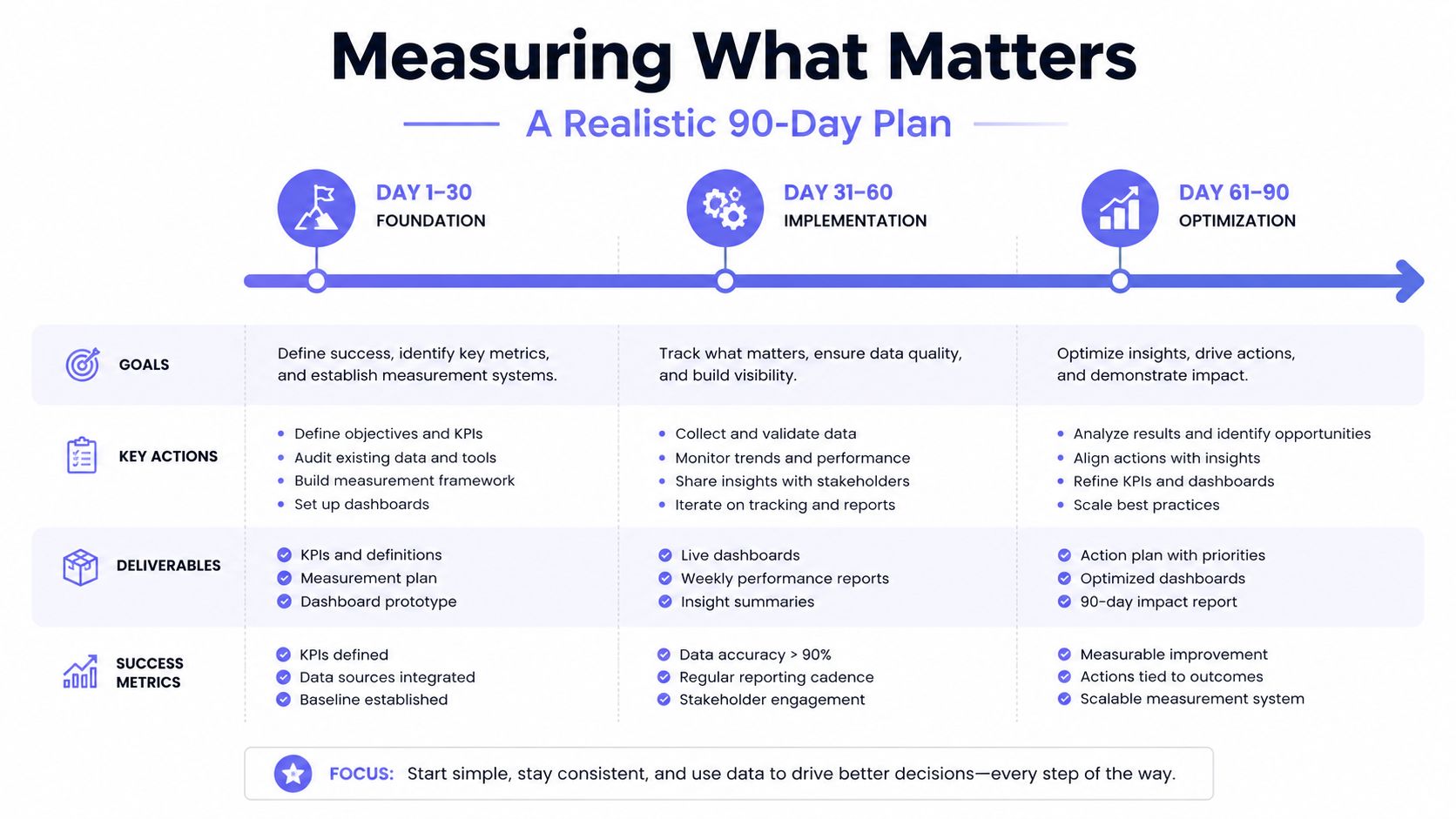
If you're busy, the plan has to be simple enough to finish. The local map pack responds to review velocity, citation consistency, and local link acquisition as measurable levers, and campaigns often fail when those become one-time chores instead of daily KPIs (Ron Kot). That means you need a cadence, not a burst of effort.
Month 1 clean up the foundation
Start with the Google Business Profile. Make sure every core field is complete, the category is right, the service area is accurate, and the photos are real. Then audit your name, address, and phone number across the web so the basics line up.
Track calls, website visits, and directions requests in GBP Insights. Those are the signals that tell you whether the profile is pulling its weight. If the numbers are flat, fix the profile before you chase anything fancier.
Month 2 build the pages that match search intent
Publish your most important service pages and one or two high-value location pages. Keep each page focused on one intent, one city, and one set of questions. Many businesses overcomplicate things, but the rule stays simple: specific pages convert better than generic ones.
Use the page titles, H1s, and body copy to match how people search. The point is not to impress another marketer. It's to make sure your best service pages can get found and clicked.
Month 3 create the trust loop
Set up a repeatable review request process and begin cleaning up citations. Ask after every completed job. Respond to each review. Keep the wording natural and local when possible.
If you're looking for another exclusive lead source once your reputation is in shape, Handvetted's lead generation page is worth a look because it focuses on one matched professional per request. That fits the same principle as good local SEO, which is reducing noise and making it easier for the right customer to find you.
What success should look like
Forget vanity rankings that don't lead to calls. Watch the profile actions, the number of real reviews coming in, and whether the most important service pages are pulling in inquiries. Those are the signals that matter in a trades business.
If you want the fastest next step, spend the next week cleaning up your Google Business Profile, then build one strong service page and one city page before doing anything else. If your online presence is solid and you want a cleaner path to exclusive requests, visit Hand Vetted Co. and see how a single verified match model can fit into your lead flow.