You paid for a lead. Then you called, texted, and emailed. The number was bad, the job was outside your service area, or the person had already talked to three other businesses and only wanted the cheapest quote.
That isn't a lead problem. It's a lead quality problem.
A lot of businesses chasing lead generation near me keep trying to fix volume when the actual leak is qualification, routing, and follow-up. Shared marketplaces make that worse. You get more notifications, but not more profitable jobs. The businesses that win locally build around intent, fit, and fast handoff. They work backward from revenue, not inbox count.
Table of Contents
- Tired of Paying for Bad Leads
- First Audit Your Local Digital Footprint
- Dominate Local Search Without Paying Per Click
- Run Smart Paid Ads for Hyper-Local Targeting
- Build a High-Intent Funnel That Converts
- Create Your Modern Local Lead Generation Mix
Tired of Paying for Bad Leads
If your current setup sends the same inquiry to a pile of businesses, you're not buying opportunity. You're buying a race.
That race usually ends the same way. The fastest caller gets ignored, the second caller gets voicemail, and the third gets a frustrated person who already regrets filling out the form. By the time your team gets involved, the conversation starts with distrust.
Guidance on funnel diagnosis points to the bigger issue. The main risk in local lead generation isn't just low volume. It's lead-quality risk caused by shared marketplaces and weak qualification, which creates wasted callbacks, duplicate outreach, and poor-fit projects when businesses focus on raw inquiries instead of qualified leads (funnel analysis guidance on qualified leads and wasted callbacks).
What bad leads usually look like
- Shared and stale: The person has already heard the same pitch from several businesses.
- Poorly screened: No one checked location, scope, budget, or timing before the handoff.
- Operationally expensive: Your office burns time chasing people who were never a fit.
- Trust-killing: Your team sounds desperate because the process forces them to be.
Bad leads don't just waste ad spend. They eat dispatch time, sales time, and owner attention.
A better system screens early, routes cleanly, and protects exclusivity wherever possible. It also makes trust visible. If you're in a category where customers care about safety and legitimacy, your process should make that obvious. Even simple trust markers like licensing, reviews, and a clear screening standard matter. That's one reason pages that explain contractor background checks and screening standards help reduce hesitation before the first call.
The shift that fixes this
Stop asking, "How do I get more leads near me?"
Start asking:
- Are these people in my service area
- Do they need the service I want to sell
- Can my team contact them immediately
- Is this inquiry exclusive or shared
- Does the intake give enough context to price and prioritize
That change sounds small. It isn't.
Once you move from quantity-first lead gen to qualified, exclusive, high-intent local demand, the rest of your marketing gets easier. Your ads get tighter. Your pages get clearer. Your close rate usually improves because your team isn't chasing ghosts.
First Audit Your Local Digital Footprint
Before you spend another dollar, check what people see when they look you up. Most local lead problems start with a messy digital footprint. The business looks one way in Google, another way on its site, and a third way inside a directory listing.
You can audit most of this in under an hour.
Search your business like a customer would
Open an incognito window and search your business name, your core service, and your main city. Don't search like an owner. Search like someone who needs help today.
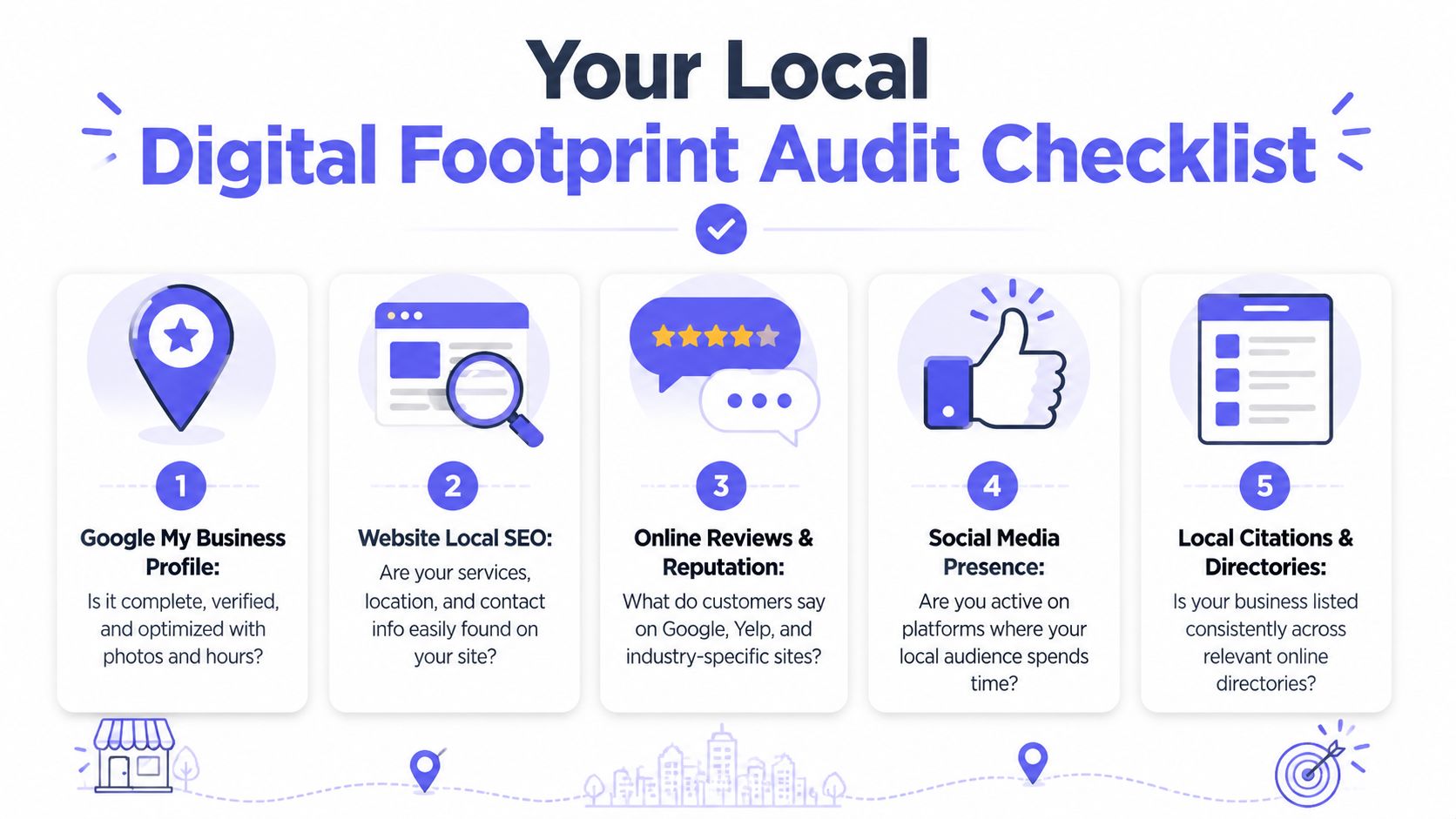
Here's what to review first:
- Google Business Profile: Is your phone number correct, your category accurate, your hours current, and your service area clearly defined
- Reviews: Do the latest reviews still reflect the quality of work you want associated with your brand
- Photos: Are you showing real work, real trucks, real crews, and real job outcomes
- Directories: Do Yelp, Angi, Apple Maps, Bing Places, and niche directories show the same business name, address, and phone number
- Search results: Does your homepage communicate what you do and where you do it
A lot of local businesses lose trust before the call because the basics don't line up. One old number, one dead page, or one outdated service area creates friction that shouldn't exist.
Practical rule: If a customer has to guess whether you serve their ZIP code, you already made the inquiry harder than it needed to be.
Check your site on a phone, not a desktop
Most owners review their site on a laptop in the office. Your customers usually won't.
Open your website on a phone and answer these questions within a few seconds:
| Check | What you should see fast |
|---|---|
| Contact path | Tap-to-call button and short quote form |
| Service clarity | Clear service names, not vague marketing copy |
| Local proof | City names, neighborhoods, review snippets, project photos |
| Trust markers | License info, insurance mention, years in business if relevant |
| Speed | A page that loads cleanly without broken layouts |
If the homepage is all branding and no direction, fix that. Local intent is simple. People want to know three things. Do you do this job, do you work in my area, and can I reach you right now?
Red flags worth fixing this week
- Thin service pages: One generic services page won't carry local search intent.
- No visible service area: This creates uncertainty and low-quality submissions.
- Buried forms: If the quote form is hidden in a menu, you'll lose ready-to-buy visitors.
- Weak proof: Stock photos and generic copy don't create confidence.
- Review neglect: A profile with old reviews feels inactive, even if you're busy.
This audit isn't glamorous, but it pays off. It cleans up the trust layer before you push harder on traffic.
Dominate Local Search Without Paying Per Click
Free local visibility still matters because high-intent searches often start in Google Maps, branded search, and service-plus-city queries. If your presence is weak there, paid ads become a crutch.
That problem is getting sharper. Recent guidance on digital strategy gaps notes that AI-driven search and discovery increasingly reward strong, complete business signals, and the bigger question for local businesses is staying visible as AI summaries and map packs reduce clicks (recent guidance on AI-driven search visibility and business signals).
Treat your Google Business Profile like a storefront
Your Google Business Profile is not a side listing. It's often the first real impression.
Fill out every field you can control. Categories, service areas, hours, products or services, photos, business description, and booking or call options all matter. Weak profiles look inactive. Complete profiles look trustworthy.
A practical local search routine looks like this:
- Update photos regularly: Before and after shots, team photos, vehicles, and work in progress all help.
- Use posts sensibly: Share recent projects, seasonal service reminders, or short updates.
- Answer questions: If the profile has common questions, don't leave them hanging.
- Keep details synced: Your website and profile should say the same thing about service areas and contact info.
Reviews do two jobs at once
Reviews help conversion, and they also strengthen your local visibility.
The mistake is asking at random. Ask right after a completed job, while the outcome is fresh and the customer still remembers the details. Make it easy. Send a direct review link by text or email, and train your team to ask as part of the closeout routine.
Good review strategy also means responding. Not with canned lines. With specifics.
- Thank people using the service type and area when appropriate.
- Address complaints directly and calmly.
- Show future customers that a real business owner is paying attention.
A quiet review profile makes an active company look smaller than it is.
Build pages for real local intent
A lot of local businesses try to rank one broad homepage for everything. That rarely matches how people search.
Create service pages around combinations people commonly use:
- roof repair in Charlotte
- AC replacement in South End
- water damage cleanup in Matthews
Don't mass-produce junk pages. Build a useful page for each core service and important area you serve. Each page should include the service, the locations, common problems, a clean call path, and proof that you're active in that market.
What to avoid
- Keyword dumping: Repeating city names over and over reads badly and doesn't build trust.
- One-page websites: They can work as a starter site, but they limit local depth.
- Generic copy: If your page could belong to any business in any city, it won't help much.
- Set-and-forget profiles: Local search changes. Your profile and pages need upkeep.
For businesses focused on lead generation near me, local SEO works best when it mirrors real buying behavior. People search with urgency, geography, and a specific problem in mind. Your digital presence should meet that exact moment.
Run Smart Paid Ads for Hyper-Local Targeting
Paid ads work best when you stop treating them like a volume game. If your budget is limited, broad campaigns usually just buy expensive noise.
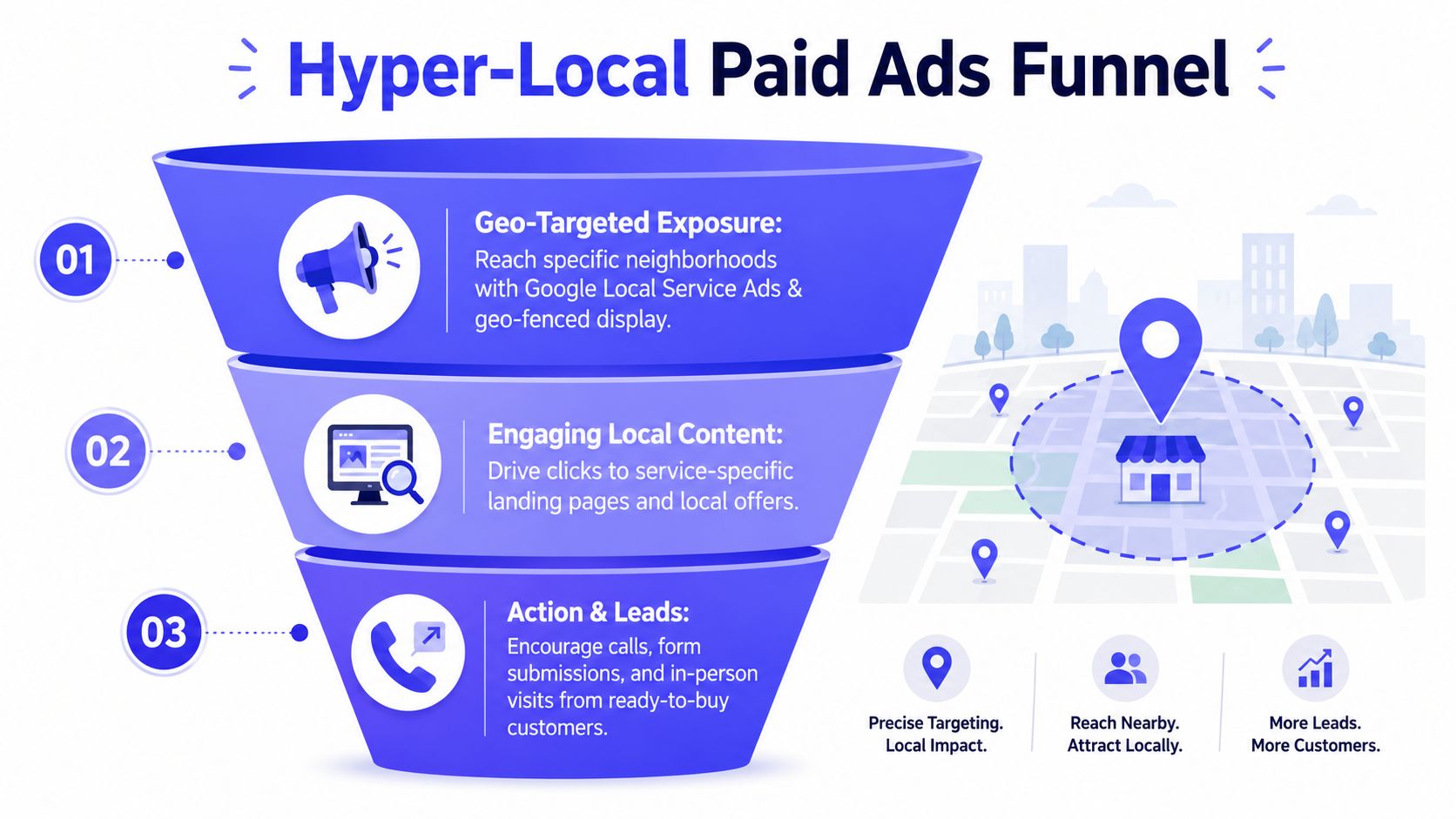
The smarter move is smaller geography, tighter intent, and better filters. That means fewer clicks, but better calls.
Go narrower than feels comfortable
A lot of businesses launch paid search across an entire metro because they don't want to miss anything. That usually backfires. Different neighborhoods produce different job sizes, travel times, and close rates.
Start with your strongest pockets:
- ZIP codes where you've already done good work
- areas with higher average ticket sizes
- neighborhoods close enough to serve profitably
- places where you already have reviews and photo proof
Then build campaigns around those areas only.
Cost per lead varies heavily by channel, and efficiency matters more than raw cheapness. In early 2026, the median B2B cost per lead reached $213, with channel costs ranging from $98 for organic content and SEO to $487 for ABM. But the expensive channel wasn't automatically worse. ABM-sourced leads converted to opportunities at 19.8% compared with 4.1% for paid social advertising, which is a reminder to judge channels by efficiency and downstream conversion, not headline cost alone (2026 lead generation cost and conversion analysis).
For local paid ads, the lesson is simple. Don't ask only, "What did this lead cost?" Ask, "Was this lead worth selling to?"
Match the ad to the job you actually want
If you offer ten services, don't advertise all ten at once unless the economics are clear. Pick the services with the best margin, strongest fulfillment, and cleanest close process.
A strong local ad setup usually includes:
- Google Local Services Ads if your category qualifies
- search campaigns around urgent, high-intent terms
- landing pages tied to one service and one area cluster
- call tracking and form tracking that show what turned into a real opportunity
Weak setups tend to send every click to the homepage, use broad match terms carelessly, and mix low-value jobs with premium services in the same campaign.
The ad copy should sound local and specific
Most local ad copy is generic. Fast service. Free estimates. Trusted pros. Everyone says that.
Write ads that reduce uncertainty:
- mention the exact service
- reference the area
- emphasize licensed or verified status if true
- tell people what happens next after they click or call
Smaller campaigns are easier to debug. If one ZIP code, one service, and one landing page aren't working, you can actually fix the problem.
If your paid ads feel unpredictable, the issue usually isn't that paid search doesn't work. It's that the targeting is too loose and the intent path is too muddy.
Build a High-Intent Funnel That Converts
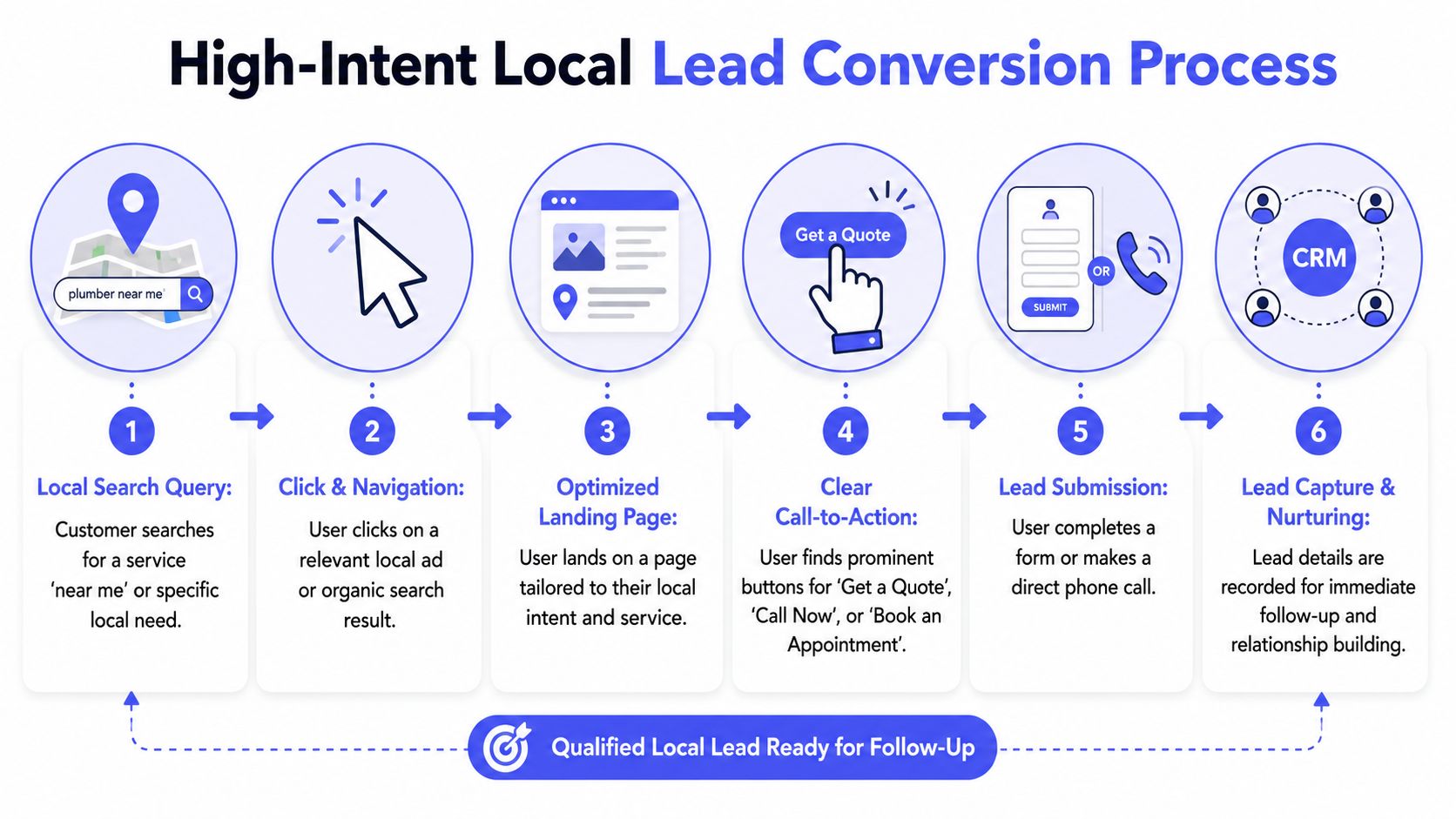
A homeowner searches, clicks, and is ready to hire. Then they land on a vague page, fill out a bloated form, wait three hours for a callback, and book with the company that answered first.
That is how good local intent gets wasted.
Send clicks to service pages, not your homepage
A high-intent funnel should help a prospect make one decision. Am I in the right place, and what do I do next?
Your homepage usually cannot do that well. It has too many competing jobs. It introduces the company, lists services, supports existing customers, and tries to rank for broad searches. For lead capture, that creates friction.
A focused landing page converts better because it matches the job the person wants right now.
Strong local landing pages usually include:
- Exact service match: The headline matches the search or ad.
- Clear service area: The page confirms where you work.
- Proof early: Reviews, certifications, photos, and financing or warranty details if relevant.
- One primary action: Call, request estimate, or book an inspection.
- Short qualifying form: Enough fields to screen fit without killing response rate.
Pricing content can also filter for serious buyers before they ever call. A page built around a real buying question, such as average price for carpet cleaning, works because it attracts people comparing options and helps set expectations before your team gets involved.
Qualify before the handoff
Contractors waste time when every form fill gets treated like a sales opportunity. Better funnels screen for fit up front so your team spends time on leads that can turn into profitable jobs.
Ask for the details that affect routing and close rate:
- ZIP code
- service needed
- project timing
- budget range, if it matters for your ticket size
- a short project description
That is enough to separate a real prospect from someone outside your area, price shopping for a tiny job, or asking for something you do not even offer.
There is a trade-off here. More fields usually lower form submission volume. But for local service businesses, lower volume and better fit often wins. Fifty weak inquiries from a shared marketplace do less for revenue than ten exclusive leads tied to the right service area and job type.
Route fast and give one person ownership
Speed matters, but speed alone is not the whole system. The handoff has to be clean.
A good local funnel routes each lead to one person or one team immediately, with the service, location, and job notes attached. That cuts confusion and shortens response time. It also prevents the common mess where the office misses the lead, two people call the same prospect, or nobody follows up because ownership was never clear.
The process should be simple:
- The prospect calls or submits the form.
- The system checks service area and basic fit.
- The lead goes straight to the right rep, estimator, or dispatcher.
- That person sees the source, requested service, and notes.
- One owner follows up until the lead is booked, disqualified, or lost.
If ownership is fuzzy, conversion drops fast.
You do not need a complicated stack to make this work. A form builder, CRM, call tracking, and clear routing rules are enough for many local teams. What matters is building a funnel that protects intent, screens out bad-fit inquiries, and gets exclusive leads in front of the right person while the job is still yours to win.
Create Your Modern Local Lead Generation Mix
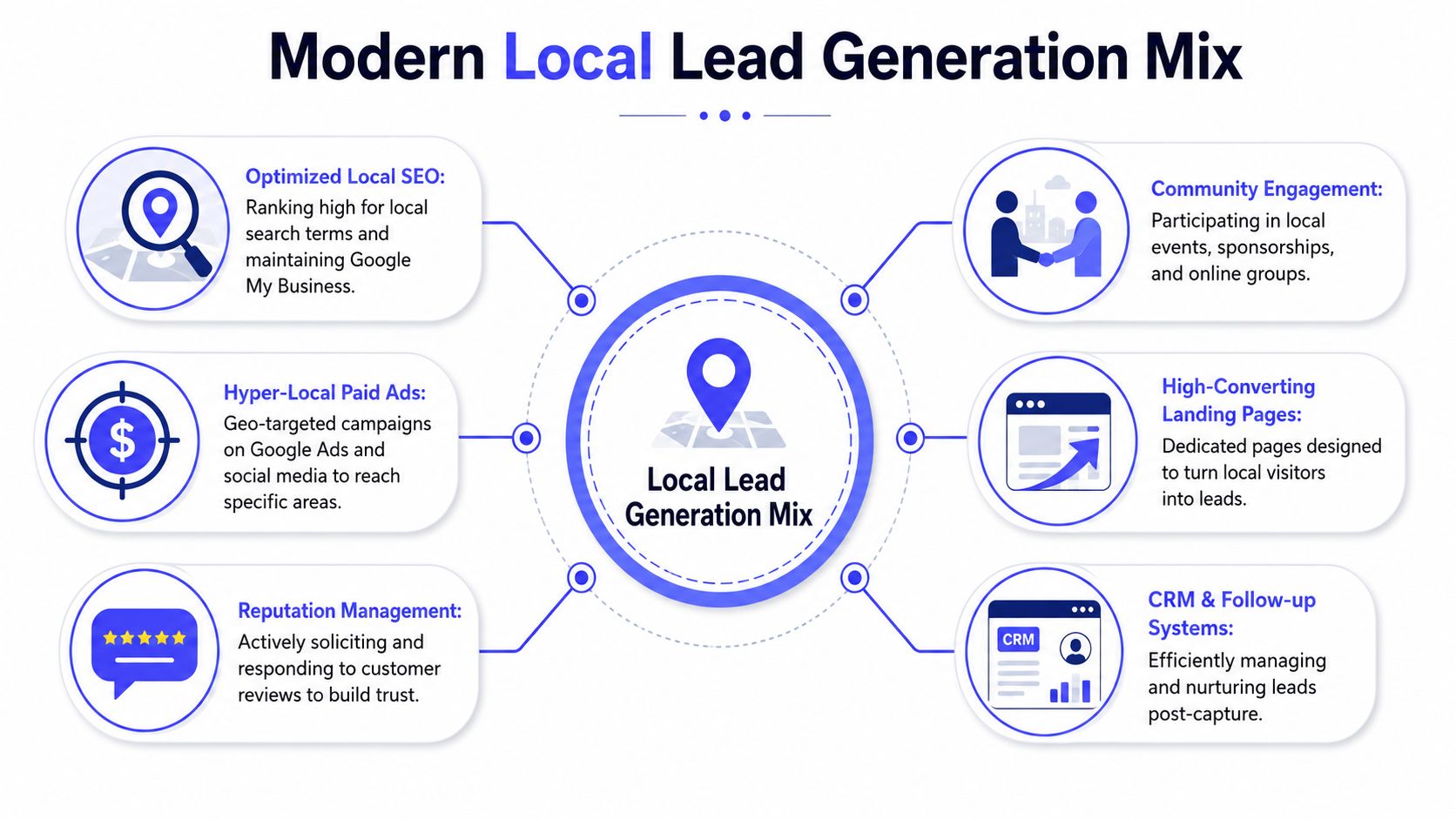
A contractor with a healthy pipeline rarely wins from one channel alone. The jobs that close at the best margins usually come from a mix of sources that capture intent in different ways and protect you when one source gets noisy or expensive.
That matters locally because every channel breaks differently. Organic search can be slow to build. Paid ads can drift outside your target zip codes if nobody is watching them. Referrals can be strong one month and quiet the next. Shared lead platforms can bury your team in price shoppers and bad-fit calls. A better mix gives you more than traffic. It gives you more shots at exclusive, high-intent jobs.
Measure the numbers tied to profitable work
Lead count is a weak scorecard.
Track the numbers that show whether a source produces jobs worth taking:
- Cost per qualified lead
- Booked estimate rate
- Close rate by source
- Average job value
- Time from inquiry to booked job
Those numbers change how you judge a channel. A source that sends fewer inquiries can still beat a higher-volume source if the leads are in your service area, match the work you want, and close without a long chase. That is the key to a local lead mix. More names in the inbox do not help if your office spends half the day sorting through junk.
It also helps to separate lead quality by source. Search leads often show stronger buying intent. Referral leads often close faster because trust is already in place. Marketplace leads may look busy in a report but stall once price becomes the only conversation.
Add trust channels your competitors ignore
Good local lead generation is not just traffic acquisition. It is trust acquisition.
The strongest supporting channels are usually simple:
- Referral partners with overlapping customers, like plumbers, electricians, roofers, restoration firms, lenders, and property managers
- Customer reactivation through service reminders, seasonal check-ins, and maintenance follow-up
- Review generation built into the job-close process
- Local presence through associations, neighborhood groups, sponsorships, and community events that put your name in front of homeowners before they need you
These channels tend to produce better-fit inquiries because the prospect already has context. They have heard your name from someone they know, seen your reviews, or dealt with you before. That shortens the sales cycle and cuts down on tire-kicker conversations.
Use exclusive lead sources to fill gaps, not run the whole machine
Exclusive lead sources can help when your SEO is still maturing, your ad costs are unstable, or seasonality leaves open slots on the calendar. They work best as a supplement to owned channels, not as a replacement for them.
The trade-off is straightforward. Exclusive matching can give you cleaner opportunities and less competition for each inquiry, but you still need solid intake, quick follow-up, and clear qualification rules. If you want to compare that model with the usual shared resale approach, review how Handvetted matches homeowners with one verified local pro.
For most local service businesses, the right mix stays pretty lean:
- strong Google Business Profile visibility
- service-specific local landing pages
- tightly controlled paid campaigns by service and geography
- a funnel that screens for fit before the office wastes time
- review and referral systems that run every week
- one or two supplemental lead sources that send exclusive or pre-qualified opportunities
That setup gives you control over quality. It also protects you from overdependence on any one channel.
The best local lead generation mix is the one that sends profitable jobs your team can win. Judge every source by lead quality, close rate, job value, and how much friction it creates in the sales process. Raw volume is cheap. Clean, high-intent opportunities are what grow the business.