You price a kitchen sink swap at one number, then the cabinet doors open and the job changes. The new basin is deeper than the old one. The drain no longer lines up. The countertop needs cutting. What looked like a routine install now costs a lot more, and that surprise is what blows budgets.
Kitchen sink installation can run from a fairly manageable project to a costly one fast. The main cost drivers are the sink style, the weight of the unit, and whether the installer has to change plumbing, modify cabinets, or cut stone or solid-surface counters.
That is the part basic guides usually miss. They hand you one average price and treat every install like a simple swap. That is bad budgeting.
A smart budget starts with the job type. A straight drop-in replacement with matching dimensions is usually predictable. An undermount upgrade, farmhouse sink, plumbing relocation, or countertop cut is where costs climb and schedules slip. If you want a quote you can trust, separate the basic jobs from the complicated ones before you hire anyone.
Table of Contents
- The Bottom Line on Sink Installation Costs
- Decoding Your Quote What Drives the Price
- Sink choice changes both material cost and labor risk
- Labor stays controlled only when the scope is clear
- Plumbing changes are the hidden budget killer
- Countertop and cabinet modifications change the project category
- Add-ons are smart only when they save a second service call
- What a good quote should tell you
- Real-World Examples Sample Sink Budgets
- The Installation Process Start to Finish
- Smart Ways to Save on Your Installation
- Red Flags to Avoid When Hiring an Installer
- Frequently Asked Questions
The Bottom Line on Sink Installation Costs
You approve a sink replacement expecting a straightforward bill, then the old sink comes out and the actual job becomes apparent. The drain lines do not line up. The new sink needs a different cutout. The cabinet rail blocks the bowl depth. That is how a modest replacement turns into a much larger project.
For a professionally installed kitchen sink, plan on a wide total range of $650 to $4,000, with many mid-range replacements falling around $1,600 to $1,800, as noted earlier. The spread is the point. A sink install is not one price category. It is a basic swap, an upgrade with accessories, or a construction job hiding inside a plumbing quote.
Labor on a simple replacement is often manageable. The final bill jumps when the scope includes the parts many basic guides skip:
- faucet replacement
- garbage disposal hookup or replacement
- old sink removal and disposal
- new supply lines, basket strainers, or shutoff valves
- countertop cut or trim work
- cabinet modification for farmhouse or deeper-bowl sinks
- plumbing changes because the drain or trap no longer lines up
Practical rule: Budget from the scope, not the average.
Use this table as your starting point before you ask for quotes:
| Project type | What it usually looks like | Budget direction |
|---|---|---|
| Simple replacement | Same size sink, same mounting style, no plumbing or counter changes | Lower end |
| Mid-range upgrade | New sink plus faucet or disposal, minor fit adjustments, standard reconnects | Middle |
| Complex install | Farmhouse or undermount conversion, heavy sink, counter cut, cabinet work, plumbing move | Upper end |
My recommendation is simple. If your new sink matches the old sink in size, depth, and mounting style, keep your budget tight and expect a cleaner install. If you are changing any of those three variables, add contingency money before you sign anything.
A flat quote with no breakdown is a problem. You need to see labor, materials, removal, reconnects, and modification work listed separately. Otherwise the low number on page one becomes the high number on install day.
The expensive mistakes are usually hidden in the words “minor adjustments.” That phrase can mean ten minutes of reconnecting. It can also mean cutting stone, rebuilding part of the sink base, or moving plumbing inside the cabinet. Those are not small extras. They are the line between a routine swap and a costly install.
Decoding Your Quote What Drives the Price
A sink quote gets expensive fast when the job stops being a straight swap. The sink itself matters, but the primary budget drivers are the parts many quotes bury in vague language such as “fit adjustments” or “minor plumbing.”
Sink choice changes both material cost and labor risk
Start with the sink type, then ask what that choice forces the installer to change around it.
World CopperSmith's kitchen sink cost guide lists broad price differences by material, including stainless steel at $100 to $800, cast iron at $300 to $900, and quartz at $800 to $1,200. That spread matters because heavier and less forgiving sinks often need more careful handling, stronger support, and more time on site.
My advice is simple. If cost control is the goal, choose a drop-in stainless model that matches the existing opening. If you want a farmhouse, apron-front, cast iron, or thick composite sink, budget for labor complications before you ever compare quotes.
Labor stays controlled only when the scope is clear
Labor pricing is stable on clean replacement jobs. It gets messy when nobody has confirmed the cutout size, sink depth, drain position, cabinet clearance, shutoff condition, and mounting method.
ConsumerAffairs' sink replacement cost overview puts the national average cost to install a kitchen sink at $430, with straightforward replacement labor often running $300 to $800. The same source says plumbers commonly charge $50 to $200 per hour. That range is wide for a reason. The labor number depends less on the sink and more on what the installer finds once the old unit comes out.
If you want a useful quote, require line items for removal, sink install, faucet reconnect, disposal reconnect, supply upgrades, and any modification work. A one-line labor total hides risk.
Plumbing changes are the hidden budget killer
This is the cost basic guides skip.
HomeServe's plumbing installation cost guide says basic plumbing work under a sink can run $150 to $500, while moving a drain or supply line more than a short distance can reach $450 to $1,000 per fixture. That is the difference between a routine install and a project that suddenly needs real contingency money.
Here is what usually triggers that jump:
- A deeper sink moves the drain lower and crowds the disposal or trap
- A new bowl configuration shifts the drain left or right
- An apron-front or farmhouse sink changes cabinet access and working room
- Old shutoff valves or corroded fittings fail once they are disturbed
If your sink style changes the drain location, assume the plumbing line item will grow. Plan for it. A kitchen renovation cost calculator helps you pressure-test the full budget before you approve the work.
Countertop and cabinet modifications change the project category
Countertop cuts and cabinet alterations are where a “reasonable” quote turns into a premium job.
An undermount conversion may require template work, edge prep, clips, adhesive, and extra cure time. A farmhouse sink can require cabinet front removal, a new support frame, and a revised cutout. Stone counters add another layer because cutting quartz or granite is a specialized task, not a casual adjustment the installer tosses in for free.
Treat these as separate scopes, not accessories. If the quote does not clearly list countertop work or cabinet modification, assume it is excluded.
Add-ons are smart only when they save a second service call
Sink day is the right time to replace worn parts that the installer already has to disconnect. Faucet replacement often makes sense. A bad disposal, leaking basket strainer, or crusted shutoff valve also belongs in the must-do category if it is near failure.
Soap dispensers, filtered water taps, and other extras are nice to have. They are not automatic value adds if they stretch the labor window and create more connection points under the sink.
My rule is blunt. Bundle the parts that prevent rework. Delay the rest.
What a good quote should tell you
A strong quote answers the expensive questions before the crew arrives:
- Is this a like-for-like replacement or a style change?
- Are plumbing relocations included or excluded?
- Is countertop cutting included, and who does it?
- Is cabinet modification included?
- Are haul-away, mounting hardware, sealants, and reconnects listed?
- Are old valves, supply lines, or drain parts assumed reusable?
If those answers are missing, the quote is incomplete. Get a revised scope before you sign.
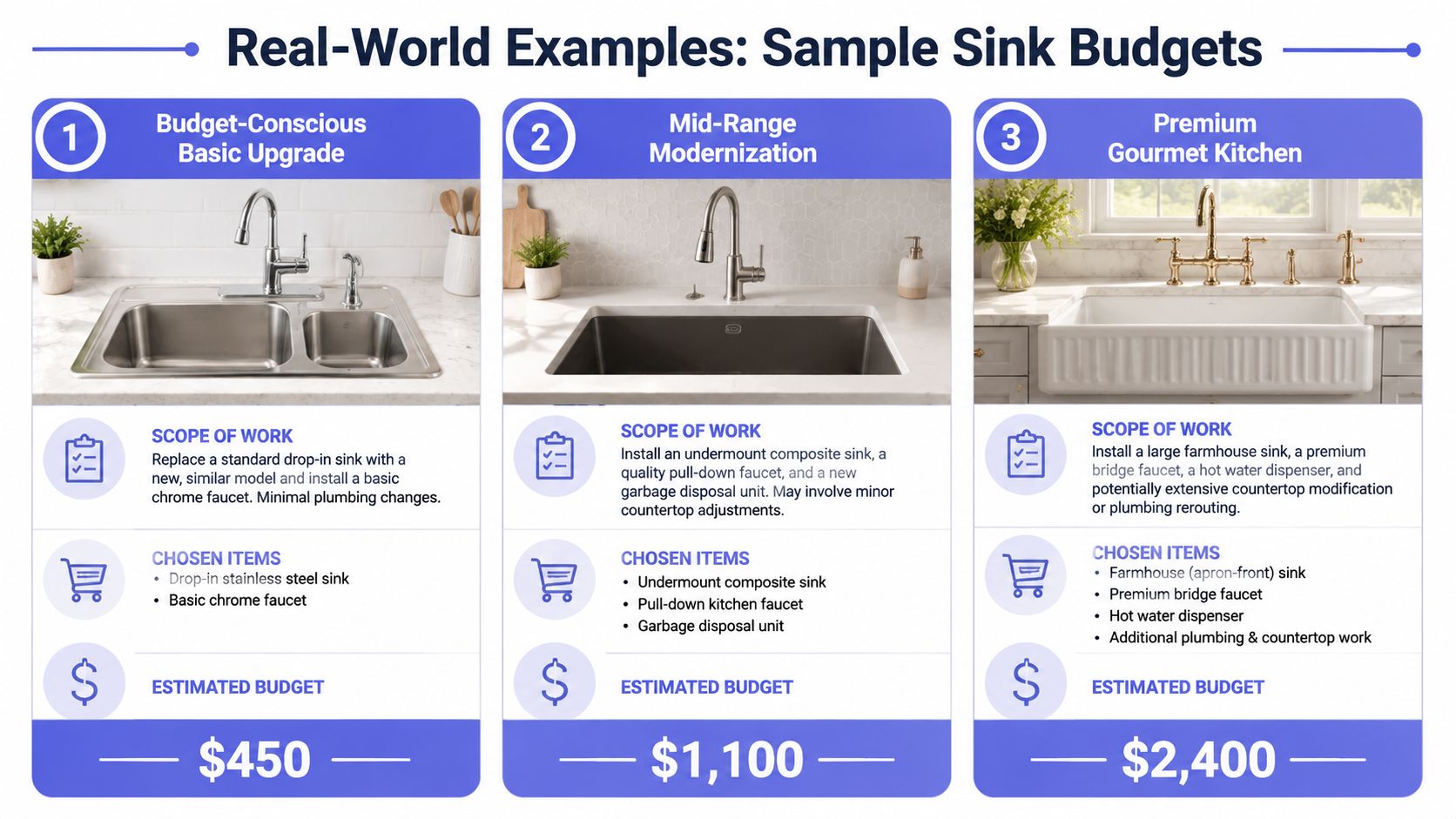
Real-World Examples Sample Sink Budgets
A sink quote looks cheap right up until the installer says the drain does not line up, the stone needs cutting, or the cabinet needs reinforcement. That is why averages mislead people. Budget by job type and complexity.

Scenario one basic drop-in swap
You have a standard top-mount sink, a matching opening, working shutoff valves, and no plumbing changes. You are swapping old for new and keeping the same general layout underneath.
This is the low-drama version of the job. Labor stays modest because the installer is not cutting counters, rebuilding support, or chasing alignment problems inside the cabinet. If your goal is a clean refresh at the lowest install cost, this is the one to choose.
A basic swap is the best value move for rental properties, resale prep, and older kitchens where you do not want to trigger extra repair work.
Scenario two undermount upgrade with bundled replacements
Now you are in the range where costs start spreading out. You want an undermount sink, a new faucet, and maybe a disposal or basket strainer while everything is apart. The plumbing stays in roughly the same place, but the install may still need cleanup, mounting hardware, fresh sealant, and small adjustments around the opening.
Smart bundling proves beneficial. Replacing tired parts during the same visit usually costs less than calling someone back a month later. Use a home renovation cost calculator for kitchen updates to map the full job before you approve a quote that only covers the sink itself.
My recommendation is simple. Bundle the parts under the sink that are already being disconnected. Skip decorative add-ons unless they solve a real problem.
Scenario three farmhouse install with hidden structural costs
Farmhouse sinks blow up budgets because the sink is only part of the job. The cabinet front often needs to be cut or rebuilt. The sink may need a support frame. The drain location can force plumbing changes. If you have quartz or granite, countertop work becomes a separate trade with separate pricing.
That turns a sink install into a small remodel.
This is the project that catches homeowners off guard. They price the sink, maybe the labor, and miss the cabinet work, stone fabrication, plumbing relocation, and extra time on site. Those are the charges that move the total from manageable to expensive.
If you want the farmhouse look, fine. Just set the budget like a renovation, not a fixture swap. That is the honest way to plan it.
The Installation Process Start to Finish
You approve a sink install thinking it is a half-day job. Then the crew finds frozen shutoff valves, a drain that misses the new basin, or a countertop opening that needs cleanup before the sink can even sit flat. That is how a simple replacement turns into a longer, pricier visit.
A well-run install follows a predictable sequence. The problem is not the basic steps. The problem is the condition of everything around the sink.
Before install day
Start with a site check, even for a replacement. The installer should confirm the sink model, mounting style, faucet hole count, disposal connection, sink base cabinet width, and whether the existing drain and supply lines fit the new sink. If that review happens only after the old sink is out, you are already in change-order territory.
Ask one blunt question before anyone shows up: is this a same-opening, same-plumbing swap, or does this job involve cuts, support work, or plumbing changes? That single answer tells you whether to expect a routine install or a small remodel.
If the budget is tight and timing matters, review your home improvement financing options for renovation projects before install day, not after an avoidable surprise shows up on the invoice.
On install day
The order should be clean and deliberate. Shut off water. Disconnect faucet lines, drain parts, disposal, and dishwasher hose if present. Remove the old sink. Clean the deck or mounting area. Dry-fit the new sink. Install the faucet and basket strainers. Set and seal the sink. Reconnect supply lines, drain assemblies, disposal, and dishwasher connection. Then test everything under load.
Straightforward jobs move fast.
Complex jobs do not. The usual delays are old valves that will not reopen cleanly, misaligned trap arms, heavier sinks that need added cabinet support, warped sink rails, and rough countertop openings that need trimming or polishing. Farmhouse and undermount installs are where schedules slip hardest because the sink depends on the cabinet and counter being right first.
Countertop work changes the whole job. If the opening needs to be enlarged, reshaped, or reinforced, the installer may need to stop and bring in a fabricator. Plumbing moves do the same thing. Once the drain location changes, the timeline extends because the rough-in has to match the sink, not the other way around.
Before the installer leaves
Do not settle for a quick visual check. Run the sink like you plan to use it.
Use this checklist before final payment:
- Run hot and cold water: Confirm the faucet works correctly and the shutoffs hold.
- Fill and drain each basin: Watch for slow drainage, backing up, or wobble in the strainer connections.
- Check underneath while water runs: Look at supply lines, slip joints, disposal connections, and the dishwasher branch tailpiece.
- Inspect the sink edge or underside seal: The sink should sit tight, with clean sealant and no visible gaps.
- Test the disposal and dishwasher discharge: Listen for abnormal vibration and check for leaks during discharge.
- Confirm cleanup and haul-away: Old caulk, sink clips, packaging, and the removed sink should not be left behind unless your quote says otherwise.
A finished install should be solid, dry, and quiet. If the sink rocks, the drain leaks, or the cabinet floor is wet, the job is not finished. Hold the final payment until it is corrected.
Smart Ways to Save on Your Installation
Saving money on a sink job isn't about hunting for the lowest number. It's about avoiding the expensive version of the project by mistake.
Buy smart not fancy
The easiest win is keeping the install simple. A standard replacement sink that matches the existing opening is usually the best value. Fancy materials and dramatic styles can be worth it, but they're not automatically a smart buy.
Old sink removal is another line item people miss. Angi's sink installation cost guide notes that removing and disposing of an old kitchen sink can add $20 to $300. Ask if that's included before you approve anything.
If budget is tight, also look at the bigger payment picture before you start. Handled carefully, a project plan using home improvement financing options can be cleaner than making rushed decisions under pressure.
Control the quote before the work starts
Most overspending comes from vague estimates. Don't accept “install customer-supplied sink” as the entire description.
Ask for these items in writing:
- What's included: Sink install, faucet install, disposal hookup, reconnects, testing, cleanup.
- What's excluded: Plumbing relocation, stone cutting, cabinet modification, permit fees if required locally.
- What triggers extras: Shutoff valve failure, drain mismatch, unsupported cabinet base, disposal replacement.
- Who supplies materials: You or the installer. That matters because supplied materials can affect the final bill.
A clear quote protects both sides. A fuzzy quote protects the seller.
Bundle only when it actually helps
Bundling can save money if the installer is already onsite and the work overlaps naturally. Sink plus faucet is a common example. Sink plus unrelated plumbing across the house is less predictable.
Only bundle tasks that share labor setup, access, or disassembly. Otherwise you're just adding spend because it feels efficient.
Red Flags to Avoid When Hiring an Installer
A sink install is small enough that people get careless hiring for it. That's backwards. Small projects attract plenty of rushed, underqualified work.
A vague quote is a bad quote
If the estimate doesn't break out what's included, stop there. You need to know whether the price assumes a basic swap or leaves room for surprise charges on removal, reconnects, disposal handling, and modifications.
Watch for these warning signs:
- No itemization: You can't tell what you're paying for.
- No discussion of fit: They haven't asked for sink specs, photos, or cabinet details.
- No mention of contingencies: They're pretending every kitchen is straightforward.
A decent installer doesn't need to overcomplicate the quote. But they do need to define the work.
Pressure and shortcuts usually cost you later
Be careful with anyone who wants full payment upfront, pushes you to decide immediately, or shrugs off licensing and insurance questions. That behavior is a problem on any home project.
If you want a cleaner screening process before someone ever enters your kitchen, review a contractor background check standard and use it as your baseline. The goal is simple. You want someone who shows up prepared, works clean, and stands behind the result.
Bad installers talk fast about price and vaguely about process. Good installers do the opposite.
A professional should be able to explain the job in plain language. If they can't, don't hire them.
Frequently Asked Questions
Can I install a kitchen sink myself
You can handle a basic drop-in swap if the new sink matches the old cutout and you know how to shut off water, reconnect drains, apply sealant, and test for leaks.
Do not DIY an undermount, farmhouse, apron-front, or heavy cast-iron sink. Do not DIY any job that needs a countertop cut, support framing, or drain relocation. Those are the jobs that blow the budget after one bad measurement or a slow leak under the cabinet.
A simple sink swap is a weekend project. A complex sink install is a repair bill waiting to happen if you guess.
Do I need a permit to replace my kitchen sink
A straight replacement often does not require a permit. The answer changes once the job includes moving supply lines, shifting the drain, adding a disposal circuit, or changing cabinetry as part of the install.
Check with your local building department before work starts. Do not accept “we never pull permits for this” as a professional answer. If plumbing moves are part of the quote, get the permit question settled before you approve anything.
How much extra does a garbage disposal or faucet swap add
Treat a faucet or disposal add-on as a separate line item, not a freebie rolled into a sink install. The labor goes up because the installer has more disconnects, more reconnections, and more leak points to test.
Costs rise faster when the old valves are corroded, the disposal needs a new flange, the dishwasher drain tie-in has to be redone, or the faucet holes do not match the new sink. That is where a “simple” install turns into a half-day job. Ask for pricing on each add-on separately so you can see what is required and what is optional.
What should I ask before approving the quote
Ask these four questions before you sign anything:
- Does the price include removal and disposal of the old sink?
- Does it include reconnecting the faucet, disposal, dishwasher line, and shutoff valves if needed?
- Does the quote assume no plumbing moves, no cabinet changes, and no countertop cutting?
- What exact conditions trigger a change order, and what do those changes usually cost?
That last question matters most. Hidden costs usually come from sink fit problems, drain misalignment, and countertop work, not the sink itself.
If you want better quotes, send the installer the sink model, faucet model, a photo of the cabinet interior, and a clear shot of the plumbing before they price the job.
If you want a cleaner way to hire for a kitchen project, Hand Vetted Co. matches you with one licensed, background-checked, highly rated professional instead of sending your info to a pile of businesses. You avoid spam, get an exclusive match, and move faster with less guesswork.