If your phone is ringing but your calendar still looks thin, the problem usually isn't lead volume. It's lead quality. Too many plumbing businesses pay for inquiries that get shopped around, never answer the phone, or were never serious about booking in the first place.
Good plumber lead generation is less about getting more names into a spreadsheet and more about building a system that produces exclusive, high-intent opportunities you can close for profit.
Table of Contents
- Why Most Plumbing Leads Are a Waste of Money
- Build Your High-Trust Local Foundation
- Master Paid Ads for Immediate High-Intent Jobs
- Develop Long-Term Referral and Partnership Funnels
- Turn Website Clicks into Customers
- Qualify and Manage Every Lead for Maximum Profit
- Frequently Asked Questions
Why Most Plumbing Leads Are a Waste of Money
Most plumbing businesses don't have a traffic problem. They have a lead quality problem.
A lot of lead vendors sell the same inquiry to multiple businesses. That creates a race. The first company to answer has the best shot, the second gets a maybe, and everyone else pays to lose. By the time your office calls back, the person has already booked or turned the whole thing into a price-shopping exercise.
That's why so much plumber lead generation advice feels incomplete. It tells you how to get found, but it doesn't solve the part that matters to you: whether the lead is exclusive, reachable, and ready to hire. Housecall Pro's plumbing lead generation guide makes that gap clear. Most guidance focuses on visibility, not on the practical difference between a shared inquiry and a real job-ready request.
Volume looks good on paper, profit looks good in the bank
The U.S. plumbing market is projected to reach $130 billion in 2025, which is why this category attracts heavy competition and a lot of marketing spend, according to FieldEdge's plumbing lead generation analysis. Big market, big demand, plenty of opportunity.
But a big market doesn't make every lead valuable.
If ten leads come in and most of them are shared, unqualified, or outside your best service mix, you didn't buy growth. You bought interruptions for your CSR and estimator.
Practical rule: A lead isn't good because it was cheap. It's good if it turns into a booked job at healthy margin.
Shared leads usually create the wrong kind of competition
Shared marketplace leads push you toward the weakest selling position. You're not competing on trust, process, or expertise. You're competing on who called first and who dropped price fastest.
That's backward.
The better model is simple:
- Prioritize exclusivity: One real opportunity beats several recycled inquiries.
- Filter for intent: Emergency, repair, and clear service requests beat vague “looking around” forms.
- Protect your time: Every bad lead burns dispatch attention that should go to profitable work.
If you want profitable plumber lead generation, stop asking, “How do I get more leads?” Start asking, “Which channels send people who are ready to book and not talking to three other plumbers at the same time?”
Build Your High-Trust Local Foundation
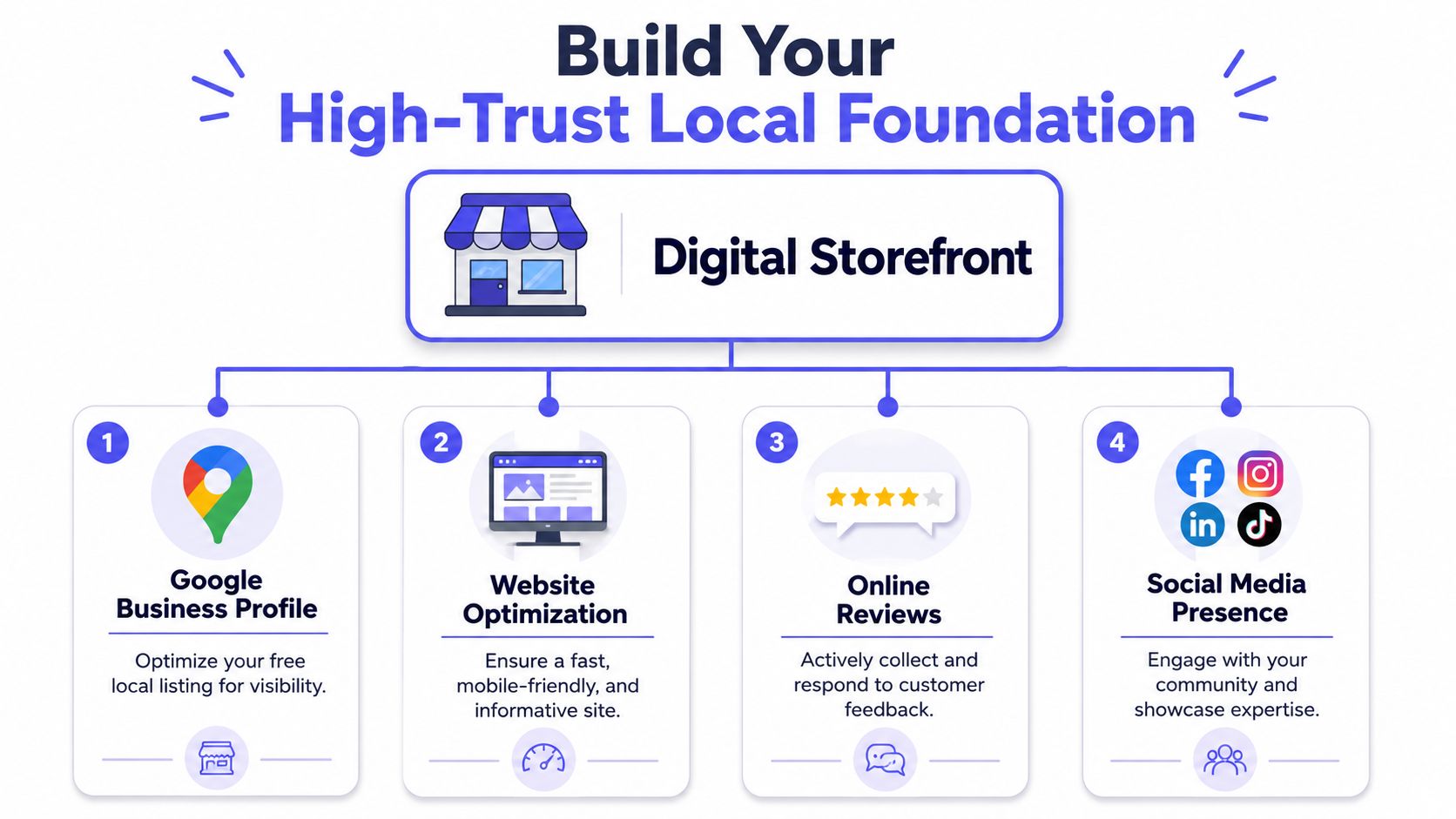
Before you spend on ads, tighten the assets that make people trust you fast. They won't give your business a long audition. They'll scan your profile, your reviews, your service pages, and your contact options, then decide.
Start with your Google Business Profile
Your Google Business Profile is often the first real impression. Treat it like a sales page, not a listing you set once and forget.
Use actual photos of your trucks, your team, jobs in progress, clean installs, and finished work. Skip generic stock images. People can tell. Write a business description in plain language that says what you do, where you work, and how fast someone can reach you.
Keep these basics tight:
- Service categories: Make sure your primary and secondary categories match your real services.
- Service areas: List the cities or areas you currently serve, not every place you hope to serve one day.
- Hours and availability: If you offer emergency help, make that visible and operationally true.
- Posts and updates: Use Google Posts for seasonal service reminders, emergency availability, and promotions.
Build service pages around real problems
Many plumbing websites don't convert well because they try to rank one generic page for everything. That usually produces broad traffic with mixed intent.
A better approach is to create separate local service pages around one high-intent problem keyword each. Gushwork's plumbing lead generation workflow recommends exactly that, and notes that plumbing websites are often cited at only 2% to 5% conversion, so small gains in intent matching can materially improve booked jobs.
That means pages like:
- Emergency drain cleaning in your city
- Water heater repair in your city
- Sewer line inspection in your city
- Leak detection in your city
Each page should answer one problem clearly. Add your service area, common symptoms, what happens next, and a direct call button. If you want to see how location-based lead matching gets framed from a consumer search standpoint, review lead generation options near you.
The closer your page matches the exact problem someone is searching, the less convincing you need to do.
Make reviews part of the job closeout
Reviews don't belong in the “nice to have” bucket. They are part of lead generation because they reduce doubt right before someone calls.
Build a simple review process into your closeout workflow:
- Ask right after a successful job: That's when goodwill is highest.
- Text the direct review link: Don't make people search for your profile.
- Tell them what helps: A sentence about the service performed and the city is useful.
- Respond to every review: Short, professional, and local.
You don't need a complicated system. You need consistency.
A high-trust local foundation doesn't feel flashy. It just makes your business easier to choose.
Master Paid Ads for Immediate High-Intent Jobs
If you need calls this week, paid ads are the fastest lever. They're also the fastest way to burn cash if the account structure is sloppy.
The goal isn't “run ads.” The goal is to buy job-ready intent without paying for junk.
Local Services Ads versus Search Ads
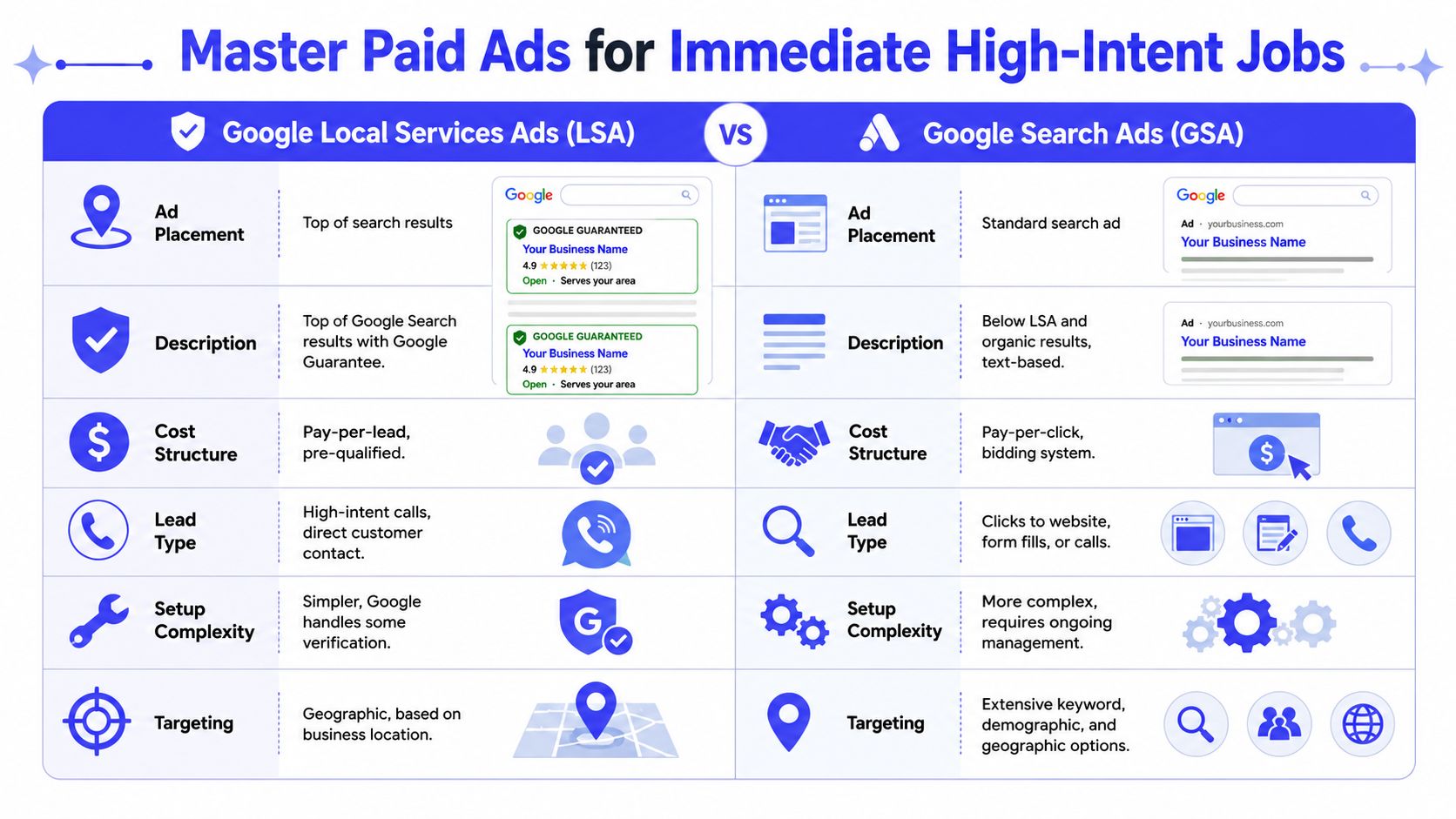
Google Local Services Ads and Google Search Ads solve different problems.
Local Services Ads are usually the cleaner starting point for many plumbing businesses because they sit at the top of results and are built around direct lead capture. They can work well for urgent service categories where people want a provider fast and don't want to browse five websites first.
Google Search Ads give you more control. You choose keywords, ad copy, landing pages, schedules, and negatives. That control matters if you want to separate emergency service from installation work, or if you want different pages for drain cleaning versus water heaters.
Here's the practical difference:
| Channel | Best use case | Strength | Risk |
|---|---|---|---|
| Local Services Ads | Immediate inbound calls from high-intent searches | Faster path to visible local demand | Less control over search query nuance |
| Google Search Ads | Tight targeting by service, keyword, and landing page | More control over intent and message | Easy to waste spend without active management |
What to expect from budgets and lead costs
Lead costs in plumbing vary sharply by source, and that's exactly why channel discipline matters. According to Built Right Digital's plumbing lead cost guide, plumbers may pay $15–$40 for a cheap shared lead, $40–$120 for PPC leads, and $100–$250+ for high-ticket emergency leads. The same guide says many businesses spend $1,500–$5,000 per month on marketing, while more aggressive growth can require $10,000+ monthly. It also notes that cost per booked job often lands around $50–$350+ depending on channel and conversion performance.
That range tells you two things.
First, a lower lead price doesn't automatically mean better economics. Shared leads can look cheap and still produce poor booked-job costs if your close rate is weak. Second, expensive emergency leads can still work if your team answers fast, books efficiently, and closes at a healthy rate.
Don't judge ad channels by cost per lead alone. Judge them by cost per booked job and job quality.
The negative keyword habit that saves money
New plumbing ad accounts often waste money on searches that were never going to become jobs. That problem is usually self-inflicted.
Review your search terms report every week and add negatives aggressively. The same Gushwork guide on plumbing paid search recommends filtering out terms like “DIY,” “parts,” “Home Depot,” “how to,” and “salary.”
Those aren't edge cases. They're budget leaks.
A strong Google Search setup usually includes:
- Tight keyword grouping: Separate emergency intent from research intent.
- Service-specific landing pages: Send “water heater repair” traffic to a water heater repair page, not your homepage.
- Call-focused ad schedules: Run harder when someone can answer.
- Weekly search term cleanup: If you skip this, Google will spend your money on curiosity traffic.
Paid ads work best when your office can respond immediately and your campaign only targets the jobs you want.
Develop Long-Term Referral and Partnership Funnels
The best plumbing lead often doesn't come from a click. It comes from someone trusted saying, “Call this company.”
That kind of lead usually closes easier because the trust transfer already happened.

The partners worth pursuing first
Start with businesses and professionals who already see plumbing problems before you do.
Property managers need fast response and dependable scheduling. Realtors need issues fixed before listings go live or before closings get delayed. Insurance agents and restoration companies run into water damage situations where a reliable plumbing partner matters. Remodelers and tile contractors often need a plumbing referral they can trust not to make them look bad.
These aren't “networking contacts.” They're potential distribution channels for exclusive work.
A good shortlist includes:
- Property managers: Ongoing service needs and repeat volume
- Realtors: Inspection items, seller repairs, buyer move-in fixes
- Insurance and restoration contacts: Water-related emergencies with urgency
- Remodelers and bathroom specialists: Higher-trust referrals for planned work
If you work around bathroom renovation projects, a practical asset to share with partners and clients is this bathroom remodel checklist. It helps frame plumbing as part of a broader project workflow, not just a one-off trade call.
A simple outreach script that works
Most referral outreach fails because it's vague. “Let's send each other business” isn't a plan.
Say something more specific:
We handle plumbing service calls in [service area], especially urgent repairs and scheduling-sensitive work. If you ever need a plumber who answers quickly, shows up professionally, and keeps your client informed, I'd be glad to be a backup or preferred option. If it makes sense, I can also send work your way when our customers need your service.
Short. Clear. Easy to evaluate.
The goal of the first conversation is not to close a grand partnership. It's to establish fit. Ask what kinds of jobs create headaches for them, what response time they expect, and how they prefer updates.
How to keep referrals coming consistently
A referral source won't keep sending work just because you had one good meeting.
You keep the pipeline alive by being easy to work with:
- Respond fast: Partners remember missed calls.
- Protect their reputation: Show up clean, communicate clearly, don't oversell.
- Send updates: A quick text after scheduling or completion goes a long way.
- Close the loop: Thank them when they refer. Tell them how it turned out.
This channel takes longer to build than ads. It also tends to produce better-fit work and less price shopping.
Turn Website Clicks into Customers
Your website is not a brochure. It's a conversion tool.
If someone lands on your site from search or ads, they should know within seconds what you do, where you work, and how to contact you. Anything that delays that decision is friction.
Your homepage has one job
The most effective plumbing sites feel simple because they are simple. The phone number is easy to find. The request service button is obvious. The service area is visible. Trust signals are above the fold.
That matters in a market this large. The U.S. plumbing market is projected to be $130 billion in 2025, and FieldEdge's guide points out that strong marketers track not just lead volume, but lead-to-customer conversion rate. That's the right lens. More traffic means little if your site leaks conversions.
Put these elements on the homepage:
- A prominent phone number: Click-to-call on mobile
- Clear request buttons: “Request Service” works better than vague labels
- Real photos: Your team, trucks, uniforms, and jobs
- Trust details: License information, insurance, service area, review highlights
- Specific service paths: Emergency repair, drain cleaning, water heaters, leak detection
If a visitor has to hunt for your phone number, your site is doing design work instead of sales work.
What to remove from your forms and CTAs
A lot of plumbing sites ask for too much too early. Long forms feel like work, especially for urgent problems.
Keep the form short. Name, contact info, service type, and a brief problem description are usually enough to start the conversation. If you use online scheduling, make sure it's simple and tied to real availability so it reduces friction instead of creating confusion.
Also remove generic copy that says a lot and proves nothing. Replace “quality service you can trust” with specifics. Say who shows up, what areas you serve, and what someone should expect after they submit.
Website conversion is where a lot of plumber lead generation wins get lost. Not because traffic is bad, but because the page doesn't make action easy.
Qualify and Manage Every Lead for Maximum Profit
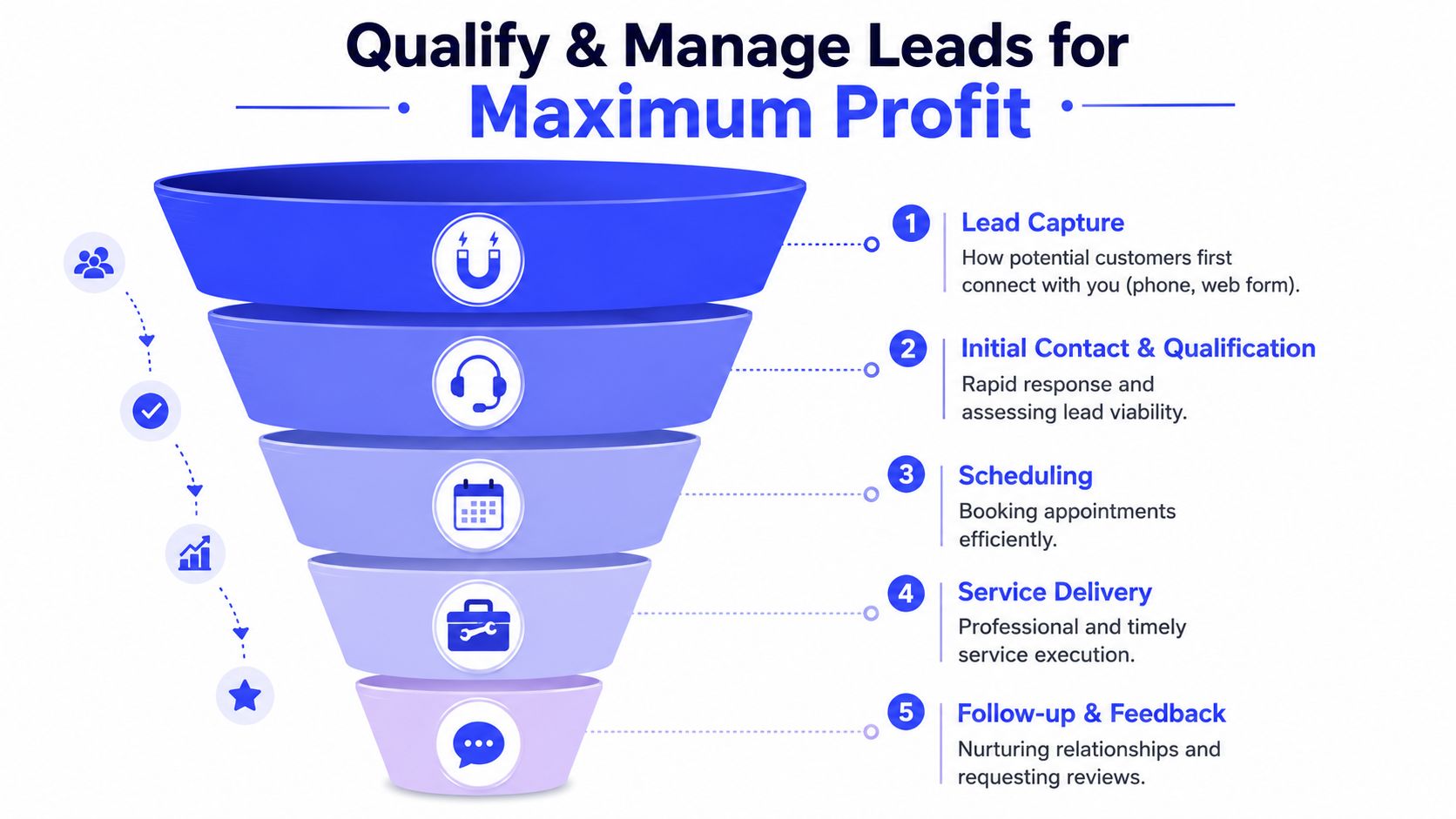
Once a lead comes in, speed matters. So does process. A good lead mishandled is still lost revenue.
At this point, most of the margin gets won or lost.
The math behind response speed and exclusivity
For pay-per-call plumbing leads, the economics are unforgiving if your follow-up is weak. ResultCalls' pay-per-call plumbing guide models a funnel where a $100 lead cost turns into 40% booked appointments, 60% of appointments close, and 24% of leads become $800 jobs. That works out to $192 revenue per $100 spent before overhead. The same source says buyers should verify that leads are 100% exclusive and track call answer rate, booking percentage, show rate, job close rate, and average job value.
That model explains why shared leads are so hard to make profitable.
If the lead is shared, response-time pressure goes up and close rates usually get worse. Your office has to answer instantly, book tightly, and compete against others who may lead with a lower price. With exclusive leads, you remove much of that chaos and give your team a better chance to run a real sales process.
A fast qualification script for incoming calls
Your CSRs don't need a complicated script. They need one that filters fit fast without sounding robotic.
Use something like this:
What's going on today?
Listen for urgency and service type.What's the property address or ZIP code?
Confirm it's in your service area.Is this repair, replacement, or an active emergency?
Route correctly.When did the issue start?
Helps prioritize and frame urgency.Are you the owner or decision-maker for the property?
Important for scheduling and approvals.What's the best number for updates?
Confirm contact details before the call ends.
That's enough to decide whether to dispatch, schedule, quote later, or politely decline.
A lead management system should make it easier to say no to bad-fit jobs, not just faster to say yes to every inquiry.
If you want a benchmark for the kind of screening serious service businesses should care about, review a contractor background check standard. The same principle applies on the marketing side. Better filtering usually beats more noise.
What to track every week
You don't need a giant dashboard. You need a few numbers your team reviews.
Track:
- Answer rate: How many calls get picked up
- Booking percentage: How many qualified leads become appointments
- Show rate: How many booked appointments happen
- Job close rate: How many appointments turn into work
- Average job value: Whether the channel brings the right kind of jobs
Those numbers tell you whether the problem is marketing, office handling, dispatch, or sales. Without them, most businesses blame the lead source for issues that are happening inside the funnel.
Frequently Asked Questions
What do plumbing owners usually ask once they stop chasing cheap leads and start focusing on booked, profitable work?
| Question | Answer |
|---|---|
| How long does plumber lead generation take to work? | The timeline depends on the channel and how well your team handles incoming demand. Paid ads can start producing calls fast if targeting is tight and the phone gets answered. SEO, reviews, and referral partnerships take longer to build, but they often create a steadier flow of exclusive, higher-trust jobs. |
| Should I do this in-house or hire help? | Handle it in-house if someone on your team can own the work consistently. That means reviewing search terms, following up fast, requesting reviews, updating service pages, and watching results every week. Hire help if those jobs keep getting pushed aside. Set expectations around booked jobs, lead quality, and profit per booked call. |
| What's the one thing I should fix this week? | Review every lead source and split them into two buckets: exclusive and shared. Then check last week's calls and form leads to see what actually turned into booked work. In a lot of plumbing shops, the fastest gain comes from cutting weak sources and tightening response time. |
| Are shared marketplace leads ever worth buying? | They can work in a narrow set of cases. You need fast phone coverage, a clear script, strong close rates, and enough margin to survive price shopping. If every lead turns into a race to the bottom, the volume looks busy but the jobs are less profitable. |
| What makes a plumbing website convert better? | A good plumbing site makes it easy for a homeowner to call, book, or request help from a phone. Use clear service pages, visible contact options, trust signals, short forms, and location coverage that matches your real service area. For emergency intent, speed and clarity matter more than clever design. |
| What should I measure first? | Start with answer rate, lead-to-booking rate, cost per booked job, and average job value by channel. Those metrics show whether you are buying profitable demand or paying for noise. They also make it easier to spot whether the issue sits in marketing, office follow-up, or sales. |
A profitable lead system is usually simpler than owners expect. Buy intent where you can get exclusivity. Build trust where homeowners check before they call. Track results tightly enough to know which channels produce strong jobs instead of cheap distractions.
If you want an alternative to recycled marketplace leads, Hand Vetted Co. is built around a simpler model: one match, one verified professional, no shared lead pile-on. You can also review How It Works, Our Standards, and the FAQ if you want to see how exclusive matching is handled.