You're staring at a project that's too big to wing. Maybe it's a kitchen gut, a basement finish, a major repair, or a renovation that keeps spawning new decisions every time you think you've got it figured out. That's where a general contractor earns their keep, not by swinging a hammer on every task, but by taking control of the moving parts so the job doesn't drift into delays, surprise costs, and avoidable mistakes.
Table of Contents
- Your Project Is Big but Your Plan Is Vague
- The General Contractor as Your Project's Central Hub
- A Breakdown of Core GC Responsibilities
- Understanding the Financial Role of a Contractor
- When You Need a GC and When You Don't
- What a General Contractor Cannot Do
- How to Find and Vet a Qualified General Contractor
Your Project Is Big but Your Plan Is Vague
A big project gets messy fast when you only have a goal and no operating plan. You know what you want the finished space to look like, but permits, trade sequencing, inspections, material lead times, and budget pressure all start crowding in at once.
That's the point where people usually make one of two mistakes. They either try to coordinate everything themselves and get buried, or they hire the first person who sounds confident and hope the rest works out.
A general contractor is the person who turns that vague plan into a managed job. They don't just “run the site.” They organize the people, the sequence, the paperwork, and the risk so the project can move from demo to final walkthrough without constant chaos. For a practical planning tool before you commit, use this home renovation project planner to map your scope and budget first.
Practical rule: If your project needs multiple trades, inspections, or a real schedule, you need someone thinking three steps ahead, not just someone available next week.
The General Contractor as Your Project's Central Hub
A good general contractor sits at the center of the job. They are the one person coordinating subcontractors, suppliers, inspectors, and every schedule decision that affects the work. According to Construction Coverage's overview of general contractors, industry coverage describes this role as coordinating vendors, trades, schedules, permits, and budget control from start to finish. This represents the core value of the role, because it puts one person in charge of the moving parts and the risk that comes with them.
A house build or major renovation does not work if each trade shows up whenever it wants. Electricians need current plans. Plumbers need the work in front of them ready. Finishes need the earlier work done right, or the next crew ends up fixing avoidable mistakes. The GC keeps that order intact.
Why that hub matters
The value is accountability. One person owns the timeline, the budget, and the handoffs, so problems have a clear owner instead of becoming a blame game between trades.
A project without a central hub turns into a pile of small misunderstandings, and those almost always cost money later.
This is also why the GC usually becomes the main client contact for the job. They hire and supervise subcontractors, obtain permits and licenses, and make sure site safety rules are followed. That matches the contractor's role as the single point of responsibility between the owner and the crews doing the work, as described in Construction Coverage's overview of general contractors and supported by Indeed's general contractor job description.
A good GC is not just keeping the crew busy. They are protecting the project from delays, bad sequencing, and expensive rework, which is how the job stays on schedule and inside budget.
A Breakdown of Core GC Responsibilities
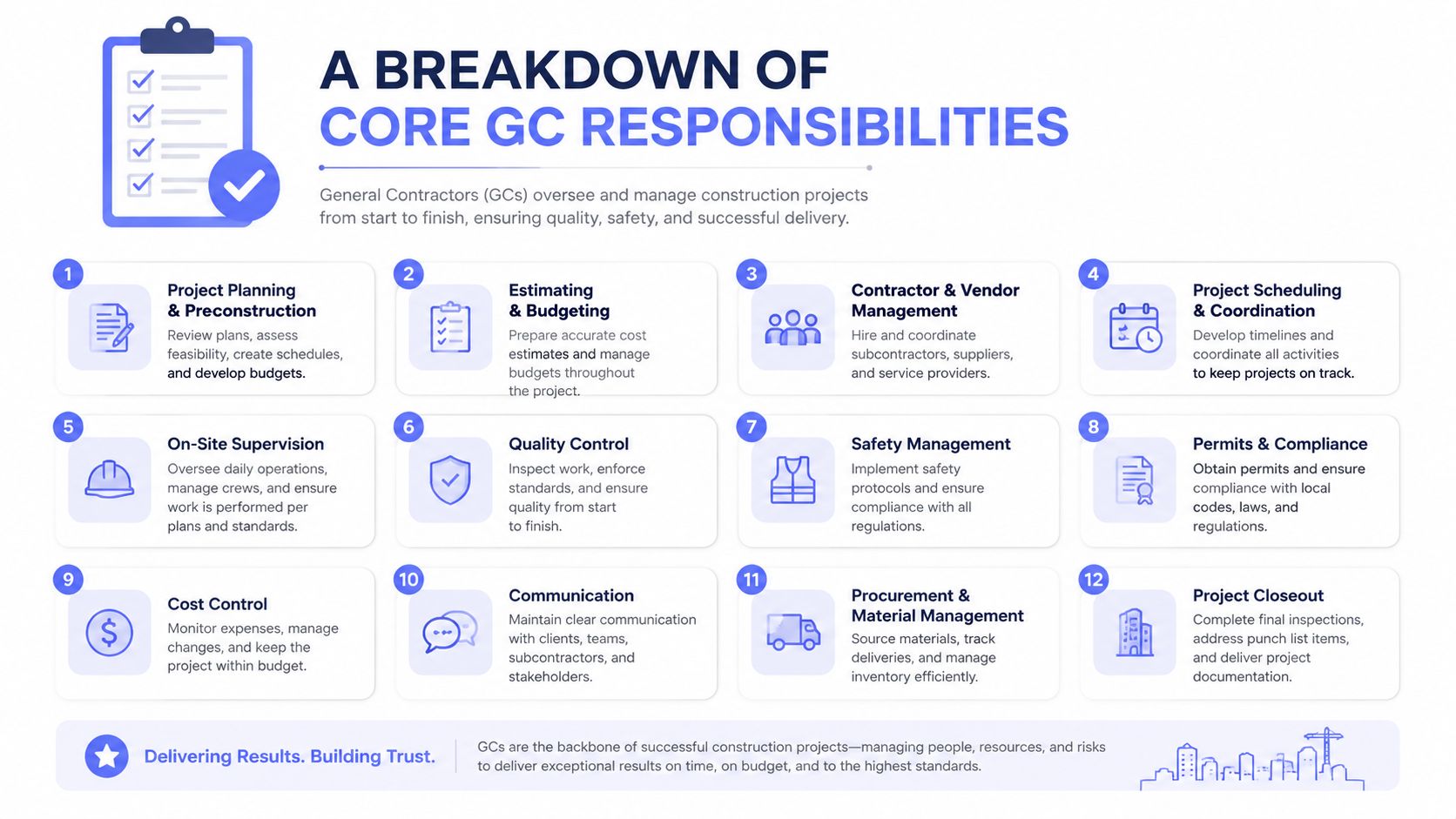
The best way to judge a GC is to look at what they do all day. The job is a mix of admin, logistics, quality control, and field oversight, and that's why it's more management than manual labor. Industry guidance says GCs coordinate schedules, manage budgets, secure permits, ensure code compliance, and hire and supervise subcontractors like electricians and plumbers, according to Safety Management Group's overview.
The work you should expect them to own
A solid GC is usually handling a few jobs at once. They're lining up subcontractors, checking whether materials are on site, watching the sequence of work, and making sure one delay doesn't snowball into three more.
They also keep an eye on quality. That means comparing the finished work against plans and specifications, catching problems early, and pushing back when something isn't being done to standard. On a busy site, that early correction matters more than you might think because it prevents bad work from getting buried behind drywall, tile, paint, or finishes.
The work they should not be doing alone
A GC manages the labor, but they usually don't perform all the labor personally. They hire the specialists for electrical, plumbing, roofing, painting, carpentry, framing, and similar trade work, then coordinate those pieces into one coherent build. That separation is the whole point of the role.
Useful test: If a task requires a license, a specialty trade, or inspection coordination, the GC should be directing it, not pretending to be the only person on site.
A strong contractor also reads the job like a risk manager. They watch for code issues, sequencing problems, and work that could cause delays later. That's the part often missed when asking what a general contractor can do, because the core answer is often “prevent the expensive mess before it starts.”
Understanding the Financial Role of a Contractor
A GC fee is where people tend to get emotional. It should not be mysterious. You are paying for coordination, oversight, and someone who takes responsibility when a project needs adult supervision.
A contractor's price reflects more than site labor. It reflects schedule control, liability, and the pressure of keeping a messy job from turning into an expensive one. That role carries real financial weight because the contractor is the person holding the job together when trades, materials, and inspections all have to line up.
What the fee is really buying
A GC fee usually covers the work that keeps a project from going sideways. That includes coordinating subcontractors, keeping communication clean, tracking costs, supervising the order of work, and making sure trades do not collide with each other. It also covers the problem-solving that comes with late materials, missed details, and inspection corrections.
A cheap quote can cost more in the end. If a contractor is underpricing the management side, they are cutting corners somewhere else or betting that you will not notice until the project is already stuck.
For people weighing payment options and cash flow, this home improvement financing guide is a practical place to start before you lock in a scope.
How to think about value
Do not treat the GC fee as overhead you reluctantly swallow. Treat it as part of your risk budget. A competent GC keeps small mistakes from becoming bigger ones, avoids sloppy handoffs, and helps protect both your timeline and your final cost.
That is the practical value. A contractor who manages the job well saves you from rework, delays, and the kind of coordination mistakes that eat budget fast. If you have ever watched a renovation stall because trades were stacked in the wrong order, you already know why that fee matters.
When You Need a GC and When You Don't
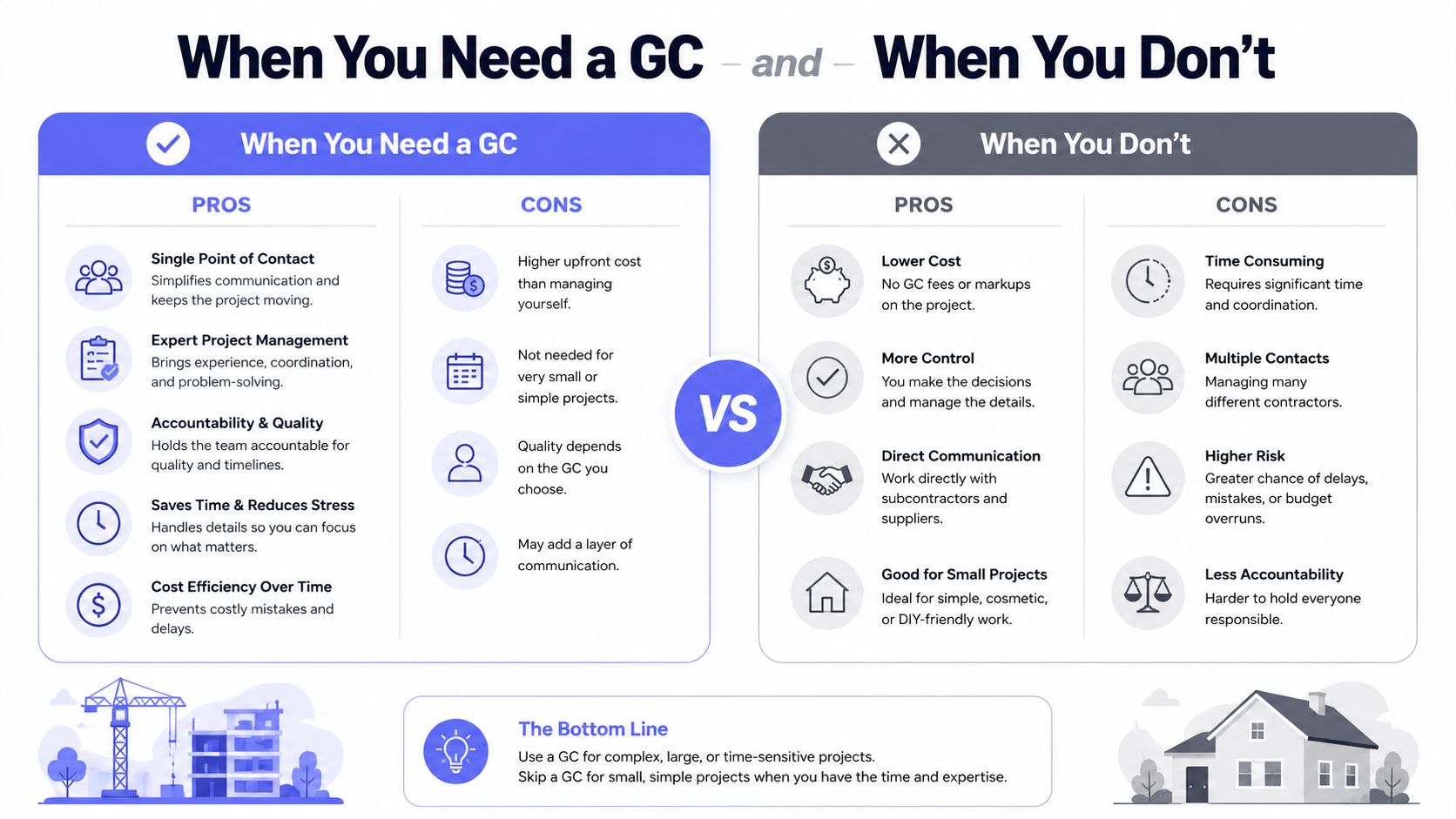
Not every job needs a general contractor. If you're swapping a faucet, repainting a room, or handling a very narrow repair, you can often work directly with the trade that does that one thing well. That's simple work with limited moving parts.
The tipping point is complexity. Once a project brings together multiple trades, permits, inspections, sequencing, and any meaningful chance of conflict between tasks, the GC stops being optional and starts being the person protecting the job from itself.
Hire a GC when the job is cross-functional
A kitchen remodel is a good example. You may need demolition, plumbing, electrical, cabinetry, counters, flooring, inspections, and maybe drywall and paint. If those pieces aren't sequenced correctly, one trade's delay can stall the next trade and drag the whole project.
The same logic applies to major repairs and additions. The more the work depends on exact handoffs, the more you need a coordinator who can keep the schedule real instead of theoretical.
Skip the GC when the scope stays narrow
If the job is isolated, direct hire can make sense. A single trade can usually handle a single trade problem. You don't need a full project hub for work that has no real chain reaction.
If you can describe the job in one sentence and it only involves one licensed professional, you probably don't need a full general contractor.
That's the cleanest way to think about it. Hire a GC when the project is a system. Skip the GC when it's a single task.
What a General Contractor Cannot Do
This boundary matters more than many realize. A GC can coordinate the job, but they are not a substitute for every other specialist you might need. According to Procore's definition of a general contractor, they typically do not perform architectural design, offer legal advice on contracts, finance projects, or manufacture their own materials.
That means you still need the right team around them. If the project needs design decisions, bring in the designer or architect. If the contract language is unclear or disputed, talk to a lawyer. If financing is part of the problem, that's a separate conversation too.
The boundary between management and specialty work
A lot of consumer confusion comes from assuming the GC “handles everything.” They don't. They manage the build, not the entire universe around the build.
That distinction matters because it keeps responsibility clean. A GC can interpret plans for the trades, but they shouldn't be drafting those plans from scratch. They can coordinate permits and inspections, but they aren't a replacement for licensed professionals who own specific technical decisions.
Why this protects you
If you blur these lines, you end up with missing accountability. People assume someone else handled the design issue, the permit problem, or the contract risk, then the project gets stuck in dispute territory.
A good GC knows exactly where their authority ends. That's not weakness, it's professionalism.
The smart move is to build the right team, not ask one person to do work they're not licensed or equipped to do. That's how you keep the project clean and the blame game out of it.
How to Find and Vet a Qualified General Contractor
Start with risk management, not price. You want a contractor who can explain how they control code compliance, safety, quality, and schedule pressure, because expert GCs reduce the chance of defects, budget overruns, and delays by verifying work, enforcing safety practices, and monitoring quality, according to RIB Software's general contractor guidance.

Ask better questions
Ask who will be on site, who handles change orders, and how they keep trades aligned when the schedule shifts. Ask how they deal with permit delays, material shortages, and inspection corrections. Ask how they report progress to you, because communication problems usually show up long before workmanship problems do.
Watch for the wrong kind of confidence
A contractor who promises everything fast, cheap, and easy is telling you they either don't understand the job or don't intend to absorb the true cost of doing it well. That's a bad sign.
Look for clean answers, not flashy ones. You want someone who can talk through sequencing, contingencies, and trade coordination without pretending every project is identical.
For a faster way to narrow the field, use this guide to finding a general contractor and focus on professionals who are already verified before you ever make the first call.
If you want a cleaner starting point, visit Hand Vetted Co.. It connects you with a single verified professional instead of spraying your request across a pile of businesses, which is exactly the kind of control this kind of project deserves.