The furnace quits on a freezing evening. You call the first company that answers, accept a price over the phone, and hope the replacement is finished before the house gets colder. That's how people end up with an oversized unit, undocumented venting changes, an unclosed permit, or a warranty that won't help when something goes wrong.
A furnace replacement contractor doesn't just sell you a cabinet. The contractor determines whether the equipment is sized correctly, whether combustion and venting are safe, whether ductwork can handle the change, and whether the installation passes inspection. The brand matters, but the installation matters more.
The right approach is simple. Verify the professional first, compare complete scopes instead of headline prices, and make the contractor own the permit and closeout. You can move quickly without skipping those checks.
Table of Contents
- Introduction When Your Furnace Forces a Fast Decision
- How to Vet a Furnace Replacement Contractor Before You Call
- How to Collect and Compare Quotes Without Getting Misled
- Understanding Pricing Financing and What Drives Total Cost
- Permits Timeline Contracts and Warranty Terms Explained
- Red Flags Post Installation Checklist and Next Steps
Introduction When Your Furnace Forces a Fast Decision
Your furnace fails on a freezing evening. The first available contractor offers equipment already in stock, a phone price, and a promise to finish quickly. That pressure can push you into a replacement before anyone verifies sizing, venting, permits, or the condition of the connected systems.
A furnace replacement includes fuel connections, electrical work, combustion air, exhaust venting, controls, and air distribution. The installed result depends on how those parts work together. The U.S. Department of Energy HVAC contractor guide places retrofit installations in broad installed-cost tiers, from $2,000 or less at the low end to $10,000 or more at the very high end, excluding distribution-system repairs or additions. The U.S. Department of Energy HVAC contractor guide explains how efficiency, venting, ductwork, and labor complexity affect the work.
A fast decision still needs verification. Require a written scope, confirm who handles the permit, and make inspection closeout part of the agreement. The contractor should show what happens beyond removing the old cabinet and connecting the new one.
What a qualified contractor protects you from
A qualified contractor prevents three expensive mistakes.
First, the contractor checks equipment capacity. The existing furnace may be rated by input Btu/hr while the proposal emphasizes output Btu/hr. Those figures describe different things. Comparing them as if they were interchangeable can leave you with the wrong capacity.
Second, the site visit exposes conditions a phone quote cannot. A higher-efficiency furnace may require different venting. Existing ducts may need repairs or additions. Electrical, gas, or condensate work can expand the scope and change the permit requirements.
Third, the contractor documents the installation. The proposal should identify the equipment, AFUE, capacity basis, venting work, ductwork work, permits, labor, startup testing, and warranty registration.
Practical rule: If the contractor cannot explain what changes beyond the furnace cabinet, the quote is incomplete.
Speed matters, but rushing doesn't
Breakdown replacements often leave little time for research. An ACEEE paper citing a contractor survey found that 86% of breakdown replacements were needed in four days or less, compared with 14% of planned replacements. The cited ACEEE market context and HVAC data sources explains why emergency work increases the risk of skipped sizing checks, undocumented venting changes, and hidden defects.
If your furnace still runs but shows warning signs, schedule an assessment before it quits. Gather past utility bills and ask contractors to explain the replacement path. If the furnace has stopped, use a short verification checklist before signing, then require permit responsibility and inspection closeout in writing.
This guide centers on that decision. It covers contractor screening, quote comparison, cost drivers, permits, and the finished-work checks that determine whether the project is complete.
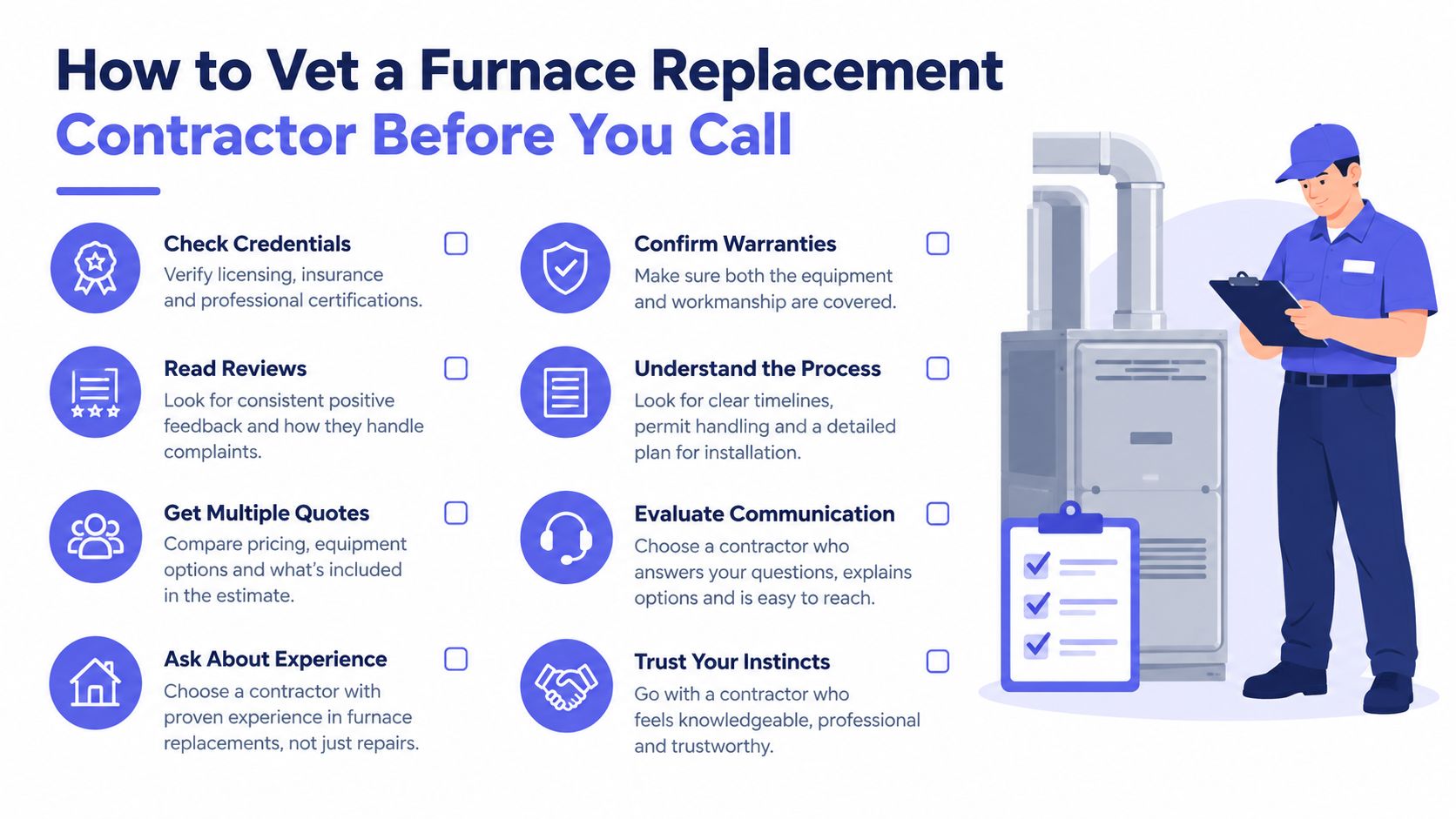
How to Vet a Furnace Replacement Contractor Before You Call
Start with qualification, not price. A low estimate from an unverified company isn't a bargain. It's an invitation to own the risk yourself.
You can run a useful pre-screen in about fifteen minutes. Build a short list of one to three professionals who can prove the basics before they visit your home.
Verify the business before discussing equipment
Ask each company for its legal business name, active state license information, proof of insurance, and the name of the person who will assess the job. Don't accept “we're licensed” as proof. Verify the license through your state's contractor or licensing database, and ask whether the license covers HVAC or mechanical work in your jurisdiction.
Insurance matters because furnace work combines gas, electricity, combustion, and property access. Ask whether the company carries general liability coverage and workers' compensation coverage. If the representative avoids the question, remove the company from your list.
Review recent customer feedback with a critical eye. Look for consistent recent reviews that mention communication, clean work, accurate pricing, permit handling, and post-installation support. A high rating with little recent volume tells you less than a strong pattern of detailed feedback.
Use a human review signal
Automated checks are useful, but they can't replace judgment. Ask what happens if the job reveals unsafe venting, damaged ductwork, or a capacity problem. A serious company will explain how it documents changes and gets approval before adding work.
Background screening should cover the owners or operators who control the business, not just a technician's name on a truck. For a practical explanation of what to verify, use Handvetted's contractor background check standards.
A shared lead marketplace can create another problem. Your contact details may go to several businesses at once, producing competing calls rather than careful evaluation. An exclusive match gives one professional responsibility for understanding your request, but you should still verify the license, insurance, reviews, and scope yourself.
Ask these questions before scheduling
Use direct questions:
- Who pulls the permit? The contractor should explain the local process, not leave you guessing.
- What will you inspect? Expect answers covering capacity, AFUE, venting, gas connections, electrical supply, ductwork, and controls.
- What proof can you send? Request license details, insurance confirmation, and a written assessment process.
- Who performs the installation? Find out whether the company uses its own crew or subcontractors.
- What happens if the inspection fails? The contract should assign responsibility for corrections.
Don't invite five unqualified companies into your home. Filter first, then schedule in-home assessments with the strongest candidates.
How to Collect and Compare Quotes Without Getting Misled
A quote is only comparable when the scope is comparable. Three prices for three different installations don't give you a useful choice.
Ask each furnace replacement contractor to inspect the home in person and produce a written proposal. A contractor who chooses equipment from a brief phone description hasn't gathered enough information to make a responsible recommendation.
Make capacity and efficiency transparent
Start with the furnace's capacity. Ask whether the proposal reports input or output Btu/hr, and ask the contractor to state the distinction in writing. Record the installed unit's AFUE as well. Efficiency affects the useful heat delivered from the fuel consumed, but the rating alone doesn't tell you whether the unit suits the home.
The evaluation protocol used in one residential HVAC program recommends documenting housing type and the exact city, ZIP code, and state so heating-degree-day normalization can support savings comparisons. It also recommends collecting at least 12 months of post-installation billing data, and, where possible, a full 12 months of pre-installation bills for a stronger before-and-after analysis. The Ameren residential HVAC evaluation report explains why weather, location, baseline efficiency, and documentation affect the credibility of savings estimates.
Don't let a contractor promise savings from a new furnace without discussing the baseline. Utility bills also reflect weather, occupancy, thermostat settings, and other equipment. A careful professional will describe the estimate as an analysis, not a guarantee.
Require line items instead of a single total
A complete proposal should show the equipment model, capacity basis, AFUE, labor, removal, startup, permits, inspection support, venting, ductwork, electrical changes, gas work, thermostat, disposal, and warranty registration. If an item isn't needed, the contractor should mark it as excluded or not applicable.
Use this checklist to normalize each bid:
| Item | What to Compare | Why It Matters |
|---|---|---|
| Capacity | Input versus output Btu/hr, plus the sizing basis | Prevents false comparisons between different rating methods |
| AFUE | Exact efficiency rating and equipment model | Confirms what efficiency level you're actually buying |
| Venting | Material, routing, chimney changes, and labor | High-efficiency equipment may require different venting |
| Ductwork | Repairs, additions, sealing, or testing | Existing distribution problems can limit delivered performance |
| Gas and electrical | Connections, controls, breakers, and code corrections | These items can change the installation scope |
| Permit and inspection | Who applies, pays, schedules, and closes the permit | Assigns responsibility for legal completion |
| Warranty | Equipment coverage, labor terms, registration, and exclusions | Prevents confusion after installation |
You can use Handvetted's questions to ask a contractor to prepare for the in-home assessment. Ask every bidder the same questions, then compare the written answers rather than relying on sales presentation.
Treat vague bids as incomplete bids
A proposal that says “install new furnace, standard materials” leaves too much unresolved. It doesn't tell you whether the contractor checked the venting, whether duct repairs are excluded, or whether permit work is included.
The cheapest complete bid may be the best value. The cheapest incomplete bid is the least informative number on the page.
Understanding Pricing Financing and What Drives Total Cost
The furnace cabinet is only one part of the bill. Two units with similar capacity can have very different installed totals because the surrounding work, access, and verification requirements differ. Price shopping without checking that scope creates false savings.
A DOE retrofit framework places installed HVAC work into broad tiers: low at $2,000 or less, medium from $2,000 to $4,500, high from $4,500 to $10,000, and very high at $10,000 or more, excluding distribution-system repairs or additions. The DOE HVAC guide makes the practical point clearly: installation complexity drives cost.
Recent cost guidance places installed gas furnace replacement at roughly $3,800 to $12,000, with many mid-efficiency installations falling between $4,500 and $7,500. Permit fees in that guide commonly add $50 to $400, depending on the municipality. The HVAC Jobs furnace replacement cost guide provides these consumer cost ranges.
The main cost drivers
Efficiency changes the equipment and installation requirements. A higher-AFUE furnace may require different venting, condensate management, controls, or electrical work. Ask whether the price difference covers equipment only or also includes added labor and materials.
Venting can turn a routine swap into a complex retrofit. The contractor may need to modify a chimney connection, change vent materials, or correct an existing safety issue. Require those items as line-item costs before approving the job. Removal is the wrong time to discover a major extra charge.
Ductwork affects the final result. The published cost tiers exclude distribution-system repairs and additions. A quote that excludes ductwork can look inexpensive while leaving you with another bill, and it may not deliver the expected heat through the house.
Labor complexity changes the total. Tight mechanical rooms, difficult access, code corrections, gas-line changes, and condensate routing all affect labor hours and materials. Permit coordination and inspection-related corrections can also change the final scope, so confirm who carries that responsibility in the contract.
A large heating and air-conditioning contractor market gives homeowners choices, but proposals can still vary sharply in what they include. Compare the written scope, not the monthly payment or the lowest headline price.
Finance the project without losing control
Financing can make a necessary replacement manageable, but the monthly payment is only one part of the decision. Ask for the interest rate, fees, term, deferred-interest conditions, early-payment terms, and cash price. Compare each offer against the full installed scope, including permit work and listed corrections.
Review home improvement financing options from Handvetted before accepting a contractor's financing offer. Keep the financing agreement, proposal, and change orders together so the repayment terms remain tied to the work you authorized.
Ask about the future system plan
A furnace replacement may stand alone or form part of a larger heating and cooling plan. HVAC industry coverage for the 2026 projection discusses R-410A phaseout pressures, A2L refrigerants such as R-32 and R-454B, and growing questions about heat pumps and equipment obsolescence. The 2026 HVAC predictions coverage explains why refrigerant changes can affect replacement discussions.
Do not replace a working air conditioner solely because refrigerants are changing. Ask whether the new furnace will work with your existing cooling system, whether a heat pump is under consideration, and whether one choice could affect future incentives or equipment compatibility. Your contractor should answer those questions before installation, not after the equipment is delivered.
Permits Timeline Contracts and Warranty Terms Explained
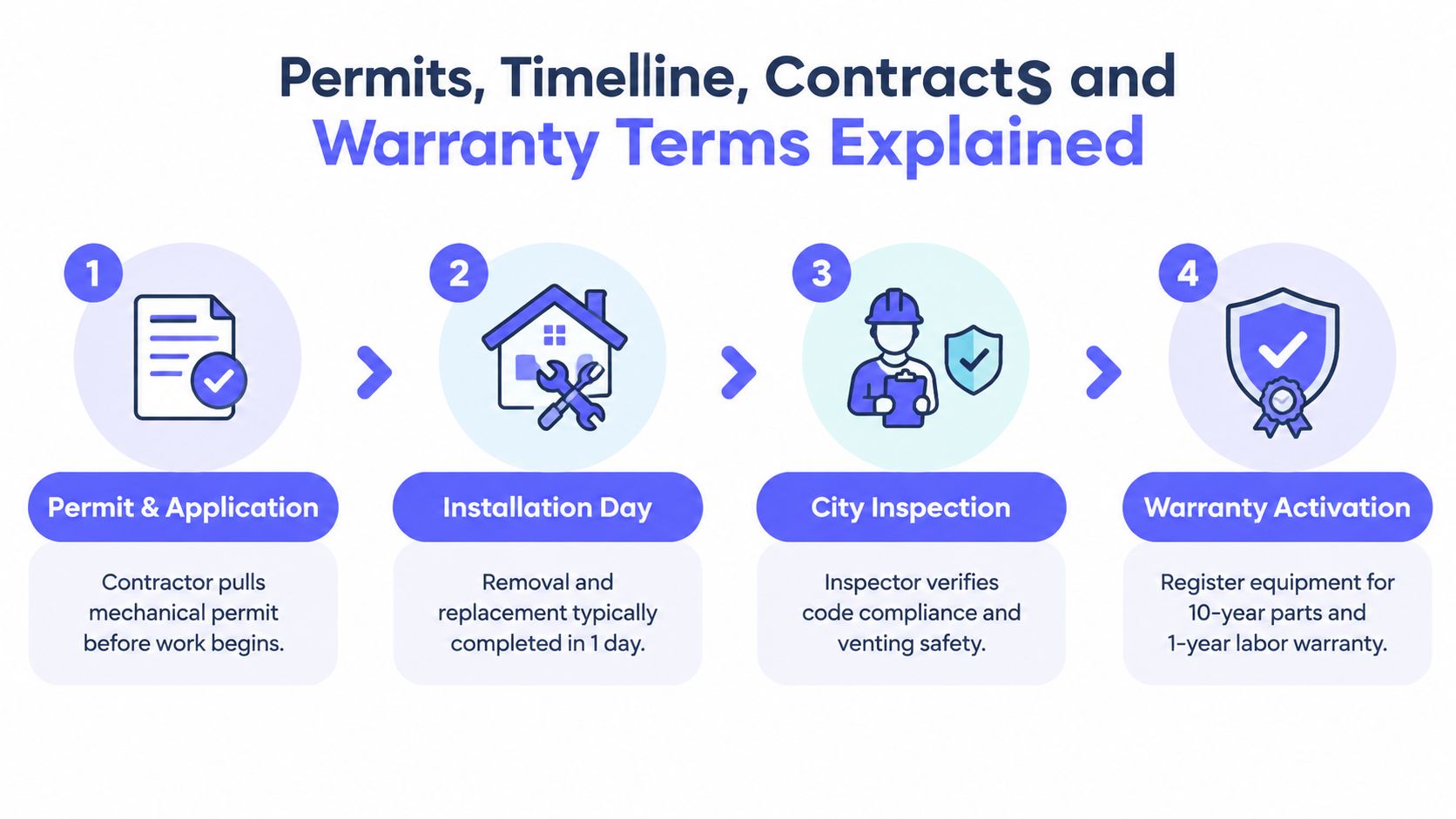
Permits are not a side note. Furnace replacement commonly involves gas piping, venting, combustion air, electrical connections, and mechanical-code requirements. In many jurisdictions, the contractor must pull the permit, schedule the inspection, and close the permit after approval.
The basic sequence is straightforward:
- Permit application: The contractor submits the mechanical or building information.
- Approval before work begins: The jurisdiction authorizes the installation.
- Licensed installation: The approved scope is installed by a qualified professional.
- Inspection: An inspector checks code compliance, combustion, venting, and connections.
- Final approval: The permit is closed after corrections, if any, are completed.
A municipal furnace and boiler guide describes this same ownership chain, from application and approval through licensed installation, inspection, and final approval. The municipal permit workflow is a useful standard for deciding what your contractor should handle.
Local rules can change the process
Seattle requires a permit for furnace replacement or alteration. The city distinguishes between a furnace or mechanical permit and a refrigeration permit for split-system heat pumps or work requiring refrigeration piping. Seattle also requires cover inspections before parts of the system are concealed and a final inspection after completion. Seattle's furnace permit infographic shows why the permit type should match the actual scope.
California furnace replacement generally requires a mechanical permit because the work can involve gas piping, venting, combustion air, and electrical connections. A C-20 HVAC contractor generally pulls the permit, and the process may include gas-pressure testing, rough inspections, final inspections, and HERS duct-test registration where required. The California furnace replacement permit guidance outlines those requirements.
Don't assume a permit is unnecessary because the contractor calls the job a “swap.” Ask the local building department or require the contractor to provide the permit number and inspection process in writing.
Put ownership in the contract
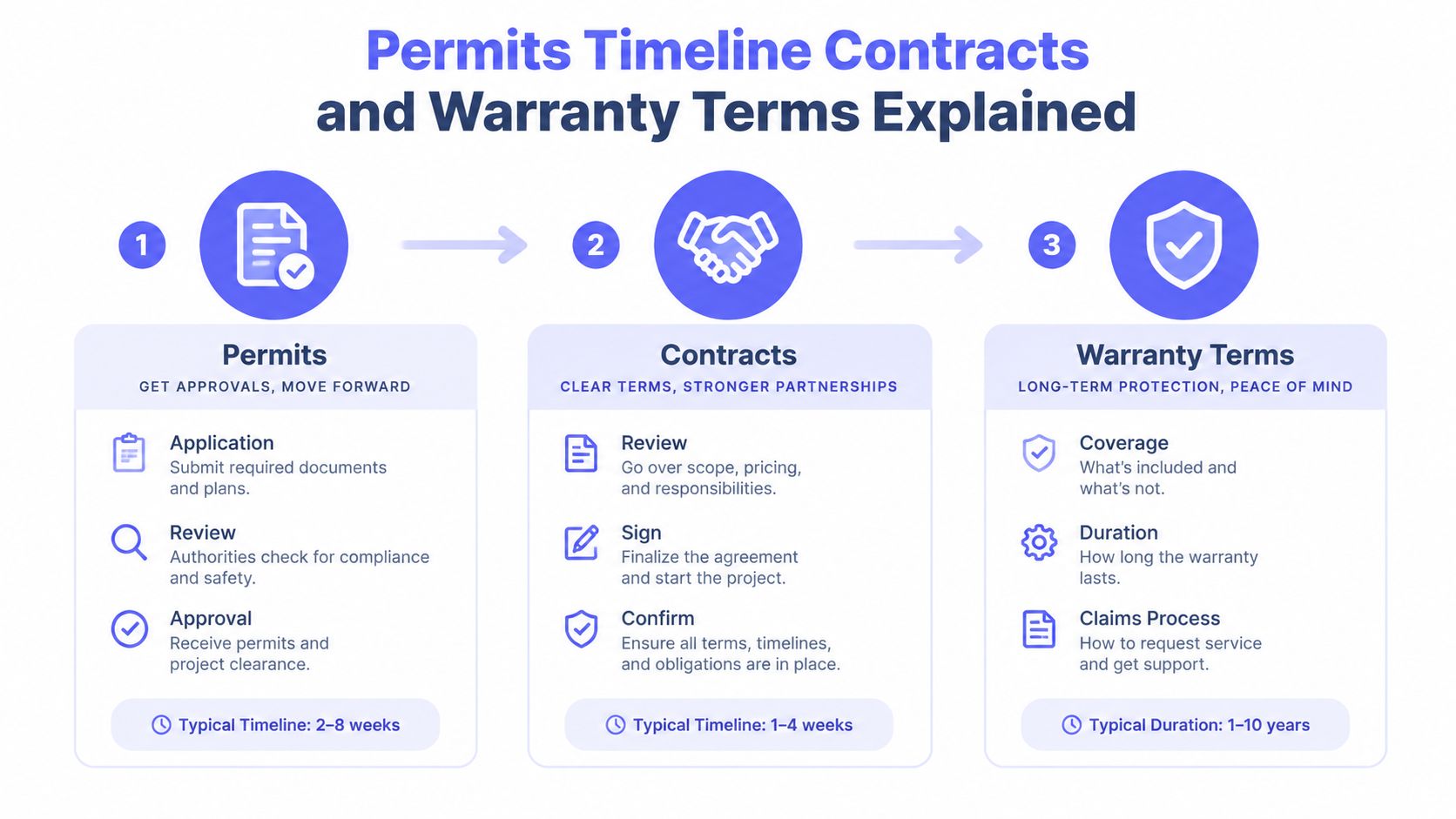
The contract should identify the exact equipment model, capacity basis, AFUE, included materials, venting, ductwork, gas and electrical work, permits, inspections, startup, disposal, payment schedule, and change-order process.
Require the contractor to state who pays for corrections if the installation fails inspection because of workmanship or an incomplete scope. Also ask who registers the equipment warranty and when you'll receive the registration confirmation.
Warranty language needs precision. Separate manufacturer parts coverage from contractor labor coverage, and identify exclusions, maintenance requirements, transfer rules, and response procedures. Never accept “full warranty” as a sufficient description.
Red Flags Post Installation Checklist and Next Steps
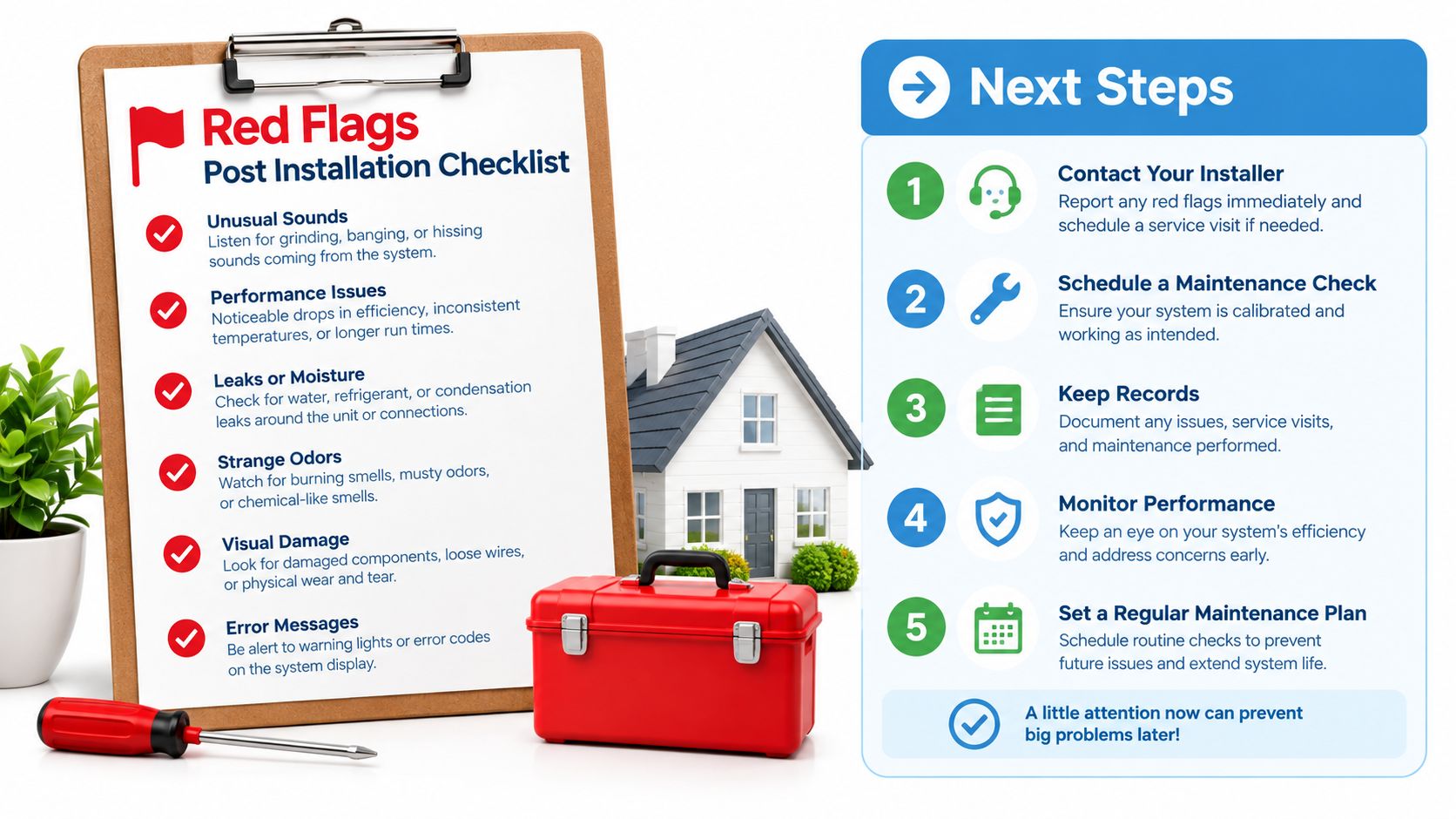
A furnace replacement contractor should make the job easier to verify, not harder. Walk away or pause the project if the company won't prove its license, refuses to pull a required permit, gives you a vague scope, pressures you to decide immediately, or won't state the AFUE and venting plan.
Other warning signs include a price that changes without a written change order, a recommendation based only on the old furnace's label, and a promise of savings without asking for location, baseline efficiency, or billing history. A professional can work quickly, but shouldn't treat documentation as an inconvenience.
Green flags that deserve your attention
A strong contractor:
- Explains the sizing basis: They distinguish input from output Btu/hr and explain why the proposed capacity fits the home.
- Documents the existing system: They record AFUE, housing type, location, venting, ductwork, controls, and visible safety concerns.
- Owns the permit process: They identify the permit type, pull it when required, schedule inspections, and provide closure documentation.
- Writes a complete scope: The proposal separates equipment, labor, venting, ductwork, electrical, gas work, disposal, and startup.
- Tests before leaving: They verify combustion, venting, gas connections, thermostat operation, airflow, and safety controls.
Use this post-installation checklist
Before making the final payment, ask for the following:
- Combustion and venting: Confirm that the contractor tested combustion and verified safe exhaust routing. Ask whether any chimney or vent modification was inspected.
- Gas and electrical connections: Confirm that connections are complete, accessible, and included in the approved scope.
- Thermostat and controls: Run the system through heating cycles and confirm that the thermostat communicates correctly.
- Documentation: Collect the equipment model, serial number, AFUE, installation date, maintenance requirements, warranty information, and permit records.
- Inspection closure: Obtain the final inspection result or permit-closure confirmation. Don't assume the contractor completed it because the furnace is running.
- Worksite condition: Check that debris is removed, access panels are secure, filters are installed, and the mechanical area is left safe and accessible.
The best replacement decision isn't the fastest quote or the most recognizable equipment badge. It's a documented installation by a licensed professional who can explain capacity, efficiency, venting, permits, warranty terms, and final testing without dodging questions.
Hand Vetted Co. connects you with one licensed, background-checked, 4.5+ star rated HVAC professional for heating, cooling, or ventilation projects, including furnace replacement. Visit Hand Vetted Co. to request an exclusive match and start with a contractor who has already been screened before the conversation begins.