You've searched for home renovation contractors, collected a few names, and now you're staring at bids that don't seem to describe the same project. One contractor promises a fast start, another gives you a vague total, and a third sends polished photos but avoids straightforward questions about licensing, insurance, or permits. The cheapest bid looks tempting until you realize it may exclude demolition, inspections, finish materials, or the work needed to correct hidden problems.
The right choice isn't the lowest headline price. It's the professional who can define the work, explain the risks, document the numbers, and communicate consistently from the first call through the final inspection. The process below helps you find, compare, and hire a renovation contractor without relying on luck or salesmanship.
Table of Contents
- Why Finding the Right Contractor Feels So Hard
- What Home Renovation Contractors Do
- How to Define Your Project Scope Before You Call Anyone
- How to Vet Home Renovation Contractors Like a Pro
- Understanding Real Costs Timelines and Bids
- Red Flags That Signal You Should Walk Away
- Your Next Steps to Hire With Confidence
Why Finding the Right Contractor Feels So Hard
The problem usually isn't a shortage of options. It's that too many listings look equally credible before you verify what's behind them.
A typical search starts with a recommendation, an online directory, or a local search result. You contact several businesses. Some never respond. Others call repeatedly, offer a quick estimate without seeing the property, or send a proposal that says little more than “complete kitchen remodel.” You're left trying to compare confidence and presentation instead of comparable scopes of work.
That uncertainty reflects a real trust problem. An independent Leaf Home survey reported that nearly 70% of homeowners worry about unreliable contractors and 41% said they had been deceived. The same survey identified incomplete jobs and poor communication as major pain points, not just poor craftsmanship.
Practical rule: Treat communication, documentation, and accountability as part of workmanship. A contractor who can't manage the hiring process clearly probably won't manage the construction process clearly.
A renovation can fail in several ways. The finished tile may look acceptable, but the contractor may leave the job incomplete. The work may be attractive, but missing permits or poor air sealing can create future trouble. The price may seem reasonable, but vague allowances and constant changes can make the final cost difficult to control.
A structured approach protects you from all of those outcomes. First, define your project well enough for professionals to price the same work. Then verify the business, its people, and its relevant experience. Finally, compare bids by total project economics, including permits, labor, schedule risk, payment terms, and change-order rules.
An exclusive, verified match can also reduce the noise created by lead marketplaces that distribute the same request to multiple businesses. You want a conversation about your project, not a race among strangers trying to reach you first.
What Home Renovation Contractors Do
A renovation contractor may be a general contractor, specialty contractor, or design-build company. A general contractor coordinates the project, schedules trades, manages materials, handles or coordinates permits, and remains your main point of contact. A specialty contractor handles one trade, such as electrical, plumbing, flooring, roofing, or HVAC. A design-build company combines design and construction within one organization.
Choose the structure that matches the work. Replacing cabinets and finishes may suit a focused remodeling team. Moving walls, relocating plumbing, changing electrical systems, or coordinating several trades requires stronger project management. If the design is unfinished, bring in a designer or design-build firm before construction starts.
The market is large and fragmented. The National Association of Home Builders reported that the number of U.S. remodeling companies rose from fewer than 69,000 in 2000 to more than 128,000 in the first quarter of 2025. Remodelers represented 56% of residential building construction companies during that period, making renovation a major part of residential construction.
Why the market structure affects your search
The same NAHB analysis reported that remodelers accounted for 49% of residential building construction workers in 2024, compared with 30% during the mid-2000s housing boom. U.S. labor data also places specialty trade contractors at 5,276.7 thousand employees in August 2026 and 597,918 private-industry establishments in the first quarter of 2026, according to the industry labor summary.
That scale gives you options, but it also creates inconsistency. Two companies may use the same “remodeler” label while differing in crew structure, trade coverage, supervision, estimating discipline, and experience working in occupied homes.
Your job is to match the project with the contractor's operating model, then verify the claims. A low bid from the wrong structure can become expensive through scope gaps, permit problems, delays, and weak communication. Compare how each company manages the full project, not just the initial price.

How to Define Your Project Scope Before You Call Anyone
Contractors can't price a moving target. Before you request bids, write a project brief that separates what must happen from what would be nice to have.
Start with the physical work
Describe the rooms and systems involved. “Update the kitchen” is too broad. A useful brief might say that you want to remove existing cabinets, install new cabinets, replace the countertop, update lighting, repaint the walls, and keep the current appliance locations. State what you don't want changed as well.
Separate your list into three groups:
- Must-haves: Work that defines a successful project.
- Nice-to-haves: Improvements you'd approve if the budget allows.
- Deal-breakers: Conditions you won't accept, such as leaving the home without a functioning sink or starting before a specified date.
Include photos, inspiration images, available floor plans, appliance specifications, and any known information about the property. Don't assume the contractor will discover every constraint during a brief visit.
Set timing and money boundaries
Give contractors a target start window, an occupancy constraint, and any fixed milestones. You might need the kitchen usable before a family event, or you might need work sequenced around remote work. You don't need false precision. You do need to explain which dates are flexible and which are not.
Define a total budget range, not just a material budget. Ask contractors to separate labor, materials, permits, disposal, design, and project management where applicable. Permit fees can add 8% to 18% of project cost, and labor represents 50% to 60% of a typical renovation, according to recent renovation cost data. Those figures aren't a substitute for a local estimate, but they show why a materials-only budget misleads you.
Ask for comparable proposals
Send every contractor the same brief and ask each one to identify exclusions, allowances, assumptions, and potential unknowns. If one professional includes drawings, permits, protection of floors, and disposal while another omits them, their totals aren't comparable.
Use the home renovation project planner to organize the scope before conversations begin. A clear brief reduces repeated explanations and gives you a written reference when a proposed change appears later.
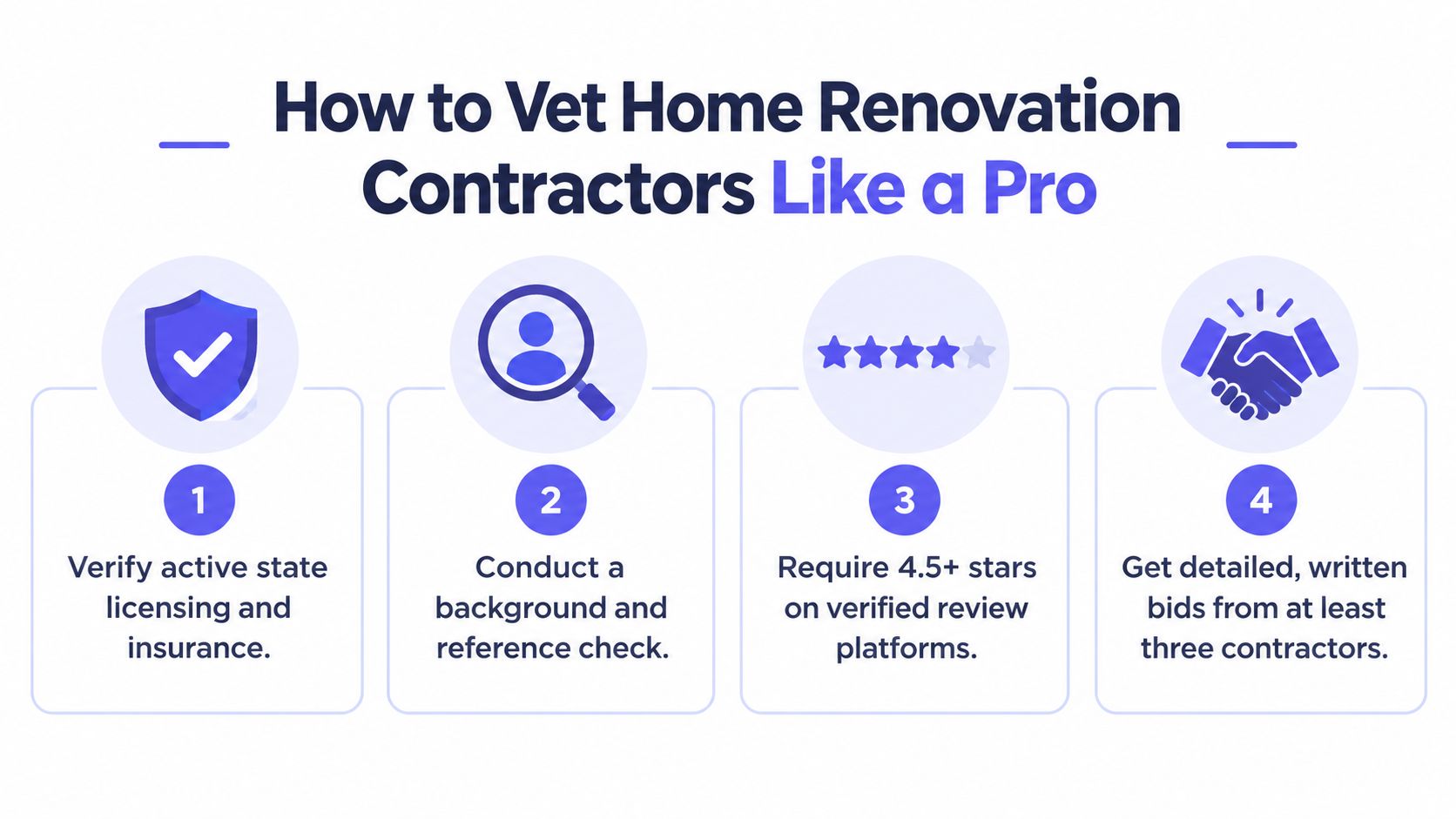
How to Vet Home Renovation Contractors Like a Pro
A polished website proves very little. Vet the business in an order that removes serious risks early.
Verify the legal baseline
Check the active license through your state or local licensing authority. Requirements vary, so don't assume a contractor is legitimate because a business name appears in a directory.
California requires anyone performing home improvement work valued at $500 or more, including labor and materials, to hold a Contractors State License Board license, and the state advises consumers to verify the license number before hiring. California also says new contractors have been subject to a criminal background check since 2005, as explained in the California consumer licensing pamphlet.
New York City sets a different threshold. A person or business that solicits, sells, performs, or obtains home improvement work above $200 must hold a Home Improvement Contractor license. The city's process includes a criminal history check, written exam, fee, and bond or restitution trust contribution, according to the New York consumer guide.
Pennsylvania ties registration to annual activity. Contractors performing at least $5,000 in home improvements per year must register under the Home Improvement Consumer Protection Act, according to the Pennsylvania Attorney General's materials. Massachusetts takes a conditional approach. Most contractors and subcontractors working on owner-occupied residential improvements must register, but the state lists exceptions that include licensed plumbers and electricians, certain small-job contractors, and specific specialties, as described in the Massachusetts home improvement guide.
Check people, reviews, and records
Ask who owns the business, who will supervise your project, and who will physically manage the site. Request proof of general liability and workers' compensation coverage, then confirm that the documents are current and apply to the business you're hiring.
Look for 4.5+ star ratings with recent review volume, but don't stop at the number. Read comments about completion, communication, cleanliness, change orders, and how the company handled problems. A perfect-looking portfolio can hide weak scheduling or poor follow-through.
Request references for projects similar in scope and age to yours. Ask past clients whether the contractor finished the work, kept commitments, explained changes, protected the home, and responded when something went wrong.
For a deeper check, review the contractor background check process. The standard you want is active licensing, thorough screening of owners or operators, credible reviews, and human judgment rather than automated profile matching alone.
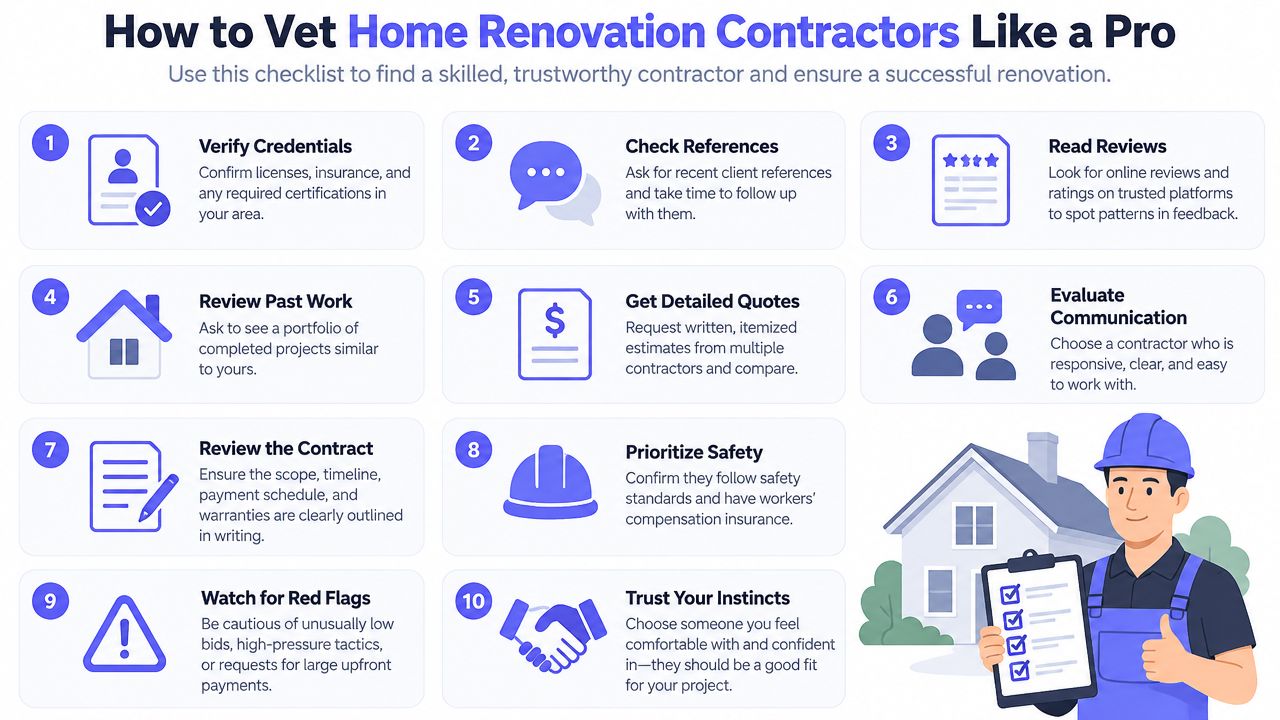
Understanding Real Costs Timelines and Bids
The cheapest bid rarely gives you the clearest picture. A low total may leave out demolition, permits, coordination, realistic material allowances, or time for problems. You are not comparing prices alone. You are comparing the contractor's plan for controlling the entire project economy.
Renovation costs cover more than materials and visible labor. They may include design, demolition, disposal, permits, inspections, temporary protection, supervision, subcontractor coordination, finish selections, and corrections to hidden conditions. Labor accounts for 50% to 60% of a typical renovation, while permits can add 8% to 18% of project cost, based on recent cost data.
Use a decision matrix instead of ranking proposals by total.
| Evaluation Criteria | What to Compare | Why It Matters |
|---|---|---|
| Scope | Rooms, tasks, demolition, repairs, cleanup, and exclusions | Missing work becomes a change order later |
| Materials | Brands, grades, finish allowances, fixtures, and owner-supplied items | Similar descriptions can conceal different quality levels |
| Labor | Crew roles, supervision, subcontractors, and project management | You're paying for coordination as well as installation |
| Permits | Who obtains permits, pays fees, schedules inspections, and corrects issues | Unclear responsibility can delay work or leave compliance gaps |
| Timeline | Start conditions, milestones, sequencing, and completion assumptions | A fast promise is useless without a credible plan |
| Payment | Deposit, progress payments, retainage if applicable, and final balance | Payment timing should follow completed work and documented progress |
| Changes | Written approval process, pricing method, and schedule impact | Verbal decisions create disputes |
| Warranty | Coverage, exclusions, response process, and duration stated in writing | You need a remedy if a defect appears after completion |
Normalize every proposal
Ask each contractor to replace allowances with specific selections, or explain exactly what each allowance covers. Flag “by owner,” “as needed,” “TBD,” and “standard.” Those labels can transfer cost, purchasing, or decision-making back to you.
Compare the communication plan as closely as the scope. Who gives updates? How quickly must change orders be approved? Who informs you about a delayed fixture or failed inspection? Clear answers reduce the cost of confusion and make shared-lead or spam-style sales follow-up easier to avoid.
Check whether the schedule includes design approvals, material availability, inspections, and trade sequencing. U.S. residential construction productivity data covers both single-family and multiple-family construction and is updated through 2024, according to the Bureau of Labor Statistics productivity report. You do not need to calculate a productivity index. Ask how the contractor will staff the work, prevent idle time, and communicate schedule changes.
Energy and code details need close review during renovations. Minnesota research found average compliance of 72.7% for residential renovations versus 80.2% for new construction under the 2009 IECC, as reported in the energy-code compliance study. Existing walls, hidden conditions, and trade coordination make retrofits harder to verify. Require inspection checkpoints and written records before the work is covered.
Red Flags That Signal You Should Walk Away
A contractor can produce polished photos and an attractive bid while creating expensive problems behind the scenes. If the scope is vague, permits are unclear, or communication collapses before work begins, the lowest price is not a bargain. It is an early warning about total project economics.
Watch how the contractor behaves during the estimate process. Someone who ignores questions now is unlikely to manage change orders, inspections, or delays responsibly after taking your deposit. Walk away if the business will not identify its legal operator, provide insurance information, or name the person supervising the job.
Look for these warning signs:
- Pressure to sign immediately: A reputable contractor should explain the proposal and give you time to review the agreement.
- A vague one-page estimate: Without defined tasks, materials, exclusions, and payment stages, scope creep becomes difficult to challenge.
- An unusually large upfront payment: Ask what the money covers. Connect payments to documented progress and delivered materials.
- No permit plan: The contractor should state who obtains permits, schedules inspections, and corrects failed work.
- Unverifiable references: Social media photos do not replace conversations with past clients.
- Unclear project supervision: Get the name and contact method of the person managing daily work.
- Disappearing communication: Slow replies during sales often become missed updates during construction.
- Cash-only or personal-payment demands: Keep a record showing the business, invoice, payment, and agreed purpose.
Pay close attention to allowances. A contractor may offer an appealing total while labeling electrical work, finish materials, and repairs as allowances. That price can rise quickly once actual selections and site conditions are known. Treat a promise to finish by a fixed date with the same caution if the contractor has not asked about permits, material selections, or existing conditions.
A useful filter: If the contractor will not put a promise in the proposal, assume it is not part of the deal.
Trust concerns are not minor paperwork issues. The Leaf Home survey found that homeowners' concerns focus heavily on reliability and deception, while incomplete work and communication problems rank among the leading frustrations. Disqualify a contractor who avoids accountability before poor workmanship gives you a reason to do it.
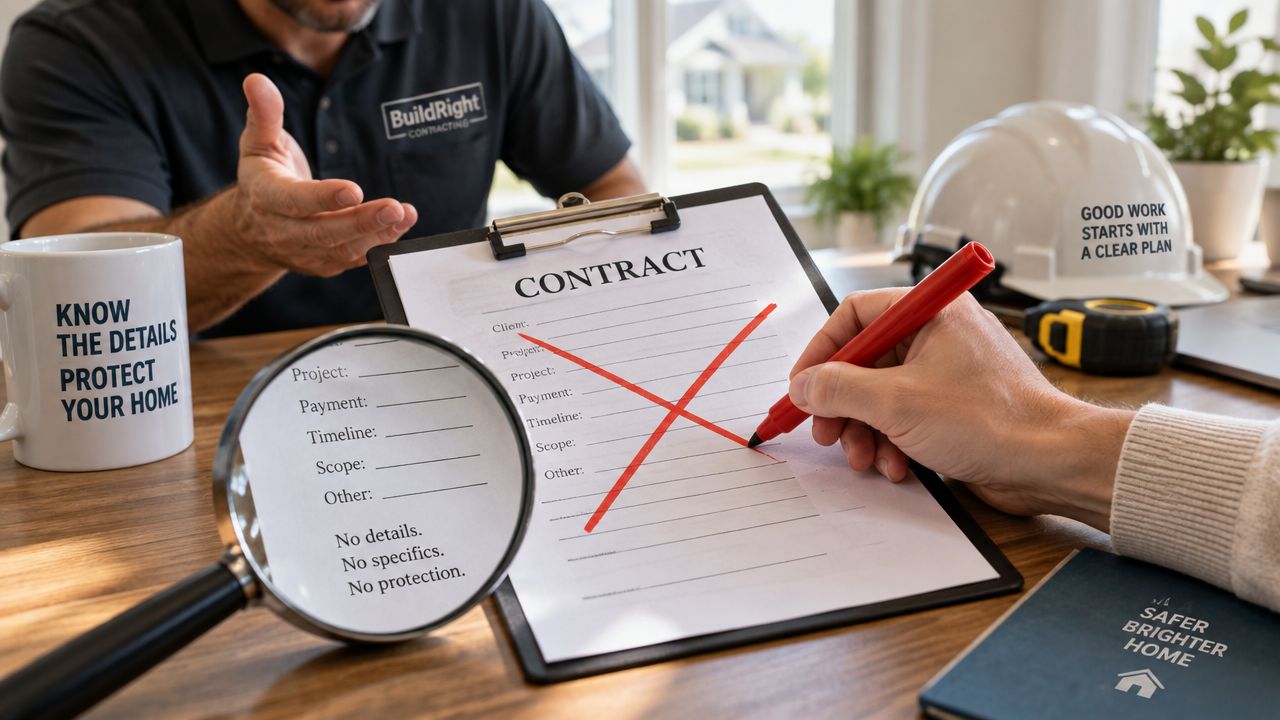
Your Next Steps to Hire With Confidence
Before signing, make the contractor's verbal promises unnecessary. The contract should carry the project.
Confirm the legal business name, license details, insurance certificates, project address, scope, drawings or specifications, materials, exclusions, start conditions, milestones, payment schedule, permit responsibility, cleanup expectations, warranty, and termination terms. If the contractor says something important during the site visit, add it to the written agreement.
Control changes before they happen
Every change should identify four things:
- What work or material is changing.
- Why the change is needed.
- How the price changes.
- How the schedule changes.
Don't approve a vague text message that says, “We'll figure it out.” Use a written change order that both sides accept before the work proceeds. Hidden conditions may require a revision, but they don't justify an undocumented price increase.
Payment should follow progress that you can inspect. Tie installments to completed phases, approved materials, or passed inspections rather than calendar dates alone. Keep invoices, receipts, selections, permits, inspection records, photos, and messages in one project folder.
Use this final pre-start checklist:
- Verify the license: Confirm the status with the relevant state or local authority.
- Confirm insurance: Check that coverage belongs to the contracting business and remains current.
- Call references: Ask about completion, communication, delays, and problem resolution.
- Review the scope: Make sure every bid inclusion and exclusion appears in the contract.
- Name the supervisor: Know who manages the site and how updates will arrive.
- Set the change process: Require written price and schedule approval.
- Document the payment plan: Match payments to visible progress.
- Confirm permits: Assign responsibility clearly before demolition or installation begins.
Use this contractor questions checklist during interviews. If you'd rather avoid a shared-lead scramble, Hand Vetted Co. matches you with one licensed, background-checked, 4.5+ star rated professional, and the request is exclusive rather than distributed to multiple businesses.
Start today by writing your scope, separating must-haves from nice-to-haves, and requesting proposals that use the same information. Then reject any contractor who won't provide verifiable credentials, a detailed contract, and a clear answer for what happens when the plan changes.
Hand Vetted Co. gives you one exclusive match with a verified renovation professional instead of sending your information to competing businesses. Visit Hand Vetted Co. with your project type, timing, location, and budget ready, then use the match as a starting point for a documented, accountable hiring decision.