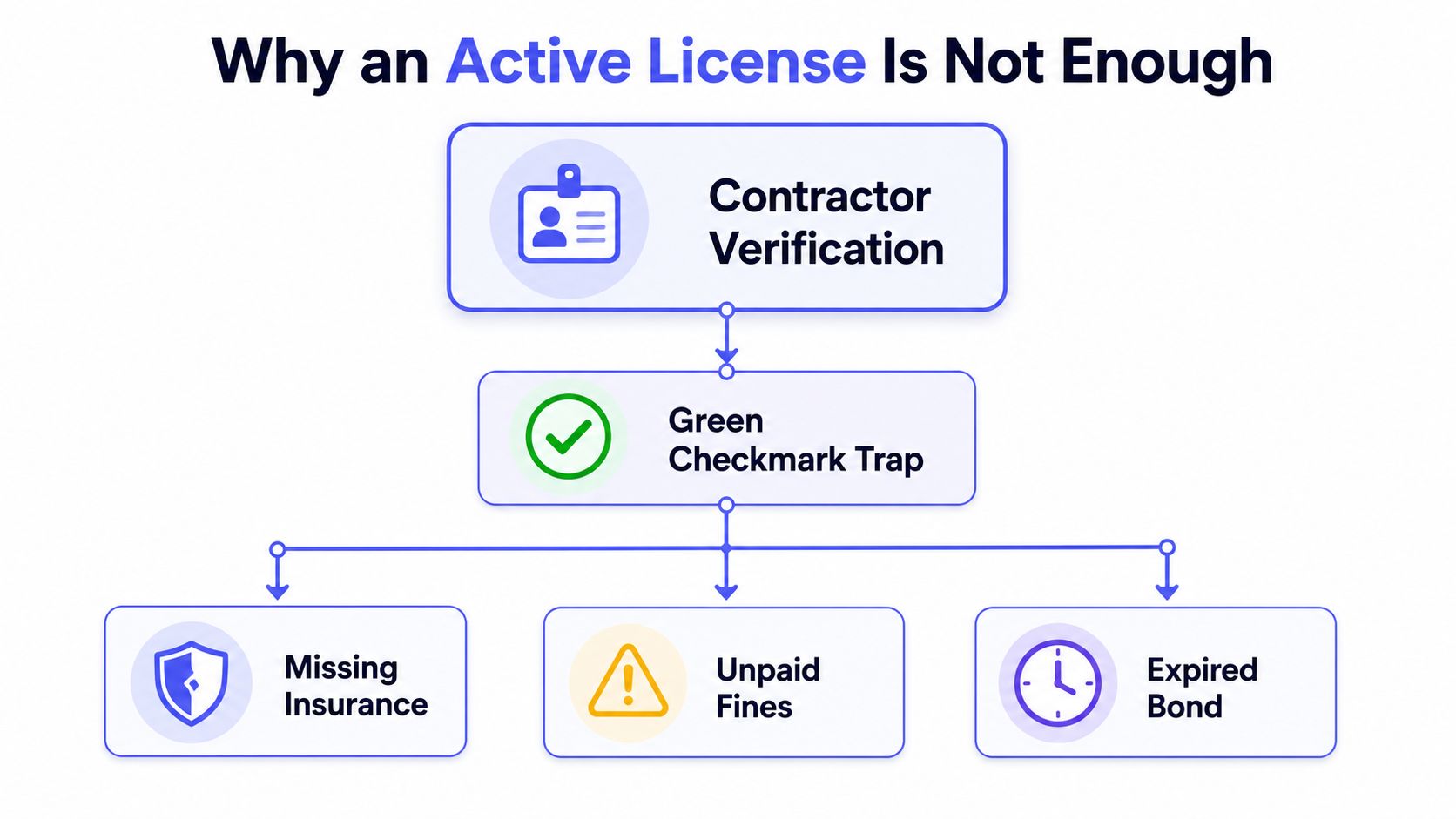
An active license is necessary, but it's the weakest possible bar. To really verify a contractor license, you need to check the classification, bond, insurance, and disciplinary history in one workflow, because a green checkmark alone can still hide bad news.
You're probably here because someone handed you a license number, a polished estimate, and a confident answer to every question you asked. That's exactly how people get burned. The mistake isn't failing to look up the license, it's stopping there.
Table of Contents
- Why an Active License Is Not Enough
- Finding the License Number and Pulling the State Record
- Matching the Classification to Your Actual Job
- Confirming Bond and Insurance Directly With the Carrier
- How State Rules Change What You Need to Check
- Red Flags That Should Stop the Hire
- Smart Questions to Ask Before You Sign Anything
Why an Active License Is Not Enough
A contractor can be licensed and still be the wrong hire. Homeowners learn that the hard way after a job goes sideways, because an active record proves only that the business cleared one gate. It says nothing about whether that contractor is the right fit for your project, in your jurisdiction, under the rules that apply to the work you need done.
The five layers that actually matter
Verification has five separate checks. The license has to be active. The classification has to match the work. The qualifier has to be in place. The bond has to be current. The insurance has to be real and live, not a glossy line on a quote.
Practical rule: if a contractor passes only one of those checks, you still have not verified anything meaningful.
California's Contractors State License Board public lookup can show status, classification, expiration, and complaint or disciplinary history, and contractor license numbers there are numeric and up to 8 digits (CSLB lookup tool). California also requires a minimum $25,000 surety bond for every active contractor license, so a missing bond is not a paperwork issue, it is a warning sign that the contractor may not be properly set up to take your job (California bond and verification guidance).
What a weak check misses
A screenshot can look convincing and still be worthless. It will not tell you whether the record is live today, whether the work falls outside the license class, or whether the license is tied to the same legal entity that is bidding your job. Live board data does.
The qualifier matters too. If the person behind the license is not attached to the business that is quoting your project, you are looking at paperwork, not accountability. The bond and insurance checks matter for the same reason. They are the parts that show whether the contractor has backed up the license with real financial and legal protection.
Permit history matters as well. A contractor with a clean-looking profile can still leave a trail of permit problems, failed inspections, or sloppy work that never showed up in the sales pitch. That history tells you how the contractor behaves after the contract is signed, which is the part that hurts homeowners.
If you want the short version, here it is. Active is the entry ticket, not the finish line. Skip the rest and you are trusting a license number instead of real verification.
Finding the License Number and Pulling the State Record
Start with the license number, not the sales pitch. If the business will not give you the number, stop right there. A real contractor does not treat a license number like a secret, because it is not.
Where to get the number
Look on the estimate, the contract draft, the business card, or the company's public profile. If the number appears in writing, match it against the legal business name and the person signing the deal. If those details do not line up, you already have a warning sign.
Once you have the number, go straight to the state board that issued it. That record is the authority, not a screenshot, not a PDF, and not a forwarded text message. California's CSLB lookup lets users search by license number or name, and it notes that California contractor license numbers are numeric and up to 8 digits (CSLB public lookup).
What the live record should tell you
You want a record that is active, tied to the same legal entity you plan to hire, and current enough to show status and expiration. You also want to see complaint or disciplinary history in the same record, because that is where the important details show up. The license record is supposed to let you check all of that in one place.
A clean-looking license copy is cheap. A live state record is what matters.
What to ignore
Ignore polished PDFs, social media screenshots, and vague claims like “we're fully licensed.” Ask for the number, search the board, and read the result yourself. That is the fastest way to avoid being misled, because the board record is the only version that counts.
If the record cannot be found, does not match the business name, or shows anything other than active status, you do not need a second opinion. You need a different professional.
Matching the Classification to Your Actual Job
A license can be active and still be wrong for your project. That is the trap. If the classification does not fit the work, the paperwork looks fine while the contractor still is not authorized for what you want done.
Why the class has to fit the scope
A classification is the category of work the license covers. Roofing, electrical, plumbing, HVAC, and general building are different licenses for different jobs, even if the record shows current status. If the class does not line up with the scope of your project, you are looking at the wrong license.
That is why the first question is not, “Is it active?” It is, “Does this class cover my job?” California guidance makes that point through its verification steps, and a separate verification workflow says the same thing in plainer language, the license record has to match the trade scope you are hiring for (California verification guidance, multi-field verification workflow). Alabama shows how messy this can get, because its categories separate general, residential, and specialty work, and some classes depend on a qualifying individual or come with project limits (Alabama scope and qualifier overview).
The qualifier matters too
A lot of homeowners stop at the license number and never check the qualifier. That is a mistake. The qualifier is the person backing the license, and if that person leaves or is no longer in good standing, the license situation can change even if the business still looks active on paper.
So check the qualifier status, not just the company name. If the contractor cannot explain who qualifies the license and how that person is connected to the exact work you need, the record is not giving you enough protection.
Five checks that tell you whether the license really fits
Classification is only one layer. A real verification also checks whether the qualifier is current, whether the bond is in place, whether insurance is live, and whether the contractor has a permit history that makes sense for the work being offered. Those checks belong together because an active license alone tells you very little.
| Verification layer | What you are checking | What a bad result means |
|---|---|---|
| Classification match | The license class covers your exact trade and scope | The contractor may be licensed, but not for your job |
| Qualifier status | The person responsible for the license is still tied to it and in good standing | The license may not be valid in practice |
| Bond | The required bond is current and tied to the business | You have less protection if something goes wrong |
| Insurance | The policy exists and names the right business | A claim may not be covered |
| Permit history | The contractor has pulled permits that fit the kind of work advertised | The business may be cutting corners or working outside its lane |
Use this as the filter, not a quick yes-or-no check.
What to do when the class is wrong
If the class does not match the work, stop. Do not let anyone talk you into “handling it anyway” or tell you the permit will sort it out later. A permit is not a substitute for the right license class.
Ask for a contractor whose classification fits the job, whose qualifier is current, and whose permit history makes sense for the work you are planning. For the insurance side, you should also review a clear summary of contractor insurance requirements before you sign anything. If the contractor cannot clear those checks, walk away and hire someone whose paperwork matches the project.
Confirming Bond and Insurance Directly With the Carrier
An active license proves very little on its own. A contractor can show up with a clean record and still leave you exposed if the bond is stale or the insurance never existed. Verify those two items directly, or you are trusting paperwork instead of protection.
Verify the bond first
A surety bond is part of the protection structure behind the license. In California, the active contractor bond benchmark is $25,000, which gives you a concrete reference point when you review the record. If the bond is missing, expired, or not tied to the right business, stop there.
Do not take the contractor's word for it. Confirm the bond with the issuing body or regulator, the same way you confirm the license record. That tells you whether the bond is live right now, not whether someone can produce a PDF.
Then verify insurance the hard way
Ask for a certificate of insurance, then call the carrier or agent named on it. You want confirmation that the policy is active, current, and issued to the same business name that appears on your estimate. That is how you catch forged certificates, expired policies, and sloppy paperwork before they become your problem.
Check for general liability and, where it applies, workers' compensation coverage. Keep a dated note of who you called, when you called, and exactly what they confirmed. If a dispute comes up later, that note is worth more than the contractor's verbal promise.
If the business gets irritated when you verify insurance, that is not a personality quirk. It is a warning.
Use a clear contractor insurance requirements guide as your reference point while you make the carrier call. If the certificate and the live confirmation do not match, believe the live confirmation and walk away.
How State Rules Change What You Need to Check
A contractor can look fine in the state record and still be the wrong hire. That is why the first question is not, “Is the license active?” It is, “Is this license the right one for this job, in this state, under this business name?”
State rules decide what “verified” even means. Some states center the public record on status and discipline. Others make you check whether the work falls into a licensed category at all, or whether a qualifier is still attached to the business. If you skip that context, you end up checking the wrong thing very confidently.
California, Alabama, and Georgia do not use the same standard
California pushes you toward the state record, but the record only helps if you read it the right way. You still need to confirm the classification, the qualifier, the bond, and any discipline tied to the license, because an active status by itself does not tell you whether the contractor is cleared for your exact project. Use the CSLB lookup once, then move on to the details that protect you.
Alabama is more segmented. License validity can turn on the contractor category and on qualifier issues, so a business can sound legitimate and still fail the check if the category does not fit the work or the qualifier relationship is off. The Alabama verification guidance explains why you cannot stop at a simple “licensed” answer.
Georgia adds another trap. Some specialties are treated differently, and some occupations, including roofers, painters, drywall contractors, and repair handymen, are not required to be licensed by the state in the same way as broader contractor services. The Georgia consumer guidance is a reminder that you have to verify the rule before you treat the record like a yes-or-no filter.
Read the rule before you trust the record
Start with the state rule, then check the record, then check whether the job matches the license. That order keeps you from being fooled by a license that is active but useless for your project.
If you are hiring across trades or comparing contractors in different states, do not assume the same license means the same thing everywhere. One state may care most about the classification. Another may hinge on the qualifier. Another may treat the trade as outside the licensing requirement entirely.
For a fuller hiring screen, use a contractor background check checklist before you sign anything. It helps you see the gaps that a basic license lookup will not catch.
| State | What you need to check first | Why the state rule matters | Where to verify |
|---|---|---|---|
| California | Classification, qualifier, bond, discipline | An active record is not enough if the license does not fit the work | CSLB lookup |
| Alabama | Category, qualifier status, and whether the license fits the job | The business can look current and still fail on category or qualifier issues | Alabama verification guidance |
| Georgia | Whether the work is actually subject to state licensing | Some specialties are treated differently, so the first check is the rule itself | Georgia consumer guidance |
If the state rule says the work is exempt, that does not mean you stop checking. It means you shift the burden to identity, insurance, permits, and whether the business has a real track record on similar jobs. A clean state lookup is only one layer, and it is the weakest one if you never confirm the rest.
Red Flags That Should Stop the Hire
Bad verification usually doesn't start with a disaster. It starts with little friction. The company name shifts, the answers get fuzzy, and suddenly you're doing work the business should've done for you already.
The warning signs that matter
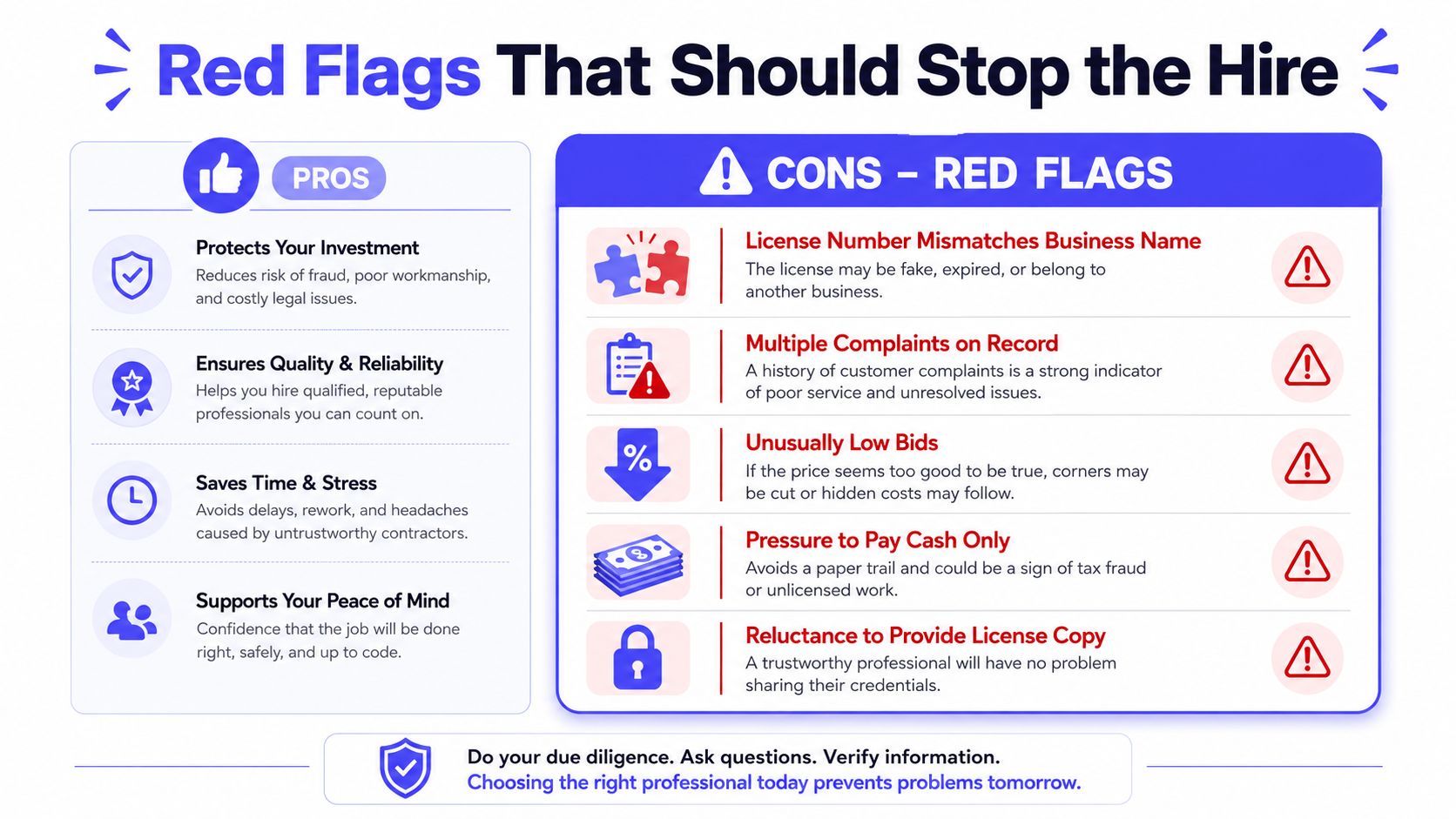
- License number doesn't match the business name. If the entity on the estimate and the entity on the record are different, pause immediately.
- The carrier can't confirm insurance. If nobody can verify the policy live, the paper isn't protection.
- The bond looks expired or missing. That's not a clerical issue, it's exposure.
- The qualifier answer keeps changing. If the story changes from one call to the next, trust that inconsistency.
- You're pushed to pay before you've checked anything. Speed pressure is often there to keep you from verifying.
What to do in the moment
Ask for the license number in writing. Ask for the insurance certificate and call the listed carrier. Ask who the qualifier is, and ask whether permits have been pulled under that license for similar work. If the answers come back evasive, stop.
The same pattern shows up in too many bad jobs. A business refuses to share the number until after a deposit, or it talks around the record instead of pointing you to it. That's exactly when you should walk.
For a deeper checklist of hiring warning signs, Hand Vetted Co.’s contractor background check guide is worth reading before you sign anything.
Smart Questions to Ask Before You Sign Anything
A valid license record is the floor, not the finish line. Contractors still get burned on scope, permit gaps, weak insurance, and a qualifier who is only useful on paper. The right questions force those weak spots into the open before you sign.
Ask these before money changes hands
- What is your license number and which state issued it?
- Does your classification cover this exact work?
- Who is the qualifier on file?
- Can you give me a certificate of insurance I can verify with the carrier?
- Have you pulled permits under this license for similar projects in the last 12 months?
Those questions do the hard part for you. They separate a contractor who is merely active from one whose license, classification, qualifier, bond, insurance, and permit history all line up with the job you need done. If the answers come back fast, consistent, and specific, that is a good sign. If the story shifts, stop there.
For a fuller checklist, use our guide on what to ask a contractor before you commit to anything in writing.
Use a matching platform to reduce the risk upfront
A service like Hand Vetted Co. works alongside your own checks because it narrows the field before you start calling strangers. The point is not to hand over judgment. The point is to begin with a professional whose license, background, classification, and reputation have already been screened.
If you want a simple next step, use How It Works to see the matching process, then read our standards and FAQ so you know exactly what gets checked before a match is made.
A CTA for Hand Vetted Co..