You hear water running where it shouldn't. A supply line has split under the sink, a washing machine hose has failed, or a ceiling stain has finally turned into a steady drip. Before you call anyone, your actions can determine whether your house insurance claim for water damage is supported by clear evidence or weakened by missing documentation and preventable additional damage.
Water damage is both common and expensive. The Insurance Information Institute's homeowners insurance data reports that about 1 in 67 insured homes filed a water-damage or freezing claim each year during 2019–2023, with an average claim amount of $15,400. Water damage and freezing accounted for 22.6% of homeowners insurance claims based on 2023 data. Treat the incident seriously, even if the visible area looks small.
Table of Contents
- Immediate Actions to Protect Your Property and Claim
- Decoding Your Policy Coverage for Water Losses
- Filing the Claim and Managing the Adjuster Visit
- Navigating Repair Estimates and Payout Structures
- Handling Claim Denials and the Appeal Process
- Selecting Verified Professionals for Complete Restoration
Immediate Actions to Protect Your Property and Claim
Start with safety, then preserve evidence. Don't walk into standing water if electrical outlets, appliances, or wiring may be affected. Shut off electricity to the wet area from a safe location, and call an emergency professional if you can't do that safely.
Follow the first-hour sequence
Stop the source. Close the main water supply or the valve serving the failed toilet, sink, water heater, dishwasher, or washing machine. If the water is coming through the roof or an exterior opening, use a temporary measure to limit entry without creating a dangerous condition.
Protect people and electricity. Keep children and pets away. Don't operate electrical devices in wet areas. Move undamaged belongings only after you've photographed the scene, and don't put yourself at risk to save property.
Document before cleanup. Take wide photographs of each affected room, then close-ups of flooring, drywall, ceilings, cabinets, baseboards, insulation, furniture, and standing water. Record video while narrating the location and visible condition. Capture the failed component, valve, hose, appliance, or opening that appears to have caused the loss.
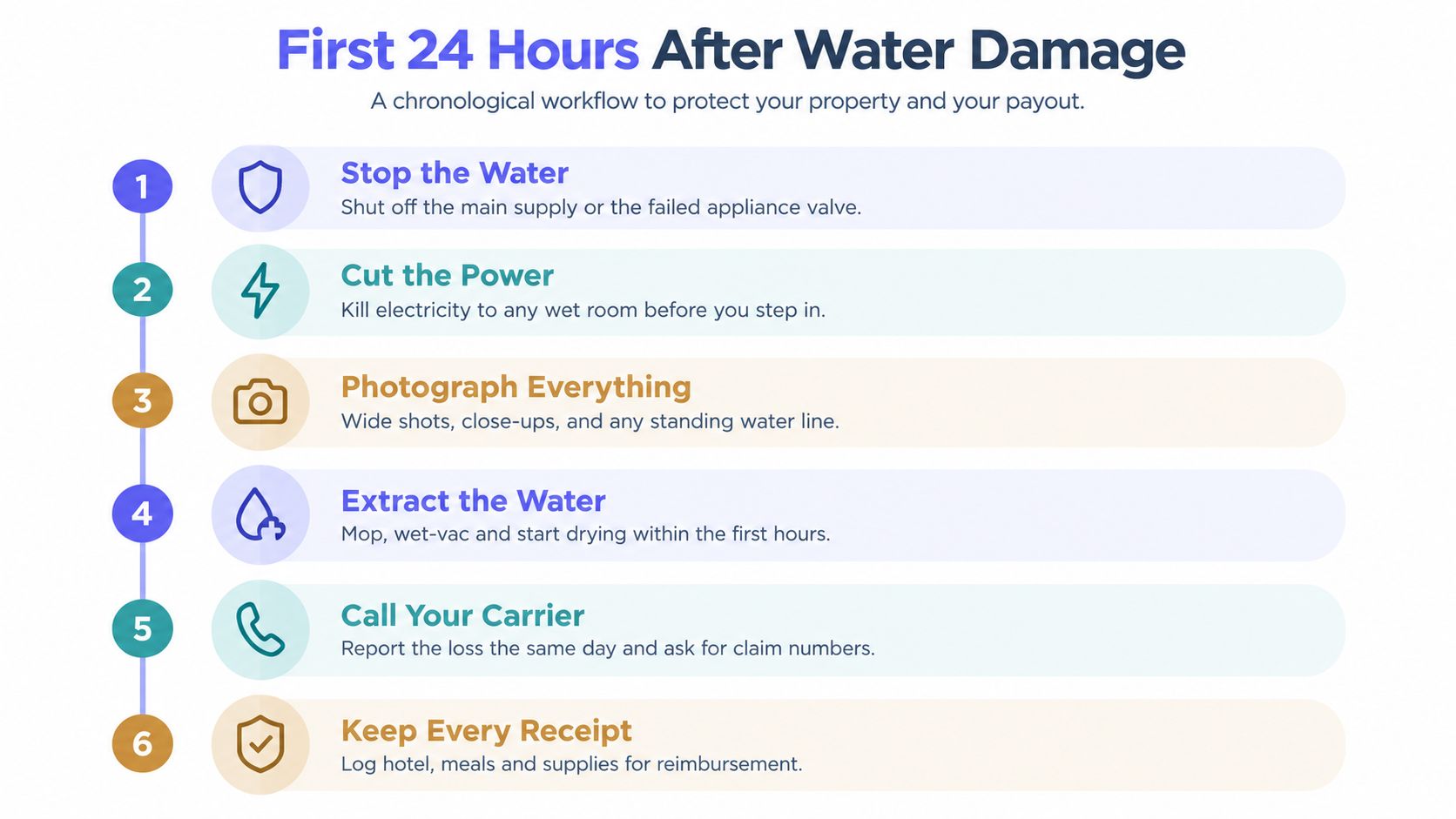
Begin temporary mitigation. Remove standing water with towels, a mop, or a wet vacuum if it's safe. Start fans or dehumidifiers where appropriate, and arrange professional extraction and drying for soaked materials. Temporary mitigation limits additional damage, but it doesn't mean you should begin permanent demolition before the insurer has had a fair chance to inspect.
Notify the carrier quickly. Report the loss as soon as possible, preferably the same day. Ask for the claim number, the assigned adjuster's contact details, required forms, inspection timing, emergency-service instructions, and the policy deductible.
Preserve the paper trail. Keep itemized receipts for extraction, drying equipment, emergency materials, hotel costs, meals, laundry, storage, and other temporary living expenses. The water-damage claim workflow from American Family Insurance emphasizes stopping the source, documenting the property before cleanup, reporting promptly, mitigating immediately, saving receipts, and preparing a contents inventory.
Practical rule: Photograph first, remove only what safety or mitigation requires, and keep every damaged item until the adjuster or insurer confirms it can be discarded.
Write down when you discovered the water, what you saw, when you shut it off, who you called, and what work was performed. If emergency drying is necessary, ask the company to record moisture readings, affected materials, equipment placement, daily readings, and drying completion. If you need urgent help, use a water-damage repair professional who can document the emergency work as well as perform it.
Decoding Your Policy Coverage for Water Losses
The source of the water matters more than the fact that water is present. A standard policy usually responds to sudden and accidental damage, not every leak that eventually becomes visible. Allstate's water-damage coverage guidance describes typical coverage for events such as a burst pipe or ruptured appliance, while identifying neglect, poor maintenance, and gradual leaks as common exclusions.
A pipe that suddenly breaks and floods a room is a different coverage question from a pipe that has slowly corroded behind a wall. In the first situation, the resulting damage may fall within the policy's covered water-loss provisions. In the second, the insurer may argue that the condition developed over time, that you should have discovered it earlier, or that maintenance exclusions apply.
Separate the damage from the failed part
Policies often distinguish between the resulting damage and the source of the loss. The policy may pay to repair water-damaged flooring, drywall, cabinets, or personal property after a covered event while excluding the worn-out hose, corroded pipe, defective seal, or aging appliance that caused it. Don't assume that approval for one automatically covers the other.
Hidden damage requires careful wording. If you found staining, swelling, musty odors, or mold late, report it promptly once discovered. Some policies exclude gradual leaks, seepage, and mold associated with those leaks, but late discovery alone doesn't answer every coverage question. The timeline, physical evidence, policy language, and cause investigation all matter.
Check the water's direction
Water entering from outside is another major trap. Flooding from rising water, storm surge, overflowing bodies of water, or surface water generally requires separate flood insurance, rather than ordinary homeowners coverage. A roof leak caused by sudden storm damage may be analyzed differently from water that enters because of long-term roof deterioration.
Sewer and drain backups also need separate attention. Standard policies commonly exclude backup losses unless you purchased a sewer-backup or water-backup endorsement. Review the declarations page and endorsements, not just the main policy summary, for limits, exclusions, and covered sources.
Ask your agent or carrier these direct questions:
- Source: Is this event classified as a burst pipe, appliance leak, roof loss, sewer backup, seepage, or flood?
- Resulting damage: Which structural materials and contents are covered?
- Mold: Does the policy provide any mold coverage, and does the cause affect it?
- Living costs: Does the policy provide additional living expense coverage if the home is uninhabitable?
- Deductible and limits: What deductible, sublimits, and special conditions apply?
Don't volunteer a theory such as “this must have been leaking for months” unless you have evidence. State what you observed, when you discovered it, and what you did next. Let the investigation establish causation.
Filing the Claim and Managing the Adjuster Visit
Your first call should be factual and organized. Give the date and approximate time of discovery, the location, the apparent source, the immediate steps you took, and whether anyone was injured or displaced. Ask the intake representative to repeat the claim number and explain the next required step.
Send photographs, video, receipts, emergency-service reports, and your initial inventory through the carrier's approved channel. Keep the originals. Create a simple claim folder with subfolders for communications, images, receipts, contractor documents, contents, and temporary living expenses.

Prepare for the inspection
An adjuster may focus on the obvious wet patch. Your job is to identify every affected area without exaggerating anything. Walk room by room and point out warped subfloors, swollen trim, damp insulation, buckled cabinets, staining behind furniture, damaged contents, and any areas that received emergency drying.
Bring a written inventory. Include the item, location, condition, approximate age, brand, model, serial number if available, and supporting photograph or receipt. Don't throw away damaged contents unless they create a health or safety hazard or the carrier authorizes disposal. If disposal is unavoidable, photograph the item from multiple angles and keep proof of what happened.
Keep the inspection collaborative but firm
Ask the adjuster to explain what they're including and excluding from the initial scope. If a moisture reading shows a wet area that isn't visible in a photograph, ask for that reading to be recorded. If the adjuster can't inspect a concealed space before necessary removal, ask how the carrier wants the condition documented.
You're not required to argue every line item during the first visit. You are required to make sure the file reflects the full loss. Request written confirmation of next steps, deadlines, additional documents, and whether the carrier will send an engineer, specialist, or separate contents adjuster.
“Please show me where that area appears in the scope, and if it isn't included, tell me what evidence you need to evaluate it.”
After the visit, send a short written recap. List the rooms inspected, damaged items discussed, documents provided, unresolved questions, and promised follow-ups. A calm written record is more useful than a heated phone call.
Navigating Repair Estimates and Payout Structures
An approved claim can still leave you short if you don't understand the estimate. The first payment may not equal the full amount needed to restore the property, especially when the policy uses actual cash value, applies depreciation, or requires you to pay a deductible.
Actual cash value generally reflects the item's value after depreciation. Replacement cost value is designed to pay the cost of replacing covered property with comparable new materials, subject to policy terms and repair requirements. Investopedia's explanation of water-damage insurance confirms that the deductible usually applies before the insurer pays and that depreciation can reduce payment when actual cash value applies instead of replacement cost value.
Compare the payout structures
| Payout Type | How It Works | Financial Impact on Homeowner |
|---|---|---|
| Actual Cash Value | The insurer calculates the covered repair or replacement amount and subtracts depreciation and the deductible. | The first payment may be lower, leaving you to fund more of the work yourself. |
| Replacement Cost Value | The policy may pay the cost to repair or replace covered property, subject to policy conditions, limits, depreciation rules, and the deductible. | You may receive more toward complete restoration, but you still need to follow the policy's repair and documentation requirements. |
| Advance or partial payment | The carrier issues funds for an accepted portion while other items remain under review. | It can help start urgent work, but accepting money doesn't mean every disputed item has been resolved. |
Read the estimate line by line. Look for demolition, containment, extraction, drying, moisture monitoring, disposal, antimicrobial treatment where appropriate, insulation, drywall, texture, paint, flooring transitions, cabinetry, trim, contents handling, and cleanup. A missing line can become an out-of-pocket cost if you don't raise it early.
Your contractor's estimate may differ from the adjuster's because the contractor sees conditions during removal that weren't visible during inspection. That doesn't automatically mean the contractor is right or the insurer is wrong. Ask for photographs, moisture readings, measurements, and a written explanation for every supplement.
Control the repair money
Don't sign an assignment of benefits, release, or final settlement without understanding what rights you're giving up. Don't let a contractor promise that “insurance will cover everything.” Your policy controls coverage, while the contractor controls workmanship and pricing.
If the scope is confusing, compare it with a detailed water-damage repair cost estimate and ask targeted questions about omitted work, material grades, code requirements, and depreciation. Keep invoices and proof of completed repairs because replacement-cost holdback may depend on them.
Water losses have also become more severe in recent claims data. An Insurance Business report on water-damage claim trends reported a 63% increase in the severity of non-weather-related water damage between 2019 and 2025, even as total claims fell. That makes a complete scope more than a paperwork exercise. It protects the budget needed to finish the job correctly.
Handling Claim Denials and the Appeal Process
A denial letter is a position, not a verdict. It should identify the policy language the insurer relies on and explain the factual basis for the decision. Read both the letter and the cited exclusion. “Gradual damage” is not a substitute for an investigation into what happened, when it happened, and what damage resulted.
The strongest appeal is factual. Start by building a timeline from discovery backward. Include maintenance records, prior inspection reports, plumbing invoices, appliance records, photographs, emergency-service logs, moisture maps, and statements from people who saw the condition before or after the event.
Identify the denial theory
Common disputes involve the alleged source, the length of time the leak existed, poor maintenance, mold, flood, sewer backup, or failure to mitigate. Respond to the exact theory instead of sending a general complaint.
For example, if the insurer says the leak was gradual, ask what physical evidence supports that conclusion. Provide the date you first saw staining or water, the date you discovered active damage, the plumber's findings, and the restoration company's moisture documentation. If the carrier says water entered from outside, distinguish roof penetration, surface runoff, rising water, and drain backup with photographs and professional observations.
The Washington State Office of the Insurance Commissioner's guidance on leaks, water damage, and mold highlights the difficult hidden-leak question. It explains that hidden water damage should be reported quickly after discovery, while many policies exclude gradual leaks, seepage, and mold connected to those leaks.
Escalate in a controlled order
Request the complete explanation. Ask for the specific policy provisions, inspection photographs, expert reports, and factual findings supporting the denial, subject to applicable rules.
Submit a written reconsideration. Attach a numbered response to each reason, with evidence labeled to match your arguments.
Request another inspection. Ask the carrier to inspect concealed areas, disputed moisture, flooring edges, insulation, cabinets, and the failed component if those items weren't evaluated.
Get independent technical evidence. A licensed plumber, restoration professional, engineer, or mold specialist may help establish the source, timing, moisture condition, and reasonable scope. Ask for measurements and observations, not a conclusion written only to support coverage.
Consider a public adjuster or attorney. A public adjuster can help value and document the loss. An insurance attorney becomes more relevant when the dispute involves substantial structural damage, bad-faith concerns, policy interpretation, or a threatened limitation period.
Don't destroy evidence during an appeal. Keep the denial, policy, endorsements, claim correspondence, estimates, reports, and receipts together. Meet every policy deadline, and contact your state insurance regulator if the carrier fails to explain its position or handle the claim fairly.
Selecting Verified Professionals for Complete Restoration
Restoration is not finished when the surface looks dry. A qualified company should identify affected materials, measure moisture, dry the structure, document the process, and explain which materials require removal. Rushed cosmetic work can trap moisture behind walls or under flooring, creating a second problem and a fresh coverage dispute.
Ask every restoration company for:
- Licensing and insurance: Verify active licensing where required and request proof of liability and workers' compensation coverage.
- Written scope: Require room measurements, affected materials, drying steps, equipment, monitoring, demolition, disposal, and reconstruction responsibilities.
- Moisture documentation: Ask for initial readings, ongoing readings, affected-material maps, and a final dry-out report.
- Claim experience: Choose a business that can separate emergency mitigation from permanent repairs and communicate clearly with the adjuster.
- Contract terms: Review pricing, payment timing, change orders, assignments of benefits, warranties, and responsibility for uncovered work.
A restoration company's estimate should support the claim, not dictate coverage. The insurer decides what the policy covers. The contractor should provide accurate evidence and a defensible repair plan.
Prevention also belongs in the final repair plan. Replace failed shutoff valves or hoses when appropriate, correct the source of entry, improve drainage, maintain the roof and plumbing, and consider leak detection where a hidden failure could cause major damage. Don't treat the payout as permission to restore only the visible surface.
For a simpler search, damage restoration companies can connect you with one professional rather than sending your contact details to several businesses. Hand Vetted Co. describes its matching process as checking active licensing, background screening, recent 4.5+ star ratings, and completing a human review before presenting a match. Verify the professional yourself, confirm the written scope, and keep the claim file separate from the service agreement.
A strong house insurance claim for water damage rests on three things: prompt action, preserved evidence, and a repair scope tied to the actual condition of the property. Stop the source, document before cleanup, report quickly, challenge unsupported exclusions, and don't sign away rights before you understand the settlement.
If you need restoration help after documenting the loss, Hand Vetted Co. matches homeowners with one verified professional for the project instead of reselling the request to multiple businesses. Visit the site, answer the project questions, and use the written estimate and moisture documentation to keep your repair and insurance records aligned.