Net 30 looks clean on paper. Then the first progress invoice sits in an approval queue, waits for a lien waiver, misses a draw, and arrives weeks after the work was completed. You still have payroll, materials, equipment, and subcontractors to cover.
A workable payment schedule doesn't just state when money is due. It explains what triggers payment, who approves it, which documents are required, how retainage is released, and what happens when someone misses the deadline. That distinction separates a contract that supports cash flow from one that merely creates an argument later.
Table of Contents
- When the Contract Said 30 Days and the Wait Was 83
- The Building Blocks of Every Payment Schedule
- Why Net 30 Rarely Means Net 30
- How Terms Shift by Project Type
- Retainage Working Capital and the 5 to 10 Percent Trap
- Liens Licensing and the Legal Floor Under Your Terms
- Clauses That Actually Protect You and a Pre-Signing Checklist
- The Two Clauses Worth Fighting For
When the Contract Said 30 Days and the Wait Was 83
A kitchen remodel can expose the gap between a payment term and actual cash. The contract says Net 30. After the contractor completes a defined stage, the progress invoice enters the homeowner's lender approval process. The general contractor requests a lien waiver. A notary appointment delays the paperwork. The bank wire arrives weeks after the stated due date.
By then, the contractor has paid the crew, ordered materials, removed the dumpster, and kept the project moving. The contract says 30 days. The money reaches the contractor's account after 83 days, a construction average reported in a guide to construction payment terms and collection timing.
That delay changes the job's economics. A project can look profitable on paper while the contractor finances labor and materials through nearly three months of collection time. The invoice has become working capital trapped in another party's approval process.
The due date isn't the whole clock
A written term may begin only when the owner receives a proper invoice. It may also depend on inspection, certification, a sworn statement, a lien waiver, or upstream payment. Unless the contract defines those conditions, a payer can point to a missing document and pause the payment clock.
Set the process in contract language. For example: “Payment is due within 30 days after receipt of a complete invoice. The payer must identify missing documents or disputed amounts within five business days. Undisputed amounts remain due on schedule.” Add a deposit clause that states what the deposit funds and when unused funds are returned. Add a retainage clause that sets a clear cap and release event. Add a prompt-pay remedy for missed deadlines.
The broader data is also blunt. One contractor-invoice dataset found that 84.5% of invoices contained no payment terms at all, while only 15.5% explicitly stated terms. Among invoices with terms, “due on receipt” appeared most often, followed by net 10, net 30, and net 15. Invoices marked Net 30 were paid in a median of 34 days, and 55.8% arrived late, according to the dataset analysis of contractor payment terms.
Practical rule: Treat the stated term as the start of a documented process, not as a promise that cash will reach your account on that day.
Name the invoice recipient, approval deadline, required attachments, payment date, and remedy for delay. Otherwise, Net 30 is a label, not a cash-flow plan.
The Building Blocks of Every Payment Schedule
Every strong payment schedule has four parts: deposit, progress payments, retainage, and final balance. Remove one of them and the project usually becomes harder to finance or harder to control.
Deposit
The deposit should fund a defined action, such as mobilization, material ordering, permit work, or reserving the project schedule. Avoid language that only says “deposit due upon signing” without explaining what the money supports and whether any unused portion is refundable.
For a small repair, the deposit may be tied to scheduling and initial materials. For a larger remodel, it can support procurement and mobilization. The exact amount should reflect the scope, local law, and the contractor's documented costs, not an arbitrary percentage copied from another contract.
Progress payments
A progress payment should follow a verifiable milestone, not a vague statement that the project is “partially complete.” Strong triggers include permit approval, rough-in inspection approval, delivery of specified cabinets, installation of drywall, or substantial completion.
A milestone clause should also state what happens if the payer doesn't inspect on time. Without an approval deadline, a completed stage can sit in limbo while the contractor carries the cost.
Retainage
Retainage is the portion withheld from a progress payment until completion or another stated release event. It gives the payer control over punch-list work, but it also removes cash from the contractor's operating cycle. The contract should state the percentage, the permitted duration, and the exact event that releases it.
Final balance
The final balance should be tied to substantial completion, punch-list resolution, required closeout documents, and properly conditioned lien waivers. Don't accept “final payment when the owner is satisfied.” Define satisfaction through an objective list of unfinished work and a written acceptance process.
| Component | Trigger | Amount | Notes |
|---|---|---|---|
| Deposit | Mobilization or material ordering | Contract-defined | State what the payment funds |
| Progress payment | Verified project milestone | Schedule-defined | Attach a schedule of values |
| Retainage | Each eligible progress payment | Contract and law controlled | State the release event |
| Final balance | Substantial completion and closeout | Remaining contract balance | Define punch-list and waiver conditions |
For a practical way to map deposits, draws, and remaining balances, use this project budget example as a planning reference. The contract still needs to control the actual payment schedule.
Why Net 30 Rarely Means Net 30
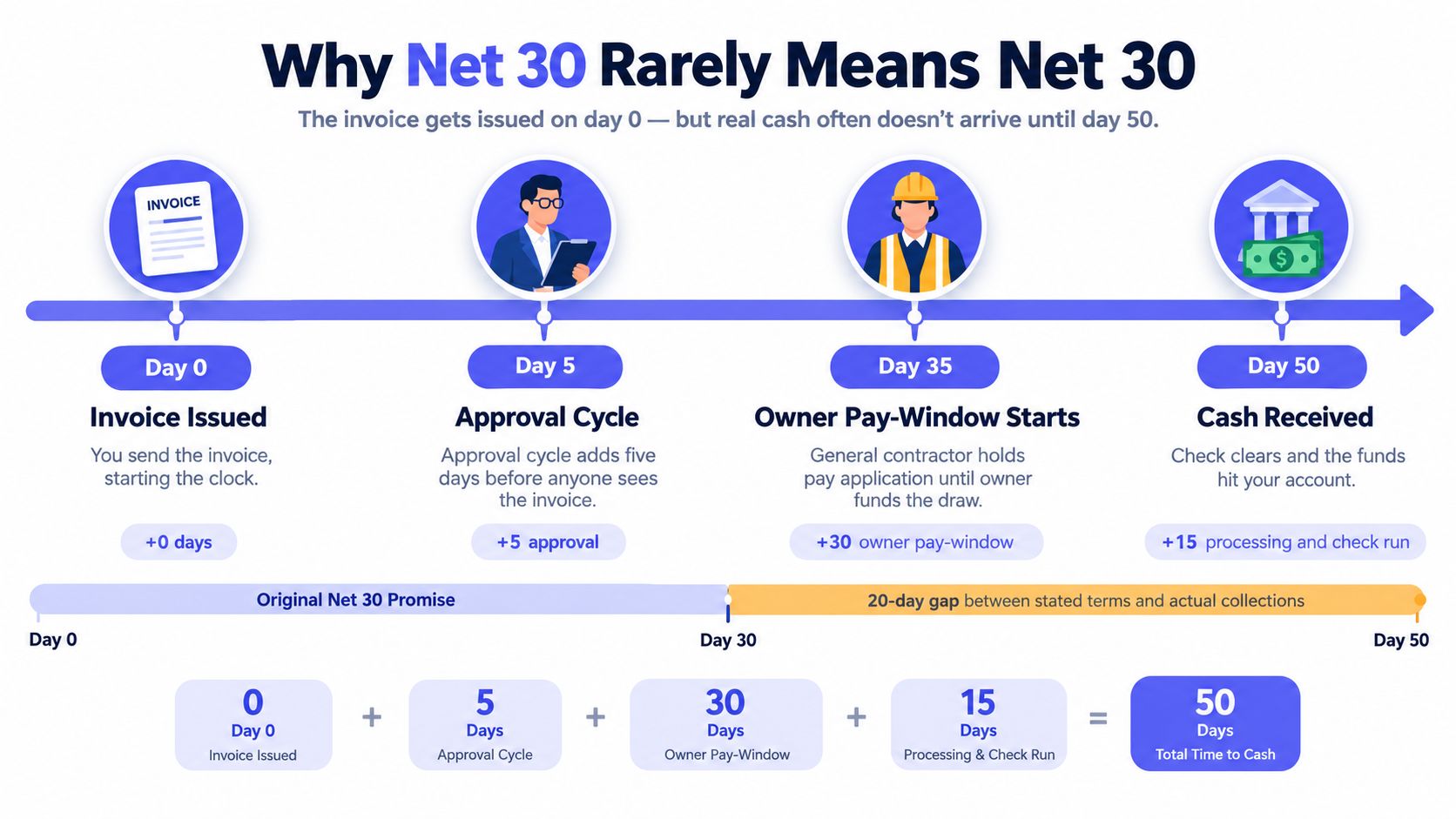
A Net 30 clause can leave you waiting far longer than 30 days. If the invoice clock starts only after approval, certification, or delivery of required documents, “Net 30” describes the final payment window, not the full cash-conversion cycle.
A project invoice may pass through submission, internal review, owner approval, lender funding, and bank processing. Each handoff can delay payment. Unless the contract assigns a deadline to each step, the payer controls the schedule while the contractor finances labor, materials, and payroll.
Measure the real collection window
Construction cash flow routinely extends beyond the headline term. The stated deadline may begin after completed work, not when the contractor incurs the cost. That gap is where payment disputes become working-capital problems.
Commercial projects add another layer. Pay applications may be monthly or milestone-based, and cash receipt can lag by 30 to 60 days. Some project-based work takes 45 to 75 days from completed work to funds in the contractor's account because of approval, owner funding, flow-down, and lien-waiver requirements, according to commercial contractor payment timing guidance.
Write the trigger and every handoff into the contract. Use language such as: “Payment is due 30 days after receipt of a properly submitted invoice. Approval, certification, or upstream funding may not extend the due date. The payer must identify disputed items in writing within the review period, and undisputed amounts remain payable on time.”
Before accepting the job, count from completed work to invoice submission, approval, certification, upstream funding, and deposit in your account. Price the labor and materials you must finance across that entire period, not just the advertised term.
How Terms Shift by Project Type
Payment structures should match exposure. A small repair, a full remodel, and a commercial build don't create the same financing risk, so they shouldn't use the same payment language.
| Project Type | Typical Deposit | Draw Frequency | Retainage | Contract Term |
|---|---|---|---|---|
| Small residential repair | Tied to scheduling and initial materials | Frequent or stage-based | Often limited or absent where lawful | Short, clearly stated window |
| Full remodel | Tied to mobilization and procurement | Milestone-based | State and contract controlled | Approval and payment deadlines |
| Commercial build | Defined in the prime contract and flow-down terms | Monthly or milestone-based applications | Governed by contract and applicable law | Layered approval and payment process |
Small residential repair
Short jobs usually need simple terms. Tie the initial payment to scheduling and materials, then collect against observable work stages. A weekly or stage-based draw can reduce the amount either party must finance.
The mistake is using a final payment structure for a job where the contractor buys materials upfront and waits until the end. The payment schedule should follow the contractor's actual cost curve.
Full remodel
A remodel needs more detail because several trades work in sequence. Use milestones such as rough-in approval, drywall completion, cabinet delivery, finish installation, and substantial completion. Each milestone should have a defined amount or percentage, a required inspection, and a deadline for objections.
Retainage can be useful, but it must not become an open-ended holdback. Connect it to a punch list and a release date.
Commercial construction
Commercial work commonly relies on formal pay applications, schedules of values, lien waivers, certifications, and upstream funding. The contractor may complete work in one month but receive money only after several parties review the application.
The contract should distinguish between approval and payment. It should also identify whether a pay-when-paid provision changes timing or merely allocates collection risk. A clause that makes payment dependent on an event outside the contractor's control deserves legal review before signing.
Retainage Working Capital and the 5 to 10 Percent Trap
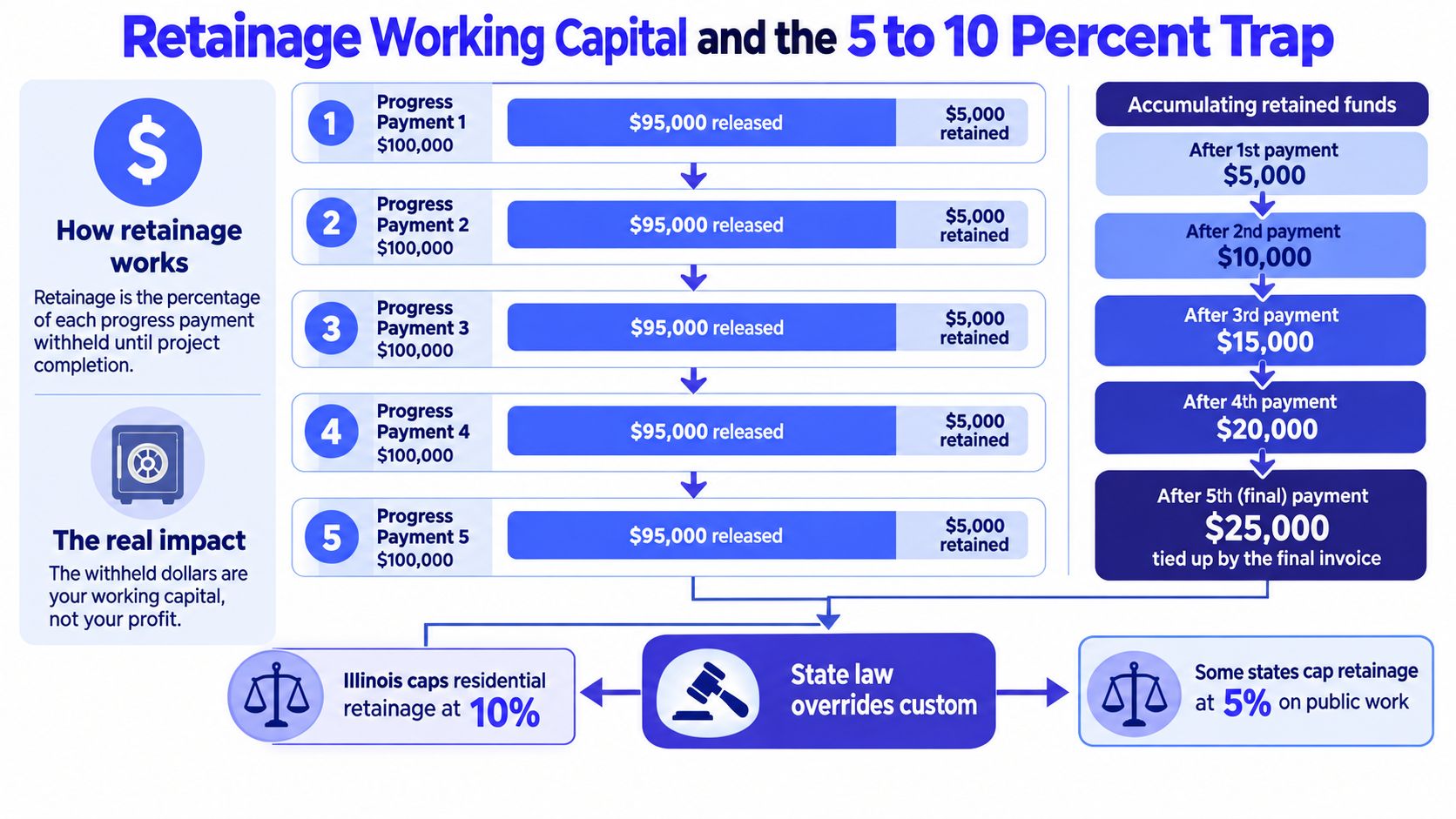
Retainage isn't automatically a late payment. It's a contractual holdback. That distinction matters because a payer may be prompt on every approved invoice while still withholding a portion of each payment until completion.
Industry guidance commonly describes retainage in the 5% to 10% range, but custom doesn't override the law. Illinois, for example, permits withholding up to 10% before a project reaches 50% completion. Once the contract is 50% complete, retained funds must be reduced so that no more than 5% is held, under the Illinois Contractor Prompt Payment Act.
Price the holdback, don't ignore it
A contractor who bills consistently while retainage accumulates carries an expanding receivable. That money may not arrive until punch-list completion, final acceptance, lien-waiver delivery, or another event stated in the contract. Retainage can also be released 30 to 365 days after completion, depending on the jurisdiction, contract language, and waiver status, according to construction retainage guidance from NetSuite.
Use one of three responses:
- Negotiate a lower rate: Ask for a smaller holdback when the work has low completion risk.
- Limit the duration: Set a firm release deadline after substantial completion.
- Use a release trigger: Tie payment to punch-list completion, occupancy, or formal acceptance where lawful.
A practical clause could read:
“Retainage shall not exceed the percentage permitted by applicable law. The retained amount shall be released within the stated contract period after substantial completion and completion of the agreed punch list, subject only to documented defective work.”
Federal construction terms also show why drafting matters. Under the Federal Acquisition Regulation retainage clause, retained amounts are due on the schedule stated in the contract or, if no schedule exists, 30 days after approval for release.
Liens Licensing and the Legal Floor Under Your Terms
A payment clause can't rescue an agreement that violates licensing, lien, or prompt-payment law. Before signing, identify the governing jurisdiction and check whether the contractor is licensed for the work being performed.
Mechanics liens can give an unpaid contractor or supplier a security interest in improved property. The notice and filing requirements vary, so a contractor who waits until a dispute escalates may already have lost ground. A homeowner should also understand what lien waivers mean. An unconditional waiver signed before cleared payment can surrender protection prematurely.
Prompt payment depends on the project
Federal and state prompt-payment rules can impose deadlines and interest when the required invoice and documentation are submitted correctly. The result is not automatic protection for a sloppy invoice. A missing approval, unsupported draw, or defective waiver can delay the legal clock.
For federally funded transportation work covered by the U.S. Department of Transportation's DBE rules, a prime contractor must pay a subcontractor for satisfactory performance no later than 30 days after the prime receives payment from the state DOT for that work. Retainage must also be paid within 30 days after the subcontractor's work is satisfactorily completed, as explained in the FHWA prompt-payment toolkit.
The contract should identify the required invoice format, approval contact, notice method, and escalation process. It should also preserve rights until payment clears.
Clauses that need scrutiny
- Pay-when-paid: Confirm whether it changes timing or only delays payment for a reasonable collection period.
- Pay-if-paid: Treat this as a major risk-transfer clause and obtain legal advice before accepting it.
- Broad lien waivers: Make them conditional on cleared funds.
- Unlicensed performance: Verify the license before work starts. In some jurisdictions, licensing violations can limit payment or lien rights.
For homeowner-side verification, how to verify a contractor license offers a useful starting point. Verify the license with the relevant authority, then match the licensed entity to the name on the contract.
Clauses That Actually Protect You and a Pre-Signing Checklist
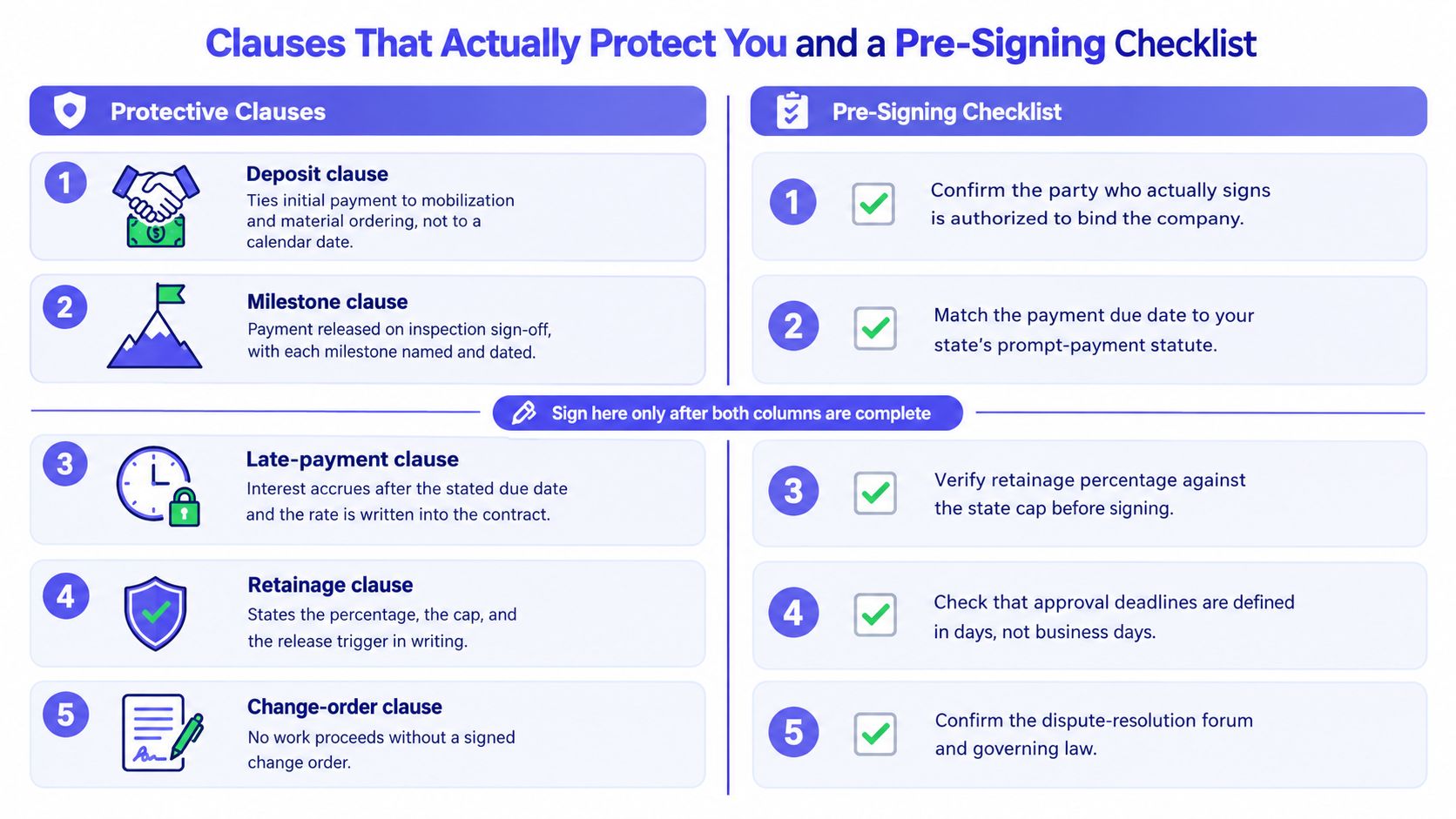
Strong payment language is specific enough to administer without guessing. It names the trigger, amount, document, deadline, and remedy.
Copy-ready starting language
Deposit clause
“The initial payment is due upon signing and shall be applied to mobilization, approved material ordering, and scheduling. The contractor shall provide reasonable documentation of ordered materials upon request.”
Milestone clause
“Payment is due after the listed milestone is completed and the required inspection or written approval is issued. The payer shall approve the milestone or provide a written itemized objection within the contract approval period.”
Late-payment clause
“Amounts not paid by the stated due date shall accrue interest at the lawful contractual rate, beginning on the day after the due date, unless the amount is subject to a documented good-faith dispute.”
Retainage clause
“Retainage shall not exceed the percentage permitted by applicable law. The retained amount shall be released after substantial completion and completion of the written punch list, subject to the release deadline stated in this agreement.”
Don't use “to the contractor's satisfaction” as a milestone. Replace it with an inspection result, delivery receipt, signed approval, or objective completion list. Don't give either party unlimited change-order rights. Require a signed description of scope, price, and schedule impact before extra work begins.
Twelve questions before signing
Every answer should be yes or a defined term.
- Is the contractor's license active and appropriate for the work?
- Are current insurance certificates attached?
- Is the change-order process written?
- Is the retainage percentage stated and lawful?
- Is the lien-waiver format identified?
- Is the payment method specified?
- Is a schedule of values attached?
- Is the dispute venue stated?
- Is the warranty period defined?
- Is the completion deadline stated, with any liquidated damages defined?
- Is the prompt-pay interest rate lawful and written?
- Does the contract explain what happens if the property is sold mid-project?
The contractor insurance requirements guide can help frame the insurance questions. The contract should then identify the actual policy types, limits, certificate holder, and cancellation notice terms that apply.
The Two Clauses Worth Fighting For
If you can negotiate only two provisions, fight for the schedule of values and the prompt-pay-with-interest clause.
A schedule of values breaks the contract into auditable line items. Each progress draw then corresponds to completed work instead of a subjective percentage. It also exposes front-loaded billing, missing scope, and unexplained increases before they become a payment dispute.
A useful schedule for a kitchen addition might separate design and permits, demolition, structural work, plumbing, electrical, cabinetry, countertops, finishes, cleanup, and closeout. Each line should have a value, a trigger, and a clear connection to the scope. Tiny line items aren't automatically improper, but unexplained fragmentation makes the draw harder to audit.
| Line Item | % of Total | Draw Amount | Trigger Event |
|---|---|---|---|
| Design and permits | Schedule-defined | Contract-defined | Approved plans or permits |
| Demolition and preparation | Schedule-defined | Contract-defined | Defined site preparation complete |
| Structural work | Schedule-defined | Contract-defined | Structural inspection approval |
| Plumbing and electrical | Schedule-defined | Contract-defined | Rough-in inspection approval |
| Cabinetry and countertops | Schedule-defined | Contract-defined | Delivery and installation |
| Finishes and closeout | Schedule-defined | Contract-defined | Substantial completion and punch list |
The prompt-pay clause should state when a proper invoice is received, how quickly the payer must object, when payment is due, and what lawful interest applies after default. It should also preserve the contractor's lien and dispute rights until funds clear. Under federal rules, retainage timing can depend on both the contract schedule and formal approval, which is why vague release language creates avoidable risk.
A clear schedule tells both sides what has been earned. A clear prompt-pay clause tells both sides what happens next. Together, they replace trust-based billing with records, dates, and an escalation path.
If you're hiring a professional, Hand Vetted Co. connects you with one exclusive, verified business rather than distributing your request to multiple companies. Visit Hand Vetted Co. to find a licensed, background-checked professional and discuss the payment schedule before work begins.