A new roof in 2026 typically runs roughly $4 to $11 per square foot installed, with most homeowners landing somewhere between $9,000 and $20,000 for a standard asphalt shingle replacement. The actual number depends on roof size, material, pitch, tear-off requirements, and overall complexity.
You're probably looking at a quote that feels disconnected from every number you've seen online. One roofer says $9,000. Another says $17,000. A third gives you a suspiciously neat price that excludes half the work.
That spread isn't automatically dishonest. Roof pricing changes fast when the roof is steep, the house has multiple valleys, old layers need removal, or the decking is rotten underneath. A national average can give you a starting point, but it won't tell you what your roof costs.
Table of Contents
- Cost Range for a New Roof in 2026
- How Roofers Actually Price a Job
- Material Choices and What They Do to Your Quote
- Where the Money Goes Beyond the Shingles
- Two Worked Roof Cost Examples
- Your Step-by-Step Estimate Checklist
- Financing, Insurance, and Finding a Pro You Trust
- Your Next Move on a New Roof
Cost Range for a New Roof in 2026
A typical single-family home with asphalt shingles usually falls between $9,000 and $20,000 for replacement in 2026. Complex designs and premium materials can push the bill above $30,000. Independent pricing guidance places mainstream installed costs around $4 to $11 per square foot, with a broad average near $9,500 (NerdWallet's roof replacement cost guide).
Roofers also quote by the roofing square. One square equals 100 square feet of roof surface, putting that mainstream range at roughly $400 to $1,100 or more per square. The measurement covers the roof surface, not your home's living area.
Practical rule: Use national figures to set a budget, not to approve or reject a quote. The written scope matters more than the headline average.
Five variables move the price most:
- Roof size: More squares mean more shingles, underlayment, labor, and disposal.
- Material tier: Asphalt costs far less than metal, tile, or slate.
- Pitch and complexity: Steep slopes, dormers, valleys, and difficult access slow installation.
- Tear-off layers: Removing multiple existing roofs adds labor and hauling.
- Regional labor rates: Labor and permitting costs vary by market, so identical roofs can receive different quotes.
Verisk reported an average U.S. replacement cost of $17,631 in 2025, compared with $4,699 for roof repairs (Verisk's 2025 roofing realities report). Repair and replacement are different financial decisions, and that gap shows why you should not compare them as if they were interchangeable.
A single average can conceal roughly $10,000 in project variation. The worked estimates later show how the calculation changes between a straightforward asphalt roof and a complicated metal installation.
How Roofers Actually Price a Job
Roofers usually price the roof surface, not the home's floor plan. A roofing square equals 100 square feet, so a roof measured at 2,000 square feet equals 20 squares. A rate of $4.50 per square foot equals $450 per square, before any scope changes.
That conversion is simple, but people still get caught by it. A 2,000-square-foot house may have a roof much larger than 2,000 square feet because of pitch, overhangs, garages, porches, and attached structures.
What installed pricing should include
“Installed” should mean more than shingles dropped at the curb. A complete price generally bundles the roofing material, underlayment, flashing, ventilation work, installation labor, normal overhead, and disposal, although every contractor defines the bundle differently.
You'll normally see one of two quote formats:
- A total installed price: Convenient, but only useful if the scope is detailed elsewhere.
- A line-item estimate: Easier to audit because it separates tear-off, materials, labor, repairs, permits, and upgrades.
The second format is safer. If a quote only says “new roof, $12,000,” you don't know whether the contractor included removal, ice-and-water protection, drip edge, flashing replacement, or plywood repairs.
Before accepting a bid, use these roof project scoping questions to force a clear answer about what's included.
A low per-square price without a written scope is not a bargain. It may exclude tear-off, valley metal, code upgrades, disposal, or ventilation. Those omissions can turn a cheap-looking quote into an expensive final invoice.
Material Choices and What They Do to Your Quote
Material choice is the largest technical cost separator. The covering affects not only the product price, but also installation time, roof weight, flashing details, and whether the structure needs review.
The ranges below reflect installed pricing guidance for common systems. They're useful for comparing material classes, but your roof's design and local labor market still control the final bid.
Residential Roofing Materials Compared
| Material | Installed Cost / sq ft | Lifespan | Best For |
|---|---|---|---|
| 3-tab asphalt | Roughly $4 to $6 | Qualitatively shorter than architectural asphalt | Tight budgets and simple replacement projects |
| Architectural asphalt | Roughly $4 to $10 | Around 30 years in common guidance | Most standard homes seeking a practical balance |
| Standing-seam metal | Roughly $8 to $16 | About 40 to 70 years | Long hold times, durability, and modern designs |
| Concrete or clay tile | Roughly $10 to $27 | Long service life when properly installed | Suitable structures and climate-specific designs |
| Synthetic slate or shake | Roughly $8 to $18 | Long service life, product dependent | Slate appearance with less weight |
The installed ranges come from roofing material cost guidance from EZ Estimator and 2026 material pricing from Excel Roofing. Those sources show the central tradeoff clearly. Standard asphalt commonly sits near the lower end, while tile and slate systems rise sharply.
Architectural asphalt is the workhorse choice. It usually makes sense if you want a conventional appearance, manageable installation, and a cost that stays within the mainstream replacement band.
Standing-seam metal costs more upfront, but it can be rational if you expect to remain in the property for decades. Tile looks excellent and handles certain climates well, but its weight means the structure and installation details deserve serious review.
Synthetic slate or shake gives you a premium appearance without the full weight of natural slate. It still isn't a budget roof, but it can avoid some of the structural complications associated with heavier materials.
Don't choose a material based only on lifespan. Match it to your budget, climate, roof framing, maintenance tolerance, and expected time in the home.
Where the Money Goes Beyond the Shingles
The shingles are visible, so people focus on them. The quote often grows through the work underneath and around them.
A contractor should identify each of these items in writing. If the estimate hides them inside a vague “miscellaneous” allowance, ask for clarification before signing.
Cost Breakdown Beyond Shingles
| Component | Typical Cost | Notes |
|---|---|---|
| Tear-off and disposal | $1 to $3 per sq ft | Depends on layers and hauling |
| Synthetic underlayment | $0.40 to $0.80 per sq ft | Waterproofing layer beneath the roof covering |
| Ice-and-water shield | $0.60 to $1.20 per sq ft | Usually limited to vulnerable zones |
| Chimney, vent, or skylight flashing | $300 to $900 per penetration | Condition and access affect the price |
| Full re-flashing | $1,000 to $2,500 | Applies when existing flashing needs replacement |
| Drip edge and starter strip | $2 to $4 per linear foot | Protects roof edges and improves shingle installation |
| Permit | $150 to $800 | Depends on the jurisdiction |
| Plywood decking repair | $70 to $100 per sheet | Added when tear-off reveals rot |
| Roof vent | $300 to $600 each | Mechanical or upgraded ventilation work |
| Ridge vent | $8 to $12 per linear foot | Installed along the roof ridge |
Tear-off deserves special attention. A quote may look competitive because it prices only the new covering, then adds removal after the inspection. Multiple layers also increase debris, labor, and disposal requirements.
Flashing is another common surprise. Chimneys, skylights, plumbing penetrations, and wall intersections are where water gets opportunities to enter. Reusing damaged flashing to preserve a low bid is false economy.
How to audit the estimate
Check whether the bid identifies the underlayment type, ventilation plan, flashing treatment, disposal method, permit responsibility, and the rate for unforeseen decking repairs. You don't need every item to be included in the base price, but you do need to know whether it's included, excluded, or priced as an allowance.
The goal isn't to eliminate every possible extra. It's to make the extras visible before the crew starts tearing off the roof.
Two Worked Roof Cost Examples
Roof math becomes easier when you stop thinking in vague home sizes and start thinking in squares, material rates, and site conditions.
Example A with architectural asphalt
Take a single-story ranch with a 1,700-square-foot roof, a moderate 6/12 pitch, easy access, and a single existing layer. The measured roof area works out to 18 squares after accounting for the roof's actual surface and waste.
The estimate might look like this:
- Materials: 18 squares at roughly $135 per square
- Installation labor: 18 squares at $200 per square
- Tear-off: 18 squares at $75 per square
- Permits and overhead: Added as separate project charges
- Decking: No repair allowance used because the sheathing is sound
That structure lands near $11,500, depending on the permit, disposal, flashing, and ventilation scope. A benchmark from Roofing Calculator places a typical 1,700-square-foot asphalt roof around $6,000 to $9,000, so a higher result needs a clear explanation of what the quote includes.
Example B with complex standing-seam metal
Now consider a two-story home with a 2,400-square-foot footprint, a steep 10/12 pitch, multiple valleys, two chimneys, and a roof measured at 28 squares. The project uses standing-seam metal, requires a two-layer tear-off, includes partial decking replacement, and needs upgraded flashing.
The cost drivers shift quickly:
- Material: 28 squares at roughly $450 per square
- Complexity labor: 28 squares at $350 per square
- Tear-off: Higher than Example A because two layers must be removed
- Decking: Partial replacement added after inspection
- Flashing: Upgraded around the chimneys and penetrations
- Permits and disposal: Included in the final project scope
That project can push the total near $42,000. It sits well above the mainstream asphalt range because the material, pitch, access, tear-off, and detailing are all more demanding.
Side-by-Side Estimate Walkthrough
| Line Item | Example A: Simple Asphalt | Example B: Complex Metal |
|---|---|---|
| Roof size | 18 squares | 28 squares |
| Material rate | About $135 per square | About $450 per square |
| Labor rate | $200 per square | $350 per square |
| Tear-off | $75 per square | Higher for two layers |
| Decking | No damage assumed | Partial replacement |
| Flashing | Standard scope | Upgraded chimney flashing |
| Approximate total | Near $11,500 | Near $42,000 |
These are worked planning examples, not promises of what a specific property will cost. The lesson is straightforward: square footage starts the estimate, but complexity finishes it.
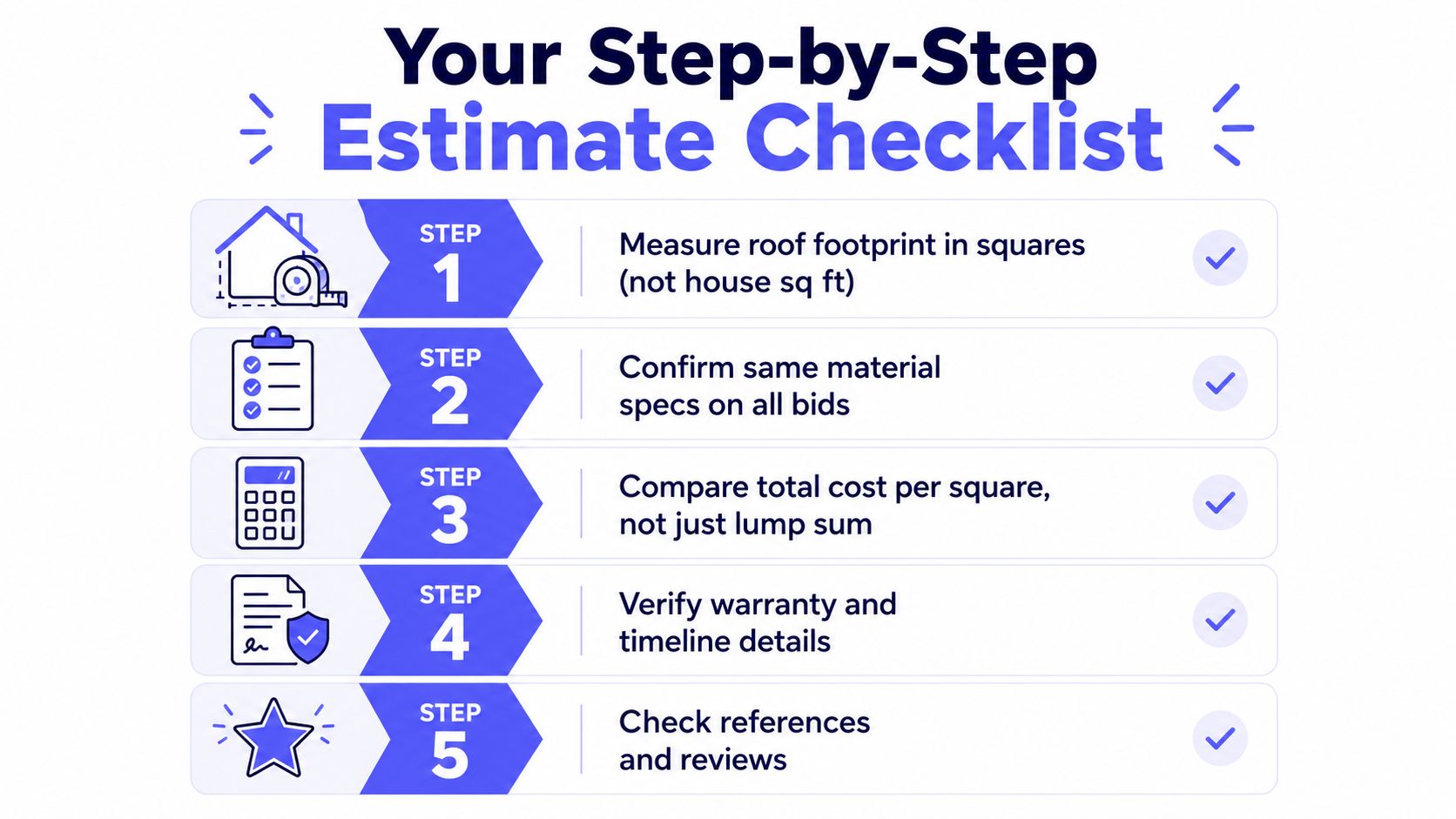
Your Step-by-Step Estimate Checklist
Collecting bids only helps if every roofer prices the same job. Otherwise, you're comparing a complete installation against a partial scope.
Build comparable bids
Measure the roof footprint in squares. Confirm the actual roof surface through an inspection, attic measurements, or reliable satellite measurement. House square footage alone isn't enough.
Choose the material and tier first. Ask every bidder to quote the same product class, such as architectural asphalt or standing-seam metal. Otherwise, the cheapest bid may use a cheaper roof.
Require a line-item proposal. The bid should address tear-off, underlayment, flashing, ventilation, permits, disposal, and the price per sheet for decking replacement.
Verify the business in writing. Confirm the required state license, insurance certificates, manufacturer certifications, warranty terms, and who will perform the work.
Ask operational questions. Get the crew size, projected start date, payment schedule, cleanup process, and contact responsible for resolving problems.
Use the project budget example as a reference when you're checking whether a contractor has explained the full scope.
Red flags that deserve a hard stop
- Vague scope: “Complete roof replacement” without materials or exclusions leaves too much open.
- Missing disposal: Someone still has to remove and haul away the old roof.
- Storm-chaser behavior: Door-to-door urgency after a storm is a reason to slow down, not sign faster.
- An unusually low quote: A price far below the others may omit labor, tear-off, or proper materials.
- Cash-only demands: Refuse payment arrangements that leave no clear paper trail.
- No physical business address: You need a real way to find the company after the job.
Don't pay more than 10% or $1,000 upfront, whichever is less, unless local law and a carefully reviewed contract justify a different arrangement. Ask for 10 references and the right to drive by a recent completed project. A legitimate roofer should be comfortable with both requests.
Financing, Insurance, and Finding a Pro You Trust
Cash is the cleanest option, but many people need financing for a five-figure roof. Compare the total repayment, not just the monthly payment.
Contractor financing may advertise 0% promotional terms, but deferred-interest language can make the balance expensive if you miss the payoff conditions. Home equity loans and HELOCs often offer lower interest than unsecured borrowing, but they take longer to arrange and place the home behind the debt. Personal loans and credit cards are faster, yet they can carry a higher total cost.
I won't attach APR bands here because the offer depends on the borrower, lender, term, and product. Read the actual agreement, including the promotional period, origination fees, variable-rate language, and consequences of late payment. The home improvement financing options guide can help you organize that comparison.
What insurance usually covers
Most policies are designed to cover sudden, storm-related damage, not ordinary aging. Your policy may distinguish between actual cash value, which applies depreciation, and replacement cost, which can reimburse eligible replacement expenses under the policy terms.
Document the condition before repairs begin. Photograph interior stains, damaged shingles, gutters, flashing, and attic moisture. Keep inspection records, invoices, and communication with the insurer. Don't let a roofer promise coverage that only the carrier can determine.
Why shared lead marketplaces create pressure
Lead marketplaces can sell the same contact details to several contractors. That creates competing calls, rushed inspections, and sales conversations focused on winning the lead rather than defining the work.
Hand Vetted Co. offers a different route. Its platform connects a homeowner with one professional, with licensing, background screening, ratings, and human review checked before the match. The request remains exclusive, so you can have a focused conversation instead of managing a crowd of salespeople.
Request a match through Handvetted when you're ready for a vetted, no-pressure roofing quote. You should still review the written scope, insurance, references, and contract yourself.
Your Next Move on a New Roof
Plan around $9,000 to $20,000 installed for a mainstream asphalt replacement in 2026. The broader installed benchmark is roughly $4 to $11 per square foot, with higher totals for larger roofs, premium materials, steep pitches, difficult access, multiple tear-offs, and expensive labor markets (HomeAdvisor's roof installation cost guidance).
Keep the five major variables in front of you:
- Roof size in squares
- Material and product tier
- Pitch and design complexity
- Existing layers and tear-off
- Regional labor and permitting
Take these steps this week:
- Measure or confirm the roof footprint from attic measurements or satellite imagery.
- Photograph interior stains and any visible exterior damage.
- Request three material-specific quotes with identical scopes.
- Confirm each bidder's license and insurance in writing.
- Ask for two recent local references and visit one completed job if possible.
Return to the estimate checklist above before comparing bids. A tight scope produces tighter pricing, and it makes a low bid easier to distinguish from an incomplete bid.
If you don't want to sort through an unverified list of roofing companies, request one pre-vetted match and keep the conversation focused on your roof, budget, and actual project requirements.
Hand Vetted Co. connects you with one verified professional for roofing and other home projects, after checking licensing, background screening, ratings, and business quality. Visit Hand Vetted Co. to request an exclusive match and start with a qualified pro instead of a shared lead funnel.