A homeowner approves a renovation, pays the first invoice, and then notices the finished work doesn't match the agreed plan. The contractor says the difference came from a conversation on site. The homeowner remembers no approval, only a vague promise to “take care of it.” Days later, the project is late, the next payment is withheld, and every new message sounds more hostile than the last.
That situation is common because contractor disputes rarely begin as legal disputes. They begin as unclear scope, undocumented changes, delayed information, or an invoice that doesn't match anyone's records. The strongest contractor dispute resolution strategy is therefore simple: create clarity early, preserve evidence continuously, and intervene before disagreement becomes a fight about credibility.
Table of Contents
- The Reality of Contractor Disputes
- Building Your Evidence Trail
- Negotiating Directly Before Escalating
- Choosing Between Mediation, Arbitration, and Court
- Filing Complaints with Licensing Boards
- Avoiding Common Pitfalls
- Your Action Plan for Resolution
The Reality of Contractor Disputes
A disagreement can begin with a single unresolved detail. The contract describes one result, a drawing appears to show another, and a verbal site instruction fills the gap. The contractor proceeds on one interpretation. The owner expects another. By the time the work is visible, both sides believe the other changed the agreement.
The evidence trail often determines whether that disagreement stays manageable. A dated drawing, written instruction, inspection record, or payment note can clarify what happened before positions harden. Without those records, the dispute becomes a contest between recollections, assumptions, and incomplete messages.
Formal letters usually arrive after practical options have narrowed. The contractor may be carrying unpaid labor and material costs. The homeowner may be facing an unfinished room, added living expenses, or concerns about safety and workmanship. Litigation can establish legal rights, but it cannot restore the time, access, or routine the project has already consumed.
Construction conflict is a recurring project risk, not an isolated exception. A National Academies report on construction disputes estimated that serious disputes arise in 10% to 30% of construction projects, and that one in four projects has a claim. It also estimated that transaction costs associated with resolving disputes and claims may reach $4 billion to $12 billion or more each year. Those figures show why early documentation and intervention deserve attention before a claim becomes expensive.

Prevention beats courtroom strategy
Start with a narrower question than “Who can I sue?” Ask what can still be clarified, inspected, repaired, or agreed today.
Early intervention preserves choices. The parties can compare the signed scope with completed work, confirm whether a change was approved, arrange an inspection, or tie payment to a defined milestone. Accusations of bad faith make each option harder to use.
Practical rule: Treat every scope disagreement as a future evidence problem. Put the issue in writing while the facts are still fresh.
Large disputes can move slowly and tie up substantial sums. Arcadis reported an average global dispute value of US$52.6 million in 2021, with an average resolution time of 15.4 months, in construction dispute data summarized by the National Academies construction dispute resource. Residential projects are usually smaller, but delay still increases pressure, cost, and distrust.
Documented intervention is the next practical step. State the disputed work or obligation, identify the relevant contract language or site condition, propose a workable remedy, and set a response date. If the other party refuses inspection, ignores written clarification, or continues defective work, those responses become part of the record and help determine whether direct resolution remains realistic.
Building Your Evidence Trail
Before sending a demand, build the file. A valid grievance can still fail if you can't show what the parties agreed to, when the problem appeared, who knew about it, and what happened afterward.
Start with one master folder. Use clear filenames, preserve original messages, and save documents in formats that show dates and authorship. A shared, read-only folder can help prevent later disputes about whether a file was altered, deleted, or added after the fact.
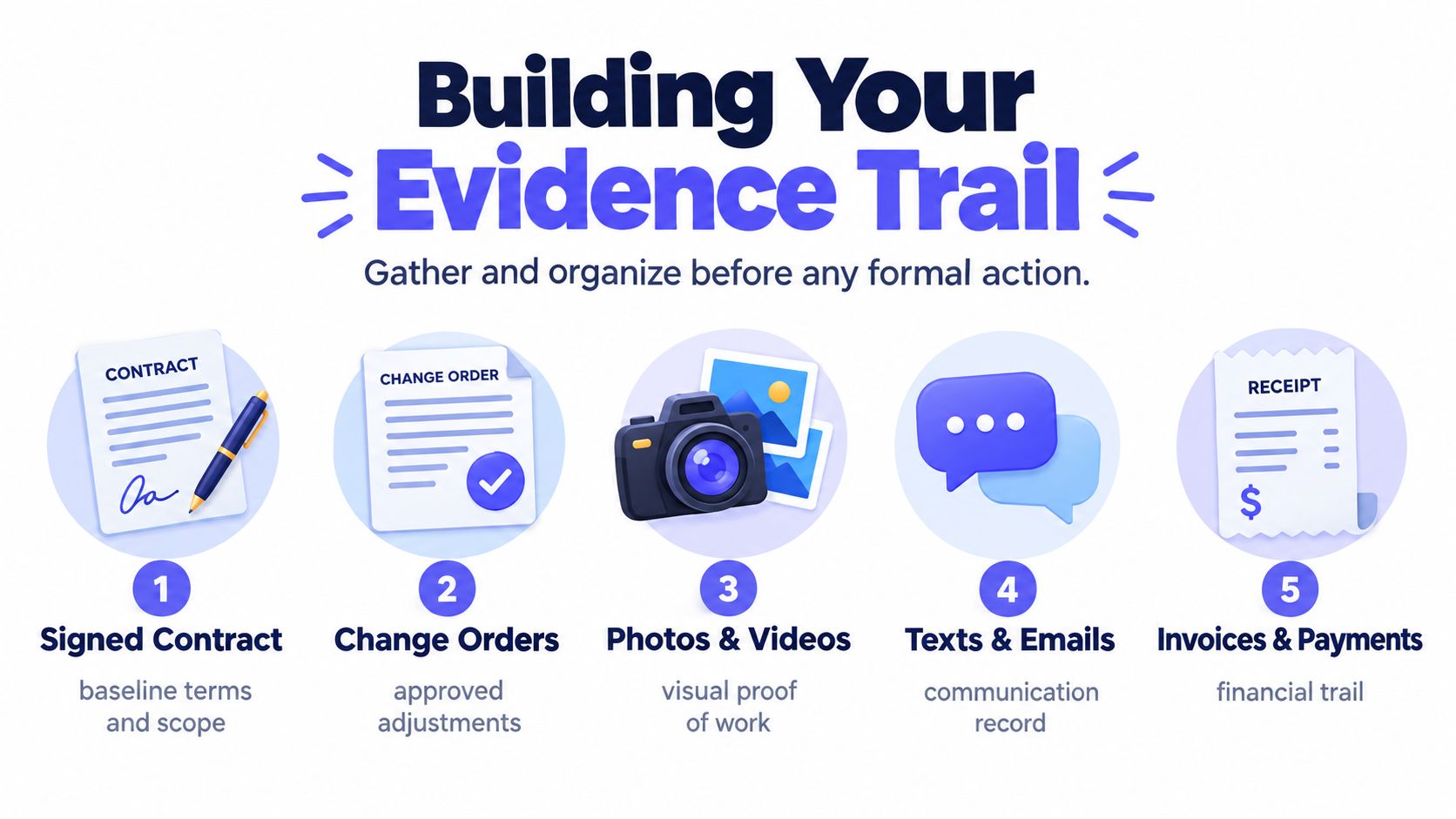
The core documentation checklist
- Signed contract: Keep the complete agreement, attachments, specifications, plans, warranty language, payment schedule, and dispute clause together.
- Change orders: Save every approved adjustment, including revised price, materials, scope, and schedule impact. If a change was discussed verbally, write a confirmation message immediately.
- Photos and videos: Capture work progress, concealed conditions before they disappear, damaged areas, deliveries, and incomplete items. Keep the original files and note when they were taken.
- Texts and emails: Export or save the complete conversation rather than isolated screenshots. Preserve messages that show requests, approvals, warnings, refusals, and promised dates.
- Invoices and payments: Match each invoice to the relevant work, receipt, payment confirmation, lien waiver, or disputed amount. Record partial payments and the reason for withholding any balance.
Make the record usable
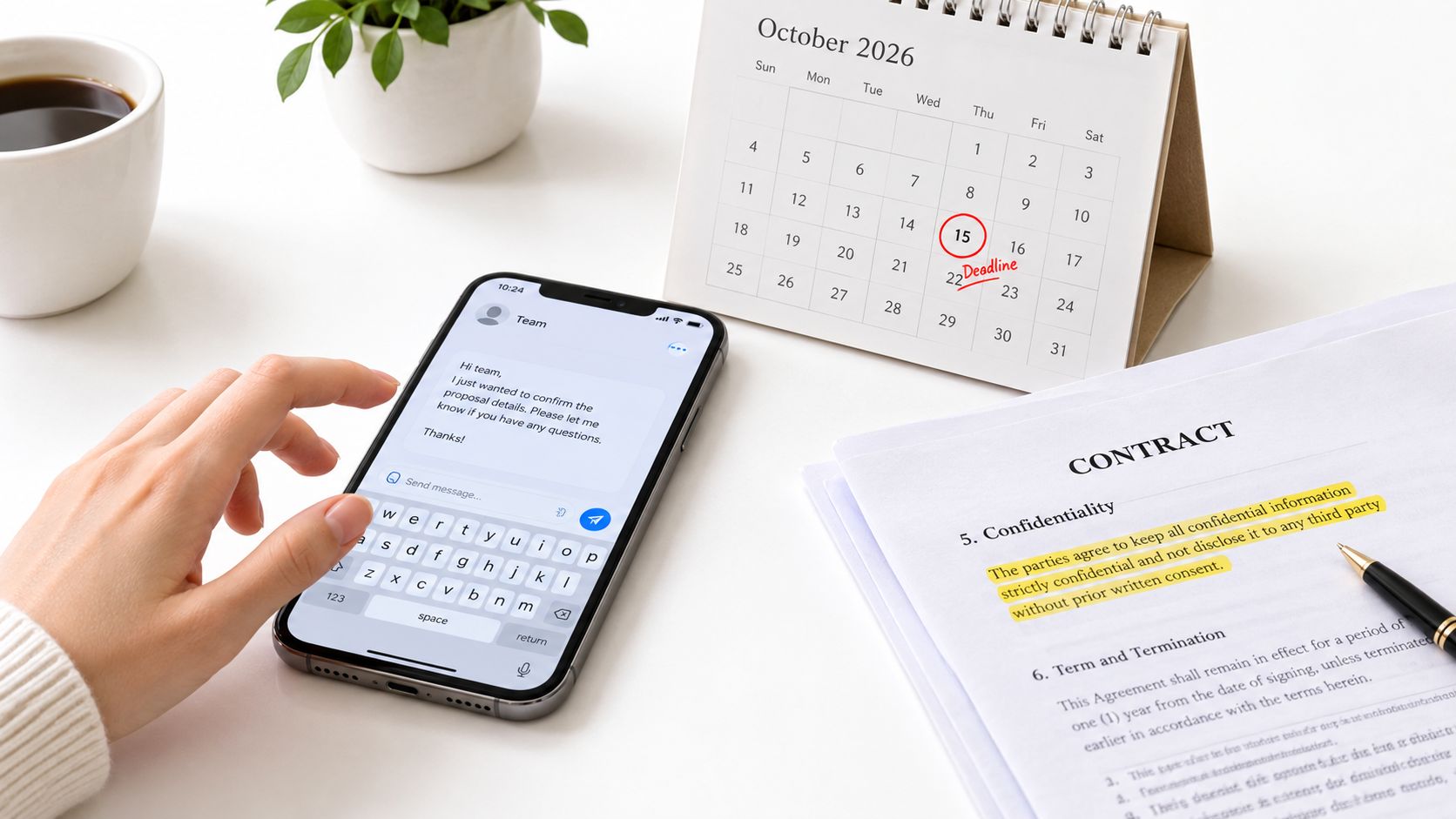
Timestamp more than photographs. Add dates to inspection notes, calls, site meetings, delivery records, and revised estimates. After a phone call, send a short recap: “Confirming our discussion today, the tile selection will change to X, the price impact is Y, and no installation will begin until written approval.”
Don't bury important facts in a long email chain. Create a chronology with four columns: date, event, supporting document, and unresolved question. A mediator or attorney should be able to understand the dispute without asking you to reconstruct the project from memory.
For insurance-related property damage, keep the evidence trail separate from the construction contract file, but cross-reference the same dates and affected areas. The guidance on documenting a homeowner insurance claim can help organize photographs, correspondence, estimates, and payment records.
Weak evidence usually creates one of two problems. It makes a strong claim look speculative, or it forces the decision-maker to choose between competing memories. Neither outcome helps you negotiate. Good records don't guarantee success, but they make the issue visible and narrow the room for invented history.
Negotiating Directly Before Escalating
Direct negotiation should usually come first because it gives the parties the fastest chance to fix a defined problem without paying a third party to discover what happened. It works best when the conversation is structured, written, and focused on the work rather than the personalities.
Start with a fact pattern, not an accusation. Identify the contract section, invoice, drawing, photograph, or message that supports your position. Then state what you want the other party to do.
Use a clear opening message
A useful first message can follow this structure:
On [date], we agreed to [specific scope or obligation]. The current condition is [specific fact], which differs because [documented comparison]. I've attached [documents or photographs]. I'm asking that we [repair, complete, credit, inspect, or approve] by [date]. Please confirm your position in writing by [reasonable response date].
Avoid words such as “fraud,” “scam,” or “breach” in the first message unless a lawyer has advised you to use them. Those terms may feel powerful, but they often make a practical correction harder. Your objective is to create a record that a neutral person can understand, not to win an argument in the inbox.
A direct negotiation can address several interests at once. A contractor may need prompt payment for undisputed work. An owner may need a completion date and confidence that defective work won't be covered prematurely. A subcontractor may need access to the site or a decision on materials before work can continue.
A firm demand letter
If the initial message doesn't work, send a concise demand letter. Include:
- The parties, project address, and contract date.
- The specific obligation or work item in dispute.
- A factual timeline with relevant dates.
- The amount claimed or the requested corrective work.
- The documents supporting your position.
- A proposed resolution.
- A response deadline.
- A statement that you reserve available rights without making unnecessary threats.
The demand should distinguish disputed sums from undisputed sums. Withholding every payment can create a separate problem if part of the invoice is plainly owed. Likewise, a contractor shouldn't demand payment for work that the records show was never completed or approved.
Document every attempt to resolve the matter. Save delivery confirmations, unanswered messages, call logs, meeting notes, and responses. If the other party offers a site meeting, send an agenda in advance and a written recap afterward.
Set a deadline that allows time for a meaningful review. A deadline isn't a trap. It's a way to stop an open-ended exchange and create a decision point. If the response is constructive, keep negotiating. If the response is evasive, hostile, or silent, the evidence file will show that you tried the lower-friction path before escalating.
Choosing Between Mediation, Arbitration, and Court
A contractor stops work after rejecting your interpretation of a change order. The owner withholds the disputed amount, the schedule slips, and both sides begin collecting messages that support their own version. Before filing, review the contract and the evidence trail. The dispute clause may require mediation, direct the matter to arbitration, name a venue, or impose notice steps that affect your rights.
Mediation usually fits when both parties still have something to gain from settlement. A neutral mediator does not normally impose a decision. Instead, the mediator tests each side's records, exposes weak assumptions, and helps the parties exchange certainty for closure. Bring the contract, change orders, photographs, payment history, schedule records, and a short chronology. A mediator cannot repair a missing evidence trail, but can help both sides assess what a judge or arbitrator may see.
Construction-specific studies reported that mediation fully resolved 59.1% of cases, while another 7.9% partially settled, according to the JLC discussion of mediation in construction disputes. The same discussion describes practice summaries with success rates above 85% and, in some settings, above 92%. Those figures do not predict your result. They show why early, well-prepared mediation can be more productive than immediate litigation.
Arbitration follows a more formal process. An arbitrator reviews the evidence and arguments, then issues a decision that may be binding under the contract and applicable rules. The American Arbitration Association's construction dispute resolution guidance explains that its construction clause sends covered controversies or claims to arbitration under the AAA Construction Industry Arbitration Rules. The resulting award may be entered as a court judgment.
Court may be necessary when the other party refuses to participate, when you need remedies mediation cannot provide, or when the contract does not require another forum. Small claims court can suit a lower-value dispute, but jurisdiction caps, procedures, and available remedies depend on the court. A technically complex claim may require a process that can handle expert evidence and extensive records.
Compare the financial trade-off
The benchmark in the mediation research shows the practical trade-off: as formality increases, median transactional costs rise before either side reaches the merits. These figures are not a quote for your dispute, and they do not include every project-specific expense.
| Method | Median Cost | Success Rate |
|---|---|---|
| Negotiation | $51,000 | Not stated in the benchmark |
| Mediation | $106,000 | 59.1% fully resolved, with 7.9% partially settled |
| Arbitration | $271,000 | Not stated in the benchmark |
Mediation preserves the most control while adding an independent view. Arbitration provides a definite ruling, but costs can grow when experts, document production, and legal submissions expand. Court offers formal enforcement tools and broader remedies, yet it requires patience, preparation, and procedural discipline.
Choose the forum by examining the relationship, evidence, contract language, and amount at stake. A continuing working relationship favors mediation. A broken relationship with strong records may justify arbitration or court after a firm demand. A lower-value claim may not support extensive fees. If the clause is unclear, obtain legal advice before paying for the wrong process.
Filing Complaints with Licensing Boards
A licensing board complaint is a regulatory step, not a substitute for a private claim. The board may investigate licensing violations, workmanship issues within its authority, insurance or bonding requirements, or conduct that breaches state rules. It may not award every form of compensation available through a contract action.
Start by confirming the correct agency and its filing requirements. Complete the official form, identify the contractor and project, describe the problem in chronological order, and attach only relevant evidence. Include the contract, change orders, photographs, invoices, payment records, inspection reports, and written attempts to resolve the issue.
Build a complaint a reviewer can follow
Organize the submission around questions a regulator can answer:
- What was promised: Identify the contract scope, license information, and payment terms.
- What happened: Use dated facts rather than conclusions about motive.
- What remains unresolved: Separate incomplete work, defective work, unpaid amounts, and safety concerns.
- What supports each point: Label attachments so every important statement leads to a document.
- What you want: State whether you're seeking investigation, corrective action, reimbursement through an available process, or clarification of licensing obligations.
Check the board's privacy and records rules before filing. Complaints may be treated as public records in some jurisdictions, and an investigation can affect a professional's regulatory standing. Don't assume the filing itself will produce a payment or force a repair. Ask the agency what authority it has and what outcome its process can deliver.
Insurance adds another track. Notify the relevant carrier promptly when the dispute involves covered damage, defective work allegations, property damage, or an insured event. Send the policy information, photographs, estimates, correspondence, and a clear explanation of the loss. A carrier may separate covered damage from contract performance issues, so present those categories accurately rather than describing every project disagreement as an insurance claim.
If the carrier denies coverage, preserve the denial letter and review the stated reason against the policy language. Request the specific provision relied upon and ask what additional documentation would change the decision. A licensing complaint and an insurance appeal can proceed alongside private negotiation, but they shouldn't replace professional legal advice where deadlines or substantial damages are involved. Before hiring or retaining a professional for future work, use a process for verifying a contractor's license and save the result with the project records.
Avoiding Common Pitfalls
The same mistakes appear across otherwise different projects. People document the problem after the argument, use a threatening tone before gathering facts, and discover the dispute clause only after filing in the wrong forum.
Act earlier. A photograph taken after demolition can't show the concealed condition that existed before demolition. A text message sent months later can't reliably capture what the parties meant during a fast site conversation. Save evidence as the project changes, not when the relationship breaks.
Four mistakes that weaken leverage
- Waiting to write: Confirm instructions, approvals, delays, and objections while everyone remembers the event.
- Using aggression as strategy: Firm language is useful. Personal attacks, public accusations, and legal threats often reduce cooperation without strengthening proof.
- Ignoring the contract: Review notice rules, payment conditions, warranty procedures, mediation requirements, arbitration clauses, and venue provisions before escalating.
- Failing to mitigate: Take reasonable steps to prevent additional damage. Protect exposed areas, secure the property, arrange necessary temporary work, and keep receipts. Don't authorize extensive replacement work before giving the responsible party a fair opportunity to inspect unless safety requires immediate action.
Scope changes are a frequent pressure point. HKA's CRUX data reported that disputed costs averaged 33.6% of project capital expenditure, and identified scope change as the leading global cause, followed by conflicting contract interpretations and delayed design information, as summarized in the CMAA State of Construction resource. The number is a reminder to treat changes as commercial decisions, not casual conversations.
Sometimes the right decision is to walk away. If the professional refuses reasonable documentation, leaves unsafe work exposed, or turns every clarification into another confrontation, preserving the relationship may cost more than replacing the person. Before ending the contract, review termination rights, protect the site, document the condition, and obtain advice about payment and replacement work. For the next hire, check more than a star rating. Review the professional's contractor background check standards and keep the verification record.
Your Action Plan for Resolution
Start with the facts you can prove. Then choose the least expensive process that can realistically produce the result you need.
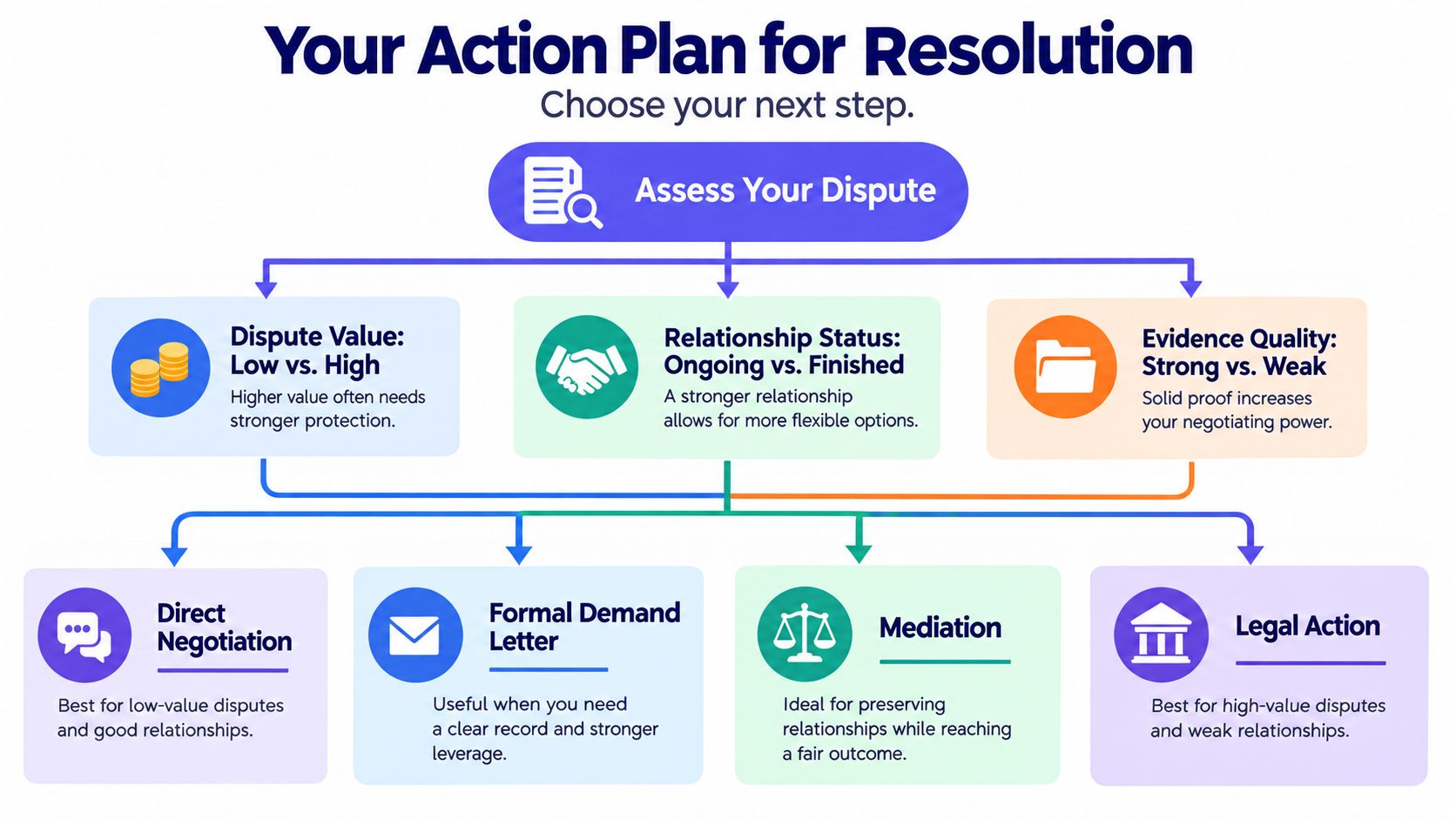
Match the response to the dispute
| Situation | Best next move | Reason |
|---|---|---|
| Low value, active relationship, strong records | Direct negotiation | The parties can solve a defined issue without adding process cost. |
| Moderate value, unresolved facts, relationship still workable | Mediation | A neutral person can test the evidence and help structure a settlement. |
| High value, clear contract, little trust | Formal demand followed by the required formal process | Written leverage and procedural compliance matter more than continued informal discussion. |
| Weak evidence, incomplete work, or disputed cause | Pause escalation and strengthen the file | A stronger record may change the negotiation before fees increase. |
| Safety risk or continuing damage | Protect the property, notify relevant parties, and obtain qualified advice | Immediate mitigation may matter more than preserving a perfect sequence of communications. |
| Relationship irreparably broken | Consider replacement and formal advice | Continuing may increase cost, delay, and damage even if the original claim is valid. |
A contractor dispute resolution plan should have an owner. Assign one person to maintain the chronology, approve communications, track deadlines, and coordinate inspections. Too many voices create contradictions. One clear record is more persuasive than a folder full of disconnected screenshots.
Use the contract's process exactly once you escalate. Send required notices through the required method, attend mediation prepared to explain your evidence, and preserve all offers in writing. Don't treat a mediation session as a performance. Bring a realistic settlement position, authority to make decisions, and a clear understanding of the work still needed.
Prevention starts before the first payment. Define scope, document changes, verify licenses and insurance, agree on communication channels, and establish how disagreements will be handled. A professional who welcomes clear records is easier to manage than one who relies on memory and informal promises.
If you're planning roofing, HVAC, restoration, or renovation work, Hand Vetted Co. connects you with one licensed, background-checked, highly rated professional instead of sending your request to multiple businesses. Use the service to begin with a verified match, then document the scope, approvals, payments, and changes from day one so small disagreements stay manageable.