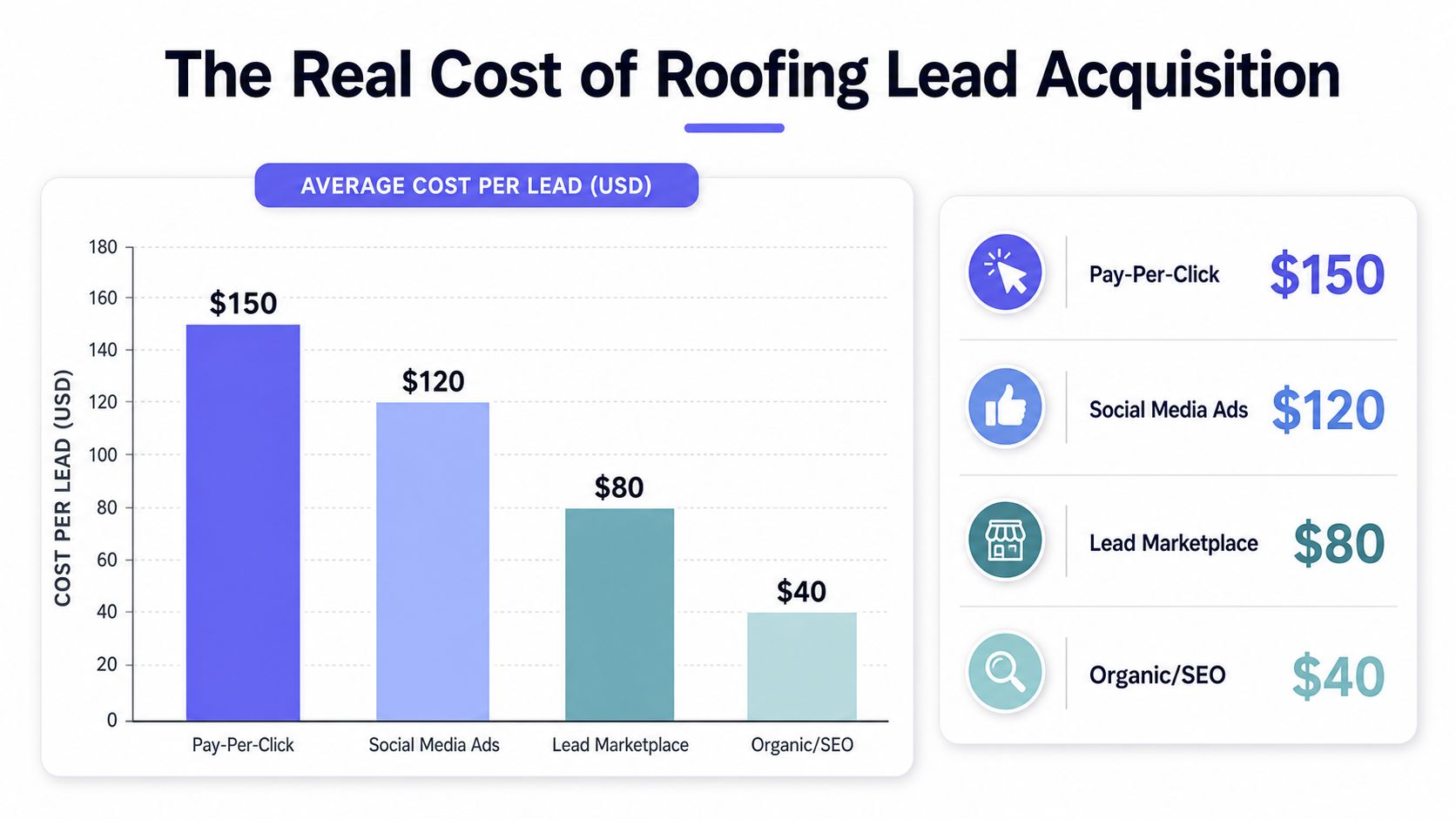
Roofing lead acquisition is expensive enough that the channel you choose can decide whether growth feels manageable or like you're burning cash. A 2025 benchmark cited in roofing-industry coverage put average Google Ads cost per lead at $228.15, with a wider range of about $80 to $350 depending on market competition and lead quality, while Local Services Ads were described as much cheaper at roughly $75 to $150 per lead and mature SEO programs at $10 to $50 after 12 to 18 months of optimization (benchmark source). That gap is why roofing lead generation isn't a volume game. It's a quality, speed, and exclusivity game.
The contractors who win don't chase every inquiry. They build systems that make every lead easier to trust, faster to contact, and more likely to close. If you're paying for shared leads that get hit by three or four other sales teams, you're not buying opportunity, you're buying a race.
Table of Contents
- The Actual Cost of Roofing Lead Acquisition
- Building Your Local Search Foundation
- Paid Channels and Where Each One Fits
- Why Lead Exclusivity Matters More Than Volume
- Converting Inquiries Into Signed Jobs
- Tracking What Drives Revenue
- Your Prioritized Action Plan
The Actual Cost of Roofing Lead Acquisition
Roofing is one of the most expensive home-service categories for paid customer acquisition, and that is exactly why lead quality matters more than raw lead count. Roofing-industry coverage cited a 2025 benchmark showing Google Ads at $228.15 per lead, with a broad range from $80 to $350 depending on competition and lead quality (source). That is not a problem you solve by pushing harder on spend. It is a market problem, and it forces you to judge every channel by who owns the lead, how exclusive it is, and how often it turns into a signed job.
The math that actually matters
A low-cost lead is expensive when it never closes. A higher-priced lead can be the better buy if it is exclusive, verified, and ready for a quote. That is the standard that matters, so measure every source by cost per signed job, not by cost per lead alone.
Practical rule: If a source cannot tell you who owns the lead, how many other contractors received it, and how fast the prospect is contacted, it is not a channel you should trust with serious budget.
The same benchmark ecosystem described Local Services Ads at roughly $75 to $150 per lead, and SEO at $10 to $50 per lead after 12 to 18 months of optimization (source). Those numbers point to a simple allocation strategy. Paid channels buy speed, while organic visibility is what brings acquisition cost down over time. If you want better margins, you need both, but you should expect them to do different jobs.
Use this local SEO guide for contractors to build the organic side correctly before you scale paid spend.
Why volume can fool you
Big lead counts hide weak economics. If your team is buying a flood of inquiries but only a small share becomes booked jobs, your true acquisition cost is much higher than the dashboard suggests. Roofing work is high-value and often seasonal, so the companies that stay profitable protect margin first and chase volume second.
The best operators build their math around close rate by source, average job value, and lifetime customer value. That gives you a clean way to compare a shared marketplace lead with a direct inbound call from someone already searching your brand. The shared lead may look cheaper on paper. The exclusive inbound call usually makes more money because your sales team is not fighting three other contractors for the same homeowner.
Building Your Local Search Foundation
Local search is still the first place to get right because roofing demand is intensely local. One industry roundup says 58% of roofing leads come from local searches, and companies using Google Business Profile effectively see a 50% increase in local project inquiries (source). That's why your profile isn't a side task. It's the front door.

Get the profile right first
Start with the basics and don't get clever. Your Google Business Profile needs the correct primary category, accurate service areas, complete business details, and a description that matches what people search for. If the listing is thin, stale, or inconsistent with your website, you're handing trust to the competitor down the street.
Your photos matter too. Upload recent images of completed roofs, crew work, trucks, and branded signage. People scanning local results want proof that you're active now, not a company whose best work was three seasons ago.
A complete profile doesn't just help ranking. It makes the first call feel safer.
Reviews and response habits
The same roofing-industry source reported that businesses that actively ask for reviews average more than 500 jobs per year, compared with about 100 jobs for those that don't (source). That's a massive operational gap, and it's not about luck. It's about making review requests part of the closeout process, not an afterthought.
Use reviews, recent posts, and photo updates together. When a person sees fresh work, real customer feedback, and a profile that looks alive, they're more likely to trust the first message they get. That trust is what local search is really selling.
For a deeper setup checklist, this local SEO guide for contractors is a practical next step if your profile is still underbuilt.
Paid Channels and Where Each One Fits
Paid lead channels don't all do the same job, and pretending they do is how budgets get wasted. Google Local Services Ads are usually the cleanest paid starting point when you pass screening, because they're built for local intent and call-driven response. Traditional PPC gives you more control, but it also demands better landing pages, stronger tracking, and tighter spend discipline.
| Channel | Avg Cost Per Lead | Lead Intent | Best For |
|---|---|---|---|
| Google Local Services Ads | $75 to $150 | High | Fast local calls and screened prospects |
| Google PPC | $228.15 average, wider range $80 to $350 | High to medium | Demand capture and market coverage |
| Social Ads | Qualitatively lower intent than search | Medium to low | Awareness, retargeting, and seasonal visibility |
| Lead Marketplaces | Varies widely | Mixed | Filling gaps, but only if exclusivity is clear |
Where each channel fits
LSAs are the best paid option for many roofing companies because the traffic is already local and problem-aware. They're especially useful when your team can answer the phone quickly and quote cleanly. That's the catch. If your intake process is sloppy, even a strong channel will underperform.
PPC makes sense when you need search coverage beyond the LSA box, or when you're targeting specific service terms in a tight geography. It's a sharper tool than social ads, but it's also less forgiving. If the landing page is weak or the follow-up is slow, you'll pay for clicks and lose the job anyway.
Social ads are usually better for visibility, retargeting, and staying top of mind than for immediate lead capture. People scrolling feeds aren't as ready to buy roofing services as someone searching “roof repair near me.” Use social to support the pipeline, not to replace search intent.
For a local buyer-intent perspective on how this category behaves, this lead generation resource near me is worth reviewing alongside your channel mix.
Don't scale faster than your process
The mistake is turning on every paid channel before your response system is ready. If leads sit untouched, the channel isn't the problem. Your operation is. Start with one paid source, prove your close rate, then expand only when the team can keep up.
Why Lead Exclusivity Matters More Than Volume
Roofing lead buying usually fails for one reason. The same homeowner gets sold to several companies, and every team calls at once. That starts a bidding war before trust has any chance to form. A spreadsheet may show plenty of activity, but in the field, exclusivity usually produces better results.
Exclusive leads give your team a fair shot. Shared leads do not. They force your reps to compete on speed, price, and volume of follow-up instead of on credibility and fit. That is a bad way to win roofing work, especially when the homeowner is already fielding repeated calls.
Shared leads punish good operators.
The problem is simple. If a homeowner has already spoken to five companies, your estimate has to fight through fatigue, skepticism, and price pressure. Even a strong sales process starts behind schedule because the prospect has already heard similar pitches too many times.
Exclusivity changes the math. It gives your team room to qualify the job properly, explain scope, and sell on trust instead of panic. That matters more than raw lead count because one clean opportunity is worth more than three noisy ones.
If the lead has already been sold to five businesses, you are not buying demand. You are buying noise.
Evaluate the lead model, not the promise
Before you buy any roofing lead source, ask three direct questions. Is the lead exclusive. Is it verified. Is it ready to quote. If a provider cannot answer those clearly, the model is built around volume, not quality.
That is why verified matching platforms usually make more sense than open marketplaces. They cut waste at the intake stage and reduce the scramble that comes with shared distribution. You are paying for one request with clearer intent, not paying to chase the same homeowner as every other contractor.
The same logic shows up in plumber lead generation. The service trade changes, but the principle does not. If the market is crowded, lead exclusivity is usually the edge that matters most, and quality beats raw volume every time.
Converting Inquiries Into Signed Jobs
Lead generation for roofing companies falls apart fast when response systems are slow. A roofing-industry guide recommends immediate notifications, an auto-text response, and calling the lead within 5 minutes (source). That's not a nice-to-have. It's how you stop losing jobs to the first company that answers.
Build the front end to convert
Your website needs more than a contact form. It needs clear service pages, visible proof, and a call path that doesn't make people work to reach you. Use strong photos, simple language, and one obvious next step on every page.
Add instant response where you can. An auto-text that confirms the request and sets expectations buys you time without making the lead feel ignored. Then call fast and call prepared.
The best follow-up feels personal, but the first touch should be immediate and consistent.
Separate follow-up by project type
Intent plus timing matters more than geography alone. One roofing sales guide recommends segmenting prospects by project type, urgency, and profitability, then building separate paths for insurance-driven and retail leads (source). That's the right approach because those buyers need different questions, different proof, and different pacing.
Insurance work often needs tighter documentation and clearer scope language. Retail work usually needs quicker education around value and timing. If your team uses the same script for both, you'll either sound too formal or too pushy.
Make the follow-up system do the memory work
Leads get lost when no one owns the next step. A basic CRM workflow should log the source, time of first contact, estimate status, and next follow-up date. If the system doesn't force accountability, people will assume someone else handled it.
The goal isn't to be fancy. It's to make sure every lead gets one clean path from inquiry to estimate to signature. Roofing businesses lose money when they generate demand and then fail to respond like professionals.
Tracking What Drives Revenue
A roofing business can get buried in lead volume and still miss the core issue. The problem is attribution. A roofing analytics report said 85% of roofing contractors either do not track leads at all or only track volume without attribution, and 42% of inbound calls are booked into jobs (source). If you cannot connect the call to the job, you are spending money without knowing which channel deserves more budget.

Stop measuring the wrong things
Lead count is not revenue. Calls are not revenue. Booked estimates are not revenue until they turn into signed work. The measurement system has to show which source creates profitable jobs, not which channel creates the most activity.
Top-performing contractors spend 7% to 10% of gross revenue on marketing and track ROI at the job level (source). That is disciplined spending. They know what each channel costs and what each one returns, so budget decisions are based on output, not hope.
The KPI stack that matters
Use a small set of metrics and review them every month:
- Source-to-job conversion: Which channels produce signed work, not just leads.
- Speed to contact: How quickly your team reaches the lead after submission.
- Booked-call rate: How many inbound calls get scheduled or quoted.
- Job-level ROI: Which source produces profitable work after all costs.
Keep those numbers in one place. If you are still reading reports that only show traffic or raw leads, you are missing the business part of the business.
Make the budget follow the evidence
If one source produces better jobs, give it more budget. If another source creates noise but no signed work, cut it. That sounds blunt because it is. Roofing margins do not reward vanity volume.
Good lead generation becomes real management. You are not buying ads. You are buying measurable revenue.
Your Prioritized Action Plan
Start with the cheapest fix that changes the most. If your Google Business Profile is weak, fix that first. It's the foundation for local intent and it supports everything else you do.
Then build the website so it converts the traffic you already earn. That means clear service pages, visible proof, and a friction-free path to contact. Only after that should you layer in instant response automation, because speed matters only when the rest of the process is ready.
The order that makes sense
- Local search first. Tighten your profile, reviews, photos, and service descriptions.
- Conversion second. Make your site simple, fast, and obvious.
- Response third. Use automation so no lead sits untouched.
- Paid scale last. Add LSAs, PPC, or marketplace spend only when intake and follow-up are reliable.
If you're small, stay disciplined and don't scatter budget. If you're larger, use source-level reporting to decide where to expand. The warning sign that matters most is simple. If lead volume rises but signed jobs don't, your problem is quality or follow-up, not demand.
Hand Vetted Co. connects people with one verified professional at a time, which is exactly the kind of exclusivity roofing lead generation should protect. If you're tired of shared leads getting hammered by competing calls, visit Hand Vetted Co. and see how an exclusive matching model changes the conversation.