The national average cost to paint kitchen cabinets in 2026 is $4,000, and most projects land between $2,500 and $6,500 depending on cabinet count, prep, and finish complexity. If your quote is far outside that band, you need a clear reason for it.
That number matters because cabinet painting isn't a bucket of paint and a free weekend. It's a labor-heavy renovation job, and the labor is what you're paying for.
Table of Contents
- What Painting Kitchen Cabinets Costs in 2026
- How Professionals Price Your Cabinet Painting Project
- The Cost Drivers That Change Your Final Bill
- DIY vs Professional Cabinet Painting Costs and Timelines
- When Painting Costs Nearly as Much as Replacing
- How to Vet a Cabinet Painter and Get a Fair Quote
- Your Cabinet Painting Decision Framework
What Painting Kitchen Cabinets Costs in 2026
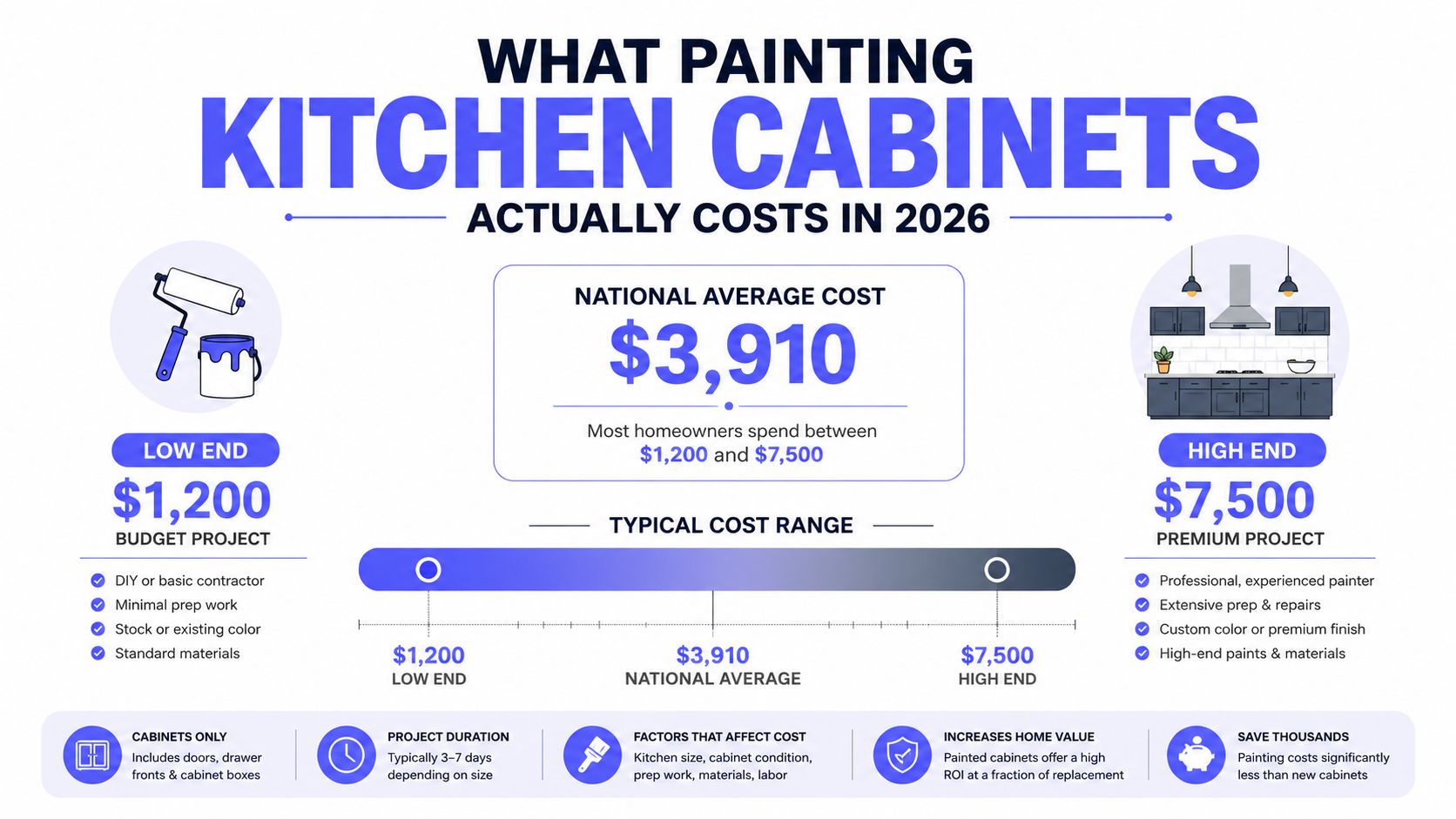
Cabinet painting sits in a narrow price band in 2026, but the spread still matters. Angi reports an average of $938, with a typical range of $425 to $1,463, and HomeAdvisor reports an average of $941 with a similar range of $425 to $1,466 in its cabinet-painting guidance from the same Angi cost guide page (Angi cost guide). That gives you a real baseline before any contractor walks through your kitchen.
The numbers move fast once the cabinet count changes. The same Angi estimate says a small DIY project can be as low as $180, while a large professionally painted kitchen can reach $3,200 (Angi cost guide). Bob Vila's market summary stays in the same neighborhood, citing a national average of $895 and a typical range of $422 to $1,415 (Bob Vila summary in the Angi guide).
The right way to read cabinet-painting pricing is simple. Treat the average as a benchmark, not a promise.
Painting cabinets is a mid-three-figure to low-four-figure project driven by labor, preparation, and finish quality rather than paint supply costs. Labor usually takes the biggest share, often around 65% to 75% of the total bill, because the work is in cleaning, sanding, masking, spraying or brushing, drying, and reinstalling hardware. A cheap paint can still produce an expensive job if the prep is heavy and the finish needs to hold up in a busy kitchen.
The cleanest way to budget is to focus on scope first, then finish expectations. A small kitchen with simple doors and minimal repair work lands near the low end, while a larger kitchen with lots of drawers, damaged surfaces, or a higher-end sprayed finish pushes toward the top of the range. For a broader renovation baseline, see this interior painting cost guide from Handvetted.
How Professionals Price Your Cabinet Painting Project
Contractors don't price cabinet painting the way they price wall painting. They look at surface count, linear footage, and sometimes square footage, because cabinet work is tied to doors, drawer fronts, and boxes, not just room size. That's why one quote can look cheap until you realize it covers far fewer cabinet faces than the next one.
Per door, per linear foot, and per square foot
CertaPro says cabinet painting is typically priced at $125 to $185 per piece, meaning each door or drawer front (CertaPro pricing guide). Kitchen-specific guides also place cabinet painting around $30 to $70 per linear foot or $3 to $10 per square foot (CertaPro pricing guide, Taskrabbit guide, Homewyse square-foot guide). Homewyse pegs the national square-foot benchmark at $5.40 to $10.79 per square foot in May 2026 (Homewyse square-foot guide).
| Cabinet Painting Pricing Models Compared | Typical Range | Best For |
|---|---|---|
| Per door or drawer front | $125 to $185 per piece | Quotes built around actual cabinet faces |
| Per linear foot | $30 to $70 per linear foot | Kitchens where the layout is easier to measure |
| Per square foot | $3 to $10 per square foot, with a national benchmark of $5.40 to $10.79 | Fast comparisons across multiple bids |
The cabinet-face count is where the math lives. Kitchen guides commonly place 21 to 40 cabinet faces around $5,000 to $7,000, and 40 or more cabinets around $7,000 to $12,000 (CertaPro pricing guide). KitchenSearch also notes a common quote band of $90 to $175 per door and $25 to $50 per drawer front, which is why small-to-medium kitchens often land around $2,000 to $6,500 (KitchenSearch pricing guide).
Count the doors first. Floor area is a weak shortcut for cabinet work.
Fixr's 2026 guide puts the broader professional range at $2,500 to $6,500, with an average of $4,000. It also breaks projects into small kitchens at $1,000 to $3,500, medium kitchens at $3,500 to $7,000, and large kitchens at $5,000 to $10,000+ (Fixr pricing guide). If you want a fair quote, ask how many doors and drawer fronts are included, then compare that count across every estimate.
The Cost Drivers That Change Your Final Bill
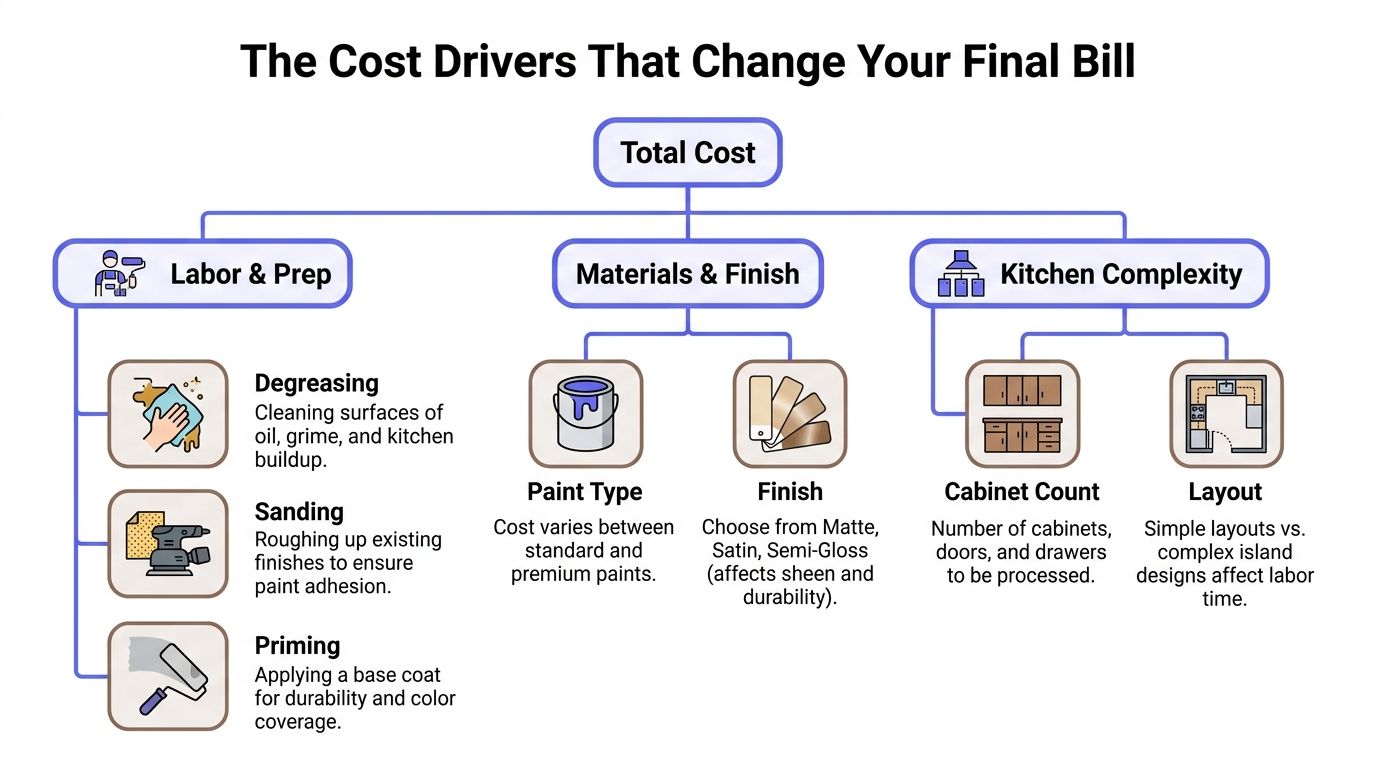
Two kitchens can share the same footprint and still land in very different price ranges. That is normal. The cost mostly comes from skilled labor and extensive surface preparation, along with the cabinet condition and the finish you want.
Labor is the bill, materials are the footnote
Labor typically accounts for 65% to 75% of total cabinet-painting cost because the work includes removal, degreasing, sanding, priming, spraying or brushing, curing, and reinstallation (Clear Home Projects cost guide). Materials usually make up only 10% to 15% of the total, so premium paint does little to change the final number compared with extra prep work.
That is why quotes catch homeowners off guard. They are paying for skilled labor, not buckets of paint. A low bid deserves a hard look if it trims prep steps that protect adhesion and finish quality.
Cabinet condition changes the job fast
Worn finishes, grease buildup, damaged edges, and loose hardware all add labor. A clean, stable cabinet box is one job. A cabinet that needs repair before it can be primed is another, and the quote should reflect that difference.
Finish complexity matters too. A single color is simpler than a two-tone setup. A smooth sprayed finish needs more masking and setup than a basic brushed application, and specialty durability coatings usually mean more time spent on surface prep and cure management.
If a quote is high, ask what problem the painter is solving. The answer is usually hidden in prep.
Per-door quotes make this easier to see. They expose the math behind a project because each door, drawer front, hinge adjustment, and repair request adds labor. When the count goes up, the bill follows. When the cabinet boxes need sanding or patching, the estimate climbs fast.
The smartest way to control cost is to control the work that creates labor hours. Keep the color simple, avoid unnecessary hardware changes during the paint job, and be honest about cabinet condition before anyone starts measuring. If damage is left out during estimating, the surprise shows up in the middle of the project, where it is harder and more expensive to fix.
DIY vs Professional Cabinet Painting Costs and Timelines
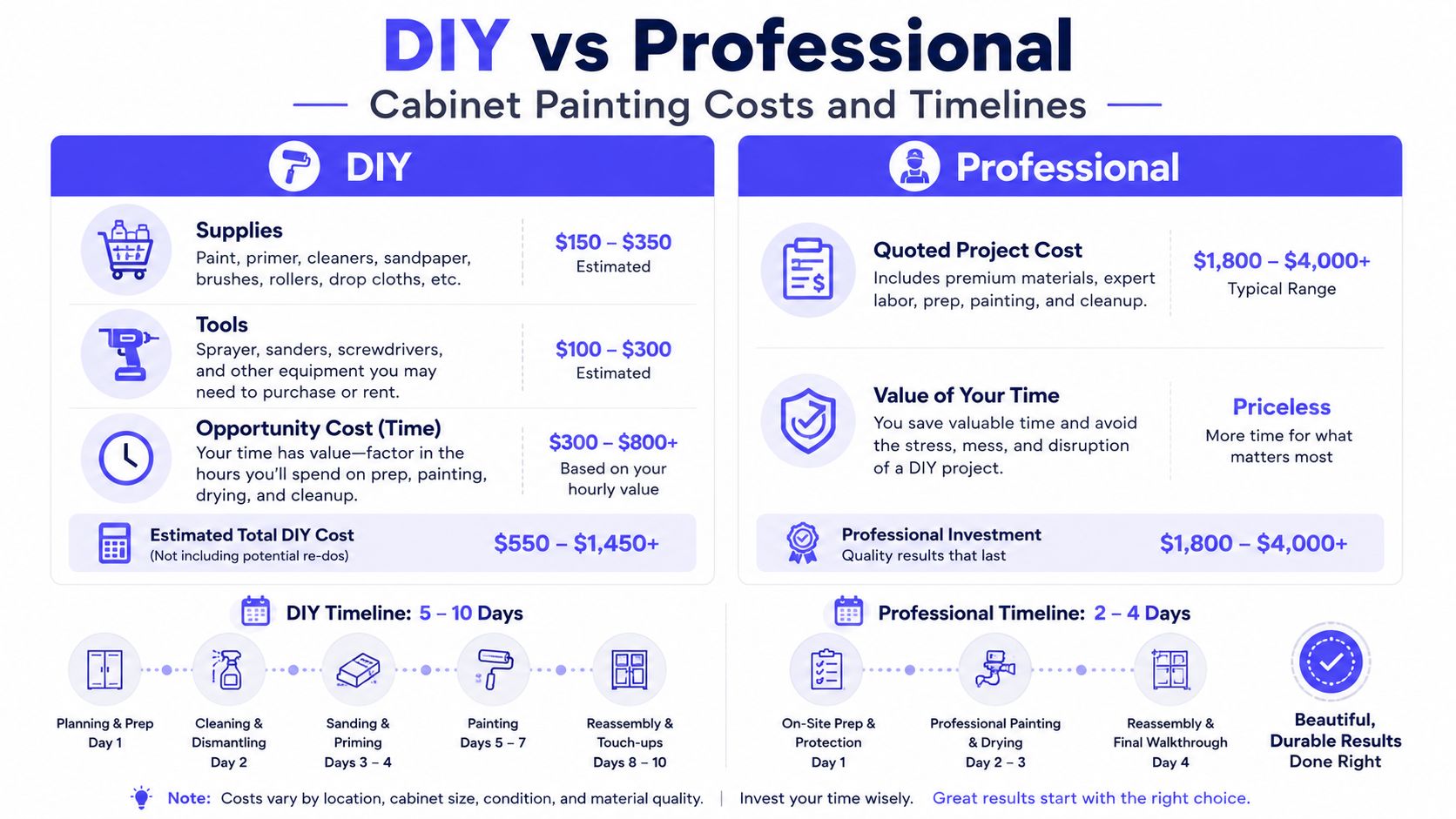
DIY looks cheap on paper. It stays cheap only if you already own the right tools, have the patience to prep properly, and can accept a finish that looks fine from a few feet away.
What You Save with DIY
A small DIY cabinet project can be as low as $180 according to the Angi cost guide. That figure represents the baseline budget for homeowners who handle the labor themselves and keep the project modest.
The savings come from skipping paid labor, not from a magical materials discount. Paint, primer, sanding supplies, tape, and cleanup items still cost money. Once you start aiming for a cleaner sprayed finish, stronger adhesion, and better reassembly, the project becomes a lot less casual.
Professional painters charge more because they bring process, equipment, and repeatable results. They also know how to handle masking, surface prep, and sequencing without wasting time correcting mistakes. The material bill stays relatively small. The labor is what drives the price.
Time Is Part of the Price
DIY usually takes longer because you are learning while you work. A professional crew moves through the job faster because the sequence is familiar and the mistakes are fewer. That matters, because cabinet painting can leave a kitchen out of commission longer than homeowners expect.
Redo risk is the main problem with DIY. Brush marks, poor adhesion, chipped edges, and uneven coverage often show up after the doors and drawers are back in use. Once that happens, the original savings shrink quickly.
DIY is only smart when your tolerance for imperfections is high.
A DIY project makes sense when the kitchen is small, the tools are already on hand, and you can work at a slow pace without frustration. If you want a durable finish that looks consistent in normal light, hire the pro. The difference is not just convenience. It is finish quality and the chance you will have to fix the job again later.
When Painting Costs Nearly as Much as Replacing
Most cabinet painting projects are labor-heavy, and that is why the price can creep toward replacement territory fast. Once a kitchen needs extensive prep, repairs, or a high-end finish system, the gap between painting and swapping cabinets gets much smaller than homeowners expect.
The The Spruce cost guide notes that professional cabinet painting can already reach $5,000 to $7,500 for a typical kitchen and $8,000+ for larger or higher-end jobs, while full replacement averages around $6,000 in one source. That is the number to watch. Once a paint quote gets close to replacement pricing, cabinet condition matters more than the new color.
Paint only makes sense when the bones are good
Solid cabinet boxes, sound doors, and a finish that still holds up give you a real return on paint. You keep the existing footprint, improve the look, and avoid the cost of a full tear-out. That is the right use case for painting.
Water damage, failing hardware, warped doors, or cabinets that are already wearing out change the math. You end up paying real money to improve a surface that still sits on a weak structure. In that situation, replacement or a different remodel path usually makes more sense over time.
Here is the blunt test. If the cabinets are mostly ugly, paint them. If they are ugly and failing, spend the money where it will hold up.
A cabinet that needs repair before paint is already telling you something.
Once the quote starts brushing up against replacement cost, ask what you are preserving. Good cabinet painting protects a cabinet that still has strong bones. It does nothing for one that is already past its useful life.
How to Vet a Cabinet Painter and Get a Fair Quote
A fair quote starts with a painter who can prove the work will be done right. A vague bid is a warning sign. If the estimate does not spell out prep, coat count, cleanup, and timeline, you are not comparing real prices.
What to verify before you sign
Ask for proof of licensing and insurance first. Then ask how they handle degreasing, sanding, priming, and curing. A painter who cannot answer those questions clearly is not set up for cabinet work.
You also want a written quote that names the exact cabinet faces included, the paint system, and the cleanup plan. If hardware removal, masking, and reinstallation are not spelled out, the quote is incomplete. That is where change orders start.
- Verify licensing and insurance. Do not rely on a business card.
- Request detailed written quotes. Scope beats vague totals.
- Ask for references and photos. Cabinet work should show consistency.
- Clarify prep and cleanup. Dust control matters.
- Compare identical scope. A lower bid with less prep is not a bargain.
Check the person behind the quote with Handvetted's contractor background check page. If a platform is sending you names, make sure it gives you one verified professional, not a stack of cold leads.
A painter who can explain the process plainly is a safer hire. A painter who dodges basic questions is selling price, not workmanship.
Your Cabinet Painting Decision Framework
Start with the cabinet count. Then check the cabinet condition. Then decide whether you care more about the lowest cost or the most durable finish. That order matters because it keeps you from overpaying for a surface that doesn't deserve premium work.
Use this simple filter. If your cabinets are structurally sound and your main goal is a clean visual reset, painting is usually the right move. If the boxes are tired, the doors are failing, or the quote creeps toward replacement pricing, slow down and compare options more carefully.
For planning and sequencing a renovation project, Handvetted's home renovation planner is a useful place to organize scope before you start collecting estimates. It helps you keep the job grounded in budget, timing, and priorities instead of a sales pitch.
A practical way to estimate your own cost
Count every door and drawer front. Compare that number to per-piece pricing, then check the total against the common kitchen-size ranges. If your estimate lands near the middle of the market, it's probably normal. If it's way above the bands in this guide, ask what's being added.
Then make one honest decision. If the kitchen is in good shape, paint it. If it needs major structural help, don't force a paint job to carry more weight than it should.
If you want a fast next step, gather two written estimates and compare them line by line, not just by total. That will tell you more than any glossy before-and-after photo ever will.
If you want a tighter path from research to a real quote, Hand Vetted Co. can connect you with a single verified professional who's licensed, background-checked, and rated 4.5+ stars. Visit Hand Vetted Co. to get matched with a pro who already understands the job before they call you.