
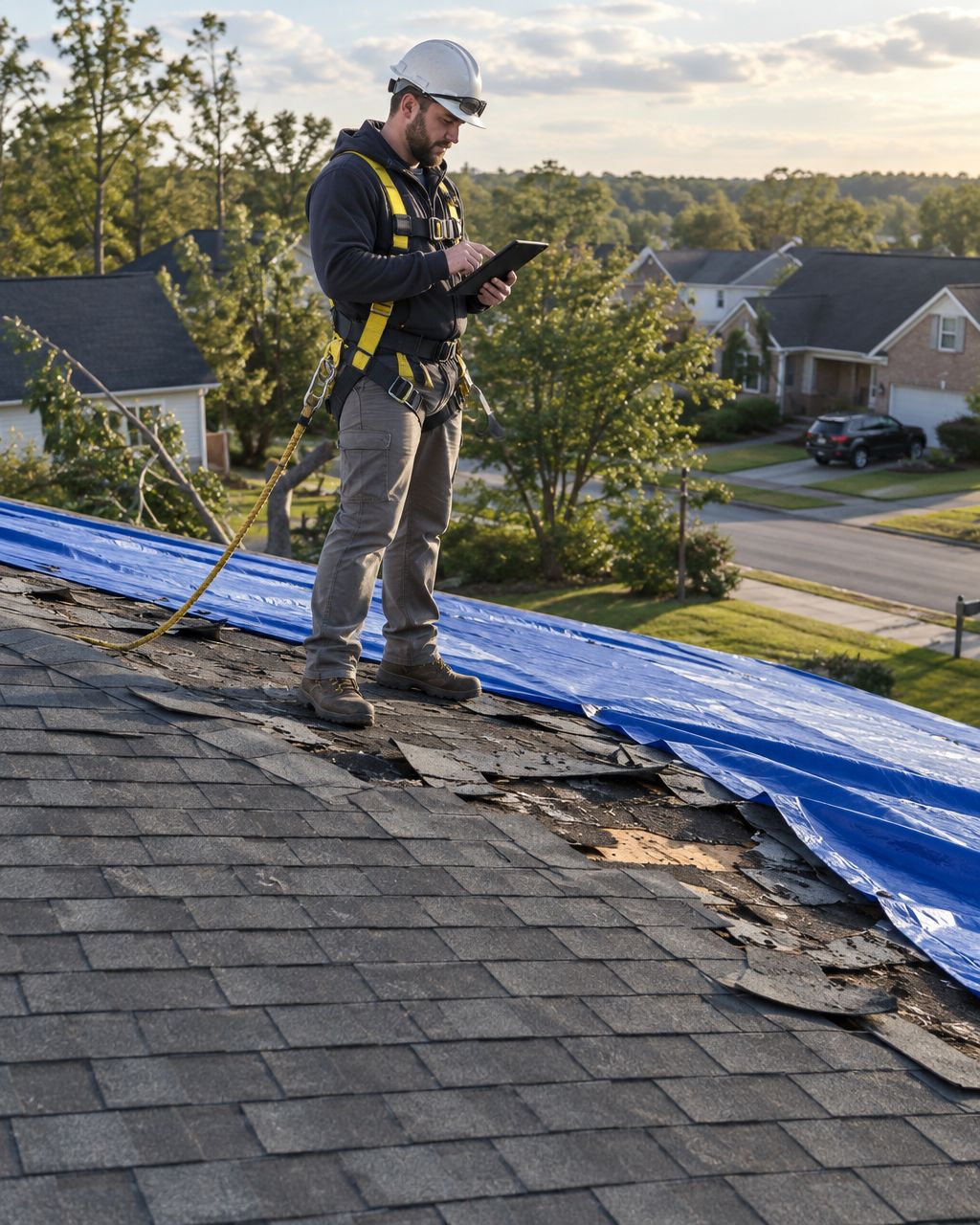
Getting from a storm-damaged roof to a finished replacement is a five-step workflow: make the home safe, document everything, file the claim, work the adjuster's scope, then schedule the rebuild with a licensed roofer. Done in order, most homeowners settle in four to eight weeks. Done out of order — signing a contract before the adjuster visits, cleaning up before photographing — is where claims stall and money is left on the table.
- Document damage before any cleanup: photos of the roof, exterior and every affected room.
- North Carolina insurers must acknowledge your claim within 30 days; most roof claims settle in 4-8 weeks.
- Never sign a replacement contract before the adjuster's inspection is complete.
- Roofers document damage and prepare estimates; the claim itself stays yours to own.
- A $40,000+ roofing project in NC requires a state-licensed general contractor.
Why this matters
Storm damage puts two clocks against each other: the insurer's claim clock and your home's exposure to the weather that caused the damage. Homeowners who treat the claim as one step — the contractor said so, the check will cover it — are the ones storm-chasers target. The 12 red flags that a home service business is not who it says it are start with high-pressure timing after a storm. The workflow below keeps you out of that pattern: evidence first, paperwork second, contracts last.
Step 1: Secure, then document (days 0-2)
Stop the water first if you can do it safely — a tarp over the breach, a bucket under the drip — and shut off power to wet rooms. Then photograph everything before anything is moved: the roof from the ground, the attic, the ceilings, the floor, the belongings. Photos with timestamps are the evidence the entire claim rests on.
Call your insurer the same day. Under North Carolina law, your insurer must acknowledge your claim within 30 days of receiving notice with enough detail to identify the coverage involved (N.C. Gen. Stat. § 58-3-100) — but you do not want to spend that window waiting. Ask two questions: what documentation do they need, and what emergency mitigation can you do now without hurting the claim? Keep every receipt for tarps, boarding and temporary repairs. Reasonable emergency work to prevent further damage is normally covered; unexplained replacement of undamaged items is not.
Step 2: File the claim, not a contract
File the claim yourself or through your agent — this is a five-minute process that starts the insurer's clock. Do not sign a roofing contract in the same week. A contract signed before the adjuster inspects locks you into scope and price the insurer has not agreed to, and a contractor who needs your signature before the inspection is telling you something about how they operate.
What to have when you file:
- The date of the storm and the damage you observed
- Timestamped photos and video
- Your policy number and a forwarding address if you relocated
- Receipts for emergency mitigation
Step 3: The adjuster meeting
The insurer sends an adjuster to estimate the damage. Your roofer's job at this stage is to document — hail hits on shingles, lifted flashing, compromised decking — and to be present when the adjuster climbs. A good roofing company walks the roof with the adjuster and points out damage an untrained eye misses. That is documentation support, and it is where a roofer earns their place in this workflow.
What a roofer cannot do is negotiate the claim. Selling, soliciting or negotiating insurance on behalf of another person is a licensed activity in North Carolina, and a contractor who claims they "handle your claim" is overstating their role. The policy is yours; the decisions are yours. If the insurer denies the claim or the offer does not cover a scope you trust, that is the moment to consider a public adjuster's review — how to choose a public adjuster breaks down the verification and fee questions first.
Step 4: The scope and the supplement
The insurer issues a scope of loss — what they will pay to repair or replace. Compare it against a written estimate from your roofer. Where they disagree on line items (decking replacement, code-required upgrades, drip edge, underlayment), your roofer prepares a supplement: the documentation that justifies the missing work. Supplements are normal and accepted practice in 2026; insurers expect evidence-based revisions rather than a flat argument that the check is too small.
Two cautions here. First, a settlement based on actual cash value (the roof's depreciated worth) pays less upfront than replacement cost value; check which your policy carries before you commit to a total. Second, keep the contract conditional: a responsible roofer signs a contingency agreement that the work starts at the insurer-approved scope, so you are never carrying the gap between a contract price and a denied claim.
Step 5: The replacement
Once the scope is agreed, schedule the work. Two legal checkpoints in North Carolina:
- Licensing. Any project valued at $40,000 or more requires a general contractor licensed by the North Carolina Licensing Board for General Contractors (N.C.G.S. § 87-1); hiring unlicensed is a Class 1 misdemeanor for the contractor and voids much of your practical protection. Verify the license yourself through the Board's public search.
- Permits. A roof replacement requires a building permit in most North Carolina jurisdictions; the contractor pulls it, and the permit confirms the work will be inspected.
What the replacement costs depends on roof size, pitch, material and the Charlotte market: roof replacement cost in Charlotte runs the numbers for 2026. If the settlement fell short of the written estimates, compare the estimates before you assume the insurer is wrong — the public adjuster settlement to restoration contractor workflow covers when claim help is worth the fee.
Red flags that break this workflow
- A contractor who shows up uninvited after the storm and asks for a signature on day one
- An offer to waive or absorb your insurance deductible — in many states this is illegal insurance fraud, and it is a red flag everywhere
- A "free upgrade" that requires you to sign an Assignment of Benefits, giving the contractor your claim rights
- Pressure to file the claim before the roofer has even seen the roof
Handvetted verifies state licenses through official registries, runs background checks, requires a 4.5-star minimum rating, and has a person review every match before it is made — which is why our roofing matches are already licensed at the $40,000 threshold before a storm ever hits.
FAQ
How long does a storm damage roof claim take in North Carolina?
Most roof claims settle within 4 to 8 weeks from filing to final payment. Simple approvals can move in 1 to 2 weeks; disputes and supplements add time.
Can my roofing contractor file the claim for me?
A roofer can document the damage and prepare estimates, but the claim itself is filed by you, the policyholder. Negotiating insurance on your behalf is a licensed activity in North Carolina.
Should I sign a roofing contract before the adjuster comes?
No. Wait until the adjuster's inspection is complete and you have the scope of loss. Sign a contingency-based agreement if you sign early, never a fixed-price contract.
What if the insurance check is less than the estimates?
Ask your roofer to prepare a supplement with line-item evidence for the missing work. If the insurer still denies it, a public adjuster can review the claim for a fee.
Does my roofer need a license in North Carolina?
Yes for projects of $40,000 or more — state law requires a general contractor license from the NCLBGC. Verify it through the Board's public license search before signing.
Related guides
- Roof replacement cost in Charlotte, NC (2026)
- How to avoid storm-chaser scams after severe weather
- 12 red flags that a home service business isn't who they say they are
Get Matched
Tell us what you need. We will match you with one licensed, background-checked roofing professional for the inspection, the documentation and the rebuild — free for homeowners. Get Matched.