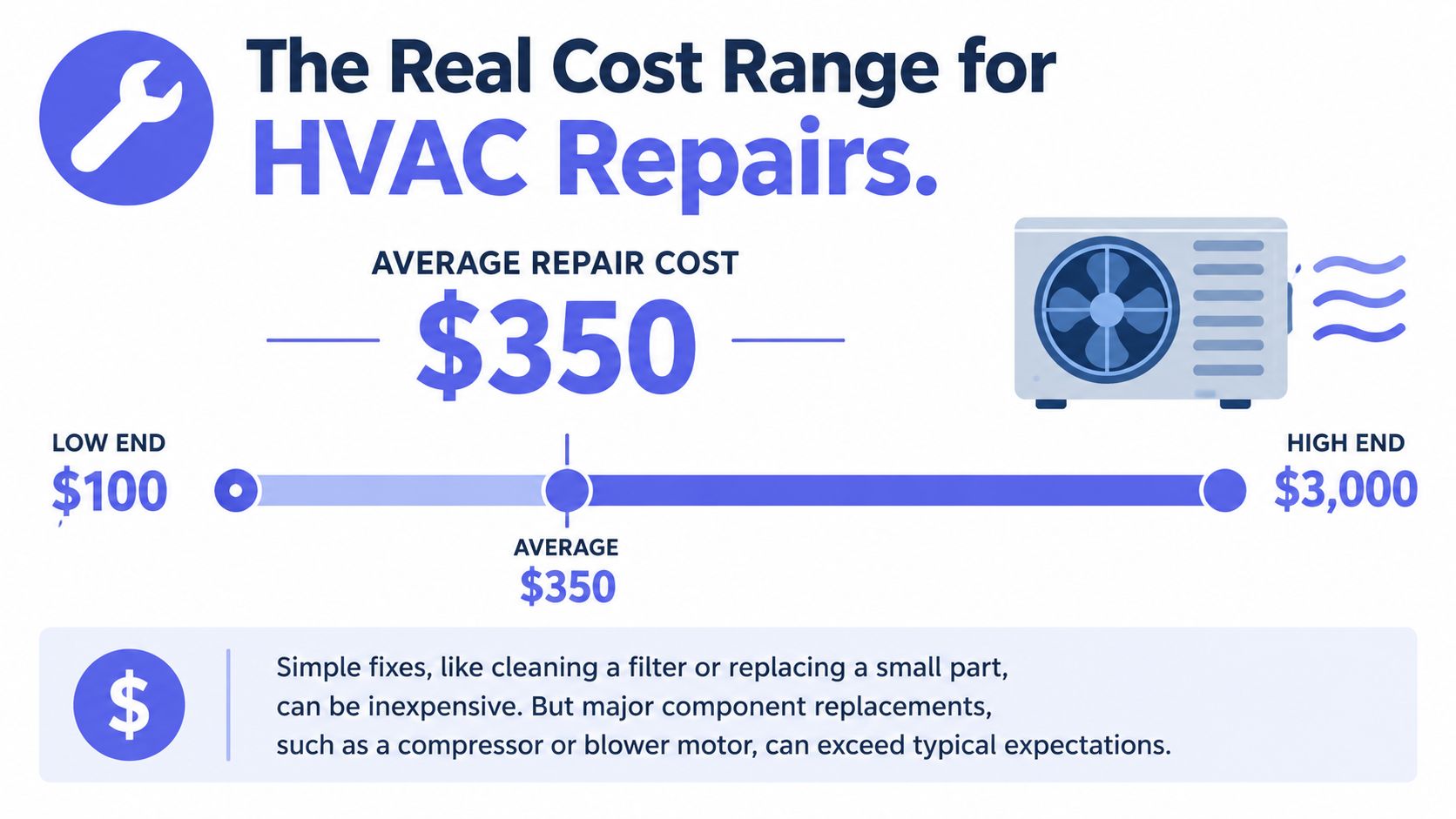
HVAC repair costs in the U.S. typically fall between $100 and $3,000, with most common repairs landing near $350. Pricing depends heavily on labor, parts, system type, and how difficult the failure is to diagnose and access.
Your system may have stopped cooling, started making a grinding sound, or begun cycling without changing the room temperature. The first quote can feel like a guess because “HVAC repair” covers everything from a small electrical component to a failed compressor. The useful question isn't only how much does HVAC repair cost, but also what are you paying for, and does repairing this system still make financial sense?
Table of Contents
- Typical Cost Range for HVAC Repairs
- How HVAC Repair Prices Are Built
- Common HVAC Repairs and Typical Costs
- When Repair Turns Into Replacement
- Hidden Fees and Quote Surprises
- How to Choose a Vetted HVAC Professional
- Practical Next Steps After You Get a Quote
Typical Cost Range for HVAC Repairs
A technician arrives because your air conditioner will not start. Testing identifies a failed capacitor, which usually falls into the lower-cost category. The same symptom can also come from a compressor, control board, or electrical fault. Those problems require different tests, parts, and labor.
Across the U.S., HVAC repairs range from about $100 to $3,000, with a practical average near $350, according to HomeAdvisor's HVAC repair cost guide. Use that average as an initial reference, not a promised final bill. A first-call quote may cover a simple repair, while testing can reveal a failure that changes the job completely.
Why the range is so wide
Common AC repairs are often priced at $172 to $664. Compressor replacement can reach $1,350 to $2,300 or more, based on HomeAdvisor's pricing reference. The gap reflects the work around the part, not only the component's price.
A compressor job may involve extensive testing, refrigerant-side work, removal of the failed component, installation, evacuation, and recharging. Access can add labor as well. Equipment in a tight attic, crawlspace, or restricted mechanical room takes longer to service than equipment with clear working space.
Practical rule: Treat $350 as a midpoint for ordinary repair work, not a ceiling. The diagnosis determines whether the bill stays in the mid-hundreds or reaches the low-thousands. Ask what the first quote includes and what finding would change it.
How HVAC Repair Prices Are Built
An HVAC invoice usually combines the service visit, labor, and parts. A clear estimate separates those charges before you approve the repair, so you can see whether the quote reflects diagnosis, installation time, materials, or all three.
Published pricing guides place ordinary HVAC labor around $75 to $150 per hour. Service-call or diagnostic fees often range from $70 to $200, according to American Standard's HVAC repair cost guide. A small repair can therefore create a meaningful bill before the replacement part is installed.
The first visit
A technician normally charges the diagnostic fee before repair begins. Home Depot's HVAC repair pricing guidance places common service-call charges around $75 to $150, with some visits reaching $200. Some companies credit that fee toward an approved repair. Confirm the policy, and ask whether the diagnostic charge includes a written explanation of the failure.
Testing may include voltage, wiring, airflow, system performance, or refrigerant conditions. Warm air, short cycling, or a system that will not start identifies a symptom, not necessarily the failed component. Diagnosis pays for tracing the cause before parts are replaced.
Why timing changes the bill
Regular labor is often about $75 to $150 per hour, while emergency or after-hours work can reach roughly $160 to $250 per hour, according to HomeAdvisor's AC repair cost information.
Ask the dispatcher whether the $160 to $250 rate is a flat emergency fee or an hourly uplift, and whether it returns to $75 to $150 if you reschedule for the next business day. If the equipment is safe to leave off, ordinary-hour scheduling can reduce labor. An electrical smell, active water damage, or another safety concern calls for prompt service instead.
Common HVAC Repairs and Typical Costs
The type of failed part gives you a better estimate than the word “repair.” A thermostat or capacitor usually belongs to the routine-fix category. A refrigerant leak, blower motor, or control-board problem requires more diagnosis and can involve more labor. A compressor or coil failure may justify a repair-versus-replacement discussion.
Industry pricing pages commonly show quotes from about $130 to $2,000, with typical averages near $350 to $450, according to Angi's HVAC repair cost overview. High-ticket components, including compressors and coils, can push costs into the $1,000 to $5,000-plus range.
A practical comparison
| Repair Type | Typical Cost Range |
|---|---|
| Thermostat or capacitor repair | Low hundreds |
| Refrigerant leak, recharge, or related diagnosis | Mid-hundreds and upward |
| Blower motor or control-board repair | Mid-hundreds and upward |
| Coil or compressor work | $1,000 to $5,000-plus |
| Broad HVAC repair range | $130 to $2,000 |
| Typical repair average | $350 to $450 |
The table gives you a category, not a guaranteed invoice. A capacitor may be easy to reach in one unit and awkward to access in another. A blower motor may require additional testing if the motor failure damaged other electrical components. A refrigerant problem also needs more than just adding refrigerant. The technician should identify why the charge is low and explain the proposed remedy.
What changes the quote
Three details often explain a price difference between professionals:
- Access: Attic, crawlspace, rooftop, and tightly enclosed equipment can take longer to service.
- Parts: A readily available standard component is different from a specialized or older-system part.
- System type: Furnaces, central AC systems, heat pumps, and ducted equipment have different components and service procedures.
A symptom tells you what the system is doing. Testing tells you what failed.
Ask the professional to identify the failed component, show the relevant finding where practical, and separate the diagnostic charge, labor, and parts. That information helps you compare a quote without assuming the lowest number represents the same work.
When Repair Turns Into Replacement
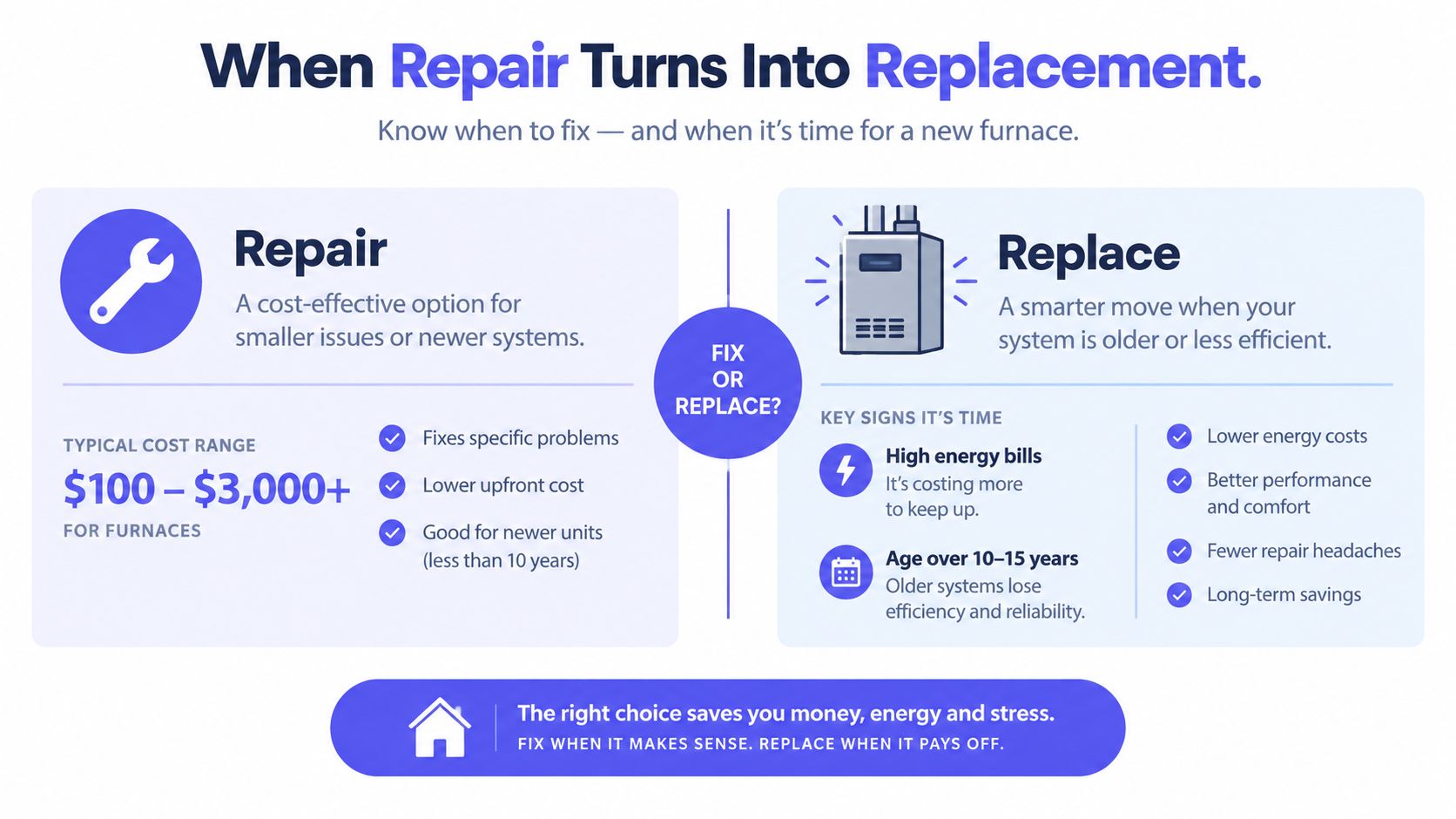
A repair quote deserves more scrutiny as it approaches replacement economics. HVAC repair can range from about $100 on the low end to $3,000 or more for furnaces and $5,000 or more for central AC or heat-pump systems, while a typical central-system replacement is often quoted around $5,000 to $12,500, according to Trane's repair-or-replace guidance.
A practical threshold is roughly $3,000 for one repair. That isn't an automatic replacement order. It means you should compare the equipment's age, efficiency, repair history, warranty status, and expected remaining life before spending the money.
A 2026 decision framework
Current replacement-oriented coverage places new HVAC system costs around $11,590 to $14,100 in 2026, while other installed-system estimates place typical replacement costs around $9,000 to $17,000, depending on equipment and installation scope, as outlined in Fuse Service's 2026 HVAC replacement guide.
That context matters for a $600 or $1,200 repair on older equipment. The repair may still be rational if the system has been reliable and the failure is isolated. Replacement deserves closer consideration if the equipment is older, inefficient, or repeatedly breaking down.
Use these questions before approving a major repair:
- Is the failed part covered by a manufacturer or labor warranty?
- Has the system needed multiple repairs recently?
- Does the repair solve the underlying problem or only restore operation temporarily?
- Are energy use and comfort already poor?
- Can the professional provide both repair and replacement options in writing?
For a structured comparison, use this repair-or-replace HVAC decision guide. The right choice is the one that fits the equipment's condition and your expected ownership horizon, not just the option with the smaller invoice today.
Hidden Fees and Quote Surprises
A low first-call quote can become a much larger invoice once the technician opens the system. The diagnostic range noted earlier, typically $75 to $200, may cover testing only. Some companies apply it to approved repair work, while others charge it separately. Confirm that policy before scheduling, using this HVAC service-call cost guide to compare what the first visit may include.
For example, an $89 diagnostic quote may exclude $150 to $300 for refrigerant recovery. The final bill can also change when a thermostat complaint leads to a wiring fault, a frozen coil reveals a refrigerant leak, or a failed blower motor exposes a wider airflow problem. A revised price is reasonable when testing confirms a separate failure. It should still be explained and approved before extra work begins.
What to ask before approval
Request an itemized estimate covering:
- Diagnosis: What tests were completed, and what failed?
- Labor: How many hours are included, and what rate applies?
- Parts: Which component will be installed, and is it covered by a warranty?
- Additional work: Are refrigerant recovery, disposal, electrical repairs, permits, or difficult access included?
- Payment terms: Does the service charge apply to the repair, and when is payment due?
Ask about charges that often sit outside the first quote, including refrigerant, leak testing, recovery, diagnostic retesting, equipment rental, disposal, and return visits. A technician may also price a repair differently if the unit requires attic access, roof access, lifting equipment, or a second technician.
Emergency scheduling widens the first-call gap. After-hours labor may reach roughly $160 to $250 per hour, compared with $75 to $150 during normal hours, as noted earlier. Confirm the emergency premium, minimum billable time, and whether parts carry a separate markup before authorizing work.
Legitimate change or warning sign
A revised estimate should identify the newly confirmed fault, show the added charges, and give you a choice before work continues. Refusal to itemize, pressure to approve immediately, or a vague “parts and labor” total warrants caution. Compare the written scope with the original quote, then approve only the work you understand.
How to Choose a Vetted HVAC Professional
The professional you choose affects more than workmanship. A weak diagnosis can lead to an unnecessary part replacement, another service visit, or a premature replacement recommendation. A careful technician tests the system, explains the failure, and gives you enough information to compare options.
Look for active licensing, background screening, strong recent customer feedback, and written estimates. Those checks don't guarantee a particular outcome, but they reduce avoidable uncertainty before anyone touches the equipment.

Why exclusive matching matters
Hand Vetted Co. matches a request with one licensed, background-checked professional who has a 4.5-plus star rating and passes a human review. The request isn't distributed to multiple businesses, so you can discuss the problem without competing calls and repeated sales pitches.
That model is one option for finding a professional, alongside referrals, manufacturer directories, and local searches. The financial benefit is clarity. One accountable professional can focus on the diagnosis, document the scope, and explain whether a repair makes sense before you compare it with replacement.
You can review Handvetted's background-check standards and ask any professional these questions:
- Are you currently licensed for this work in my state?
- Do you carry the required insurance?
- Is the diagnostic fee credited if I approve the repair?
- Will I receive an itemized estimate before work begins?
- What warranty applies to the part and labor?
A vetted match doesn't remove the need to read the estimate. It gives you a more reliable starting point for that conversation.
Practical Next Steps After You Get a Quote
Start by classifying the repair. A quote near the ordinary mid-hundreds may be reasonable for a routine component failure, while a quote involving a compressor, coil, heat exchanger, or extensive refrigerant work requires a broader review. Don't compare totals until you know whether both professionals included the same parts, labor, diagnostic work, and warranty coverage.
Ask for a second opinion when the diagnosis is unclear, the repair would consume a large share of the system's value, or the professional won't explain the testing. A second opinion is especially useful when an older system receives a major-component recommendation and you haven't been shown a repair and replacement comparison.
Prepare before the next visit
Give the technician useful information before arrival:
- Record the symptom: Note whether the system is short cycling, blowing warm air, leaking, freezing, tripping a breaker, or making unusual noise.
- Share the history: Identify recent repairs, maintenance, and any previous refrigerant or electrical work.
- Confirm access: Clear the area around the indoor and outdoor equipment so diagnosis doesn't take longer than necessary.
- Gather documents: Find warranty paperwork, equipment details, and prior invoices if you have them.
- Ask about timing: Confirm normal-hours availability and any emergency pricing before booking.
Use this quote checklist
Before signing, verify that the estimate includes:
- The professional's license and insurance information.
- A clear diagnosis, not only a symptom description.
- Separate parts, labor, diagnostic, and service-call charges.
- Whether the initial fee applies toward approved work.
- The parts and labor warranty.
- The expected repair outcome and any known risks.
- A repair-versus-replace option when the equipment is aging or the work is substantial.
The best outcome is not just the lowest bill. It's a decision you understand, supported by a diagnosis that matches the work and a quote that shows what you're buying.
Hand Vetted Co. connects you with one licensed, background-checked HVAC professional instead of sending your request to multiple businesses. Visit Hand Vetted Co. to request an exclusive match and get a clearer starting point for your repair quote.