Exclusive leads cost 300–400% more than shared leads, and that premium only pays off when exclusivity is paired with a fast response and pre-qualified intent. If your team can't reach a serious buyer quickly, you're paying for an advantage your operation isn't equipped to use.
The basic promise sounds simple: one homeowner inquiry goes to one business instead of several competitors. The actual buying decision is harder. You need to know whether “exclusive” means one buyer forever, whether the request reflects real project intent, whether the professional is properly qualified, and whether your sales process can turn speed into booked work.
Table of Contents
- What Exclusive Home Improvement Leads Actually Are
- Exclusive vs Shared Leads Compared
- Why Response Speed Changes the Math
- Vetting Standards That Protect Your Spend
- Where Exclusive Leads Come From
- How to Evaluate an Exclusive Lead Provider
- Plugging Exclusive Leads Into Your Sales Workflow
- Common Pitfalls and Your Next Step
What Exclusive Home Improvement Leads Actually Are
An exclusive home improvement lead is a project inquiry sold to one business rather than distributed to multiple businesses at the same time. The distinction matters because the buyer isn't just purchasing contact information. They're purchasing a cleaner conversation, less competitive noise, and a better chance to become the first credible professional the customer speaks with.
One industry analysis of 2.3 million home service leads found that exclusive leads carried a 300–400% price premium over shared leads, as reported in this analysis of verified remodeling leads. That premium makes sense only if the lead produces a materially better opportunity to close. Otherwise, the higher acquisition cost cuts deeper into margin.
A practical roofing example
A property owner submits a storm-damage request, identifies the service area, and describes the work needed. A genuine exclusive program routes that inquiry to one roofer promptly. That roofer can call, confirm the situation, ask about urgency, and schedule an inspection without competing against several companies making the same first call.
A shared program sends the same request to multiple businesses. The customer may hear several pitches in a short period, ignore later calls, or choose the first company that sounds prepared. The lead becomes a race instead of a controlled sales conversation.
Read the delivery terms carefully
True exclusivity means one buyer receives the request and the provider doesn't resell it to another business. The contract should define that plainly.
Soft exclusivity often means something else. A provider may offer a short “first look” period, use “priority routing” language, or broadcast the inquiry later. Those terms don't give you ownership of the opportunity. They give you an early position in a distribution queue.
Look for three warning signs:
- Vague delivery language: The agreement never defines how many businesses can receive one inquiry.
- Weak credit terms: The refund or replacement window is shorter than your team needs to identify duplicates, bad numbers, or irrelevant projects.
- Promotional wording: Phrases such as “first look” and “priority routing” appear where a direct exclusivity clause should be.
Practical rule: If the word “exclusive” isn't defined in writing, treat the lead as shared.
Ask where the request originated, when the customer submitted it, when it was delivered, and what happens if the customer already received calls from another buyer. A premium lead deserves a transparent chain of custody.
Exclusive vs Shared Leads Compared
Exclusive and shared leads serve different sales motions. Neither is automatically profitable. The right choice depends on project value, response coverage, qualification standards, and the amount of competition your team can handle without letting opportunities fall through.
The 300–400% premium is the clearest warning against comparing sources only by unit price. A cheaper lead can cost more per booked job if several businesses receive it and your salespeople spend their time chasing customers who have already chosen someone else.
| Metric | Exclusive Leads | Shared Leads |
|---|---|---|
| Buyer competition | One business receives the inquiry | Multiple businesses may receive the inquiry |
| Customer conversation | More controlled, with less immediate competition | Competitive, often requiring rapid differentiation |
| Unit economics | Higher price, justified by stronger intent and reduced overlap | Lower price, justified by greater volume |
| Best fit | High-value replacements, roofing, HVAC, restoration, and remodeling | Lower-ticket service work or broad volume acquisition |
| Operational requirement | Fast routing, staffed phones, disciplined follow-up | High activity levels and tolerance for lower contact quality |
A useful behavioral benchmark supports the speed argument. One home-service benchmark reports that 78% of homeowners choose the first company to reply, while average response time is about 42 minutes, as documented in this home-service lead response automation benchmark. Exclusivity helps only if your business can act before another option becomes more attractive.
Match the lead type to the job
Use exclusive distribution for projects where one sale can support a higher acquisition cost, such as a major roof replacement, an HVAC replacement, restoration work, or a substantial remodel. These jobs usually justify more qualification because the cost of a wasted sales visit is meaningful.
Shared distribution can make sense for lower-value service calls or broad storm-related volume when your team has strong throughput and the margin doesn't support a premium. It still requires a clear credit policy, accurate service areas, and fast handling.
For a more detailed explanation of how businesses pay for individual opportunities, see pay-per-lead explained.
The decision rule is simple: buy exclusivity when the expected profit from a better close rate exceeds the premium. For a high-value project, that calculation can work. For low-margin work, it often doesn't unless the provider filters aggressively for location, project type, timeline, budget, and decision-maker status.
Why Response Speed Changes the Math
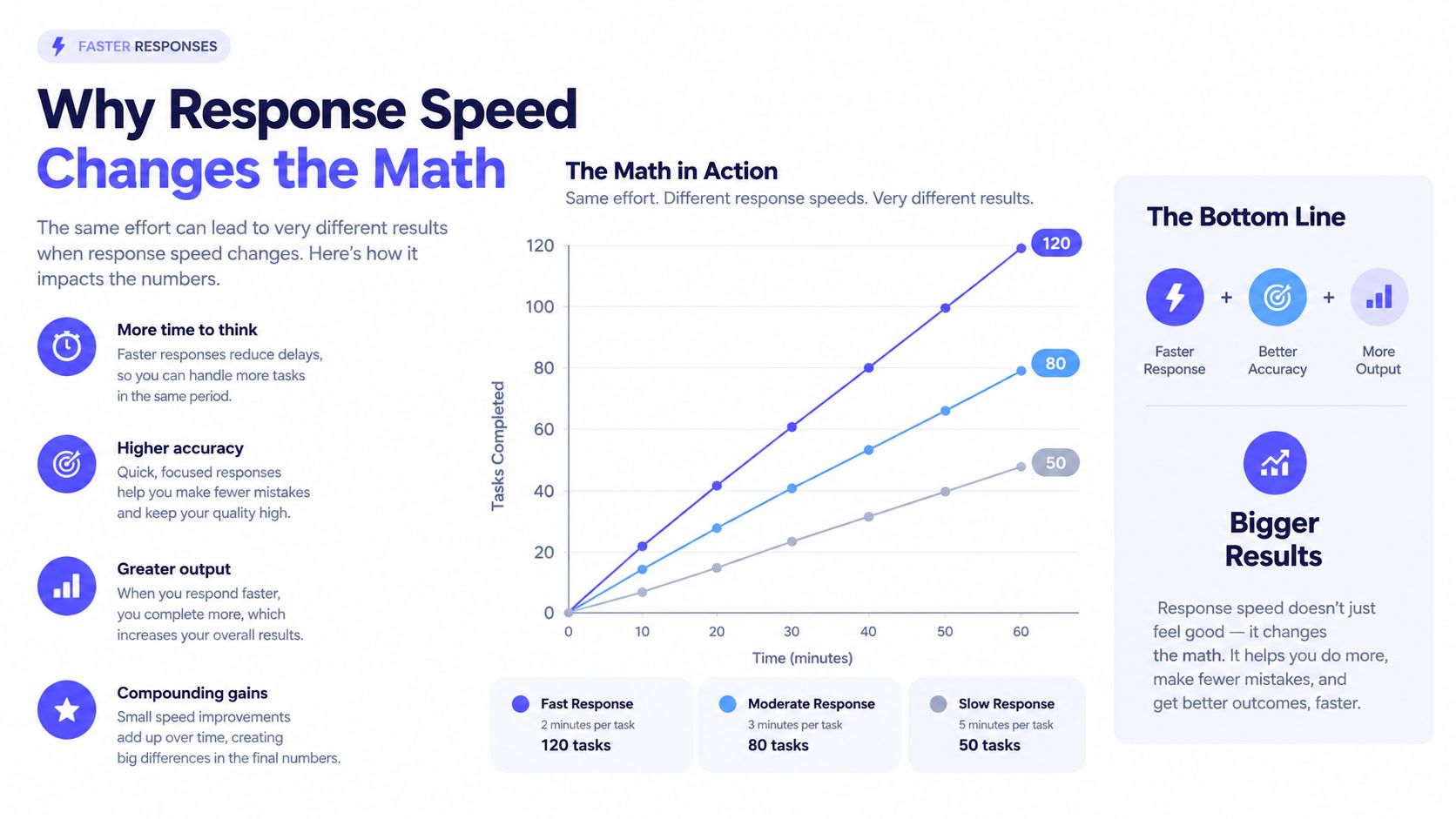
Exclusivity doesn't create value by itself. It creates a short window in which your business can become the only active conversation. Silence wastes that window.
A home-services benchmark reports that responding within 2 minutes produces a 62% conversion rate, compared with 28% at the 42-minute industry average, according to this lead response time analysis for home services. The gap is large enough to change how you staff phones, assign inquiries, and judge a lead source.
The same source reports that 95% of companies don't respond within five minutes, while 71% miss the one-hour mark. Those figures describe an operational failure, not a lead-quality problem. A legitimate inquiry can become worthless while it sits in an inbox.
Why exclusivity raises the stakes
With a shared inquiry, several businesses may be calling. The customer can compare offers, ignore you, or respond to another company first. With an exclusive request, the main threat is usually delay. The opportunity grows stale because nobody makes contact, not because five salespeople are crowding the customer at once.
That changes the required workflow:
- Live ownership: Assign every lead to one person or queue immediately.
- Immediate contact: Call while the request is still fresh, then use a concise text if the call isn't answered.
- Visible accountability: Track delivery time, first attempt, conversation, appointment, and outcome.
- Coverage outside office hours: If your team only checks email the next morning, don't buy a product that depends on immediate intent.
A provider can send a high-quality inquiry, but it can't compensate for an empty phone queue. Exclusive leads demand staffing, routing, and follow-up discipline.
Speed isn't a courtesy in lead buying. It's part of the product you're paying for.
Vetting Standards That Protect Your Spend
A lead is not valuable merely because a person submitted a form. The customer must be connected to a properly licensed, qualified professional, and the project must fit the business receiving it. Vetting protects both sides of the transaction.
Four checks are essential:
- Active license verification. Confirm the license with the relevant state or local authority before routing the request.
- Background screening. Screen owners and operators according to a documented policy.
- Ratings and reputation review. Check recent customer feedback and meaningful review history, not just a star badge.
- Human review. Have a person inspect ambiguous, incomplete, or suspicious submissions before delivery.
California provides a concrete regulatory example. The California Contractors State License Board guidance says contractors must verify four years of journey-level experience, pass trade and law-and-business exams, post a license bond, and meet criminal background-check requirements for new contractors introduced since 2005. The board also requires contractors to place their license number in advertisements.
New York City offers a different but equally practical consumer standard. Its official guidance says a contractor performing home improvement work costing more than $200 must hold a Department of Consumer and Worker Protection license, and it advises customers to check license status and complaint history through its home improvement contractor guidance.
What screening should look like
Arizona shows why background screening belongs in a serious qualification process. The Arizona Registrar of Contractors background-check information describes criminal-record checks tied to licensing decisions. That makes screening more than a marketing preference. It is part of how regulators manage risk.
| Vetting check | Cost added | Rejection rate | Close-rate lift |
|---|---|---|---|
| Active license check | Not specified | Not specified | Not specified |
| Background screening | Not specified | Not specified | Not specified |
| Ratings history | Not specified | Not specified | Not specified |
| Human review | Not specified | Not specified | Not specified |
The table has no invented performance claims because providers should supply their own evidence. Ask for rejection reasons, screening timestamps, license status, and the process used when a professional no longer qualifies.
The New York consumer contractor tips also recommend checking complaint history and obtaining reliable references. That is the right standard for lead buyers too. A low-priced inquiry routed to an unqualified professional isn't a bargain. It creates wasted labor, customer dissatisfaction, and avoidable exposure.
Where Exclusive Leads Come From
Lead sources differ by intent, delivery format, and the amount of qualification performed before a request reaches your team. Buying from a recognizable marketplace doesn't guarantee exclusivity. Buying from a smaller provider doesn't guarantee quality either.
Direct-to-consumer platforms
Large direct platforms can generate broad demand for kitchen, bath, window, and general improvement work. They may suit businesses that want consistent volume and have enough sales capacity to filter inquiries internally.
The tradeoff is control. Ask whether the request is exclusive, how it was captured, when it was delivered, and whether the same contact can appear through another channel.
Aggregator networks
Aggregator networks can fill pipeline gaps during slower periods or expand coverage into nearby service areas. They work best when you already know which project types your crews can absorb and which ZIP codes produce profitable work.
Don't confuse overflow volume with qualified demand. A full queue of poorly matched projects can distract estimators from work your company actually wants.
Pay-per-call programs
Pay-per-call sources fit urgent categories such as emergency HVAC, plumbing, and restoration, but only if a real person answers. A missed call is a missed sales process, not a future follow-up task.
Pricing varies by category and qualification. Require call recording access where lawful, clear duration rules, service-area filters, and credits for wrong numbers or irrelevant requests.
Local referrals and associations
HOAs, property managers, insurers, and local referral groups can produce stronger trust signals because the customer may arrive with context. The volume is less predictable, so these sources work best alongside a controlled paid program.
Matching services
Matching services combine customer questions with professional screening before assigning one business. Hand Vetted Co. is one example. Its stated model matches a customer with one licensed, background-checked, 4.5-plus-star-rated professional, and keeps each request exclusive rather than sending it to multiple businesses. You can review its contractor-focused approach to lead generation for contractors.
Match the channel to your sales motion. Emergency services need live coverage. High-ticket replacements need qualification and consultative follow-up. Broad remodeling demand needs filters that separate serious project planning from casual research.
How to Evaluate an Exclusive Lead Provider
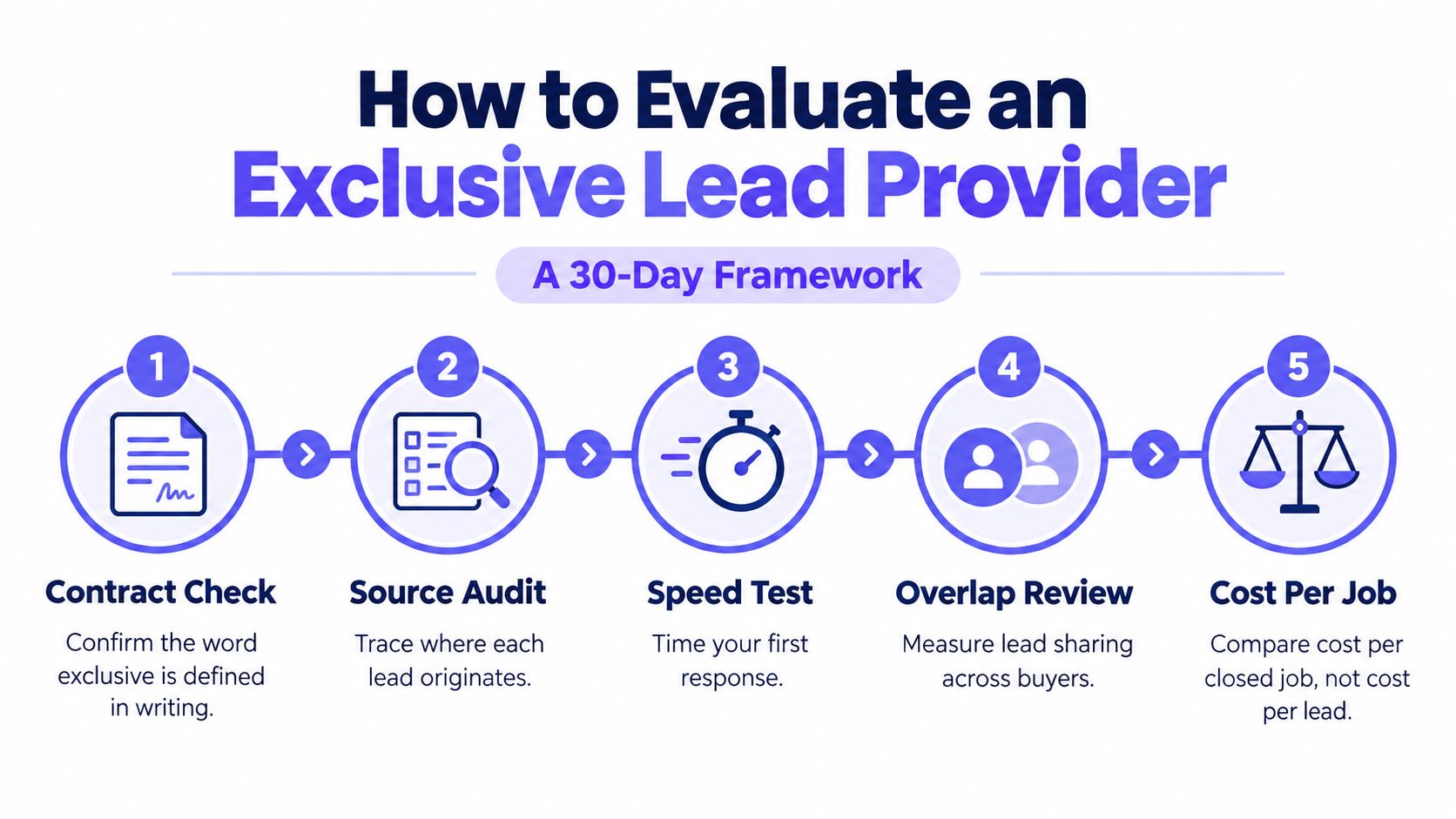
Don't sign a long agreement because a salesperson says “exclusive.” Run a controlled evaluation that tests the provider's claims and your team's ability to monetize them.
Start with the contract
Find the definition of exclusivity first. It should say how many businesses receive one inquiry, whether the provider can resell it later, and what counts as a duplicate. If those terms are missing, assume the distribution rules favor the seller.
Then examine the rematch policy. It should identify acceptable triggers, such as a bad number, an out-of-area request, or a customer who never answers. The credit process should identify who reviews the dispute, what evidence is required, and how quickly the account is credited.
Request evidence before scaling
Ask for 10 sample leads with timestamps, source information, and consent records. Call the sample contacts and ask whether they submitted the request that day. You're testing freshness, accuracy, delivery, and customer recognition at the same time.
Review the reporting dashboard for:
- Source attribution: You can identify where each inquiry originated.
- Response tracking: The system records delivery and first-contact times.
- Outcome reporting: Your team can log appointments, estimates, closed jobs, and lost reasons.
- Duplicate controls: The provider can investigate repeated records instead of dismissing them as normal overlap.
Don't accept pricing benchmarks without a source and a defined project category. Market guidance can vary widely, and the verified data available here confirms that shared leads may cost around $15, while exclusive leads can reach $200 or more, as described in this home improvement lead pricing guidance. Compare cost per closed job, not just cost per inquiry.
A sound pilot has a defined start date, service area, project type, lead cap, response owner, credit process, and review date. If the provider won't let you measure those conditions, it isn't offering a test. It's asking you to accept a claim.
Plugging Exclusive Leads Into Your Sales Workflow
A lead source can be sound and still fail inside a disorganized sales process. The handoff from delivery to close needs an owner, a timestamp, and a next action.
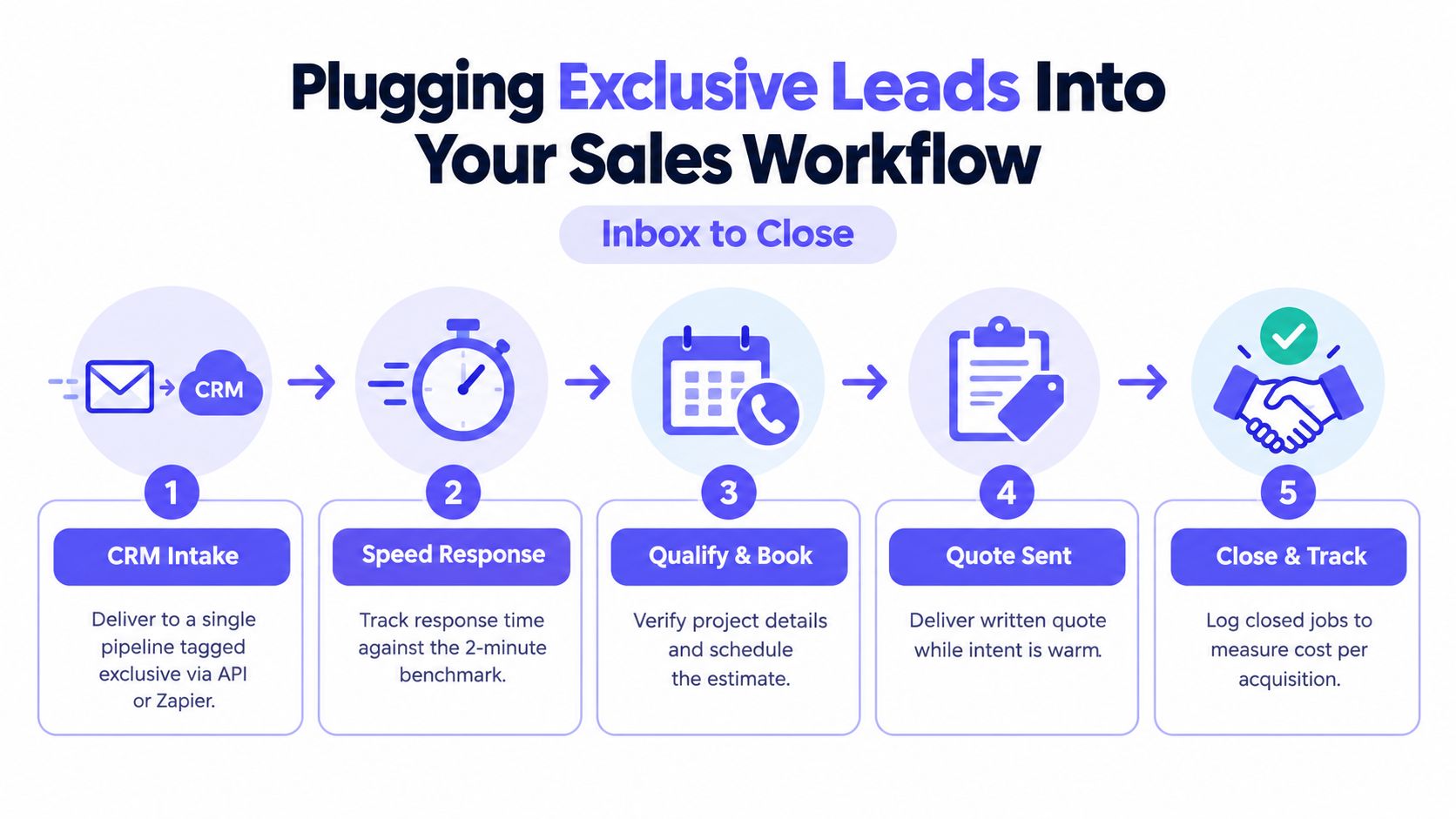
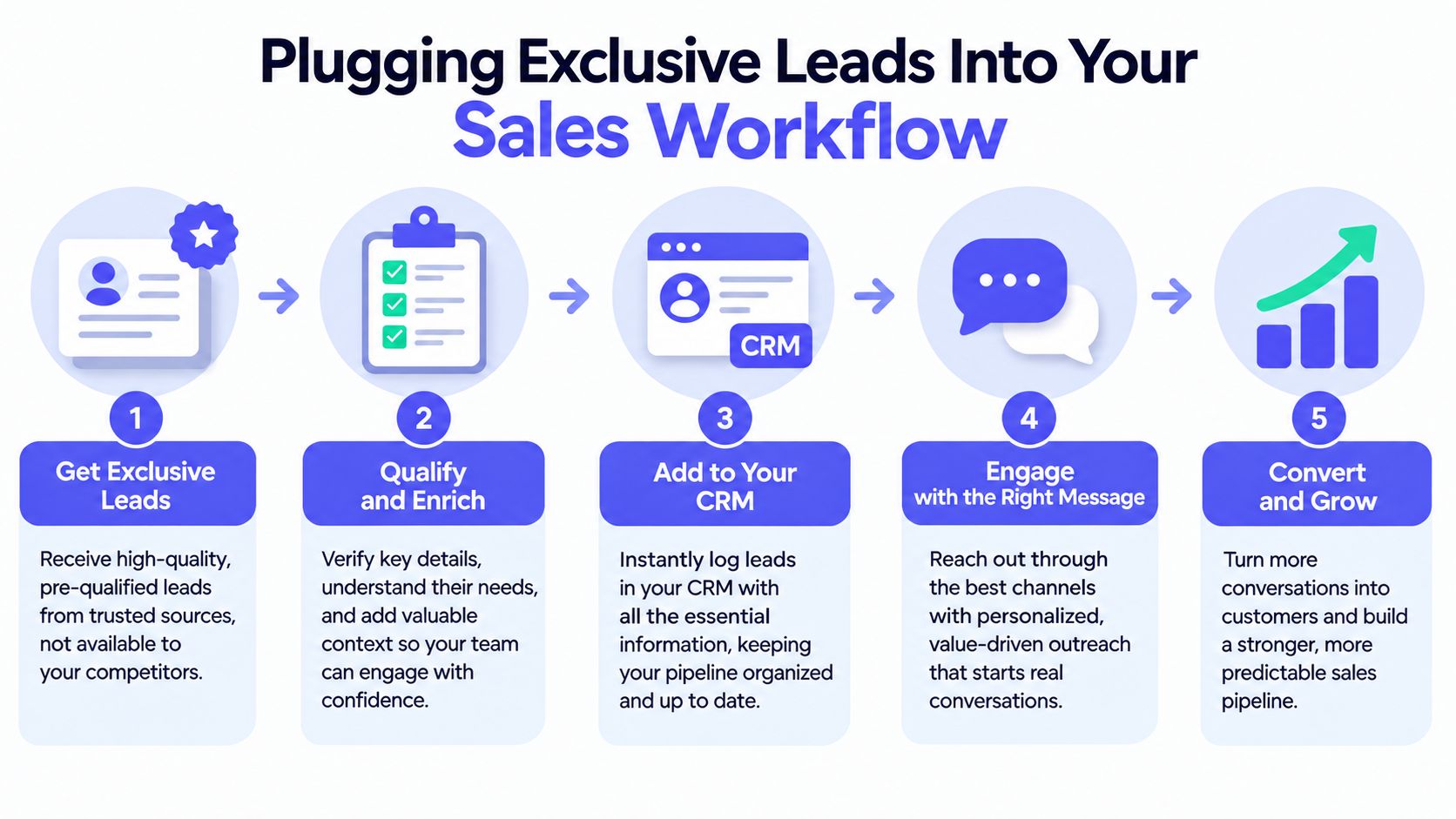
Start by sending every request into one CRM pipeline labeled exclusive. Use an API or Zapier webhook where possible so the delivery timestamp survives the handoff. Email forwarding is acceptable for a small test, but it makes response measurement and duplicate handling harder.
A workable operating sequence
First, respond within two minutes. Call the number, mention the project the customer submitted, and ask whether now is a good time to discuss it. If nobody answers, send a short message such as: “Hi, this is Alex with [Business]. I received your request about the roof repair. I can ask a few questions and arrange the next step. What time works for you?”
Next, qualify without turning the call into an interrogation. Confirm the service address, project type, timing, ownership or decision-maker status, and any budget information the customer volunteered. Don't invent qualification data that the customer hasn't provided.
Then, book the estimate while intent is active. Offer clear appointment options, explain what the professional will inspect, and send a confirmation message. For larger projects, connect the appointment to the right estimator instead of sending the first available person.
Finally, record the outcome. Log whether the customer answered, qualified, booked, received a quote, accepted, declined, or became unreachable. Record job value and source after the sales team has enough information to calculate acquisition cost.
The response benchmark gives managers a practical accountability line. The cited data compares 62% conversion within two minutes with 28% at the 42-minute average, so your dashboard should show where each lead landed against that standard, not merely whether someone eventually called.
For a trade-specific example of building a pipeline around qualified inquiries, see plumber lead generation. The principle is the same across HVAC, roofing, restoration, and remodeling. Route the request quickly, qualify the project, book the next action, and connect the final sale back to the original source.
Common Pitfalls and Your Next Step
The most expensive mistakes are operational and contractual, not technical.
Shared leads marketed as exclusive are the first trap. Demand a written definition, ask whether the inquiry can be resold, and require a clear remedy for duplicates. “Priority” isn't the same as exclusive.
Slow response is the second. One benchmark reports that 78% of homeowners choose the first company to reply, while the average response takes about 42 minutes, as documented in the earlier response-speed source. If your phone isn't staffed, reduce buying volume or choose a source that matches your coverage.
Weak professional screening creates a third risk. License checks, background screening, ratings history, and human review should happen before a request reaches the sales queue. Public agencies in California, New York City, and Arizona all demonstrate why licensing and background information matter to consumer protection.
Buying the wrong project economics is the fourth. A premium lead may work for a substantial replacement but fail for a low-margin service category. Don't judge the purchase by lead count. Judge it by qualified appointments, sold work, gross profit, and the time your team spends pursuing each opportunity.
Run this checklist before increasing spend
- Audit current economics: Calculate cost per qualified appointment and cost per closed job by source.
- Set the response standard: Assign ownership and require a two-minute first-contact target where the product depends on urgency.
- Test two providers: Request sample records, contract terms, delivery evidence, and credit rules.
- Verify screening: Confirm how license status, background checks, ratings, and human review are documented.
- Run a controlled pilot: Keep the territory, project type, lead cap, and review criteria fixed before scaling.
The right source is the one your team can verify, reach, sell, and measure. Exclusive home improvement leads are worth the premium only when the entire chain works, from customer intent to professional vetting to fast follow-up.
Hand Vetted Co. matches customers with one licensed, background-checked, highly rated professional instead of distributing the request across competing businesses. Visit Hand Vetted Co. to review its exclusive matching model and see whether it fits your next controlled lead test.