Are you trying to win more jobs, or just buy more names and phone numbers?
That gap is where most contractor marketing falls apart. You can have forms coming in, missed calls piling up, and a sales board that still looks thin. The problem usually isn't that you have no leads. It's that too many of them were never worth chasing, or they were handled badly once they showed up.
Table of Contents
- The Real Problem with Contractor Leads
- Choosing Your High-Impact Lead Channels
- Marketplaces vs Exclusive Vetted Platforms
- Capturing and Qualifying Leads Like a Pro
- Measuring What Matters and The Right Tech Stack
- Your Action Plan to Build a Better Lead Engine
The Real Problem with Contractor Leads
A lot of businesses still think more leads fixes everything. It doesn't.
Lead generation is the top priority for 91% of B2B marketers in 2025, yet 45% of businesses still say they struggled to generate enough leads over the last year, and 80% of new leads never convert into sales according to Cirrus Insight's lead generation statistics. That tells you something important. A bigger pile of leads doesn't automatically create revenue.
For contractors, this shows up in familiar ways. You pay for a batch of leads. Half don't answer. A few were price shopping from the start. Some wanted a service you don't even want to sell. Then someone says the answer is to buy more.
That's how people burn cash.
Why volume feels productive but often isn't
A dashboard full of inquiries looks good until you ask harder questions:
- Did they answer the phone
- Did they fit your service area
- Did they have a real project
- Did anyone book an estimate
- Did the job close
If the answer to most of those is no, then your lead generation for contractors problem isn't top-of-funnel. It's quality, qualification, and follow-up discipline.
Practical rule: A bad lead doesn't become good because you got it cheaply.
The businesses that get this right stop obsessing over raw lead counts. They get picky. They define what a good lead looks like. They build faster response habits. They stop buying channels that create a race to the bottom.
What profitable lead generation actually looks like
Profitable lead generation for contractors has three parts working together:
- A source that attracts the right people
- A process that filters weak fits fast
- A sales follow-up system that keeps good leads from going cold
Miss one of those and the whole thing leaks.
You don't need every channel. You don't need fancy reporting on day one. You do need a system that helps you close real jobs instead of feeding admin work and callback lists.
Most teams don't lose because they had zero demand. They lose because too much of their demand was low intent, shared, mistimed, or mishandled.
That's fixable. But it starts with dropping the idea that every lead is worth the same.
Choosing Your High-Impact Lead Channels
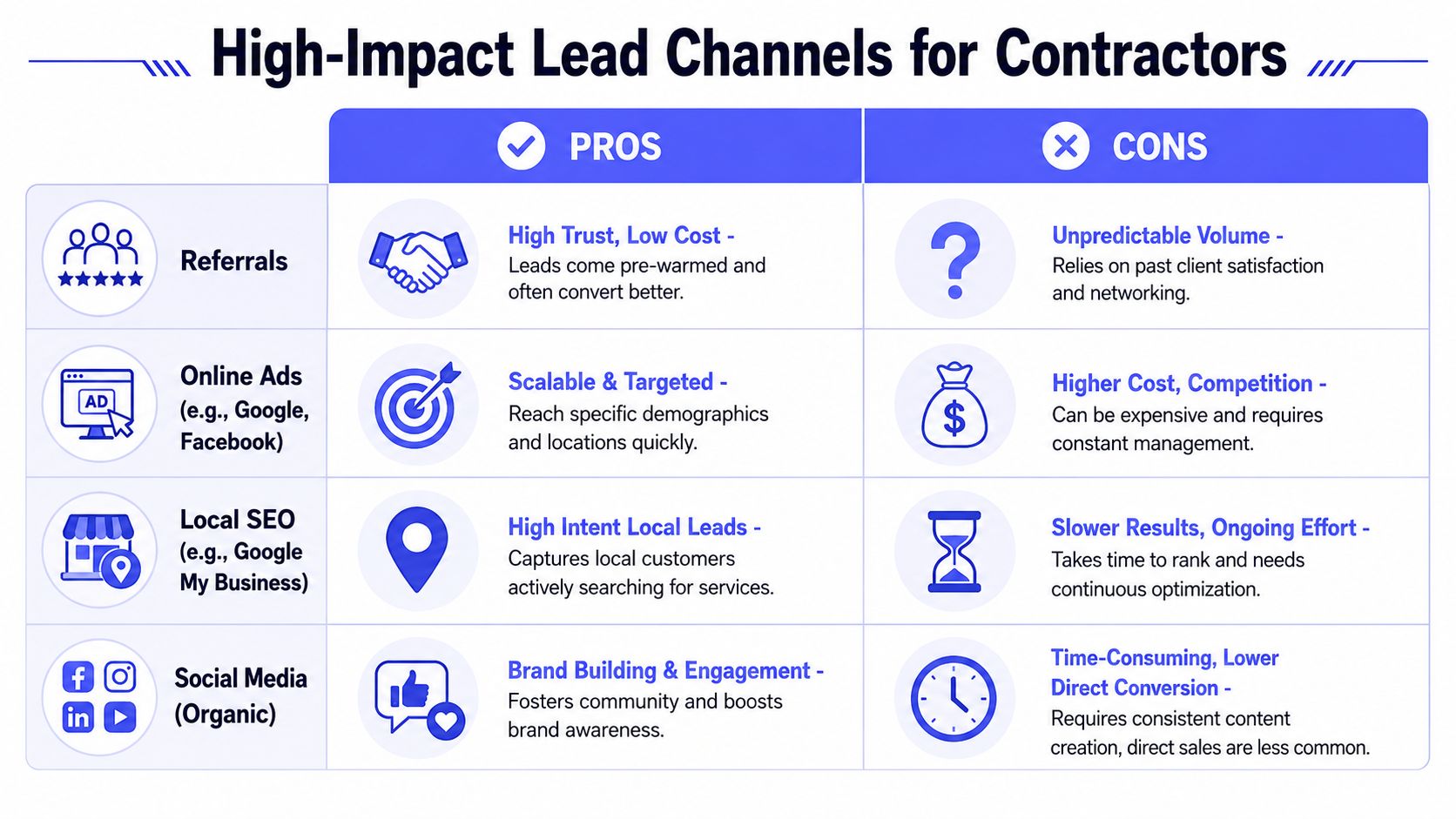
Some channels create trust slowly and compound over time. Others can produce inquiries fast but come with more noise. The smartest contractor lead generation setup usually isn't one source. It's a mix that matches your budget, your follow-up capacity, and the type of jobs you want more of.
What each channel is really good at
Referrals are still the cleanest leads most contractors will ever get. Trust is already there. The catch is volume. You can't fully control when they show up, and many businesses never build a real referral process after the job is done.
Local SEO and Google Business Profile help you show up when people are already looking. Those leads often come in with stronger intent because the person searched for the service, the area, or both. This channel takes upkeep. Reviews, photos, service details, and a decent website all matter.
Organic content is slower at the start, but the economics can be hard to ignore. Martal's lead generation statistics report that content marketing generates 3 times more leads than traditional outbound methods while costing 62% less, and active bloggers generate 13x more leads than non-blogging competitors. For contractors, that doesn't mean publishing fluff every week. It means building useful service pages, project pages, location pages, and answers to the questions people ask before they call.
Paid ads can turn demand on quickly. They're useful when you need more opportunities now, want coverage in a new area, or need to support seasonality. They also punish sloppy follow-up and weak landing pages. If your ad sends people to a generic homepage with no clear next step, you're paying for confusion.
Partnerships often get overlooked. Realtors, property managers, insurance professionals, lenders, and adjacent trades can all send strong leads if the relationship is real and both sides know what a good fit looks like.
A quick side-by-side view
| Channel | Best use | Main upside | Main downside |
|---|---|---|---|
| Referrals | High-trust work | Warm introductions | Unpredictable volume |
| Local SEO | Local intent capture | Strong fit and credibility | Takes ongoing effort |
| Organic content | Long-term demand capture | Lower-cost lead generation over time | Slower ramp |
| Paid ads | Fast demand generation | Speed and targeting | Cost and management load |
| Partnerships | Niche trust network | Often better-fit jobs | Requires relationship building |
How to build a balanced mix
A lot of teams make one of two mistakes. They either rely only on referrals and wonder why growth stalls, or they pour money into ads before the basics are in place.
A better mix usually looks like this:
- Keep referrals active: Ask after successful jobs, stay in touch with past clients, and make introductions easy.
- Own your local presence: Your Google Business Profile, reviews, and core service pages need to look alive and credible.
- Use paid ads carefully: Turn them on when you can answer fast and when your landing pages are specific.
- Add content where it compounds: Publish the pages people need, not generic “about quality” filler.
A channel isn't good because it produces leads. It's good if it produces leads your team can close profitably.
If you want a starting point for evaluating local options, browse a lead generation near me resource and compare providers by lead quality, exclusivity, and follow-up expectations, not just by price per lead.
The biggest win comes from balance. Referrals build trust. Local SEO catches intent. Content compounds. Paid ads fill gaps. Partnerships provide advantage. Put all your budget into one source and you usually inherit that source's weakness too.
Marketplaces vs Exclusive Vetted Platforms
Not all lead sources are built on the same business model. That matters more than most contractors realize.
One model sells the same contact details to multiple businesses and lets everyone race to call first. The other model sends one qualified opportunity to one business. Those are completely different economics, even if both get labeled as “leads.”
Why shared leads wear teams out
Shared lead marketplaces look cheaper at first glance. That's the trap.
If the same person's information gets sold to several contractors, the job often turns into a speed contest, a price contest, or both. Your office spends time calling. Your sales rep spends time chasing. The customer gets flooded with calls and stops answering. Even when you reach them, you're one of several near-identical options.
That setup trains the buyer to compare quotes before they compare trust.
ProjectMark's contractor lead generation analysis notes that emerging 2024-2025 data shows exclusive appointments drive 3-5x higher conversion rates for licensed contractors because they reduce spam and competing pitches. That lines up with what many contractors already know from experience. Exclusivity changes the conversation.
A second source adds useful cost context. SMB Sales Boost's breakdown of exclusive contractor leads says exclusive leads cost $50–$200 per lead, while shared leads cost $15–$85 and go to 3–8 contractors. It also reports a 10–15% close rate for shared leads, while exclusive leads close at 3–4 times higher rates. The per-lead price alone doesn't tell you which option is cheaper after the dust settles.
Shared Leads vs. Exclusive Leads at a Glance
| Metric | Shared Leads (Marketplaces) | Exclusive Leads (Matching Platforms) |
|---|---|---|
| Distribution | Same contact sold to multiple businesses | One matched opportunity goes to one business |
| Competition | Immediate and direct | Minimal built-in competition |
| Buyer experience | Often flooded with calls and texts | More controlled and less chaotic |
| Per-lead price | Usually lower upfront | Usually higher upfront |
| Conversion potential | Lower because several businesses chase the same person | Higher because attention isn't split |
| Sales environment | Often price-driven | More room for trust and fit |
Why paying more can produce better ROI
A cheap lead that creates admin work, quoting work, and no job is not a bargain. It's overhead.
Exclusive models force you to think differently. You stop asking, “How many names did I get?” and start asking, “Did this person match my service, area, and job type well enough to justify my team's time?” That's a much better question.
If you're comparing vendors in lead generation for contractors, don't stop at price. Ask:
- Is the lead shared or exclusive
- How much qualification happens before I get it
- Will I be one of several calls
- What kind of project detail do I receive
- Is this a raw inquiry or an actual appointment-ready opportunity
For plumbers specifically, a plumber lead generation comparison can help frame those questions in a trade where speed and local fit matter a lot.
The broad point applies across trades. Shared marketplaces sell access to chaos. Exclusive vetted platforms sell cleaner shots on goal. If your team is good at closing, cleaner shots usually win.
Capturing and Qualifying Leads Like a Pro
A lead's value drops fast. Not eventually. Fast.
If someone reaches out and your team doesn't respond until later that afternoon, you may already be too late. Local Biz Guru's contractor lead strategy guide cites a Velocify study showing that calling a lead back within 1 minute increases conversion rates by 391% compared to waiting 10 minutes. The same source says contractors who fail to respond within 5 minutes during business hours see a drastic drop in booked estimates.
The first five minutes decide a lot
This is the part too many businesses treat casually. A lead comes in. Someone plans to call after lunch. Someone forgets. Someone assumes the office got it.
That's how jobs vanish.
Your first-response workflow needs to be automatic and boring. That's good. Good systems are usually boring.
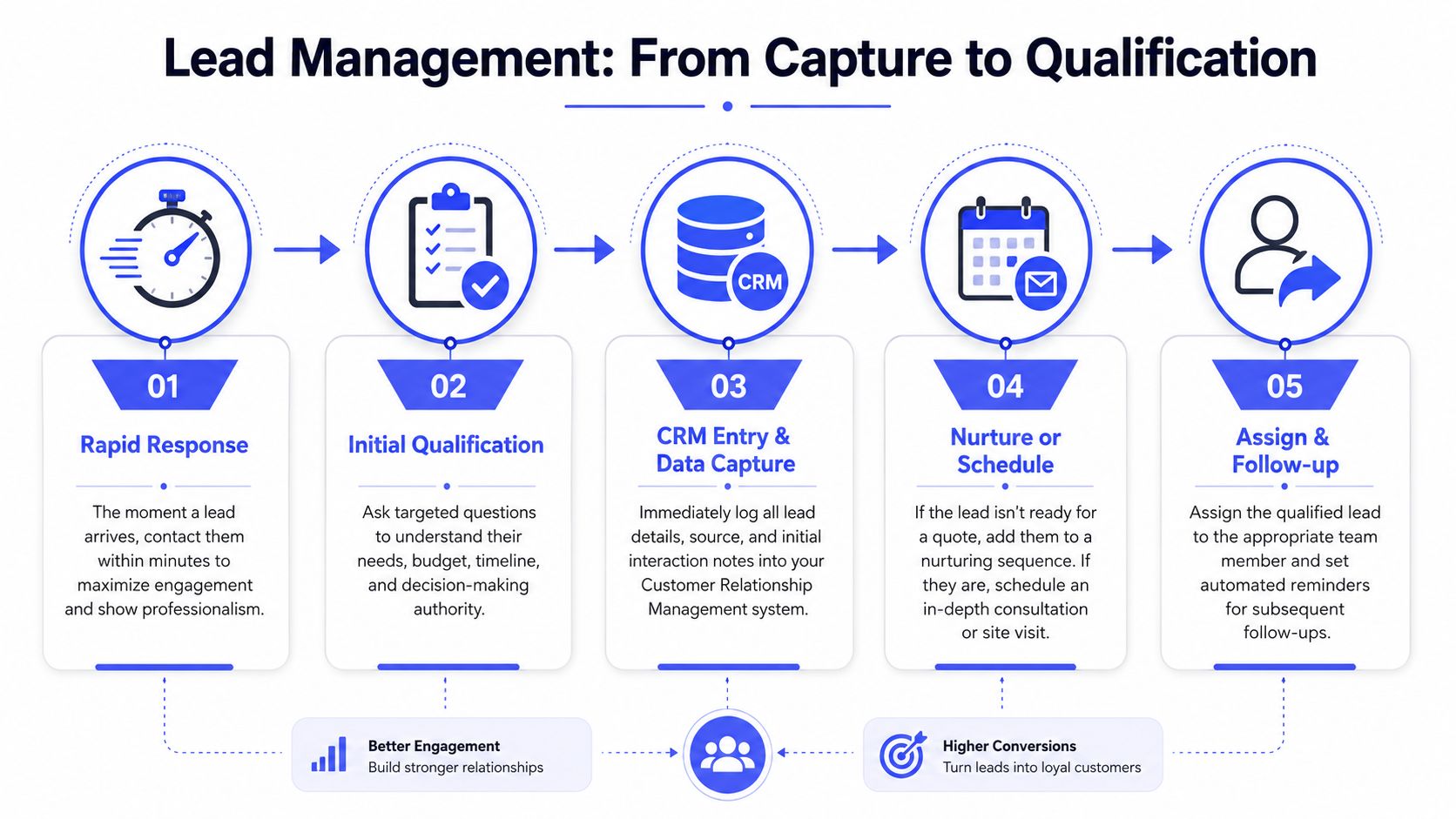
Use this sequence:
- Instant text: Confirm you got the inquiry and set the expectation that a call is coming.
- Live call within five minutes: Don't overthink it. Call.
- Second attempt later the same day: If they miss the first call, try again.
- Log the outcome immediately: No sticky notes. No memory-based follow-up.
Here's a text template that works because it's simple:
Hi, this is [Name] from [Business]. I just saw your request come through. I'm giving you a quick call now to learn a bit more and see if we're a fit.
And here's a call opener:
- Acknowledge the request: “You reached out about your project and I wanted to respond right away.”
- Confirm the basics: Service needed, location, timing.
- Set direction: Either book the next step or politely disqualify.
A simple qualification workflow
Fast response matters, but speed without qualification creates busywork. You need to sort leads cleanly.
Use four filters on the first call:
| Qualification point | What you need to learn |
|---|---|
| Fit | Is this a service you actually want to take on |
| Location | Is it in your service area |
| Timing | Is this urgent, active, or just research |
| Decision readiness | Are they actually moving forward soon |
If the lead fits, book the next step before ending the call. Don't leave it vague. Put a site visit, estimate slot, or callback on the calendar.
If the lead isn't ready yet, move them into a nurture bucket with notes. If they're the wrong fit, close the loop politely and move on.
Respond fast, qualify faster, and don't let weak leads steal time from good ones.
If your local visibility is producing inbound calls but the close quality feels uneven, tightening your local SEO for contractors process can help align the traffic you attract with the jobs you want.
One more operational habit matters here. Review every inquiry from the past week and make sure three things happened: same-day response, a clear next step, and a recorded reason the lead was won or lost. That's where patterns show up.
Measuring What Matters and The Right Tech Stack
If you only track total leads, you'll make bad decisions with confidence.
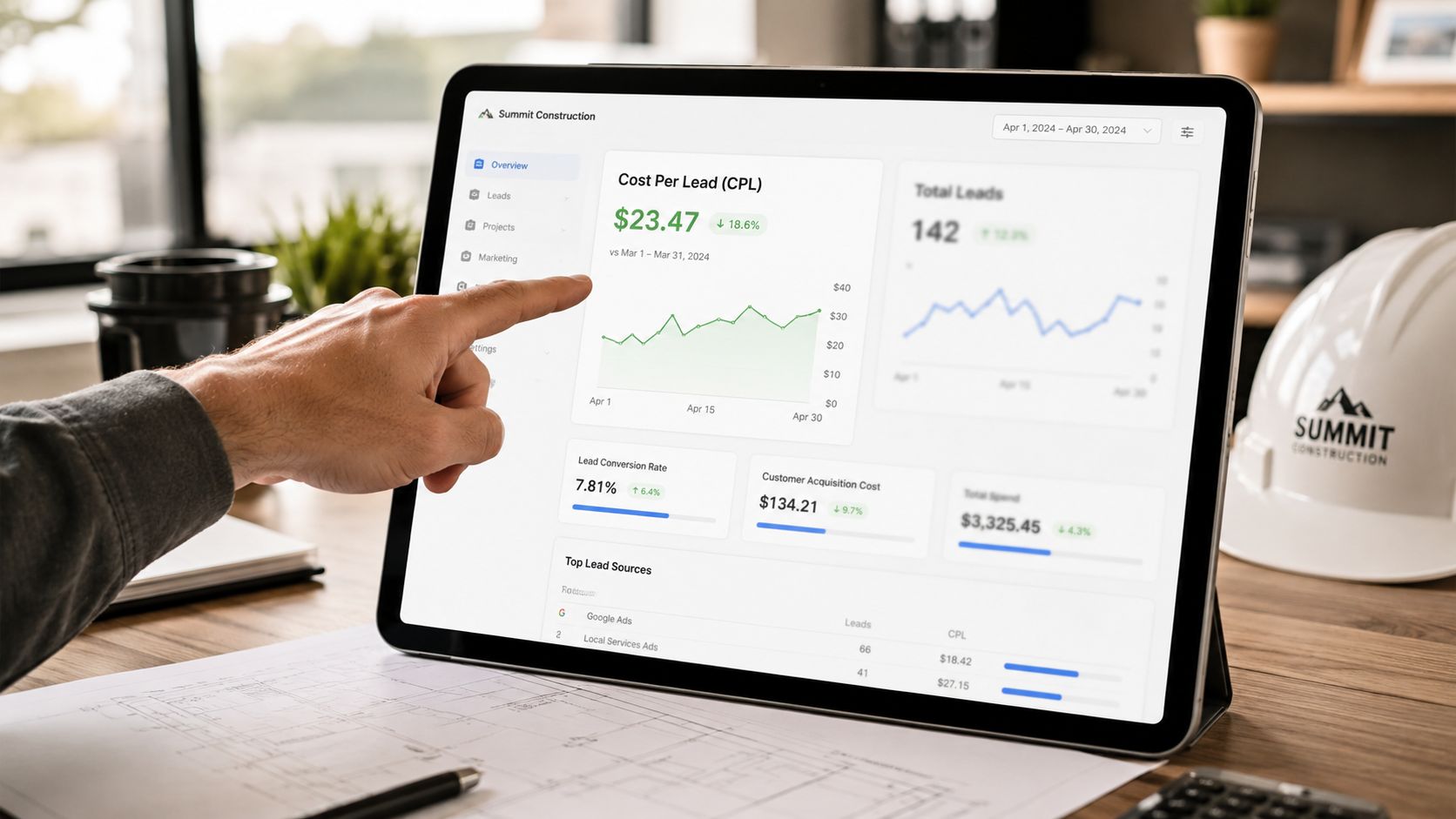
A source that sends lots of inquiries can still be a terrible source. Another source can look expensive up front and still produce your best jobs. You won't know which is which unless you track the outcome all the way to closed work.
Track closed jobs, not just inquiries
Projul's guide to getting more construction leads reports that contractors using CRM-tagged lead sources see 40% higher ROI by focusing on closed-deal metrics instead of inquiry counts. That's the right lens.
You need to know:
- Which source created the inquiry
- Which source booked the estimate
- Which source closed the job
- What kind of work each source tends to bring in
That's how you stop rewarding channels that look busy but don't pay.
A simple setup works fine. Give each channel its own source tag. Use unique phone numbers or landing pages where practical. Make sure every lead record carries the source all the way through the pipeline. Then review closed jobs by source, not just leads by source.
The lead source with the best ROI is often not the one generating the most form fills.
A lean setup that actually helps
You don't need a bloated software stack. You need a few pieces that work together and get used every day.
Start with a CRM. It can be simple, but it has to capture source, contact details, job type, status, and outcome. If your team still runs leads from missed calls, inboxes, and spreadsheets, tracking will break.
Add scheduling. If a qualified lead is ready, let your team lock in the next step fast. Reducing back-and-forth helps protect momentum.
Use light automation. Auto-text confirmations, reminders, pipeline updates, and follow-up tasks are typically sufficient. The goal isn't to sound robotic. The goal is to prevent good leads from slipping through cracks.
A workable stack for lead generation for contractors usually has three layers:
| Layer | Job |
|---|---|
| CRM | Stores lead, source, notes, and outcome |
| Scheduling tool | Books estimates or callbacks without friction |
| Automation | Triggers texts, reminders, and task assignments |
If a tool doesn't help your team respond faster, qualify better, or measure outcomes more clearly, it's probably noise.
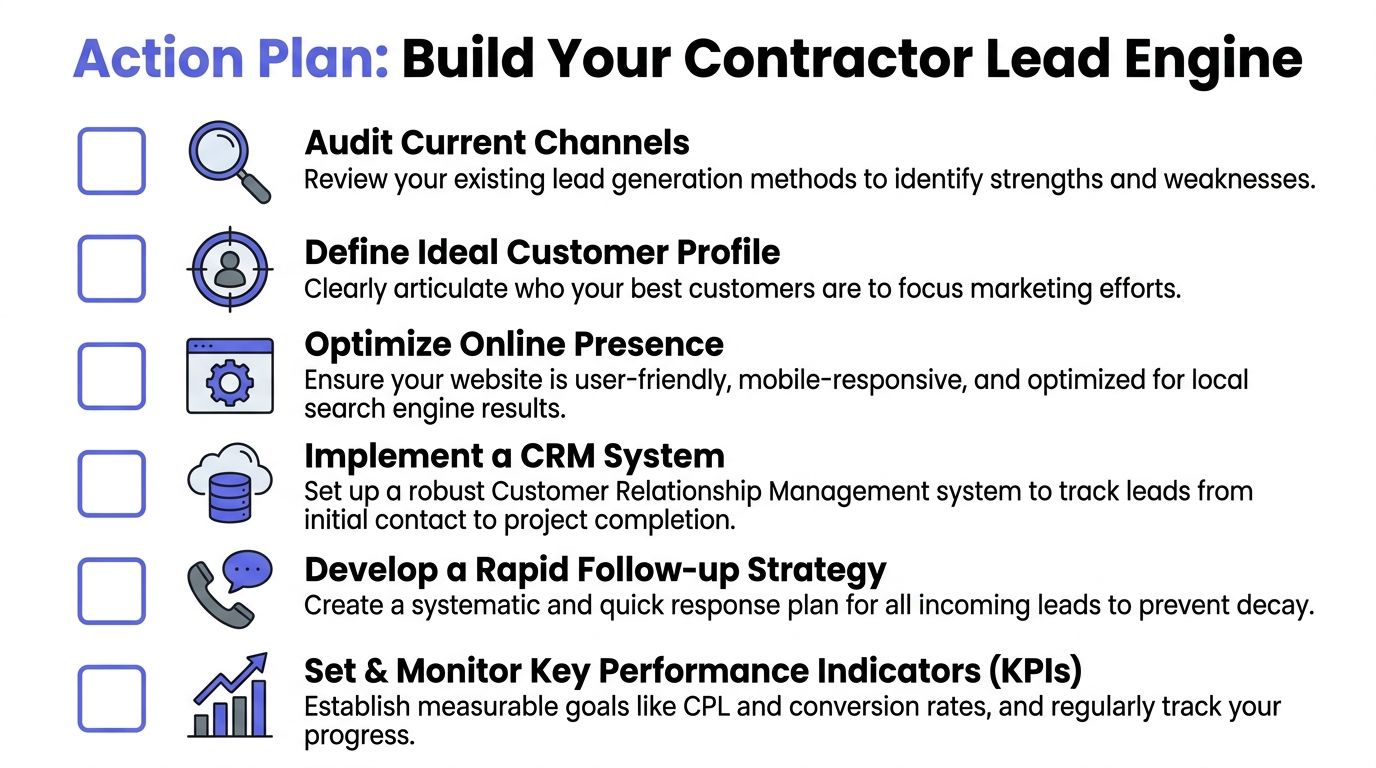
Your Action Plan to Build a Better Lead Engine
The fix usually isn't “do more marketing.” It's “build a tighter system.”
Most contractor lead generation problems come from a handful of weak points. Wrong channels. Slow response. Poor qualification. No source tracking. You can clean up a lot of that in one quarter if you work in the right order.
This week
Audit what's already happening.
- Pull your last batch of inquiries: Look at what came in recently and mark which ones turned into conversations, estimates, and jobs.
- Check response speed: See how long it took your team to text or call back.
- List your current sources: Referrals, local SEO, paid ads, marketplaces, partners. Write them down in one place.
If you can't see the path from inquiry to job, start there. Don't buy more traffic yet.
This month
Tighten your process and tracking.
Create one standard first-response workflow for every new lead. Set up source tags in your CRM. Make sure every rep logs whether a lead was qualified, disqualified, scheduled, lost, or won.
Then clean up the front end:
- Refine your messaging: Make your service pages and forms clearer so the wrong people self-select out.
- Sharpen qualification: Give whoever answers the phone a short list of must-ask questions.
- Review lead quality by source: Not all channels deserve equal budget.
This quarter
Test smarter, not wider.
Pick one promising source you believe can deliver better-fit leads and evaluate it based on closed jobs, not lead count. If you're using shared marketplaces heavily, compare them against a more exclusive model and watch what happens to your booked estimates, sales effort, and close quality.
Keep one rule in place the whole time. If a source creates noise but not revenue, cut it.
Good lead generation for contractors isn't about feeding your inbox. It's about building a repeatable way to get the right people, respond fast, and close profitable work.
The next move is simple. Audit what you already have. Fix response time. Track closed deals by source. Then put more budget behind channels that send real work, not just activity.
If you're ready to try a cleaner model than shared lead marketplaces, Hand Vetted Co. is worth a look. You can review How It Works, see Our Standards, or check the FAQ to understand how exclusive matching works and why it cuts down on spam, overlap, and wasted follow-up.