You're standing in the driveway with two cars boxed in, the kid's nap already on the calendar, and the tint quote still sitting unread in your inbox. That's usually the moment people realize they don't just want darker glass, they want the job done without losing half a day. Mobile window tint exists for exactly that problem, but the convenience is only worth it if the installer knows how to work in the world, not just in a spotless bay.
The market around tinting isn't some tiny side hustle either. U.S. window tinting services revenue reached $624.7 million in 2024, after a 1.9% CAGR over the prior five years and a 1.6% rise in 2024 alone (IBISWorld). On the global side, automotive window tint film installed area exceeded 1.45 billion square meters in 2024, up 24% versus 2021, with a market projected to grow from USD 176.31 billion in 2026 to USD 257.54 billion by 2035 at a 4.3% CAGR (Industry Research). That scale matters because it tells you one thing plainly, tinting is mainstream, and the mobile version is competing in a serious, established market.
Table of Contents
- What Mobile Window Tint Is and How It Works
- Mobile Tint vs Shop Tint and the Trade-offs That Matter
- Film Types from Dyed to Ceramic and What Each One Does
- Reading the Specs Without Getting Lost
- What Mobile Window Tint Typically Costs and How Long It Takes
- Tint Laws and How a Mobile Installer Should Handle Them
- Field Conditions Mobile Tint Has to Beat
- Prep Checklist and Questions to Send Before You Book
What Mobile Window Tint Is and How It Works
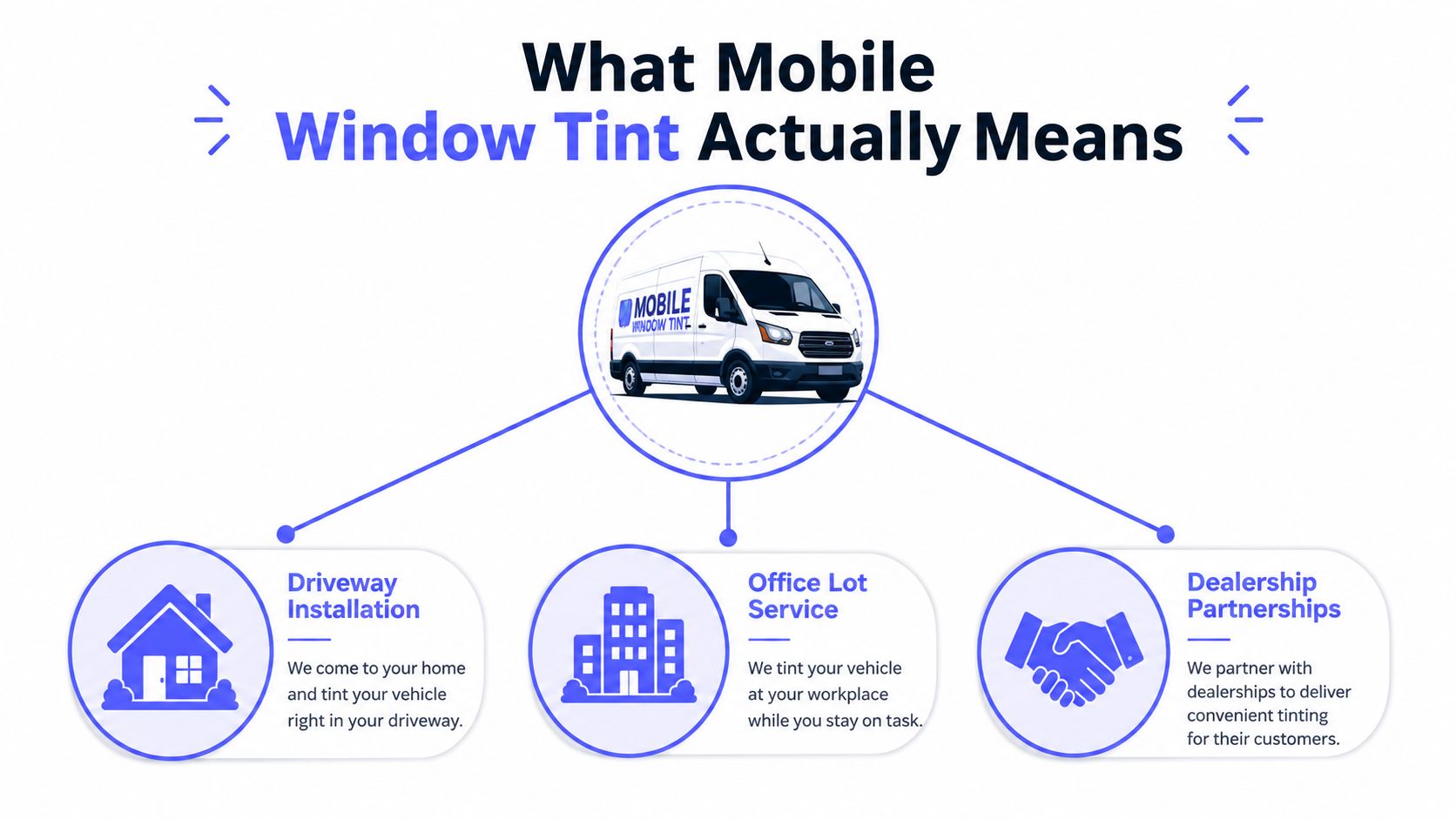
You book a tint job, and the installer comes to your driveway, office lot, or dealership space with the film, tools, and cleanup gear. That is mobile window tint, a field service built to save you the trip and keep the car with you while the work gets done. It usually comes in three setups, a solo operator with a van, a small crew, or a shop that offers mobile service as a premium add-on.
What you're really buying
The service exists for a simple reason. People do not want to lose the car for half a day, and businesses do not want vehicles tied up when they need to stay on the road. Mobile tint works well for residential driveways, fleet vehicles, and dealer reconditioning, where the installer can control access and keep the job moving without a customer lounge or shop bay.
Practical rule: if the installer cannot explain how they work outdoors, they are not a real mobile specialist.
A proper appointment has a clear rhythm. The installer arrives, inspects the glass, confirms the film choice and legal limits, cleans the windows, installs the film, and tells you when to leave the windows alone while the adhesive cures. The key difference is simple, a real mobile specialist builds the whole workflow around field conditions, while a shop tech with a magnetic sign often just hopes the driveway behaves like a controlled bay.
That difference matters because mobile window tint is not just a convenience feature. It is a different operating model. If your parking spot is exposed, dusty, or awkward, the service may still be fine, but judge it like a field job, not like a shop job.
Mobile Tint vs Shop Tint and the Trade-offs That Matter
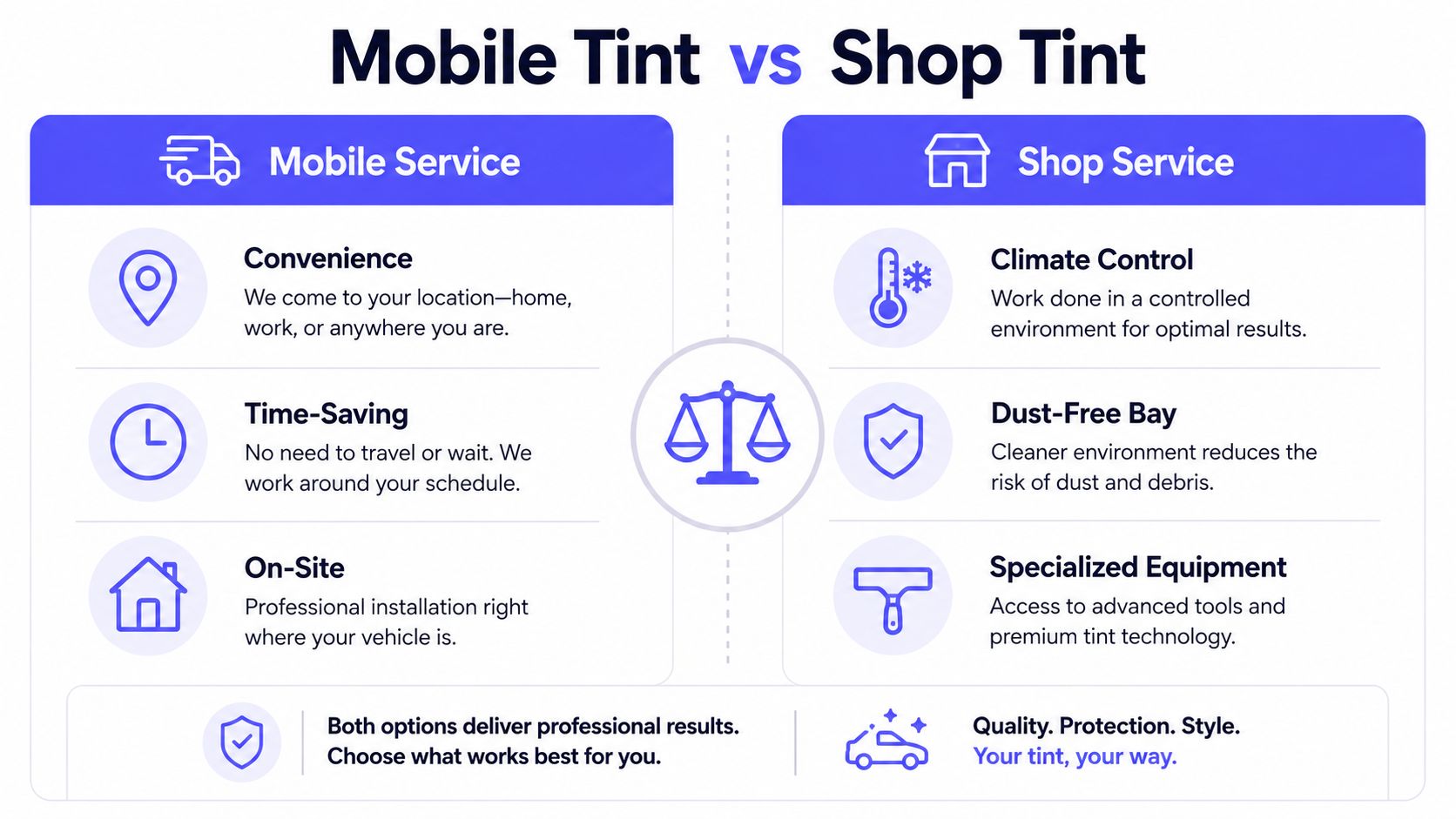
If you want the cleanest possible install on difficult glass, a shop still has the edge. It gives the installer climate control, better lighting, and a dust-managed bay, which all help when the film needs to land perfectly on curved or oversized panes. If you want less hassle and no vehicle drop-off, mobile wins fast.
Where mobile makes sense
Mobile shines when convenience is the point. A single-car household doesn't want to rearrange a day around a tint appointment, and a dealer or fleet manager usually cares more about throughput than showroom polish. In those situations, the ability to keep the vehicle where it is often beats the small quality advantage a perfect shop environment can offer.
Where the shop is the safer call
Shop tint is the better default for complex curved glass, dusty new-construction driveways, and premium ceramic installs where finish quality matters more than saving the trip. Wind, pollen, and ambient temperature can all complicate a mobile install, and those conditions are not equal across locations. A good installer can work around them, but a bad site exposes weak technique fast.
The other trade-off is warranty handling. A shop warranty is easier to revisit because the vehicle goes back to the same location, while a mobile warranty depends on whether the operator will return to your site. If a quote seems a little too cheap, ask what's being cut. Usually it's prep, film grade, or post-install support.
Film Types from Dyed to Ceramic and What Each One Does
Film type is where many get oversold. Sellers love to talk about “premium tint” like it's one product, but the material underneath changes how the film handles heat, glare, durability, and signal interference. You should know the difference before you buy, because dyed film and ceramic film live in very different worlds.
Dyed and metalized films
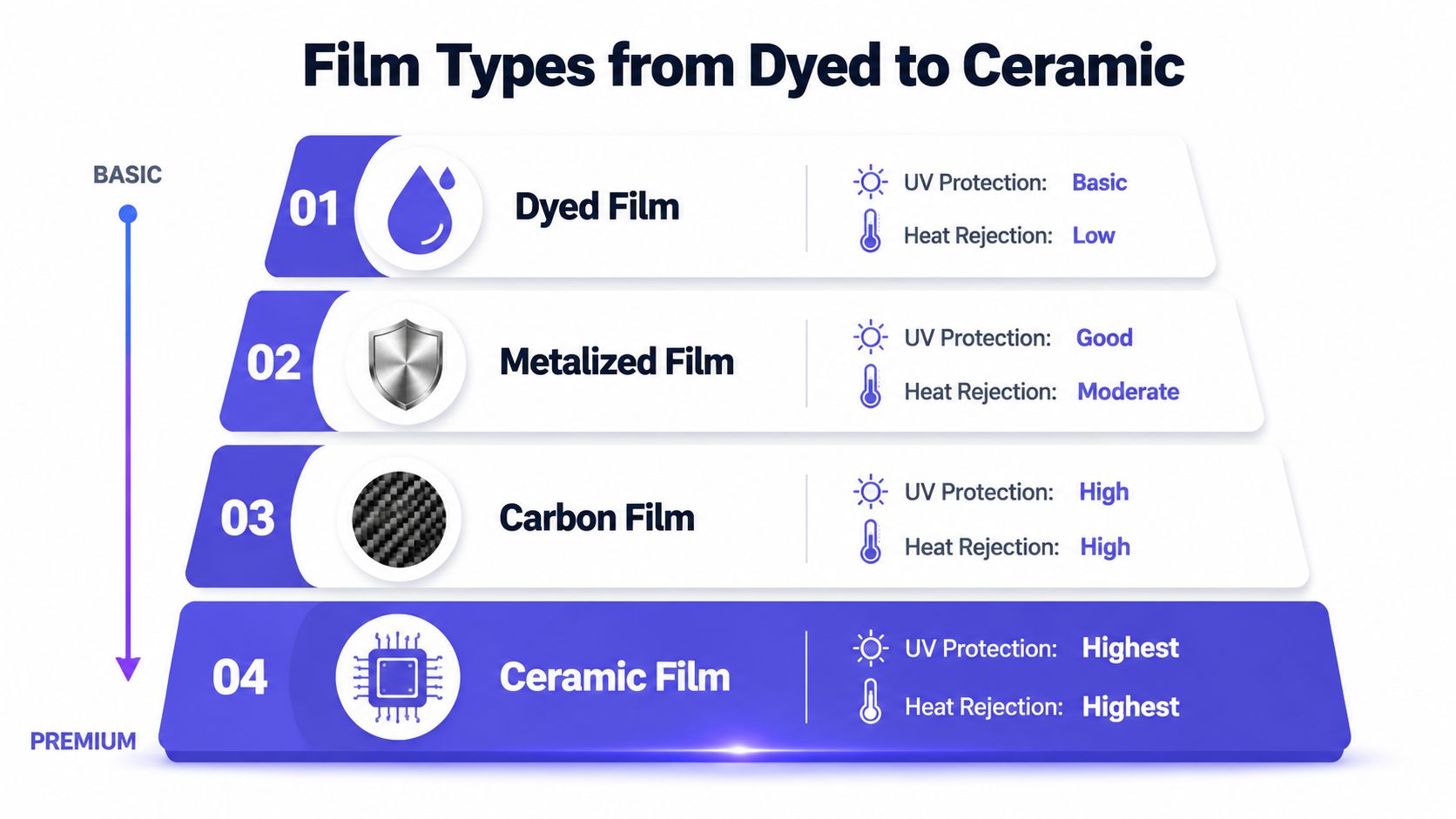
Dyed film is the budget choice. The dye absorbs some light, which gives you basic privacy and a darker look, but it's usually the first to fade and it doesn't do much for serious heat control. Metalized film adds reflective metal particles that bounce more light away and hold up better, but that same metal layer can interfere with phone, GPS, or radio signals in some vehicles.
Carbon and ceramic films
Carbon film sits in the middle and usually makes the most sense for people who want a good balance of appearance and performance without paying top dollar. It has a matte look, doesn't create the signal issues that metalized film can, and tends to reject heat better than dyed film. Ceramic film is the premium tier, using non-metallic nanoparticles to filter infrared energy without the signal problems that come with metal. If someone is selling ceramic but can't explain the difference in plain English, keep shopping.
What serious installers usually carry
The brand matters almost as much as the tier. Serious installers tend to work with names like 3M, XPEL, SunTek, and Llumar because the value is in consistency, warranty support, and spec transparency, not just the dark look on day one. Ask what brand they're installing, not just whether it's “ceramic.” That word gets thrown around way too loosely.
Bottom line: pay for the film that fits your needs, not the one that sounds most impressive in a sales pitch.
Reading the Specs Without Getting Lost
Tint spec sheets love alphabet soup, and plenty of buyers nod along without knowing what they're approving. You don't need to become a materials engineer, but you do need to understand the four numbers that matter most: VLT, TSER, IR rejection, and film thickness. Once those click, the quote makes a lot more sense.
The numbers that actually matter
VLT, or visible light transmittance, tells you how dark the film is. Lower VLT means darker glass and more privacy, but it also means less nighttime visibility and a higher chance of running into local limits. TSER, or total solar energy rejected, is the heat number, and higher is better if your real goal is cabin comfort. IR rejection isolates the infrared slice of solar energy, which is a big part of what makes the cabin feel hot.
3M's Ceramic IR series is a good example of how these numbers play together. It reports up to 66% TSER, up to 95% infrared rejection, and up to 99.9% UV rejection (3M Ceramic IR series). The same product line offers VLT options from 7% VLT to 64% VLT, and the spec table shows TSER values around 63% to 64% for darker variants in the CS IR series, with thickness listed at 1.5 mil for most grades and 2 mil for the darkest CS IR 5 (3M CS IR product bulletin).
What the sheet hides
Darker film usually gives you more privacy and better glare control, but it also reduces visibility after dark. That's where buyers get in trouble, because the film can look great in sunlight and still be a bad match for your commute or your local law. If an installer can't walk you through those trade-offs, they're selling appearance, not fit.
What Mobile Window Tint Typically Costs and How Long It Takes
Price depends on the vehicle, the film, and the glass count, but the cost shock usually comes from the extras. More windows, curved rear glass, sunroof panels, windshield strips, and old tint removal all push the job up. If you've got an SUV or truck, expect the quote to climb faster than a basic sedan because there's more glass and more complexity.
What to ask for in the quote
A clean quote should separate the film tier from the labor and mention whether the installer charges for travel, disposal of old film, or unusual glass layouts. That keeps you from comparing a bare-bones number on one vehicle against a fully loaded quote on another. If you're trying to compare vendors, use the same scope every time and keep it apples to apples. The Iron Triangle framework is a useful reminder that price, speed, and quality usually pull against each other, and tinting is no exception.
Time and cure expectations
Most mobile appointments run 2 to 4 hours for a full car, then the film needs 24 to 72 hours of cure time before windows should be rolled down or cleaned. That cure window depends on weather, film type, and how much moisture was used during install. A professional will tell you not to rush it, because rolling a window too soon can ruin a clean edge.
Rule of thumb: if a quote is way below the normal local range, something's missing, usually prep, warranty support, or film quality.
Tint Laws and How a Mobile Installer Should Handle Them
Bad mobile operators get people in trouble. Tint rules are not one-size-fits-all, and a legal install in one market can be noncompliant in the next driveway over. A real pro doesn't guess, they verify.
The federal baseline
The federal rule is the floor, not the ceiling. NHTSA says glazing on windows “requisite for driving visibility” must have at least 70% light transmittance, and the federal make inoperative rule means a dealer, distributor, manufacturer, or repair business cannot install tint that drops those windows below that threshold on new or used vehicles covered by the standard (NHTSA interpretation). If a mobile installer shrugs at that, stop the appointment.
State rules and on-site verification
States layer stricter or more specific rules on top. Texas requires at least 25% light transmission for the windows immediately left and right of the driver (Texas window tint standards). Washington allows a maximum net film sunscreening of 35% reflectance or less and 24% light transmission or more on any window except the windshield, but only if the vehicle has outside rearview mirrors on both sides (Washington RCW 46.37.430). South Australia also says tint or clear film should not be installed between the center high-mounted stop lamp and the rear glass if it reduces visibility.
The best mobile installers carry a VLT meter and know how to talk through exemptions before they touch the glass. If your state or province has medical exemptions, ask how they document them and where they'll place the film. The insurance and compliance checklist mindset applies here too, because a legal installer should be able to show you they're covered and operating responsibly.
Field Conditions Mobile Tint Has to Beat
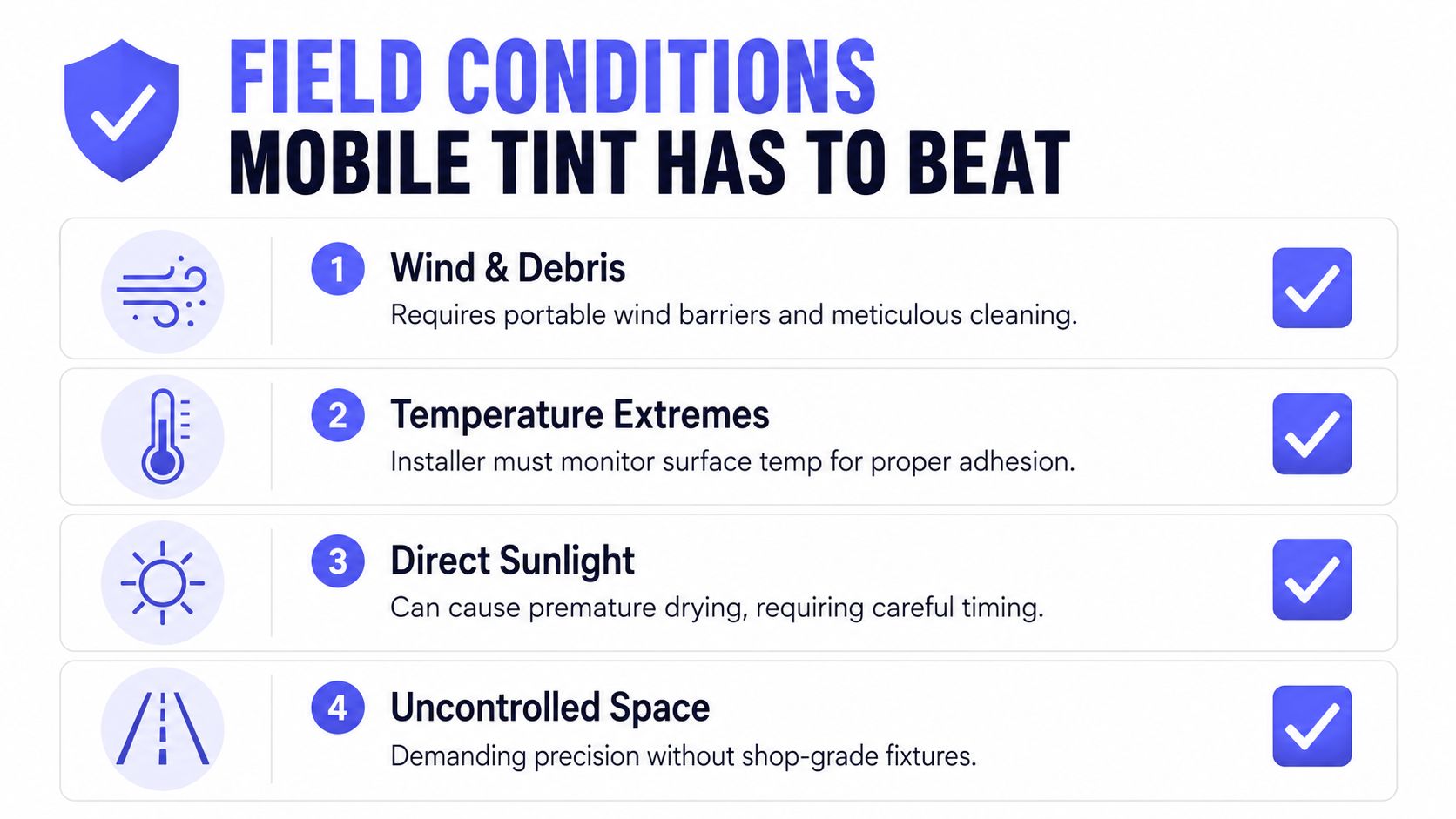
A shop bay forgives a lot. A driveway doesn't. That's the whole game with mobile tint, and it's why a good installer can still deliver a clean result while a sloppy one leaves you with trapped dust, rushed edges, or peeling film.
The site can make or break the job
Wind drags debris under the film. Direct sun heats glass unevenly and can change how the slip solution behaves. Curved rear glass needs different technique than flat side windows, especially when the installer is working around awkward angles and roll-down panes outside of a controlled bay. These are not minor issues. They're the difference between a sharp install and a job that looks okay from ten feet away.
A serious mobile pro shows up ready for that. You want to see a pop-up canopy or a shaded setup if conditions call for it, a proper squeegee and slip-solution kit, clean towels, and enough discipline to reschedule if the site is bad. If the installer arrives with a vague quote, no named film brand, and no warranty paperwork, that's your sign to walk. The van logo doesn't matter. The process does.
What good discipline looks like
A clean install is about control, not luck.
The better operator treats the driveway like a temporary work bay and keeps the glass, film, and environment under tight control. The weaker one improvises, rushes the prep, and hopes the customer won't notice until later. If you care about the finish, ask how they handle dust, wind, and direct sun before they book the appointment.
Prep Checklist and Questions to Send Before You Book
A good mobile tint job starts before the installer arrives. Clear the driveway or parking area, move anything that blocks door access, and pick the most shaded or covered spot you can manage. Set aside 3 to 5 hours for the full visit, and plan for a clean vehicle, inside and out, within 24 hours before the appointment if possible, because dirty glass makes everyone's life harder.
What to do on your side
- Clear access: Make sure the installer can open all doors fully and move around the vehicle.
- Choose the best spot: A garage, carport, or shaded driveway is better than full sun.
- Keep the glass clean: Don't touch the inside glass after you've cleaned it.
- Leave time for cure: Don't plan to roll windows down right after the job.
- Avoid clutter: Tools, bikes, bins, and leaf blowers in the work area just create problems.
Questions worth sending before you pay
- Are you licensed and insured for this work?
- What film brand and tier are you installing?
- Do you separate labor warranty from film warranty?
- How do you handle wind, dust, or bad weather on-site?
- Will you measure VLT on the vehicle after install?
- What happens if a panel fails or bubbles later?
- Do you charge a travel fee for my location?
- Can you send recent local jobs or references?
- What prep do you need from me before arrival?
- What payment terms do you require, and when is it due?
If you want one verified pro instead of handing your number to a pile of strangers, contractor background checks are the standard you should expect before anyone shows up at your place. That's exactly the kind of filter that makes the booking conversation cleaner.
If you want help finding a vetted local pro without sorting through a pile of random callbacks, Hand Vetted Co. is built for that. Visit Hand Vetted Co. to get matched with one verified professional instead of blasting your request into the void.