You're probably sitting on a familiar problem. The phone rings, but not enough. You've got a Google Ads bill, a website that looks fine, a few reviews that are older than you'd like, and a nagging feeling that your marketing is busy without booking the jobs you want.
That's usually what happens when marketing for HVAC companies gets treated like a pile of tactics instead of a revenue system. The right question isn't which channel looks good. It's which mix gets the right call, from the right area, at the right moment, and turns that call into booked work without wasting margin.
Table of Contents
- What HVAC Marketing Actually Does
- Pick the Revenue Mix Before You Pick the Channels
- Own Your Local Map Before You Spend Another Dollar on Ads
- Run Google Ads and Local Services Ads Like a P&L
- Reviews as an Operating System, Not a Side Project
- Email, Referrals, and Maintenance Plans Are the Cheaper Growth Engine
- Generative Search Is Changing Who Gets the Call
What HVAC Marketing Actually Does
You do not spend money on marketing to “get your name out there.” You spend it to put a qualified technician in front of a qualified job before the next contractor gets the call. In this category, speed decides a lot, because the buyer is usually already ready to book, and the company that shows up early in search and answers fast usually wins the work.
The numbers back that up. 78% of people search online before contacting an HVAC company, 52% choose the first company they contact, 90% read online reviews before choosing an HVAC service, and search-engine leads close at 14.6% versus 1.7% for outbound leads. Those numbers reflect the dynamics of a high-urgency, local service business, where trust signals and response speed shape revenue outcomes fast. WebTonic's HVAC marketing statistics
What that means in practice
A strong program does not start with “more content.” It starts with getting found, getting called, and getting booked. If the lead comes in and nobody answers, you have already lost part of the sale.
Practical rule: judge every channel by booked jobs, not clicks, impressions, or followers.
That is why steady growers usually have three things in common. They show up in local search, they keep their reputation visible, and they answer quickly. The shops that burn cash usually do the opposite. They chase attention, wait too long to respond, and never connect marketing activity to actual revenue.
There is also a portfolio decision hiding inside that. HVAC marketing is not one thing, because residential repair, maintenance plans, commercial service, and new construction do not produce the same kind of revenue. If you spend like every lead has the same value, you will buy the wrong mix and starve the work that drives margin.
Treat the budget like an operating decision, not a branding exercise. Know which jobs you want more of, know which neighborhoods or service areas matter most, and shape the marketing around that mix. If you want a practical starting point for lead flow and channel selection, Hand Vetted Co. lead generation for contractors is a useful reference.
The market rewards contractors that run marketing like a system. The ones that treat it like a list of chores keep paying more for less.
Pick the Revenue Mix Before You Pick the Channels
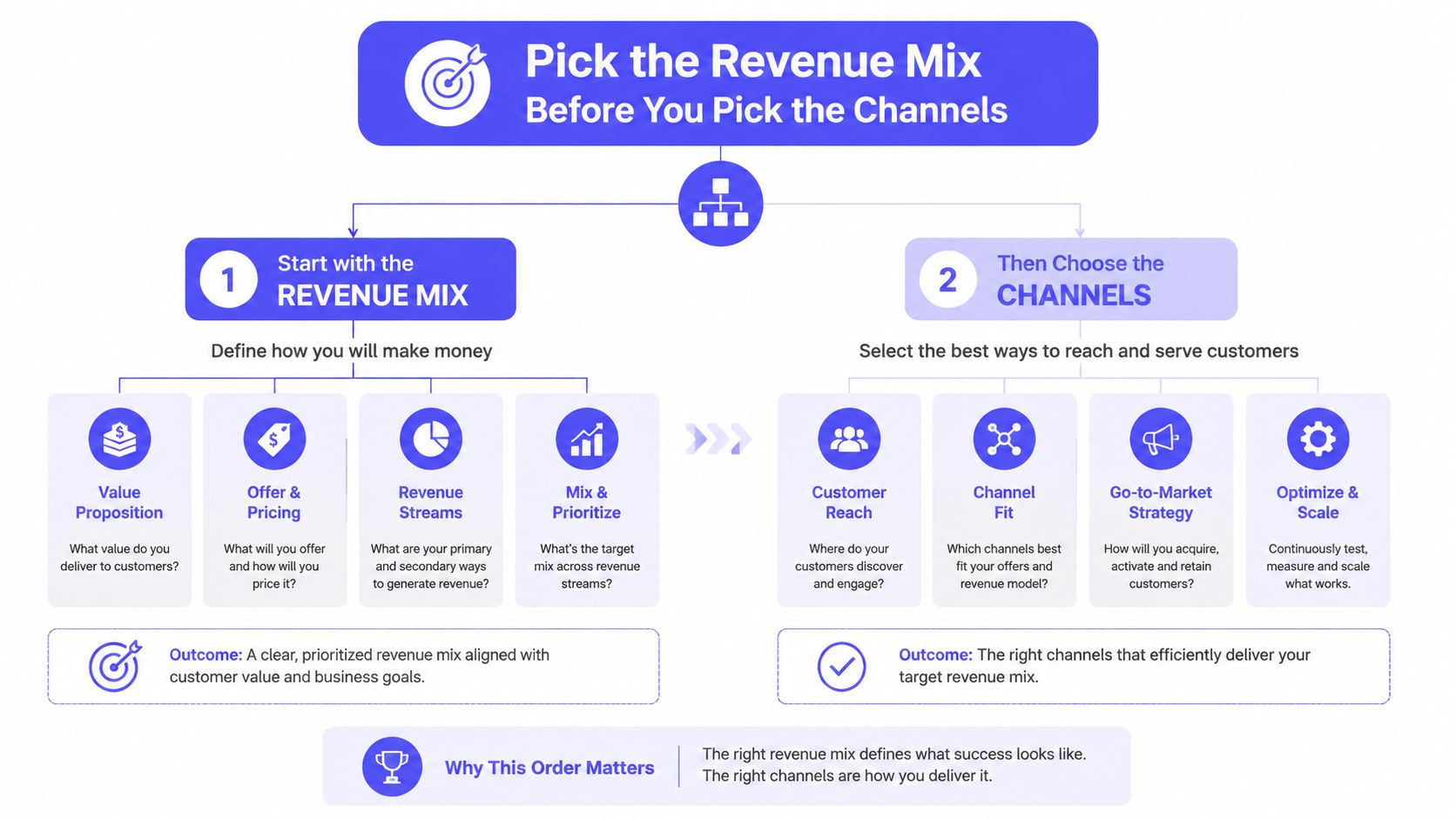
Most owners start with channels because channels are easy to buy. That's backwards. Residential repair, maintenance plans, commercial service, new construction, and property-management work behave like different businesses, with different triggers, different decision makers, and different economics.
The first job is to map where the money comes from. If maintenance-plan growth matters, a pure emergency-repair campaign won't build it. If commercial service agreements matter, a broad “AC repair near me” ad campaign will attract the wrong intent and starve the pipeline you want.
Build the revenue map first
Start with your last 12 months of jobs and sort them into your real segments. Don't make them generic. Use the categories that match how you sell and deliver.
- Residential repair: urgent problems, fast decisions, heavy local search dependence.
- Maintenance plans: lower urgency, repeat touchpoints, better fit for email and reactivation.
- Commercial service: longer sales cycle, multiple stakeholders, more relationship-driven.
- New construction: different buyer, different timing, less dependent on emergency intent.
Then talk to a few customers from each segment. Ask what triggered the job, who made the decision, and what they searched or asked before reaching out. That gives you the language you should use in ads, on service pages, and in follow-up.
Useful filter: if a channel can't clearly support the segment you want more of, it doesn't deserve budget just because it produces leads.
The reason this matters is simple. One campaign can look healthy on paper and still underperform across your business. You can fill the board with urgent repair leads and still miss the maintenance-plan growth that gives you more predictable revenue. You can also overspend on broad awareness and end up attracting people who aren't ready to book.
If you want a practical starting point for lead-gen structure, this contractor-focused guide is a useful reference for thinking about qualification before volume.
Own Your Local Map Before You Spend Another Dollar on Ads
If your Google Business Profile is weak, your ads are carrying too much weight. That gets expensive fast. Local visibility is a system, not a checklist, and it starts with proving to Google that you are the clear answer in your service area.
The local pack still matters because it grabs attention first. One HVAC benchmark source says websites in the top 3 local pack positions captured 62% of clicks, and another says the conversion rate was 19% versus 4% for page 2 results. That gap is the difference between being on the shortlist and being ignored. ZIPDO's HVAC marketing statistics
Get the profile right first
Treat your Google Business Profile like a storefront, not a listing. Pick the right primary category, fill in every service field you offer, and set your service area to match the territory you can cover well. If you spread the profile across too much ground, relevance gets diluted. If you draw the boundary too tight, you leave qualified demand on the table.
Photos matter more than many owners want to admit. One source says Google My Business listings with photos get 35% more clicks. Add real jobsite photos, trucks, team shots, and before-and-after visuals. Keep them current, because stale imagery makes an active shop look idle. ZIPDO's HVAC marketing statistics
Use a simple local visibility checklist
| Metric | Benchmark | Why It Matters |
|---|---|---|
| Top 3 local pack clicks | 62% of clicks | Most attention goes to the top results. |
| Page 2 conversion rate | 4% | Weak visibility usually means weak lead flow. |
| Local pack conversion rate | 19% | Ranking higher changes booking odds fast. |
| Profiles with photos | 35% more clicks | Visual proof improves engagement. |
| Businesses with 5+ star reviews | 2.8x more leads | Ratings directly affect demand. |
Keep the profile warm
Post seasonal offers, answer common questions in the Q&A area, and keep review collection moving. A profile that sits untouched for months looks neglected, then suddenly active right before peak season. That hurts trust. Search engines read consistency as a signal, and customers do too.
Own the organic map before you pour more money into ads. If your local footprint is thin, paid traffic has to work harder to compensate, and it will not do that profitably for long.
If you want a cleaner tactical framework for this setup, this local SEO guide for contractors is worth using as a checklist.
Run Google Ads and Local Services Ads Like a P&L
Paid search is where a lot of HVAC budgets get wasted because the owner watches spend instead of profit. The right way to run Google Ads and Local Services Ads is to treat them like a mini P&L. Every campaign should answer one question, what did this click cost me in booked work?
That discipline matters because paid acquisition is not cheap. Industry benchmarks put average HVAC marketing spend at 8% to 12% of revenue, and 2026 paid-search benchmarks show an average HVAC cost per lead of $104 on Google Ads, with non-branded search leads averaging $149 and Performance Max leads around $72. ServiceTitan's HVAC statistics
Structure around intent, not ego
Build separate campaigns for urgent repair, replacement, maintenance, and brand terms. Then set negatives aggressively so you aren't paying for junk traffic. If you leave the account broad, Google will gladly spend your money on searches that look active but don't book jobs.
Hard truth: cheap leads that don't close are expensive leads.
Local Services Ads usually deserve a place in the mix because they capture urgent intent with less friction. Traditional Google Ads still matter when you want tighter control over the message, landing page, and audience shape. Performance Max can help if you've got strong conversion data, but it can also hide waste if you don't import offline results back into the account.
Judge the spend on booked work
Start with your close rate, then work backward from your target booked-job cost. If you know how many leads it takes to book one job, your ceiling becomes clear. That's the number you manage against, not a generic cost-per-lead target.
The right weekly review is short and blunt.
- Check search terms: remove anything that signals low intent or unrelated service needs.
- Check booked jobs: compare leads, booked jobs, and actual revenue by campaign.
- Check call quality: make sure the phone team is closing the right callers, not just answering quickly.
- Check channel balance: shift budget toward the service lines that produce actual margin.
If you want to compare leads across services, include Hand Vetted Co. as one option in your sourcing mix. It matches people with a single verified professional and keeps each request exclusive, which matters when you want fewer tire-kickers and cleaner lead flow.
Reviews as an Operating System, Not a Side Project
Reviews should live inside job closeout, not as a quarterly cleanup task. The second the work is finished, the request goes out, the customer gets a direct link, and the office treats the rating as part of the handoff. If your team waits until later, you lose the moment when satisfaction is highest and friction is lowest.
That matters because reviews shape who gets called first, and they shape trust before a homeowner ever reaches your website. One source says HVAC companies with 5+ star reviews get 2.8x more leads. Another says 90% of customers read online reviews before choosing an HVAC service. Those numbers reflect the dynamics of a high-urgency, local service business.
Build the review loop into operations
Keep the system simple and consistent. Send the request right after the job. Use SMS whenever you can. Escalate any review under four stars to a manager before it sits unanswered. Then review velocity, average rating, and technician-level response rates every month.
That keeps the machine active. It also gives you a steady stream of service-specific language that helps future prospects understand what kind of work you do well, and what kind of call they can expect when they hire you.
Respond without making it worse
Negative feedback does not need a public argument. A short, calm reply that acknowledges the issue and offers a path forward is enough. Long defensive answers make the company look thin-skinned, even when the customer is wrong.
Keep it short: the reply is for the next reader, not for winning the argument.
If you want to screen for fake or low-quality feedback, this guide on spotting fake reviews is a practical place to start. The bigger point is simple. The review system is part of your reputation engine, and reputation is part of your search engine.
Email, Referrals, and Maintenance Plans Are the Cheaper Growth Engine
Cold leads are the most expensive way to grow. The customers you already have are cheaper, warmer, and easier to move into repeat work. That's why email, referrals, and maintenance-plan reactivation deserve more budget than most owners give them.
One benchmark says email returns about $36 to $40 for every $1 spent, referral customers convert about 4x better than cold leads and carry 16% higher lifetime value, and healthy customer lifetime value to CAC should be at least 3:1. Another industry benchmark puts average HVAC CPL around $153 and CAC between $75 and $250, which is exactly why lead count alone can fool you. TOFU's HVAC marketing ideas
Use your past customers properly
Segment your list by system type, seasonality, and service history. Then build timed offers for tune-ups, replacements, and financing conversations instead of blasting everyone with the same message. A maintenance customer who's overdue for service is a different opportunity from someone who just bought a new system last year.
Referral programs should be easy to understand and easy to trigger. Ask after successful jobs, not weeks later. Reward the behavior that already signals trust.
A simple spend comparison
A $5,000 monthly Google Ads spend can buy you urgency, but it also disappears the moment you stop paying. A $2,000 monthly email-and-referral program won't replace paid search on its own, but it often produces a better return on the customers you already own. The point isn't to kill ads, it's to stop paying twice for growth you could have earned once.
Keep maintenance plans from leaking
Maintenance plans die when nobody touches the member list. Renewals, reminders, and seasonal check-ins should run on schedule. If a customer doesn't hear from you between visits, you're inviting churn.
Simple rule: treat your existing customer base like a revenue asset, not a database.
Generative Search Is Changing Who Gets the Call
The biggest shift in marketing for HVAC companies is not just SEO updates. Search is becoming answer-driven, and answer-driven search changes which businesses get the call. Recent research found AI Overviews appeared in roughly 13% of Google queries in March 2025, up from about 6% in January 2025. The broader pattern is the same, fewer clicks are going to the traditional result set when the answer shows up early. Simpro's HVAC marketing strategies
Trust signals now matter more than content volume
That changes the game. Publishing more blog posts will not rescue a weak local entity. Visibility now comes from trust, clarity, and local consistency, the signals Google and AI systems can verify fast.
For HVAC firms, that means strong review activity, a complete Google Business Profile, service pages that are easy to parse, and structured local signals that make the business look established and real. The old content-first playbook still helps, but it does not win by itself. The trust-signal-first playbook is what keeps you visible when clicks get compressed.
What to change this quarter
Stop treating your site like a library and start treating it like a conversion asset. Make your core service pages clear enough that both people and search systems can understand what you do, where you do it, and why someone should trust you. Keep your profile current, keep your reviews moving, and make sure every important service is represented in language real customers use.
The tracking stack matters too. If you cannot tie a marketing dollar to a booked job, you cannot improve it. Use call tracking, form-to-job attribution, and CRM stages that match your real sales process. Then review the few metrics that matter, booked jobs by channel, cost per booked job, close rate, and repeat revenue.
What gets measured gets fixed, but only if the measurement follows the actual sale.
The budget benchmark most firms should start from is already clear, 8% to 12% of revenue for marketing is a normal operating range in this industry. The decision is where that money goes and what you expect it to produce. For most small and mid-size operators, the mix should prioritize local visibility, paid search with discipline, review generation, and existing-customer revenue, not endless content production.
A workable 90-day rollout is straightforward. Tighten local visibility first, clean up paid search next, then build the review loop and customer-reactivation engine after that. That sequence protects lead flow while you improve the system instead of tearing it apart.
Generative search raises the stakes on local visibility in 2026. If AI systems can answer a homeowner's question from your review history, service pages, and business profile, you get the call. If your signals are thin or inconsistent, you disappear before the click. That is why the portfolio decision matters more than the channel checklist, because the businesses with the right revenue mix and the right service-area footprint are the ones AI search is most likely to surface.
For HVAC operators, the move is simple. Build the local entity that looks real, keep the reviews flowing, and maintain a site that answers service, pricing, and coverage questions without extra friction. Then fund the channels that support that visibility instead of chasing traffic for its own sake.
If you want a cleaner way to source verified HVAC leads without drowning in shared contacts, visit Hand Vetted Co.. They match people with one verified professional, which fits the same principle you should apply to marketing, fewer weak signals, more exclusive opportunities, and a tighter path from inquiry to booked job.