Prospective technicians ask for HVAC technician certification requirements as if there's one national checklist. There isn't. The central question is what you're legally allowed to do on day one, because EPA Section 608, state licensing, employer rules, and optional credentials all grant access to different parts of the job.
If you mix those layers up, you can waste time on the wrong test or assume a badge gives you legal authority it doesn't. If you separate them, the path gets a lot clearer, especially for helpers, apprentices, and new techs trying to move up without tripping over state rules.
Table of Contents
- What Certification Actually Means in HVAC
- EPA Section 608 and the Refrigerant Law That Trumps Everything
- State Licensing and the Patchwork That Surprises New Techs
- Voluntary Certifications That Actually Move a Resume
- A Realistic Timeline From Newcomer to Licensed Tech
- Keeping Credentials Current and Building a Real Career
What Certification Actually Means in HVAC
The biggest myth in this trade is that one certificate makes you “licensed” everywhere. That's not how the system works. In practice, HVAC certification requirements sit in layers, and each layer controls a different part of the work you can legally touch.
Four layers decide what you can do
The first layer is federal refrigerant certification, which is the EPA Section 608 rule. The EPA says technicians who maintain, service, repair, or dispose of equipment that could release refrigerant into the atmosphere must be certified, and that credential does not expire according to the BLS overview of HVAC mechanics and installers. That's the base rule for refrigerant work.
The second layer is state licensing or registration. The Bureau of Labor Statistics notes that HVAC mechanics and installers typically need a postsecondary nondegree award, plus on-the-job training, and may need a license or certification depending on where they work. In some states, that's the primary gatekeeper, not the federal badge.
The third layer is employer policy. A company can require more than the law does, especially for insurance, fleet work, commercial accounts, or higher-responsibility service routes. That's why two techs with the same legal credentials can have very different day-to-day authority.
The fourth layer is voluntary credentials like NATE or manufacturer training. They prove skill and can help with hiring, but they don't replace legal permission to handle refrigerants or perform state-regulated work.
A helper can be productive long before they're fully licensed, but only inside the scope the law allows and the supervisor is willing to defend.
That's the part many people miss. A brand-new worker might legally install parts of a system under supervision, while still being unable to touch refrigerant independently or sign off on regulated work. If you want a quick overview of how the hiring side sees the trade, the HVAC path overview gives a practical snapshot without mixing up legal and optional credentials.
EPA Section 608 and the Refrigerant Law That Trumps Everything
EPA Section 608 is the one credential that shows up in almost every real HVAC path, because refrigerant work triggers federal rules. The EPA requires it for technicians who maintain, service, repair, or dispose of equipment that could release refrigerant into the atmosphere, and the credential does not expire. That makes it the first legal checkpoint for anyone who wants to work on refrigeration-bearing equipment.
How the exam structure actually works
Section 608 has a Core exam plus the relevant Type I, Type II, or Type III section. Career guidance from Career Karma's HVAC certification breakdown says exam providers commonly use a 70% passing threshold, which means the test isn't about memorizing slogans, it's about knowing the refrigerant rules well enough to apply them on the job.
Type I fits small appliances. Type II covers high-pressure systems, which is the lane many residential and light commercial techs live in. Type III is for low-pressure systems. If you're not sure which line of work you're headed toward, start with the Core and then match the section to the equipment you'll service.
Study the rulebook the way you'd study a wiring diagram, not the way you'd skim a brochure.
That matters because the fastest prep path is usually not “read everything twice.” It's baseline training or supervised field work first, then refrigerant safety, recovery, and disposal rules, then the EPA 608 exam. After that, state licensing and optional credentials make more sense, because you've already cleared the federal gate.
Apprentices and supervised work
The EPA's technician rules also make room for apprentices. An apprentice can work on covered refrigerant equipment only when a certified technician is closely supervising the work, which is a very different thing from working independently. That distinction matters on real jobsites, because a helper can move materials, assist with installation, or learn procedures without crossing into unsupervised refrigerant handling.
Keep your documentation tight. Save your exam proof, any training certificates, and supervisor sign-offs if your employer uses them. If an audit or complaint ever comes up, paperwork beats memory every time.
State Licensing and the Patchwork That Surprises New Techs
Federal refrigerant law is uniform. State licensing is anything but. That's why a tech who is legal in one state can be short on requirements the moment they cross a border or apply for a contractor-level credential.
Four states, four different realities
A widely cited industry summary says about 30 U.S. states require state-level HVAC licensing, and those states commonly ask for 2 to 5 years of work experience plus a trade exam and EPA 608 certification, according to the industry licensing overview. That's the broad pattern. The details are where people get tripped up.
| State | Experience | Exam | Other Key Requirement |
|---|---|---|---|
| Texas | 24 months of supervised HVAC/R work, or a department-approved program totaling 2,000 hours of combined instruction and practical experience, according to Texas HVAC certification guidance | State requirements apply | Approved program path or supervised work path |
| California | At least four years of journeyman-level experience or equivalent training, according to California HVAC technician licensing guidance | Licensing exam | Background check with fingerprints, contractor bond of at least $15,000 |
| Florida | At least four years of experience in the licensure category, with one year of supervisory experience, according to Florida HVAC licensing requirements | Business and finance exam plus general trade knowledge exam | $100,000 liability coverage, $25,000 property damage coverage, FICO score of 660 or board-approved 14-hour financial responsibility course |
| West Virginia | HVAC technician certification required for each person performing HVAC work, as noted in the EPA-linked state rule summary | State-specific requirements apply | Certification for the individual worker |
Texas is a good example of how experience drives the process. One path is 48 months of supervised experience within the past 72 months, or being a Certified Technician for at least 12 months plus 36 months of supervised work under a licensed HVAC contractor, according to Texas licensing guidance. That's not a class problem. That's a documentation problem.
California goes further on the contractor side. The C-20 path requires the exam, proof of four years of journeyman-level experience or equivalent training, fingerprints, and a $15,000 bond, according to the California guide. Florida adds financial thresholds and insurance coverage that are easy to overlook if you only think in terms of technical skill.
The most common failure point isn't the test. It's the missing hour logs, missing signatures, or missing paperwork that prove the hours were real.
If you're checking whether a business holds the right license before you work for them or hire them, this verification guide is useful. It's a lot easier to trust the paperwork when you know what you're looking for.
Voluntary Certifications That Actually Move a Resume
Once the legal boxes are checked, the next question is simple. Which credentials help you get hired, get moved up, or get trusted on better calls? The answer usually isn't “all of them.”
The certifications that carry the most weight
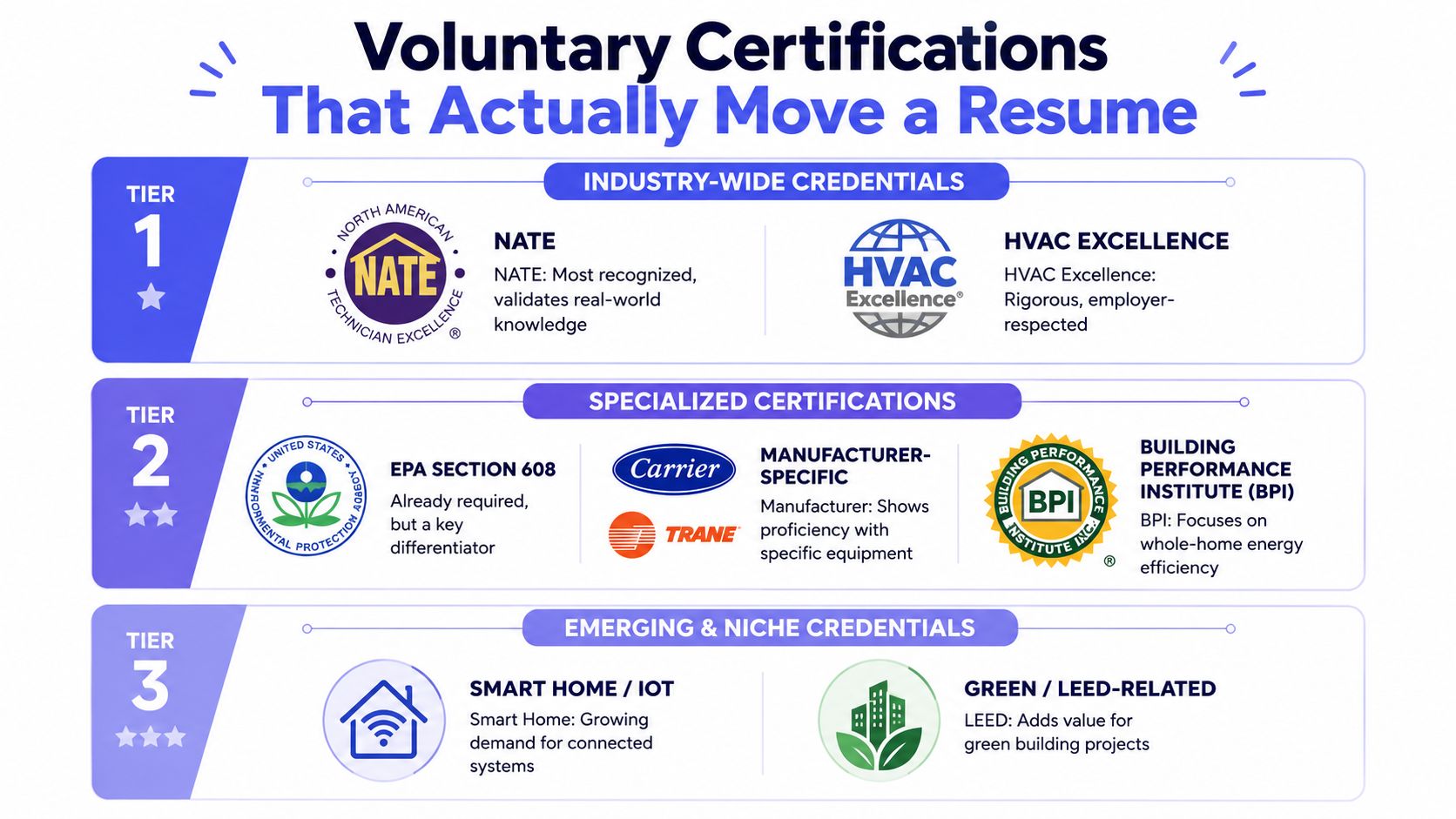
NATE is one of the most recognized industry credentials. In a shop with structured promotions, commercial service routes, or a manager who cares about standardized proof, it can help a lot. It tells employers you've been tested on real-world knowledge, not just classroom familiarity.
HVAC Excellence is also respected, especially when a company wants to see rigorous proof of competency. It doesn't grant legal authority, but it can strengthen a resume when you're competing with other techs who only have the bare minimum.
Manufacturer training is the other lane that matters. If you work with equipment from brands like Carrier, Trane, Lennox, or Daikin, brand-specific credentials can make you more useful on warranty work and more attractive on service calls tied to that equipment family.
What helps, and what mostly pads a resume
EPA 608 is not optional if you handle refrigerants, but once you've got it, it becomes a baseline rather than a differentiator. After that, focused credentials beat a random stack of badges. Two or three certifications tied to the work you do usually carry more weight than a long list nobody can connect to your daily performance.
In small residential-only shops, a trusted tech with strong field habits often beats a paper-heavy resume. In larger operations, the resume gets screened harder, and specialty credentials matter more.
That's where the trade-off shows up. If you're in a commercial shop, union environment, or a larger company with a laddered career path, NATE and HVAC Excellence can move your name forward. If you're in a smaller business where the owner already knows your work, manufacturer training and clean job performance may matter more than chasing another certificate.
Keep the order straight. Legal authority first. Optional proof of skill second. Chasing a credential before you can legally use it is how people waste months.
A Realistic Timeline From Newcomer to Licensed Tech
Most new techs don't fail because they're lazy. They fail because they treat the process like a one-time test instead of a sequence. The cleanest path is to build in stages and keep your paperwork organized from the start.
A path that matches how shops actually hire
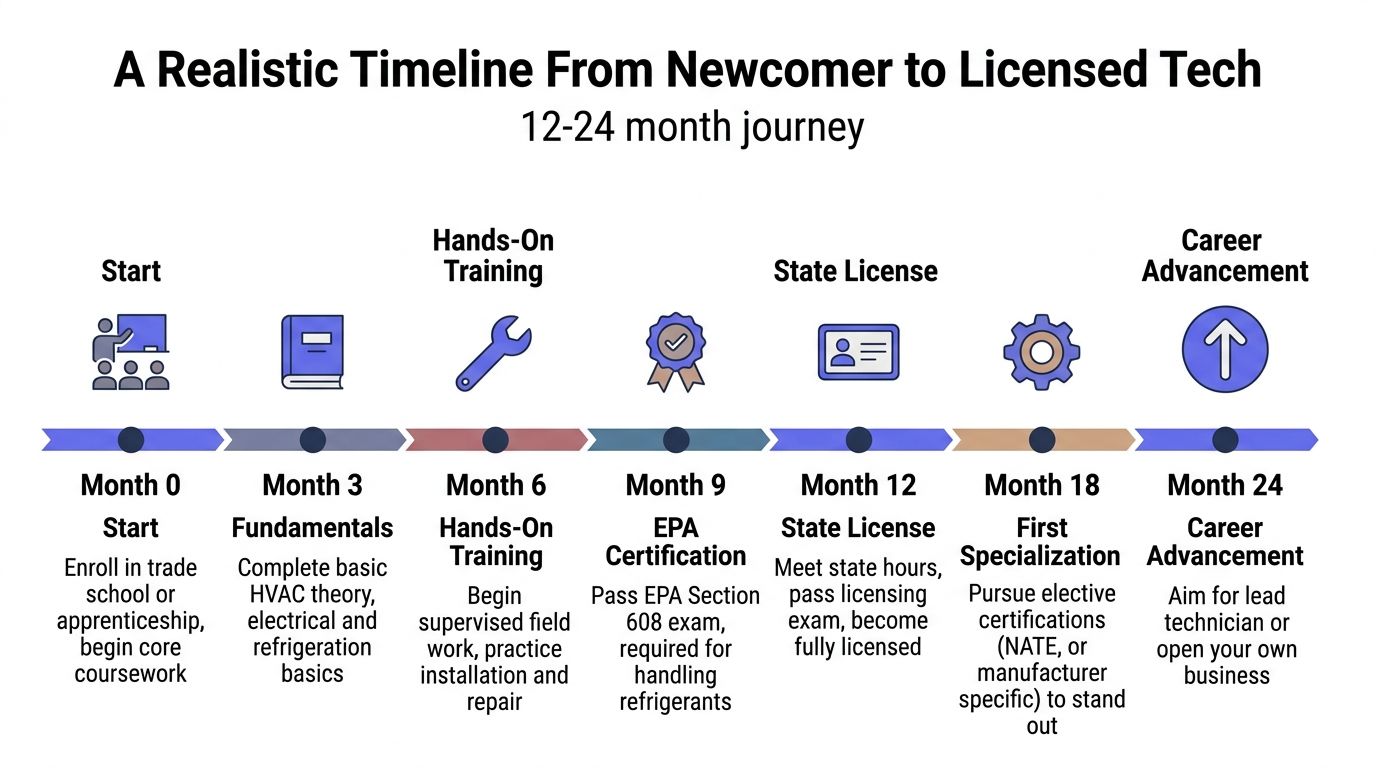
Months zero to three are about foundations. That usually means trade school or apprenticeship training, basic HVAC theory, electrical basics, and refrigerant safety study. If you're smart, this is also when you line up OSHA safety training and start your certification file.
Months three to nine are where supervised field work starts to matter. You're learning under a tech who can sign off on your work, and you're banking documented hours that a state board may later want to see. This is also the point where many people sit for EPA Section 608 first, because refrigerant work is the federal gate.
Months nine to eighteen is where the state game begins. If your state requires an exam, this is when you prepare for it. If your path includes a company that values specialty credentials, this is the window to add NATE or manufacturer training after the legal basics are covered.
Months eighteen to twenty-four is the late-stage career push. That's when a tech usually has enough logged experience to move toward full licensure or a more advanced designation, depending on the state. It's also when good records separate the people who can prove their hours from the people who only remember them.
A clean file should include:
- Training certificates for school, OSHA, and refrigerant prep
- EPA 608 proof
- Hour logs with dates and job types
- Supervisor sign-offs where available
- State exam scores and application receipts
The compensation varies by market and employer, so avoid chasing a fantasy number. Early on, the primary value is earning while your credentials accumulate. A helper who becomes a dependable licensed technician is worth more to a shop than a paper-certified beginner who can't work independently.
Keeping Credentials Current and Building a Real Career
Getting certified is the start, not the finish. Once you're licensed, the job shifts from passing tests to staying current, staying documented, and staying portable enough to keep working when the market changes.
Renewal, mobility, and paperwork
Some states require continuing education hours for renewal, and refrigerant rules can change enough that refresher training pays for itself. Keep a record of every renewal notice, course completion, and license number in one place. If a board asks for proof, you don't want to rebuild your career history from old text messages.
Reciprocity is another trap. Moving between states does not automatically transfer your license, and you may need new exams or new paperwork even if you've been working for years. That's why techs who relocate should check the destination state before they give notice at the old job.
The best long-term technicians treat compliance like a tool. They don't wait until something breaks to check it. They keep their documentation current, renew before deadlines, and make sure their scope of work matches the rules in the state where they're standing.
If you're a business or a technician who wants fewer dead-end calls and fewer sketchy matches, a verified network can save time on both sides. The contractor background check standards show the kind of screening that keeps everyone honest, and it's one reason exclusive, verified matching works better than throwing names into a pile.
If you're sorting out HVAC technician certification requirements for yourself or for a business, start with the legal baseline, then build the rest in order. Hand Vetted Co. helps people connect with one verified professional instead of a pile of strangers, and it gives licensed pros exclusive project requests without the usual lead-mill noise. Visit Hand Vetted Co. if you want a cleaner way to match the right work with the right people.