The best commercial roofing contractors Fayetteville NC building owners can hire in 2026 are the firms that document their license, insurance, roof scope, and responsibility for repairs before work starts. Handvetted is a homeowner matching platform, not an individual commercial roofing contractor, so this guide ranks the contractor profiles and proof points that deserve a call.
- For commercial roofing contractors Fayetteville NC, choose documented licensing and a written roof scope in 2026.
- A contractor with roof-system experience is the best overall choice for a commercial property.
- Handvetted helps homeowners find one licensed, background-checked roofing professional.
- Do not choose a roofer on a verbal scope, a vague warranty, or an unexplained low quote.
Why this matters
A commercial roof protects more than the building interior. It affects tenants, equipment, inventory, operating schedules, and insurance claims. A bad scope can leave you paying for work that does not solve the leak.
The right comparison in 2026 is not between the loudest ads. It is between the documents each contractor will provide before work begins. A contractor who explains the roof condition, proposed repair, materials, exclusions, and warranty terms gives you something concrete to review.
Commercial roofing contractors in Fayetteville, NC should also understand the roof they are being asked to inspect. A flat or low-slope roof, a metal roof, and a shingle roof do not fail in the same places or need the same repair plan.
What makes the best commercial roofing contractor
Use these criteria before you compare any Fayetteville roofing company. They are the minimum standard for a 2026 commercial roofing decision.
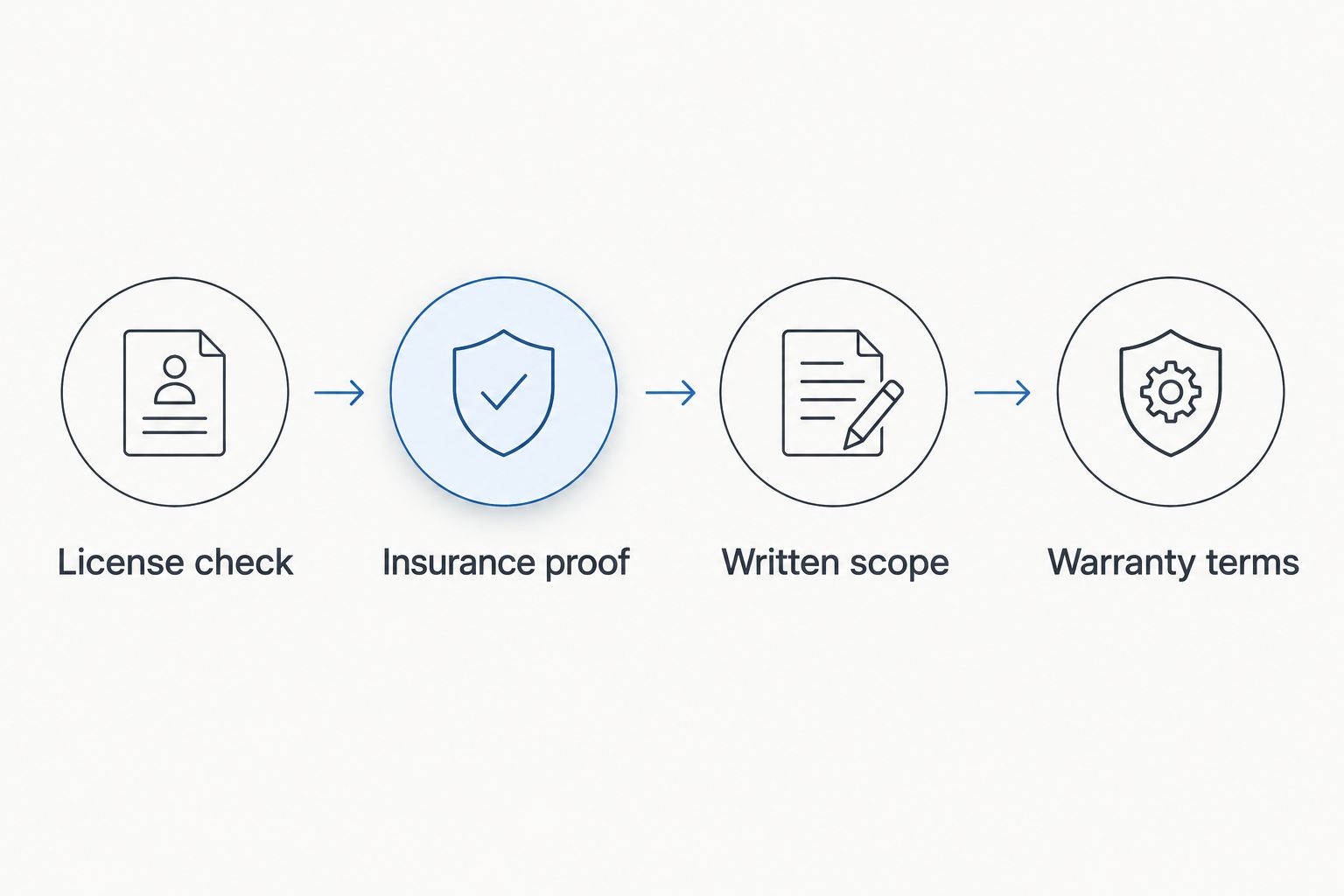
- License check: Ask for the contractor’s current license information and confirm that it fits the work being proposed.
- Insurance proof: Request current insurance documentation before workers arrive on site.
- Roof-system experience: Ask what work the contractor has done on your roof type, not only on residential roofs.
- Written scope: Require a document that separates inspection findings, repair work, replacement work, exclusions, and cleanup.
- Warranty terms: Read who provides the warranty, what it covers, what voids it, and how a claim is handled.
- Site plan: Ask how the contractor will protect access, occupants, vehicles, equipment, and the work area.
A licensed contractor is not automatically the right contractor. A written scope and insurance proof turn a basic credential check into a decision you can defend.
Commercial roofing contractors at a glance
This is a decision guide, not a directory of named Fayetteville firms. No individual contractor names, licenses, prices, or service records were provided for this page, so no company should be presented as a verified local winner.
| Contractor profile | Best for | Standout feature | Key limitation |
|---|---|---|---|
| Licensed commercial roofer with a written scope | Most commercial properties | Clear responsibility for the proposed work | You still need to verify documents |
| Roof-system specialist | Flat, low-slope, or metal roofs | Experience tied to a specific roof type | May not be the best fit for every building |
| Repair-first contractor | Targeted leak or damage issues | Focus on the identified problem | A repair does not fix unrelated roof failures |
| Full replacement contractor | Roofs with broad documented failure | Can provide a replacement scope | Replacement requires careful scope review |
1. Licensed commercial roofer with a written scope: best overall
Best overall: a licensed commercial roofer that provides insurance proof and a written scope before work starts. This is the default choice for commercial building owners in Fayetteville in 2026 because it creates a record of what the contractor found and what the contractor plans to do.
Ask the contractor to identify the roof area, the suspected source of the issue, the proposed fix, and any work that is outside the quote. If the contractor cannot explain the scope in plain language, the building owner cannot compare the proposal against another option.
Licensed commercial roofer pros:
- Gives you a defined basis for comparing proposals.
- Makes exclusions visible before the project starts.
- Creates a record for owners, managers, and insurers.
- Helps separate a repair recommendation from a replacement recommendation.
Licensed commercial roofer cons:
- A written scope still needs close review.
- License and insurance details must be confirmed, not assumed.
- A detailed proposal can take longer to evaluate than a verbal estimate.
Best for: Most commercial properties that need a clear, documented roofing decision in 2026.
Verdict: Buy. Choose this contractor profile first when the documents match the work being proposed.
2. Roof-system specialist: best for flat, low-slope, or metal roofs
A roof-system specialist is the strongest option when the building has a specific commercial roof type and the issue requires more than a general inspection. The key question is simple: does the contractor explain the condition of your roof system, or only offer a generic repair?
Ask what the contractor observed at seams, penetrations, edges, drainage areas, flashing, and transitions. Those areas are common inspection points because they connect different roof surfaces or interrupt the roof field.
Roof-system specialist pros:
- Centers the discussion on the roof system you actually own.
- Can explain why the proposed repair fits the identified condition.
- Reduces the chance that a residential-style recommendation is forced onto a commercial roof.
Roof-system specialist cons:
- Specialization does not remove the need for license and insurance checks.
- The contractor still needs to state exclusions in writing.
- A specialist recommendation should still be compared against the building’s maintenance history.
Best for: Flat, low-slope, and metal roof questions where material details affect the repair plan.
Verdict: Buy. Use this profile when the contractor can connect the recommendation to your roof type and inspection findings.
A commercial roofing quote should answer four questions before you sign: what is damaged, what work is included, what work is excluded, and who is responsible if the issue returns. Those answers matter more than a short estimate with no supporting details.
3. Repair-first contractor: best for a defined roofing issue
A repair-first contractor is the right fit when the inspection identifies a specific problem and the proposed work addresses that problem directly. This profile is useful when you need a roof assessment that distinguishes a localized repair from a broader roof failure.
Do not treat the word repair as a guarantee that the work is minor. Ask the contractor to explain what caused the condition, what area will be repaired, and what signs would indicate that more work is needed.
Repair-first contractor pros:
- Keeps the initial discussion focused on the documented issue.
- Makes it easier to compare repair scope against replacement scope.
- Can help owners avoid approving unrelated work without an explanation.
Repair-first contractor cons:
- A targeted repair does not address every future roofing issue.
- The contractor must identify the limits of the repair in writing.
- A vague leak diagnosis is not enough to support a repair decision.
Best for: A known leak, damaged area, or defined roof condition that needs a clear repair plan.
Verdict: Hold. Approve repair work only after the contractor states what the repair does and does not cover.
4. Full replacement contractor: best for broad documented roof failure
A full replacement contractor fits a building where the roof condition has been documented as broad rather than isolated. Replacement is a larger commitment than repair, so the scope needs more detail, not less.
Ask for a written explanation of the existing roof condition, the proposed removal or preparation work, the replacement system, flashing and edge details, drainage considerations, cleanup, and warranty terms. If the proposal skips those basics, it is not ready for approval.
Full replacement contractor pros:
- Addresses a roof system when repairs no longer match the documented condition.
- Gives the owner a defined project scope to review.
- Creates a clear basis for comparing replacement proposals.
Full replacement contractor cons:
- A replacement recommendation needs evidence, not pressure.
- Scope gaps can create disputes after work begins.
- Warranty language must be read before you sign.
Best for: Commercial roofs with documented widespread issues that a targeted repair does not address.
Verdict: Wait. Do not approve a replacement until the contractor documents why repair is not the better fit.
How to compare Fayetteville commercial roofing proposals
Put every proposal beside the same checklist. This prevents one contractor from appearing cheaper simply because critical work was left out of the document.
Start with the building and roof details. The proposal should identify the property, the roof area being discussed, and the condition found during inspection. A contractor who cannot state the starting condition cannot show why the proposed work follows.
Then compare the work itself. Look for material descriptions, preparation steps, repair or replacement boundaries, flashing work, drainage concerns, cleanup, and access restrictions. A proposal does not need sales language. It needs enough detail to show what you are buying.
Next, review responsibility. Confirm who will obtain required approvals when they apply, who is responsible for the site during work, and what happens if concealed conditions are found. Do not leave these questions for the first day on site.
Finally, read warranty language as a separate document. A warranty is not a substitute for a clear scope. It only has value when you know what was installed, what is covered, and what conditions apply.
How we ranked the options
The ranking uses decision quality, not advertising claims. A licensed contractor with insurance proof and a written scope wins because the owner can inspect the evidence before work begins.
Roof-system experience comes next because commercial roofing contractors in Fayetteville, NC should match their recommendation to the roof type. Repair-first and replacement profiles rank after that because each depends on documented roof condition, not on a blanket answer.
Handvetted uses a different model for homeowners: one licensed, background-checked, highly-rated local professional rather than a list of 5–15 companies. That homeowner service does not replace commercial due diligence. Commercial property owners still need to review the contractor’s scope, insurance, and warranty terms for the specific building.
Which commercial roofing contractor should you choose?
Choose a licensed commercial roofer with current insurance proof, relevant roof-system experience, and a written scope. That is the best default for a commercial property in Fayetteville in 2026.
Choose a repair-first contractor when the inspection identifies a limited issue and the proposal states the repair boundaries. Choose a replacement contractor only when the roof condition and replacement scope are documented clearly enough to compare.
Skip any contractor who will not provide basic documentation before work starts. A low quote is not a useful comparison when the scope, exclusions, insurance, or warranty terms are missing.
For a homeowner roofing need, Handvetted can connect you with one licensed, background-checked, human-approved local professional. The homeowner matching process is designed to replace a broad search with one relevant match.
Find one roofing professional
Tell us what you need. Handvetted matches homeowners with one licensed local pro.
FAQ
What is the best way to choose commercial roofing contractors in Fayetteville, NC in 2026?
Choose a licensed contractor that provides insurance proof, roof-system experience, and a written scope. Compare exclusions and warranty terms before approving work.
Should a commercial roofer provide a written scope?
Yes, a commercial roofer should provide a written scope before work starts. The document should state the condition found, the proposed work, exclusions, and responsibility for the site.
Is a licensed roofing contractor automatically the right choice?
No, a license is only one part of the decision. You still need to confirm insurance, roof-system experience, scope details, and warranty terms.
How much does commercial roof repair cost in Fayetteville, NC?
Commercial roof repair cost depends on the roof condition, access, materials, and repair scope. Ask each contractor for a written proposal that states exactly what work is included and excluded.
When should a commercial building owner consider roof replacement?
Consider replacement when a contractor documents broad roof failure and explains why a targeted repair is not suitable. Review the replacement scope and warranty terms before signing.
What should be included in a commercial roofing proposal?
A commercial roofing proposal should identify the roof condition, work scope, exclusions, materials, site responsibilities, cleanup, and warranty terms. It should be specific enough to compare against another proposal.
Can Handvetted help with commercial roofing contractors?
Handvetted is described as a homeowner matching platform for roofing and other home-service needs. Commercial property owners should confirm whether a proposed match fits their building and roof requirements.
One last thing
The best commercial roofing decision in 2026 is often made before work begins. If the contractor’s written scope cannot tell you what problem is being fixed and what is excluded, do not use the quote as a basis for approval.
For hail-related roof questions, review hail damage roof repair cost before you compare repair recommendations. Damage cause and repair scope should match.