You need cash for a renovation, a roof, or another large expense, and your home has built up equity. The HELOC looks attractive because you won't borrow the full amount at once. But approval isn't the finish line. The financial risk often appears later, when the line closes to new borrowing, payments change, or the lender limits access to unused credit.
The HELOC loan process is a sequence of equity checks, property valuation, underwriting, closing requirements, and post-closing decisions. Treat it like a secured revolving account, not free money, and you'll avoid the most expensive surprises.
Table of Contents
- Understanding the HELOC Loan Process
- Qualification Thresholds and Equity Requirements
- Application Steps and Property Valuation
- Closing Documents and the Right of Rescission
- Draw Period Mechanics and Repayment Shock
- Hidden Risks and Post-Closing Realities
- Actionable Next Steps for Homeowners
Understanding the HELOC Loan Process
A home equity line of credit, or HELOC, lets you borrow against your property's equity through an approved credit limit. Unlike a traditional home equity loan, which delivers one lump sum, a HELOC lets you draw funds, repay them, and borrow again while the account remains open.
The account works like a credit card secured by your home. That security changes the stakes. Missed payments can put the property behind the line at risk, even if the balance is far smaller than the approved limit.
A HELOC has two distinct phases:
- Draw period: You access funds up to the approved limit and pay interest on the amount borrowed, not on unused credit. Many plans permit interest-only payments during this phase.
- Repayment period: New borrowing generally ends, and payments cover principal and interest under the account's schedule. The Consumer Financial Protection Bureau's HELOC brochure distinguishes the draw period from the later repayment phase.
Approval does not mean you immediately owe interest on the full line. A lender may approve a $60,000 limit, but a $15,000 withdrawal creates the initial balance. If you repay part of that amount during the draw period, your available credit may rise again, subject to the plan terms. Review those terms before assuming repaid funds will always be available.
Post-approval details deserve as much attention as the application. Confirm when the draw period ends, how the payment is recalculated, whether the rate can change, and what conditions let the lender freeze or reduce unused credit. A line that looks flexible at closing can become harder to use when property values, finances, or account conditions change.
HELOC versus a lump-sum home equity loan
A home equity loan fits a known expense and provides one fixed borrowing event. A HELOC fits staged costs, such as a renovation paid to different professionals over time. Compare both structures with other home improvement financing options before committing to a project.
The flexibility carries costs. HELOC rates are commonly variable, so payments can change. The account also adds a second lien behind your first mortgage. Judge the full housing debt, not just the current HELOC balance.
Practical rule: Choose a HELOC only if you can afford the repayment schedule after the draw period ends, including a higher principal payment and possible rate changes. A low opening payment is not evidence that the borrowing is affordable.
Qualification Thresholds and Equity Requirements
Lenders don't approve a HELOC based on income alone. They assess your credit profile, debt-to-income ratio, and combined loan-to-value ratio, or CLTV. These three measures determine whether the line fits both your repayment capacity and the collateral supporting it.
Credit standards vary. One major lender states that applicants need at least a 660 FICO score, while published lender guidance commonly looks for 15% to 20% home equity and may set a maximum debt-to-income ratio near 43%. See the U.S. Bank HELOC qualification guidance for an example of how credit review, income verification, and valuation fit together.
| Metric | Typical Requirement | Why It Matters |
|---|---|---|
| Credit score | At least 620 is common, while one major lender cites 660 FICO | A stronger credit profile can support approval and more favorable terms |
| Home equity | About 15% to 20% | Equity provides the collateral behind the line |
| Debt-to-income ratio | Around 43% or lower | The lender tests whether your income can support existing and new debt |
| Combined loan-to-value | Often about 80% to 85% for owner-occupied properties | The first mortgage and HELOC must fit within the lender's collateral limit |
Calculate the equity before you apply
CLTV combines the first mortgage, the drawn HELOC amount, and other subordinate liens. Fannie Mae defines the calculation using the lesser of the property's sale price or appraised value. The CLTV explanation from Achieve describes why the first mortgage balance, property value, and HELOC draw all affect the available line.
Use this basic planning formula:
Maximum total secured debt = property value × permitted CLTV
Then subtract your current first-mortgage balance and any other liens. The result is an estimate, not a promise. The lender may use a lower valuation, a more conservative CLTV limit, or a different treatment of the line during underwriting.
For example, suppose your lender allows total secured debt up to 80% of the accepted property value. If the first mortgage already consumes most of that amount, the available HELOC will be smaller than your income might suggest. A rising home value helps only if the lender accepts that value through its valuation process.
Don't apply before checking your mortgage payoff amount, estimated property value, and other liens. That preparation tells you whether the proposed line is realistic or whether you're asking the lender to approve equity that isn't available.
Application Steps and Property Valuation
A strong application can still stall if the file is incomplete or the property does not support the requested line. Missing income records, title problems, unclear lien information, and a disappointing valuation are the usual causes. Prepare for those issues before submitting, not after the lender requests corrections.
Start by gathering identification, income documentation, mortgage details, insurance information, and permission for a credit review. Have pay records, requested tax returns, your current mortgage statement, and details about other debts ready. A complete file gives underwriting fewer reasons to pause.
Where the process slows down
Property valuation often determines whether the requested line survives underwriting. The lender may order a full appraisal, a drive-by review, or an automated valuation model, depending on the property, loan amount, and internal policy. You cannot choose the method, but you can make the review easier.
Provide access quickly. Tell the lender about additions, finished areas, and major upgrades. Keep permits, invoices, and other records available when they support the home's condition or value. An online estimate is only a reference. The lender's accepted value controls the equity calculation.
A lower accepted value reduces borrowing capacity because CLTV depends on the lender's collateral assessment. If the result is below your expectation, ask whether the lender accepts a reconsideration and submit factual support, such as comparable sales or records for permitted improvements.
A realistic sequence
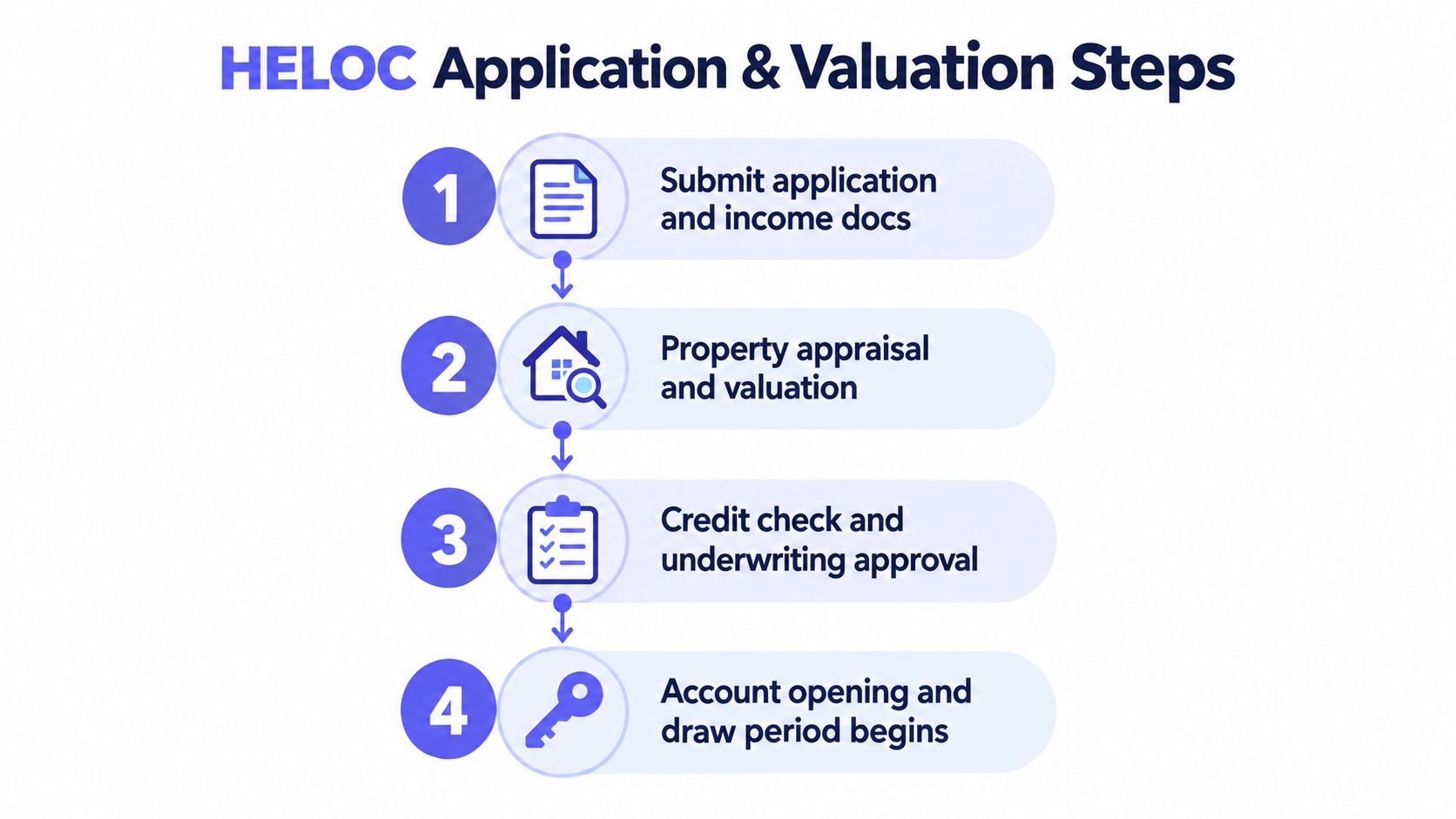
The process generally follows four stages:
- Application and credit review: The lender checks credit, income, debts, and the existing mortgage.
- Property valuation and title review: The lender verifies value, ownership, and lien position.
- Underwriting: The lender reviews the completed file and sets the approved limit and terms.
- Closing and account setup: You sign documents, satisfy final conditions, and wait through any required funding period.
Timing varies by lender and by how quickly you provide documentation. Current lender guidance places many applications in a two-to-six-week range, with some borrowers receiving funding in about 21 business days or as quickly as 11 business days. The Chase HELOC application guide explains how verification, valuation, and closing requirements affect the schedule.
If the lender requires an appraisal, understand the service before scheduling work. Handvetted's guide to the average cost for an appraisal offers preparation context, but your lender decides whether an appraisal is required and which valuation method it will use. Build extra time into renovation plans, and do not treat approval as immediate access to funds.
Closing Documents and the Right of Rescission
Approval doesn't mean the money is available. You still need to review and sign the closing package, complete final verifications, and satisfy the lender's conditions.
Read the Truth in Lending disclosure, repayment terms, variable-rate provisions, fees, draw rules, and consequences of missed payments. Confirm whether the line has an annual fee, an early-termination fee, or restrictions on converting the balance. The exact terms come from your lender's agreement, not from a generic HELOC explanation.
The three-business-day window
For many HELOC transactions secured by a primary residence, federal law provides a three-business-day right of rescission. The clock generally begins only after you receive the closing documents, the Truth in Lending disclosure, and the notice explaining your right to cancel. The Chase explanation of the right of rescission outlines those triggering documents.
That waiting period can disrupt a renovation schedule. Don't book a professional, order expensive materials, or promise a start date based on the assumption that signed documents equal cleared funds. Ask the lender exactly when the period ends and when you can access the line.
When an application is taken by phone, federal consumer guidance also requires the HELOC disclosures and brochure to be delivered or mailed within three business days. That disclosure step is separate from the post-closing rescission period, so track both.
Before signing: Ask for a written funding timeline, the first payment date, the draw instructions, and the exact conditions that could delay access to money.
You can compare this timeline with the broader mortgage refinance process, but don't assume the products have identical documents or funding rules.
Draw Period Mechanics and Repayment Shock
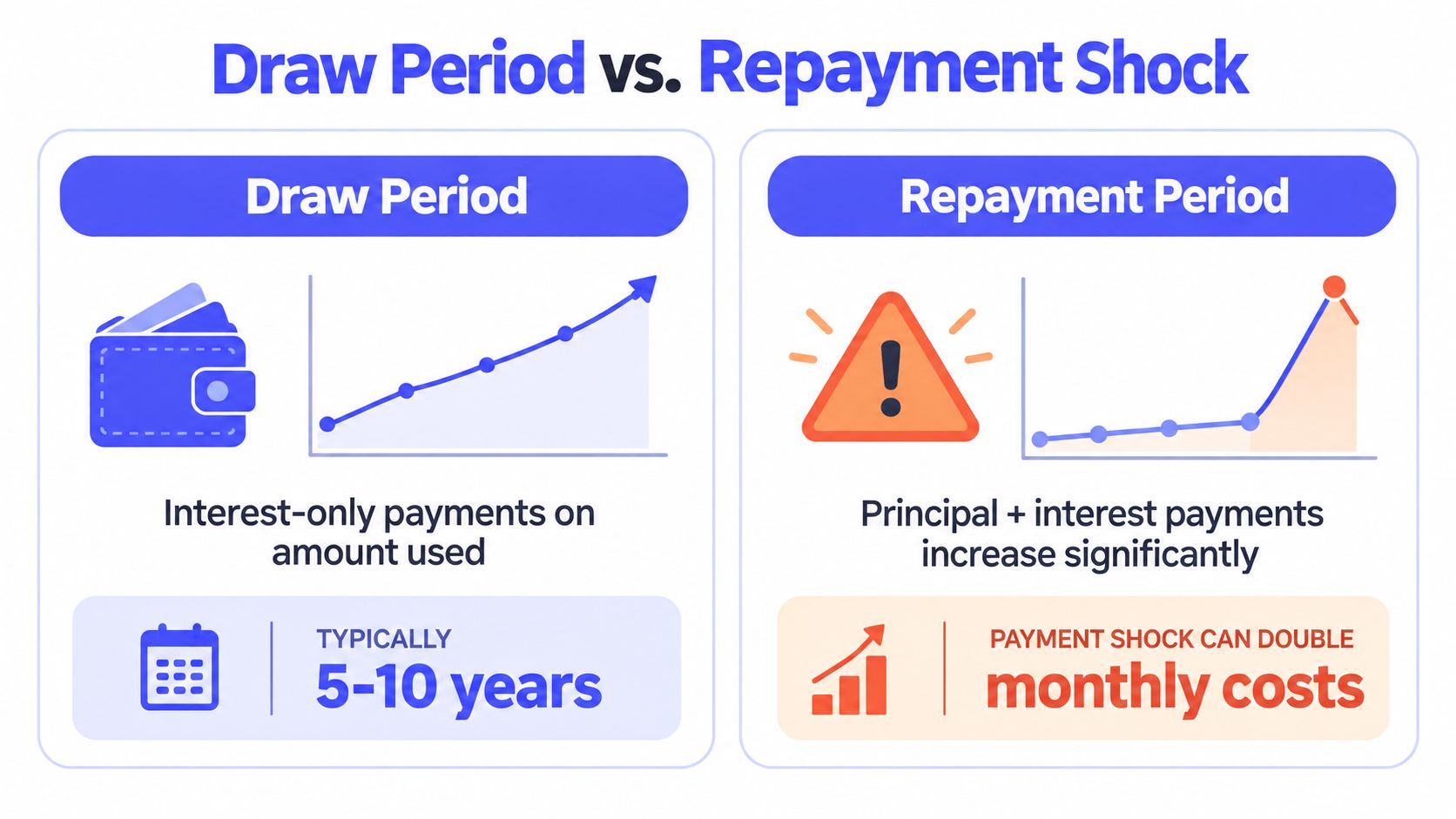
The draw period is where many borrowers underestimate the cost of a HELOC. A plan commonly allows withdrawals for 3 to 10 years, followed by a repayment phase that often lasts 10 to 20 years, according to Chase's explanation of HELOC draw periods.
During the draw period, you may be allowed to make interest-only payments on the amount used. That keeps the required payment lower, but it doesn't reduce the principal. A borrower who treats the minimum payment as a complete repayment strategy may reach the end of the draw period with nearly the same balance they originally borrowed.
The payment changes when borrowing stops
Consider a borrower who draws $30,000 and makes interest-only payments during the draw period. The monthly payment during that phase reflects the interest rate and the outstanding balance, but the $30,000 principal remains.
Once repayment begins, the borrower must amortize the principal and interest over the repayment schedule. The payment can rise sharply because the account no longer focuses only on interest. The exact amount depends on the balance, rate, and contract, so no honest adviser can calculate the future payment without those terms.
The structure is the important point:
| Draw period | Repayment period |
|---|---|
| You can generally borrow, repay, and re-borrow up to the limit | New borrowing generally stops |
| Payments may be interest-only on the amount used | Payments include principal and interest |
| The balance may remain unchanged if you pay only interest | The balance must be amortized |
| Variable-rate changes can affect the payment | Rate changes and principal repayment can combine |
Plan for the payment you don't see yet
Don't budget from the opening minimum payment. Ask the lender for a payment illustration based on the amount you expect to use, including the projected payment after the draw period. Then test that payment against your income, first mortgage, insurance, taxes, and other obligations.
If the projected repayment payment would force you to cut essential spending, the HELOC is too large or the project is too expensive. Paying principal during the draw period can reduce the later shock, but only if your budget can support those extra payments.
Hidden Risks and Post-Closing Realities
A HELOC isn't a permanent emergency fund. The lender can evaluate the line after closing, and access to unused credit isn't the same as cash sitting in your bank account.
The most obvious risk is the home's security interest. If financial pressure causes missed payments, the lender can pursue remedies tied to the property. The line also adds another monthly obligation behind the first mortgage, which can make a later income disruption harder to manage.
A lender can restrict unused credit
Lenders may freeze or reduce a HELOC when property value, credit conditions, or the borrower's financial profile changes under the account agreement. A line that looks available today may not remain fully accessible when you need it.
That risk matters if you plan to use a HELOC as your only emergency reserve. Keep a separate cash buffer where possible, and don't commit to a project that depends on future draws you haven't secured.
Variable rates require active monitoring
Many HELOCs use variable rates. Your payment can change even if you haven't drawn additional money, depending on the contract's index, margin, adjustment rules, and any applicable caps. Read those provisions before signing, then check statements for rate and payment changes.
Servicing can also change. A lender may transfer servicing, which can change the website, payment address, customer-service process, and instructions for requesting draws. Keep every closing document, monitor notices, and confirm new payment instructions through a trusted channel before sending money.
Risk test: If your plan fails because the lender freezes the unused line, the property valuation falls, or the rate rises, you don't have a durable plan. You have a dependency.
Research on HELOC use describes these lines as revolving loans secured by the home, while housing-law analysis has highlighted servicing concerns involving HELOCs and so-called zombie second mortgages. The Canada consumer research on home equity lines of credit reinforces why post-closing servicing and default protections deserve attention, not just the application checklist.
Actionable Next Steps for Homeowners
Treat the HELOC as a long-term liability before treating it as a source of project money. Start with your own numbers, then compare lenders, then verify that the project can survive the repayment phase.
Use this checklist
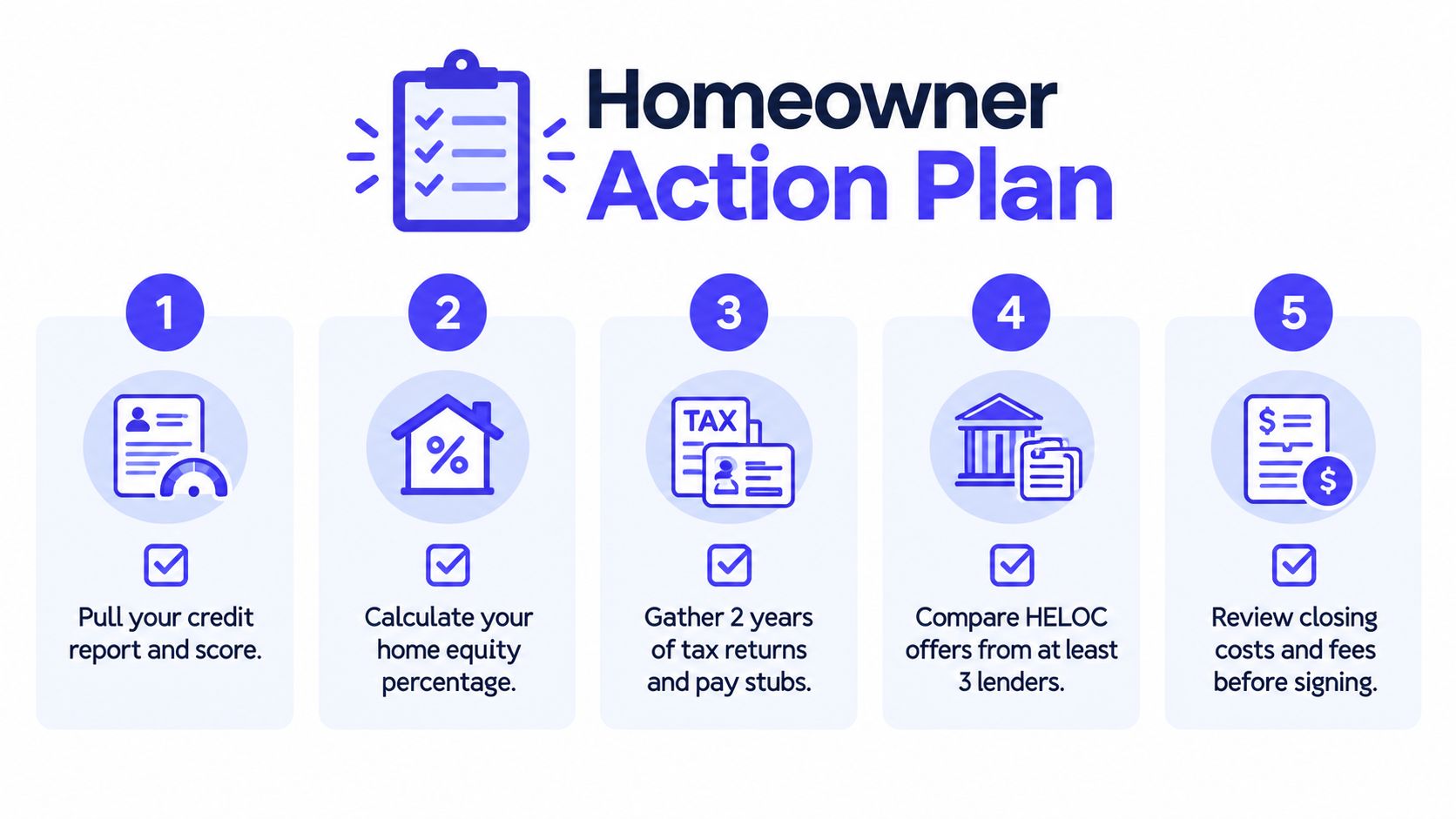
- Pull your credit report and score: Check for reporting errors, recent inquiries, overdue accounts, and the score a lender is likely to use.
- Calculate your equity percentage: Estimate the current property value, subtract the first-mortgage payoff and other liens, and test the result against a lender's CLTV limit.
- Gather income documents: Have pay stubs, tax returns, mortgage statements, insurance details, and information about other debts ready.
- Compare lender offers: Review rates, margins, draw rules, repayment terms, annual fees, conversion options, and conditions for freezing the line.
- Review closing costs and funding timing: Confirm the rescission period, first payment date, funding instructions, and every fee before signing.
Don't stop at the approved credit limit. Ask three practical questions: How much will I draw? What will the payment be after the draw period? Can I still afford it if the rate changes or the line becomes unavailable?
For a renovation, secure a qualified professional before releasing funds. Hand Vetted Co. matches homeowners with one licensed, background-checked, 4.5-plus-star-rated professional for a project, which can help you move from financing decisions to a properly scoped job without sharing your request with multiple businesses.
If the numbers work, apply with complete documentation and keep a written record of every lender deadline. If they don't work, reduce the project scope or delay the borrowing. Your home equity is valuable, but protecting your monthly cash flow matters more.
Hand Vetted Co. connects you with one verified professional for roofing, HVAC, restoration, and renovation projects, including work financed through home equity. Visit Hand Vetted Co. before you draw funds, so you can discuss the project with a screened professional and make the borrowing plan match the work.