You're probably feeling this already. You pay for leads, half of them go to three other businesses, the customer is price shopping, and your team burns time chasing people who were never serious. Meanwhile, another business gets the call because they showed up first on Google.
That's why local SEO for contractors matters so much. It helps you build a lead engine you own. Not rented attention. Not shared lead scraps. Your visibility, your reputation, your website, and your Google presence working together to bring in people who were already looking for the exact service you offer in the exact area you serve.
Table of Contents
- Why Local Search Is Your Best Salesperson
- Your Foundation The Perfect Google Business Profile
- Building Your Digital Job Site On-Site SEO
- Earning Trust Citations and Customer Reviews
- Becoming the Local Authority Links and PR
- Measuring What Matters and Deciding Your Path
- Your Local SEO Action Checklist
Why Local Search Is Your Best Salesperson
Shared lead platforms create a bad habit. They train businesses to rent demand instead of building it. You pay, you compete, and you hope your phone skills are strong enough to win a race you didn't control.
Local search works differently. A person types in a service plus a city, or searches on their phone when something just broke, and they're already close to hiring. That's not cold traffic. That's buying intent.
Page Optimizer's local search data shows that 78% of mobile local searches result in an offline purchase within 24 hours, and 46% of all Google searches have local intent. For roofing, HVAC, and restoration businesses, that's the whole game. You want to be visible when urgency is high and comparison shopping is short.
Practical rule: If someone needs a roofer after a storm or an HVAC company during a no-cool call, they usually don't want ten options. They want one business that looks trustworthy right now.
The biggest shift is mental. Stop thinking about SEO as blog posts and keyword tricks. Think about it as a sales system that works after hours, answers first impressions before you ever speak to the customer, and keeps producing even when you stop buying leads for a week.
Here's the trade-off:
| Approach | What you get | What you give up |
|---|---|---|
| Shared lead platforms | Faster short-term volume | Margin, exclusivity, and control |
| Local SEO | Slower build, stronger long-term lead quality | Patience and consistent execution |
Neither path is useless. But only one becomes an asset on your balance sheet. A strong Google presence, strong reviews, and location pages keep working. That's why local SEO for contractors is less about gaming rankings and more about building a pipeline you own.
Your Foundation The Perfect Google Business Profile
Your Google Business Profile is the first thing many people see before they ever visit your website. If it's thin, outdated, or half-filled, you're handing business to competitors with weaker operations but better presentation.
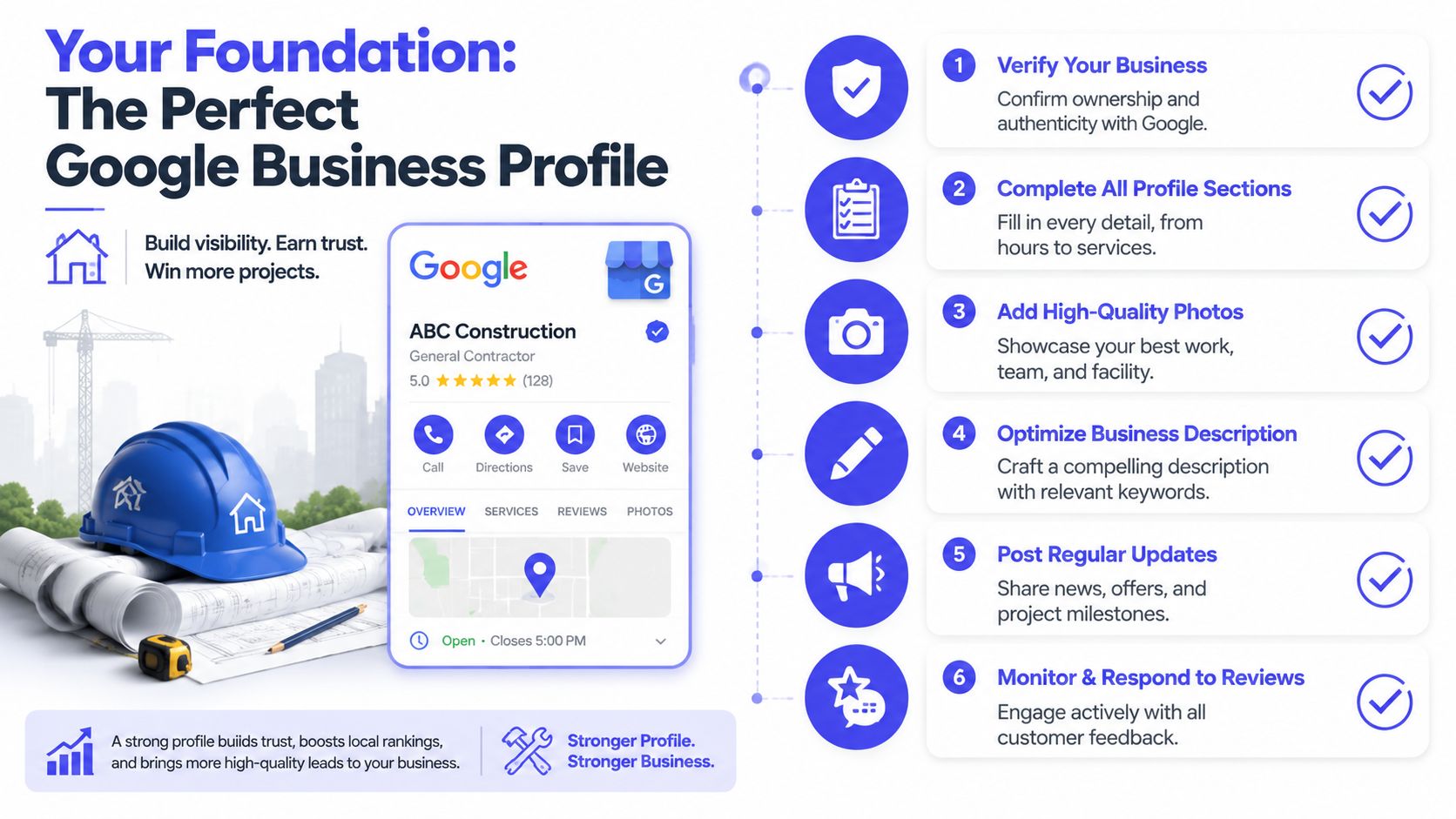
Complete every field before you chase anything else
This isn't busywork. Padula Media reports that completing 100% of Google Business Profile sections can boost visibility by up to 30% compared to incomplete profiles. The same source notes that contractors who post weekly GBP updates and engage in community sponsorships see a 40% increase in inbound calls over 6 months compared to those who only update quarterly.
That means the basics matter more than most businesses think.
Start here:
- Business name: Use your real business name. Don't stuff it with city names or extra services.
- Primary category: Pick the closest match to your core service. Not the broadest one.
- Secondary categories: Add related offerings only if you perform them.
- Hours and phone number: Keep them current. Wrong hours create bad calls and bad reviews.
- Service list: Add every major service you want to rank for.
- Description: Write clearly. Mention what you do and where you work in plain language.
- Service area: For a service area business, define real areas you serve.
For SABs, people often get sloppy. They try to look bigger than they are, overstate coverage, and create a profile that doesn't match how the business really operates. That usually backfires. Your service area should reflect where you can reliably sell, schedule, and fulfill jobs.
Set up your profile like an actual sales asset
A strong profile doesn't just exist. It answers objections.
Use photos that prove the work is real. Jobsite photos, completed projects, trucks with branding, team photos, equipment, and office or warehouse images all help. Skip generic stock art. People can spot it instantly.
Then tighten the trust layer:
- Add project photos regularly: Fresh photos signal an active business.
- Use the Q&A section: Seed common questions and answer them clearly.
- Post updates weekly: Share completed jobs, seasonal service reminders, financing availability, or community involvement.
- Respond to reviews: Fast, calm, professional replies show you're paying attention.
A great Google Business Profile should make a customer think, “This business looks established, active, and easy to contact.”
One more practical point. Don't treat GBP as separate from the rest of your marketing. The services you list there should match the services on your website. Your phone number and business details should match your directory listings. Your latest projects should show up in both places. Consistency wins because it reduces doubt for both Google and the customer.
Building Your Digital Job Site On-Site SEO
Your website has one job. Turn search visibility into calls, form fills, and booked estimates. If your site is thin, confusing, or generic, it wastes the trust your Google Business Profile created.
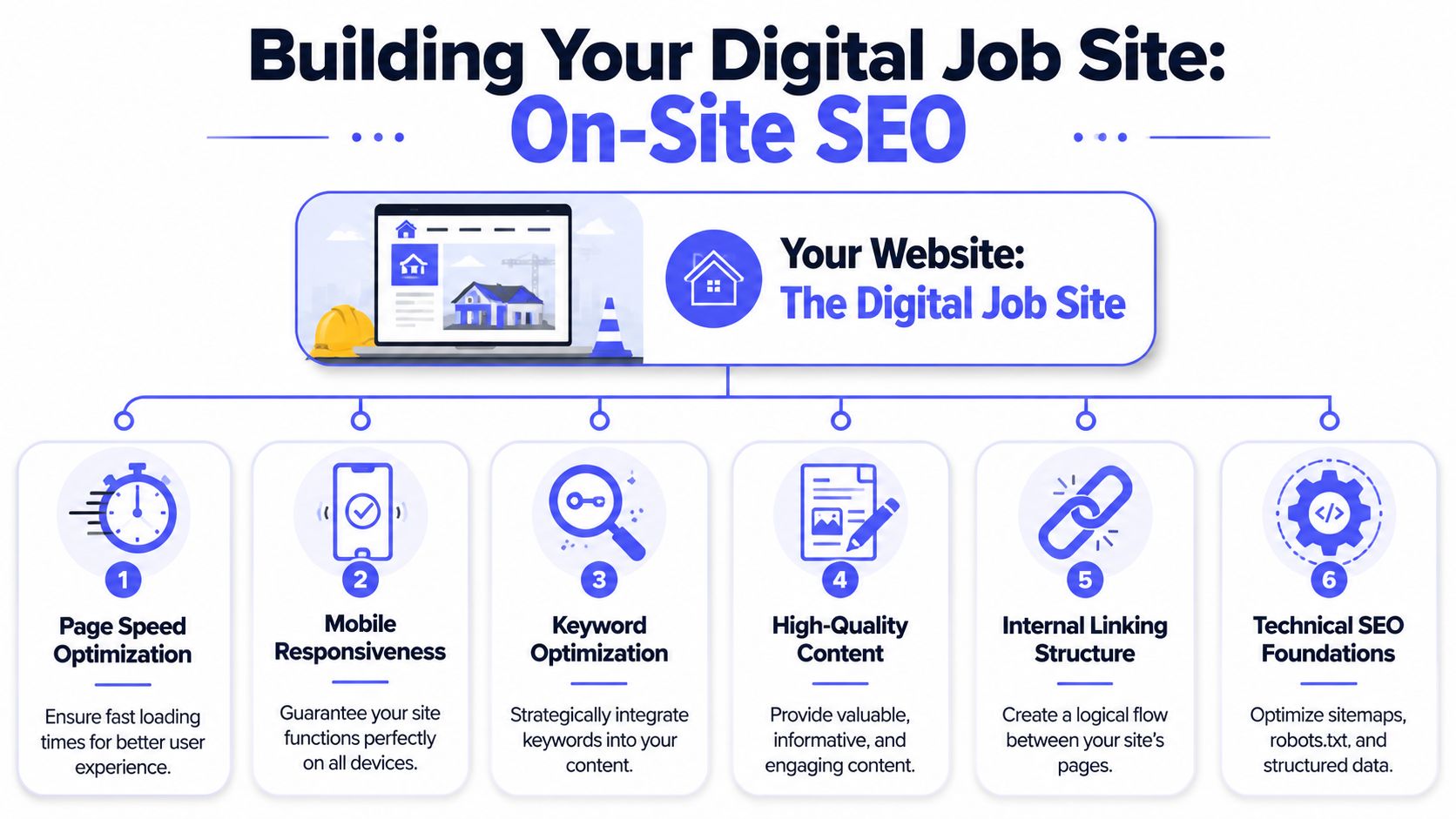
Build service pages for the work you actually want
A lot of contractor sites make the same mistake. They put every service on one page, write a few vague paragraphs, and call it done. That doesn't help Google much, and it doesn't help customers make decisions.
Create a dedicated page for each core service. If you do roof repair, roof replacement, emergency tarping, storm restoration, and insurance claim support, those should not live in one blob page. Same for HVAC repair, AC replacement, furnace installation, ductwork, indoor air quality, or emergency service.
Each page should answer practical questions:
- What problem does this service solve
- Who it's for
- What the process looks like
- What areas you serve
- How to contact you quickly
If you publish educational content too, make it support the service pages. A helpful example for insurance-related jobs is a guide like contractor insurance requirements, which can help clarify what customers and businesses often need to verify before work starts.
Create city pages that deserve to rank
Most businesses either skip city pages or do them badly. They clone the same copy across ten towns, swap the city name, and wonder why nothing moves.
Clicks Geek's local SEO guidance gives a solid baseline. Create dedicated city pages with a unique title tag under 60 characters formatted as [Service] in [City, State] | [Business Name], an H1 with the primary keyword, a 150–160 character meta description, and embedded LocalBusiness schema. Each city page should contain 500–750 words of supporting text, relevant images, and a Google Business Profile map embed.
That's the framework. The quality comes from making each page specific.
A good city page should include:
- neighborhoods or nearby landmarks you serve
- common service issues in that market
- examples of job types common in that area
- a clear CTA tied to the service on that page
If your city pages read like templates, customers feel it. Google usually does too.
Make the site easy for Google and people to use
This part is less glamorous and more important than most businesses want to admit.
Here's the short version:
| Site element | What good looks like | What hurts you |
|---|---|---|
| Mobile experience | Fast, clean, tap-friendly buttons | Tiny text, slow pages, buried phone number |
| Internal linking | Service pages link to city pages and back | Orphan pages with no clear path |
| Schema | LocalBusiness and service markup | No structured data at all |
| Navigation | Simple menu by service and location | Clever labels nobody understands |
For local SEO for contractors, clean architecture beats clever design every time. A customer on a phone should be able to land on a page, trust what they see, and call in seconds.
Earning Trust Citations and Customer Reviews
Citations and reviews do different jobs. Citations help search engines confirm your business is real and consistent. Reviews help people decide whether they trust you enough to call.
The problem is that many businesses treat both as one-time setup tasks. They aren't.
Citations are basic trust signals
A citation is a mention of your business name, address, and phone number on another site. That could be a directory, local chamber listing, trade association page, or an industry platform.
The goal isn't to be everywhere. The goal is to be accurate wherever you are.
Check these first:
- Core business details: Your name, address, and phone number should match exactly.
- Website URL: Use the same canonical website version across listings.
- Business categories: Keep them aligned with your actual services.
- Old listings: Remove duplicates and outdated locations when possible.
If your citations are messy, you create friction. Search engines see conflicting information. Customers do too.
Reviews need a process not wishful thinking
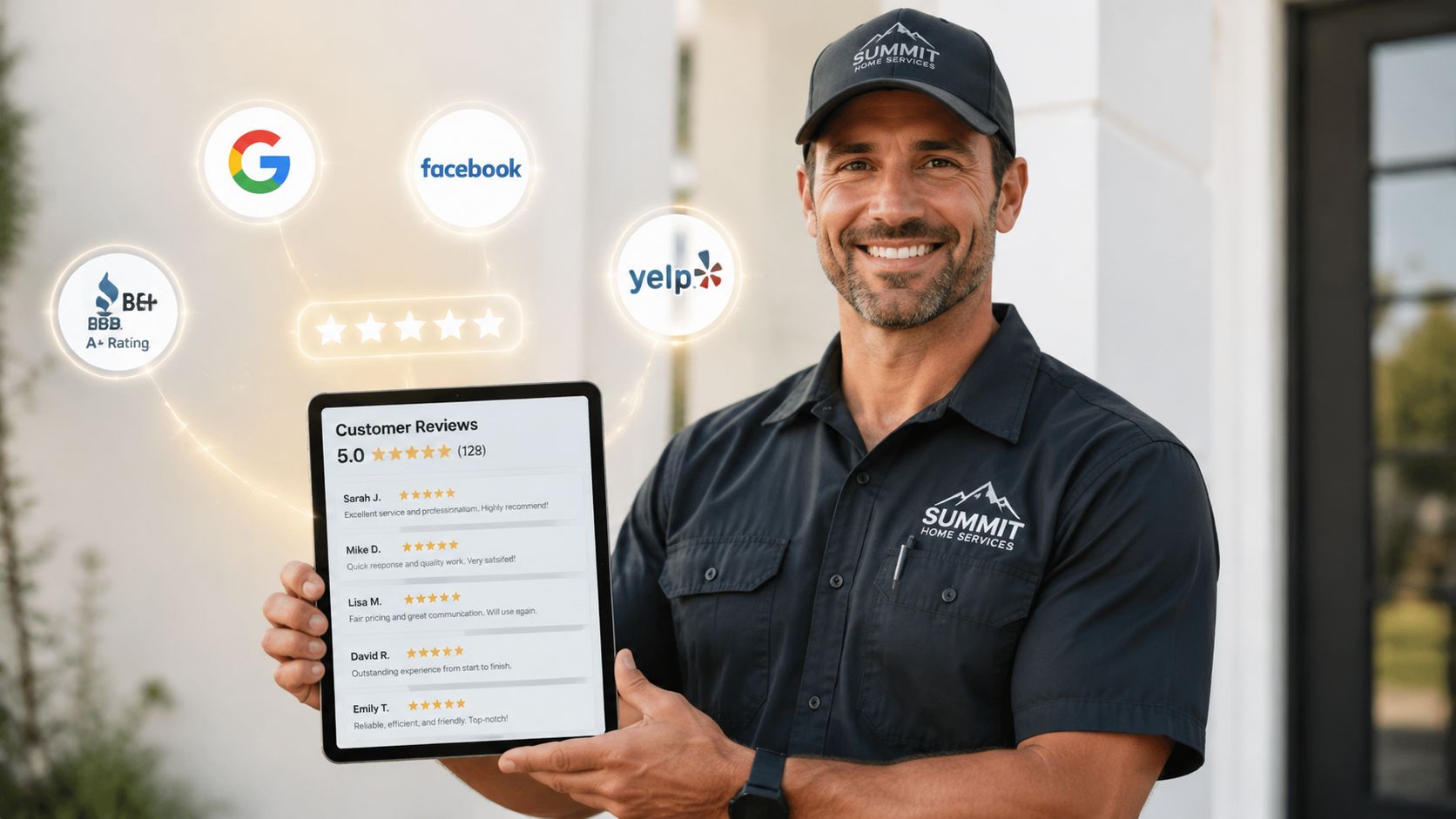
The strongest review strategy is simple. Ask every happy customer, ask quickly, and make it easy.
The Blueprint's local SEO benchmark recommends a steady cadence of 2–4 new reviews per week to maintain consistent local ranking momentum. It also notes that review quantity, recency, and text directly influence algorithmic trust far more than anonymous five-star ratings.
That means “Can you leave us a review?” is a decent start, but it isn't enough by itself. You want reviews with actual words.
Try language like this after a completed job:
“Thanks again for trusting us with the project. If you're open to it, a Google review mentioning the service we did and your area would really help.”
That works because it's direct and specific without sounding scripted.
A few practical habits help a lot:
- Ask at the right moment: Right after a successful job, not three weeks later.
- Send one clear link: Don't make people hunt for your review profile.
- Coach for detail, not for stars: You want honest reviews that mention the work performed.
- Respond to all reviews: Positive, negative, short, detailed. All of them.
For businesses that care about trust at the intake stage, the same mindset applies to hiring and screening. If you're tightening your reputation stack, resources like contractor background check guidance help reinforce what customers now expect from serious service businesses.
Bad review responses usually fall into two buckets. Defensive or robotic. Don't do either. A calm reply that acknowledges the issue and offers a path offline is almost always the right move.
Becoming the Local Authority Links and PR
The businesses that dominate local search for years usually don't win on website copy alone. They earn local authority. That comes from mentions, links, and real-world visibility that other sites reference.
What local authority looks like in real life
Take a roofing company trying to grow in two neighboring cities. It could spend all year tweaking title tags and still look interchangeable. Or it could do a few local things that create genuine signals.
Sponsor a youth baseball team. Join the chamber. Offer a storm-readiness talk for a neighborhood association. Partner with a realtor who needs reliable contractors for inspection issues. Support a school fundraiser. Those aren't gimmicks if they're real. They often lead to local press, community pages, partner listings, and links from organizations people already trust.
That's the key distinction. A citation says you exist. A local link from a respected community site suggests you matter.
Why this compounds over time
This work feels slower because it is slower. But it stacks.
Amra and Elma's local SEO statistics roundup reports that businesses investing in local SEO for three or more consecutive years generate 2.7 times more local organic traffic than first-year adopters. The same source says small businesses investing in SEO see an average ROI of 400% within two years.
That matches what experienced operators already know. The first few months are mostly setup, cleanup, and consistency. Then the engine starts to build momentum. Reviews accumulate. Pages age well. Local links add authority. Brand searches increase. Referrals convert better because the customer checks Google and sees a business that looks established.
Local authority usually comes from boring, repeatable community involvement done well, not flashy campaigns.
If you want a useful filter, ask one question before pursuing any PR or link opportunity: would you still do this if Google didn't exist? If the answer is yes, it's usually the kind of signal worth building.
Measuring What Matters and Deciding Your Path
A lot of businesses get lost here. They track impressions, clicks, and ranking screenshots, but can't answer the only question that matters. Did local SEO create more qualified calls and booked jobs?
Track business outcomes not vanity metrics
For contractors, the scoreboard is small.
Watch these:
- Calls from Google Business Profile: People who found you and called directly.
- Website form submissions: Especially from service and city pages.
- Rankings for money keywords: Service plus city terms tied to real revenue.
- Review flow: Whether new feedback is arriving consistently.
- Lead quality by source: Which channels bring the best jobs, not just the most noise.
Google Business Profile Insights, Google Search Console, and Google Analytics can give you enough visibility to make solid decisions. You don't need a giant reporting stack to know whether the phone is ringing from the right places.
A simple monthly review works well. Check what pages got leads, what services got traction, what cities improved, and where you still look weak.
DIY versus hiring help
Here's the honest comparison.
| Path | Best for | Main upside | Main downside |
|---|---|---|---|
| DIY | Owner-led businesses with time and discipline | Lower cash outlay, more control | Slower execution, easier to stall |
| In-house marketing staff | Businesses with admin support and process discipline | Better consistency | Limited specialized SEO depth |
| Agency or consultant | Businesses that want speed and expertise | Faster implementation, stronger systems | Higher cost, quality varies widely |
DIY works if someone owns it. Not vaguely. Specifically. If nobody is responsible for updates, reviews, pages, and cleanup, the project drifts.
Hiring help makes sense when your opportunity cost is higher than the fee. If your team closes jobs well but doesn't have time to build city pages, post GBP updates, manage citations, and track conversions, outside support can be the right call.
There's also a middle ground. Keep building your owned lead engine while filling short-term pipeline gaps with channels that produce more exclusive opportunities. If you're comparing options, it helps to understand what lead generation near me should actually look like when it isn't built around recycling the same contact to multiple businesses.
Your Local SEO Action Checklist
A good local SEO plan is boring in the right way. It turns into weekly habits, not one big marketing sprint.
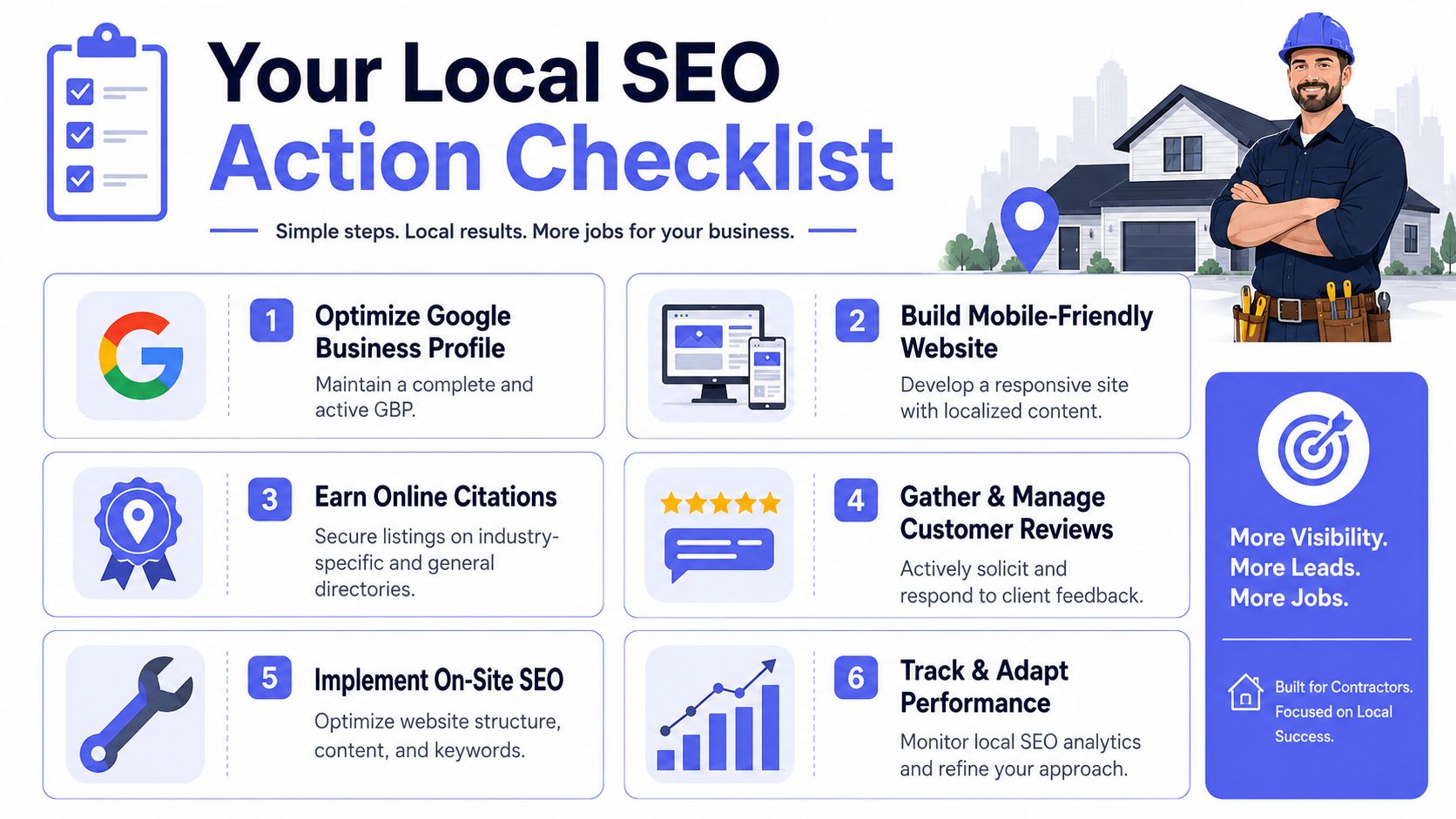
Use this as your working list:
Google Business Profile
- Verify and complete everything: Categories, services, hours, description, phone, website, and service area.
- Upload real photos often: Recent jobs, team, equipment, vehicles, and branded presence.
- Post updates weekly: Keep the profile active with useful, local updates.
- Answer reviews consistently: Short, professional, and fast.
Website and on-site setup
- Build one page per core service: Don't bury high-value work on a generic services page.
- Create real city pages: Unique copy, proper title tags, schema, images, and clear service intent.
- Improve mobile experience: Make calling and form submission easy from a phone.
- Link pages logically: Service pages, city pages, and contact paths should connect cleanly.
Reviews, citations, and authority
- Ask for reviews every week: Build a steady flow, not random bursts.
- Clean up citations: Fix inconsistent business details across listings.
- Earn local links: Community involvement, partnerships, sponsorships, and local PR.
- Review performance monthly: Track calls, forms, rankings, and lead quality.
If you do these basics well, local SEO for contractors stops feeling mysterious. It becomes a repeatable operating system for getting better jobs from the markets you want to own.
If you want a second channel while your SEO engine gains traction, Hand Vetted Co. is worth a look. Instead of selling the same lead to multiple businesses, Handvetted matches people with one licensed, background-checked, 4.5+ star rated professional. If you want to understand the process, start with How It Works, review Our Standards, or check the FAQ.