Your kitchen renovation starts with demolition, then the exterior work follows after the weather clears. The contractor needs one payment now, another after materials arrive, and more as each phase finishes. Meanwhile, labor and material quotes keep moving. A lump-sum loan can leave you paying interest on money sitting unused, while a variable-rate HELOC can make a long project harder to budget.
That's why the right HELOC loan for home improvement isn't automatically the cheapest loan or the largest line available. It's the option that matches your project schedule while leaving enough equity and monthly-payment capacity after the work is done.
Table of Contents
- Is a HELOC the Right Way to Fund Your Renovation
- How a HELOC Works for Home Improvement Projects
- HELOC vs Cash Out Refinance vs Personal Loans Compared
- Qualifying for a HELOC and What It Really Costs
- Repayment Phases Variable Rates and Protecting Your Equity
- How to Apply for a HELOC Step by Step and Timing
- Choosing the Best Funding Path for Your Project
Is a HELOC the Right Way to Fund Your Renovation
Your renovation budget changes as each phase finishes. Demolition may reveal electrical work, material prices may shift, and the contractor may request payment at different milestones. A HELOC loan for home improvement fits that pattern because you draw only what the project needs, then repay and reuse available credit as later phases begin. You pay interest on the balance you use, not the full approved limit.
That flexibility has a direct cost: a HELOC usually carries a variable rate. A rate increase can raise your payment before the renovation is complete and make the final cost harder to predict. If the contractor has quoted one defined project and needs most of the funds immediately, a fixed home equity loan gives you a clearer payment schedule. A cash-out refinance can also offer a fixed rate, but it replaces your existing mortgage, so its closing costs and new mortgage terms deserve close review.
Home-equity borrowing remains connected to renovation spending. A Mortgage Bankers Association market benchmark reported by HousingWire found that combined originations of open-ended HELOCs and closed-end home equity loans rose 7.2% year over year among lenders reporting in both periods. The benchmark recorded $24.8 billion in originations, $167.4 billion in maximum credit extended, and $70 billion in outstanding loans at year-end 2024. Renovations represented 46% of total origination volume in 2024, down from 56% in 2023 and 65% in 2022. Borrowers also used home-equity products for purposes such as debt consolidation.
A quick decision rule
Choose a HELOC when:
- Your project is phased: You need funding at several milestones.
- Your final bill is uncertain: You want access to a reserve without borrowing it immediately.
- You can handle rate movement: Your budget still works if the variable payment rises.
- You protect your equity: The renovation leaves a comfortable gap between total borrowing and your home's value.
Choose a fixed alternative when the work has a firm scope, most costs arrive at once, or a rising payment would threaten your post-project budget. Preserving equity matters too. Avoid borrowing the maximum because the lender approves it.
A verified professional can help turn an ambitious wish list into a realistic scope before you commit to financing. Handvetted matches people with one licensed, background-checked, highly rated professional, which can give you a clearer project plan and borrowing target.
How a HELOC Works for Home Improvement Projects
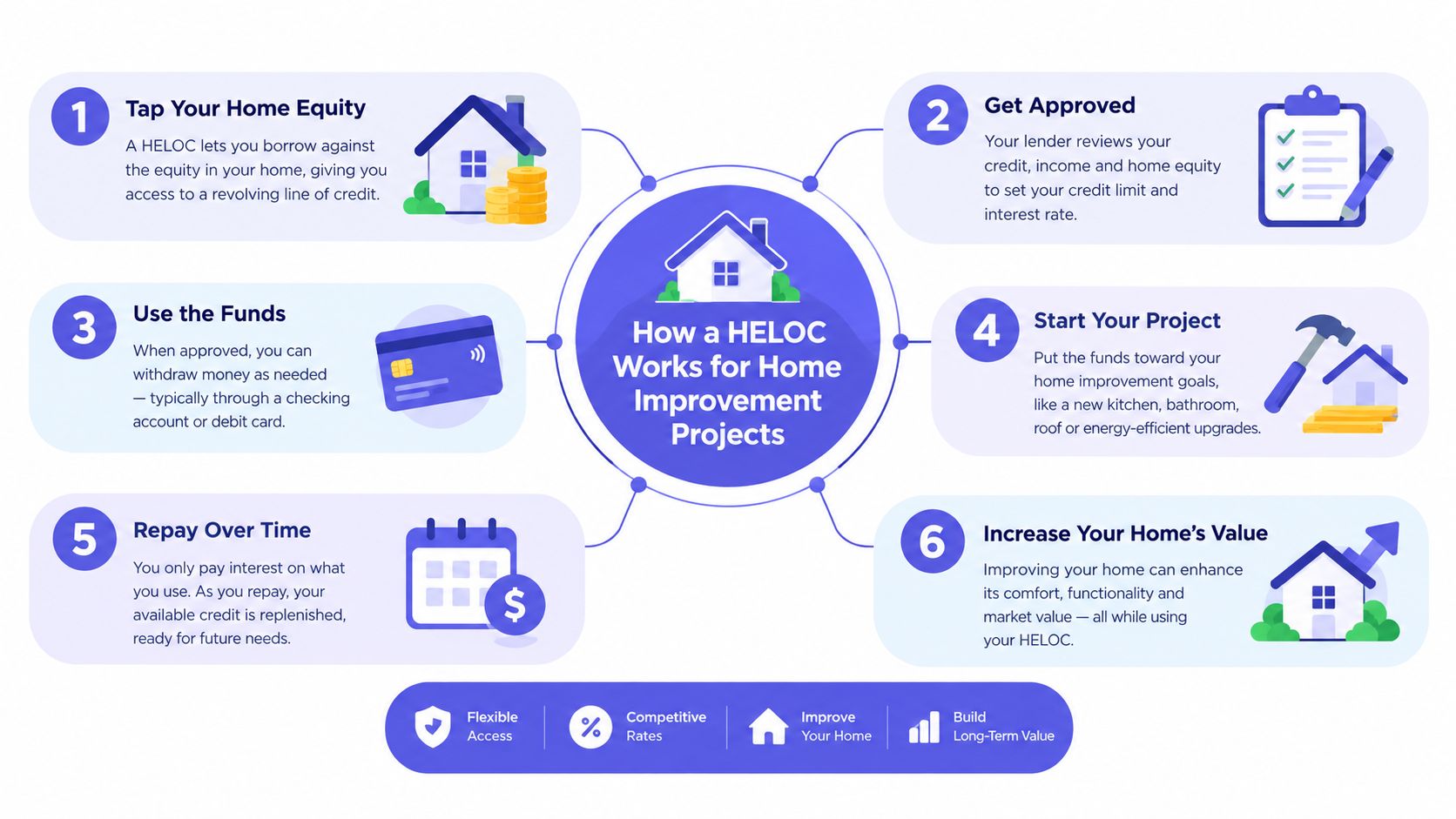
A home equity line of credit gives you revolving access to money secured by your home. The lender sets a credit limit, then you draw only what the renovation requires. That structure suits phased work, where invoices arrive over time. It hurts when you borrow the full amount early, pay variable interest while funds sit unused, or let a rising rate weaken your post-project budget.
The Consumer Financial Protection Bureau explains HELOC mechanics through two phases:
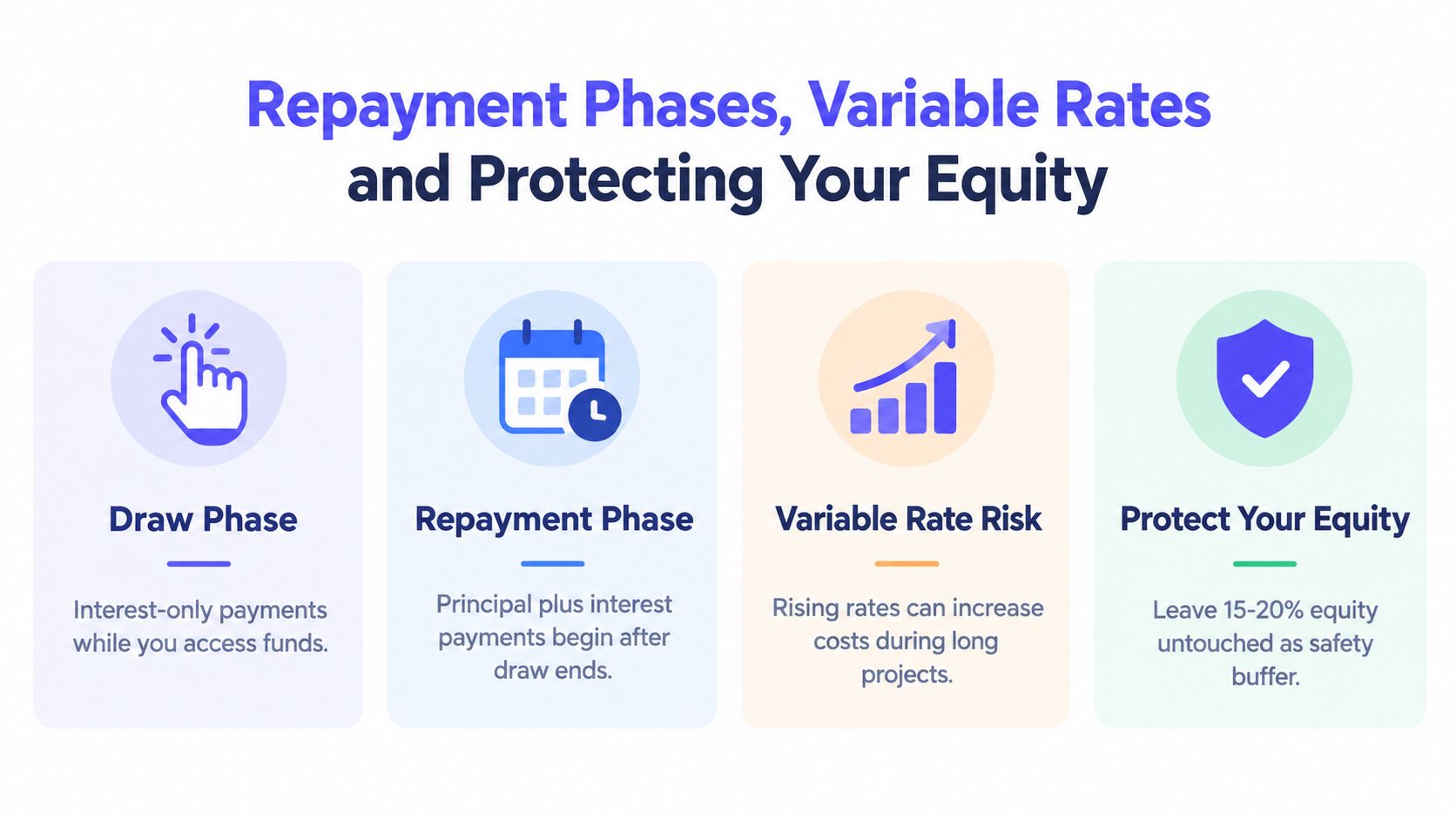
- Draw period: You access money up to the approved limit. You can generally borrow, repay, and borrow again during this phase. Many lenders require interest payments on the outstanding balance, although the agreement controls the exact terms.
- Repayment period: New borrowing may stop. You then repay principal and interest according to the lender's schedule.
A draw period often lasts up to 10 years, followed by a repayment period commonly lasting up to 20 years. Those time frames are common structures, not guarantees. Confirm the actual dates, payment formula, rate adjustments, conversion options, and renewal rules before signing.
Match each draw to a project milestone
Do not draw the full line on day one just because the lender approved it. Match each advance to an invoice or completed stage:
- Planning and deposits: Use cash for design, permits, or an initial deposit when practical.
- Materials: Draw when the supplier requires payment, rather than months before delivery.
- Installation: Fund labor as the contractor reaches agreed milestones.
- Final work: Keep capacity for approved changes, inspections, or necessary repairs.
This phased approach limits unused borrowing costs and shows how much credit remains. Keep a written draw schedule aligned with the contractor's payment schedule.
Practical rule: A HELOC funds a renovation in stages. It does not justify spending the entire approved limit.
Your home remains collateral throughout the loan. Missed payments can trigger remedies associated with mortgage-secured debt. Before accepting the line, verify whether the rate is variable, how often it adjusts, whether you can convert part of the balance to a fixed rate, and how repayment changes after the draw period ends. Compare those risks with a fixed alternative, especially when the renovation has a firm scope and protecting your remaining equity matters.
HELOC vs Cash Out Refinance vs Personal Loans Compared
Your renovation schedule should determine the financing structure. A HELOC keeps your existing first mortgage and adds a revolving second lien. A cash-out refinance replaces that mortgage with a larger one and gives you the difference in cash. A personal loan leaves your home untouched as collateral, but its unsecured pricing depends on your credit and overall finances.
| Criteria | HELOC | Cash-Out Refinance | Personal Loan |
|---|---|---|---|
| Access to funds | Draw as needed during the draw period | Receive a lump sum at closing | Receive a lump sum |
| Rate type | Usually variable | Commonly fixed, depending on the product | Commonly fixed, depending on the lender |
| Repayment flexibility | Borrow, repay, and potentially re-borrow during the draw period | Fixed repayment schedule for the new mortgage | Fixed installment schedule |
| Closing costs | May include lender and property-related charges | Can include appraisal, origination, taxes, and other closing-related charges | Often fewer property-related costs |
| Existing mortgage | Keeps the current first mortgage in place | Replaces the existing mortgage | Leaves the mortgage unchanged |
| Best fit | Phased or uncertain renovation spending | Large one-time project when refinancing terms make sense | Smaller project or borrowers who don't want home-secured debt |
| Main risk | Variable payments and secured collateral | Higher total mortgage balance and possible loss of favorable existing terms | Higher pricing and no equity-based collateral |
Use this comparison of home improvement financing options to organize questions before requesting quotes.
When a HELOC has the edge
A bathroom renovation, siding replacement, and drainage project may happen months apart. A HELOC lets you draw for each phase instead of borrowing the full budget immediately. You pay interest on the amount used, not the unused credit, while keeping capacity for a contingency.
That structure suits projects with uncertain scope. Older homes can reveal wiring, plumbing, or structural problems after demolition begins. The available line gives you a funding source for those changes, although every additional draw increases secured debt and can weaken your remaining equity cushion.
A variable rate creates the trade-off. If rates rise while you are still drawing, later work becomes more expensive. If the finished project raises the property's value, the equity may absorb some of that pressure, but you should not depend on an appraisal to rescue an oversized balance. Use a HELOC for staged spending only when your budget can handle payment changes.
When a fixed loan wins
A fixed home equity loan fits better when the contractor has provided a dependable total price and requires the full amount at the start. You know the principal, repayment schedule, and monthly obligation from day one. That certainty protects your cash flow and makes the project's effect on your equity easier to measure.
Cash-out refinancing requires a separate calculation because it changes the debt secured by the entire property. It may fit when the new mortgage terms work with your finances, but the refinance can add appraisal, origination, tax, and other closing-related charges. It can also replace a favorable existing mortgage with a more expensive one, increasing the cost of every dollar already borrowed.
Choose a personal loan when keeping the house outside the collateral package matters more than minimizing the interest rate. The mortgage and equity remain unchanged, but unsecured borrowing may carry a higher rate or shorter repayment period. For a major remodel, that can produce a less comfortable monthly payment than a home-secured option.
Qualifying for a HELOC and What It Really Costs
You may have enough equity for a HELOC and still fail underwriting. Lenders review your credit, income, mortgage balance, other liens, property value, and debt obligations. They may also require an appraisal, automated valuation, or another property review. Use this guide to budget for the average cost of an appraisal before applying.
Published lender guidance commonly points to 15% to 20% home equity, a credit score near 620 or higher, and a debt-to-income ratio below 43%, according to Lower's HELOC qualification guidance. Depending on its policies and your financial profile, a lender may allow borrowing up to approximately 85% to 95% of home value or equity.
Treat those figures as screening markers, not promises. Strong income and limited debt can improve your terms, while unstable income or several existing liens can weaken an application even with the same credit score.
Check the numbers before applying
Prepare these four items:
- Mortgage statement: Confirm your balance, interest rate, and every other lien.
- Property estimate: Start with a credible valuation, then expect the lender to verify it.
- Income records: Gather documents showing consistent earnings.
- Debt list: Include car payments, student loans, credit cards, and recurring obligations.
Your available line depends on the lender's valuation and maximum combined loan-to-value limit. Do not set your renovation budget from a home-value estimate alone. Leave room for overruns, especially if you plan to draw in phases as costs change.
Budget for more than interest
Ask about application charges, appraisal or valuation fees, origination costs, annual fees, closing charges, early termination fees, and minimum draw requirements. A product with low upfront costs may impose conditions or fees if you close the line early.
The rate controls only part of your cost. A variable rate can raise payments while work is underway, and an introductory rate may expire. Request the margin, adjustment frequency, index, rate cap, floor, and written payment examples for both draw and repayment phases. If your budget cannot handle a higher payment after the project, a fixed loan deserves serious consideration.
Tax treatment is narrower than many borrowers assume. For tax years beginning after 2017, the IRS explains that HELOC interest is deductible only when the money is used to buy, build, or substantially improve the home securing the loan, subject to applicable limits. The IRS generally limits combined qualified mortgage debt to $750,000, or $375,000 for married taxpayers filing separately, as described in current HELOC tax guidance from Freedom Mortgage. Keep invoices and contractor records, then ask a tax professional to assess your situation.
Repayment Phases Variable Rates and Protecting Your Equity
A long renovation creates two separate risks. First, your interest rate can move before the contractor finishes. Second, you can complete a beautiful project while leaving yourself with too little equity to absorb a property-value decline, another major repair, or a future borrowing need.
Recent market coverage gives that concern context. HousingWire's reporting on Bank of America data says HELOC utilization rates had climbed above their 2014 to 2019 average, HELOC-funded home spending was up sharply as of June 2026, and national average HELOC rates remained in the low-to-mid 7% range in mid-2026. Treat that rate environment as a budgeting scenario, not as a guaranteed quote for your application.
Stress-test the payment before you draw
During the draw period, many borrowers focus on the interest-only payment. That can make a large line feel affordable. The repayment phase is different because principal enters the calculation, and the line may no longer accept new draws.
Run your budget under three conditions:
- Base case: The payment at the lender's quoted rate and your expected balance.
- Higher-rate case: A payment based on a meaningfully higher variable rate.
- Completion case: The payment after the draw period ends, when principal repayment begins.
Don't let a contractor's monthly payment schedule substitute for a debt stress test. Your renovation budget should include the HELOC payment alongside the first mortgage, insurance, taxes, utilities, and ordinary maintenance.
Protect the equity that remains
Home-equity borrowing can improve the property, but the improvement doesn't guarantee that the market will support the value you need later. Consumer guidance often discusses combined borrowing caps around 80% to 85% of home value, which leaves a meaningful cushion if prices soften or another repair arrives. Don't treat the lender's maximum as your personal target.
The broader balance trend also argues for restraint. A summary of home improvement financing statistics reports an average HELOC balance of $52,347 in 2026, up 11.2% year over year, and outstanding HELOC debt of $427.6 billion, up 12.9% year over year. The same source cites a Citizens survey in which 63% of homeowners expected to need financing for home improvements or a home purchase within the next one to five years.
The practical lesson is simple. Borrow enough to complete the work properly, but don't use every dollar the lender offers. Preserve room for the next problem.
How to Apply for a HELOC Step by Step and Timing
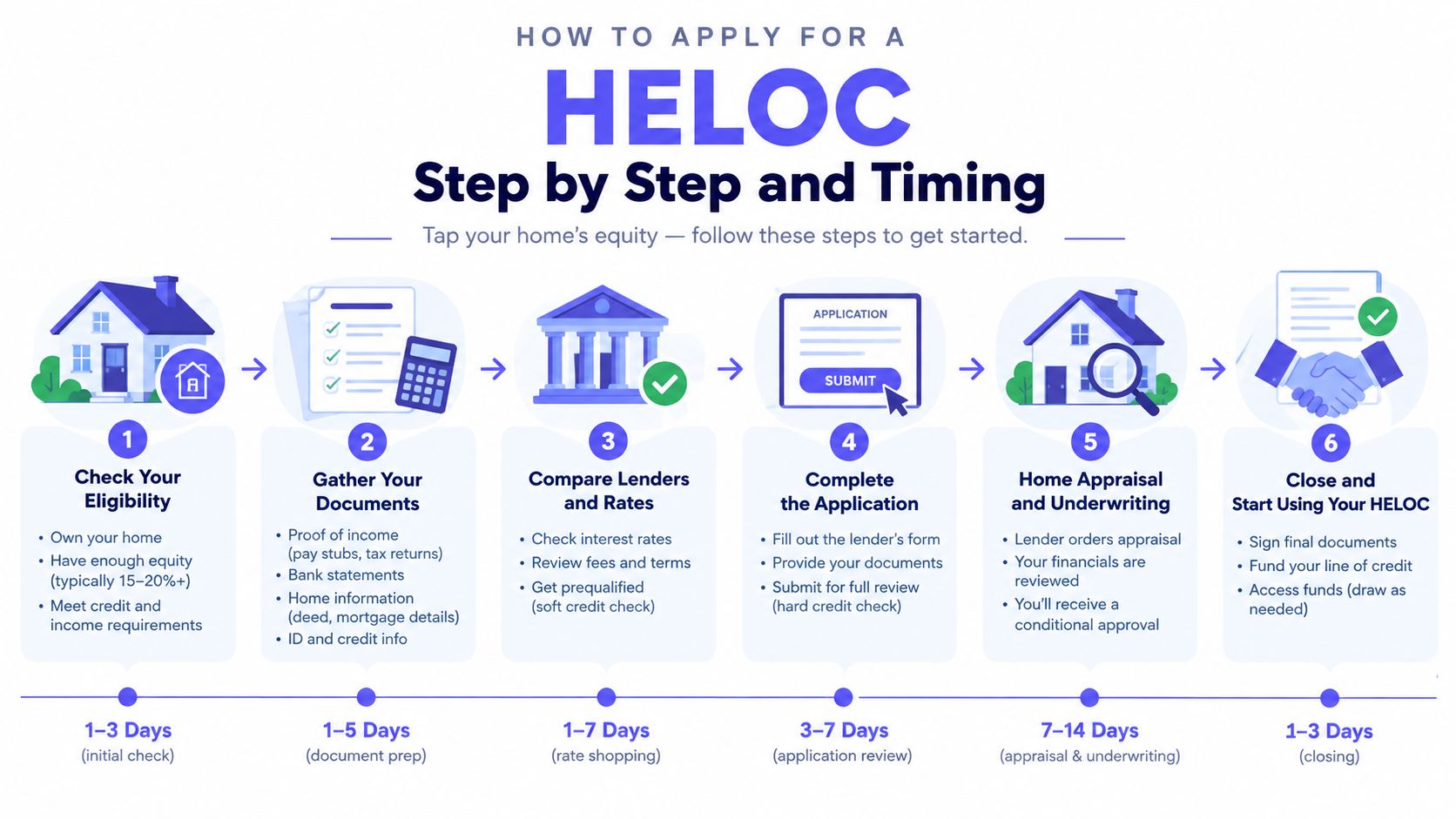
Start before demolition. A HELOC application involves property valuation and mortgage-style underwriting, so waiting until a contractor is ready to invoice can create an avoidable scheduling problem.
A 2023 TD Bank homeowner survey found that 69% of homeowners were renovating or planning to renovate within two years, while 38% of those planning renovations expected to use a HELOC or home equity loan. The demand is real, but your financing still needs to line up with your actual project calendar.
Prepare the file
- Gather mortgage and equity details. Save your mortgage statement, identify other liens, and form a conservative property-value estimate.
- Review credit and DTI. Check your credit reports for errors, list recurring debts, and calculate your debt-to-income ratio before a lender does.
- Build the project budget. Separate design, permits, materials, labor, and contingency funds. Ask the contractor which payments occur at each milestone.
- Compare lender offers. Review the rate formula, draw rules, repayment start date, fees, minimums, rate caps, and fixed-rate conversion options.
- Complete valuation and underwriting. Provide income documents and respond quickly to appraisal or property-review requests.
- Coordinate access to funds. Confirm how you'll draw, how long transfers take, and whether the line will be available before the first major invoice.
Keep the contractor schedule realistic
Don't sign a payment agreement that assumes immediate access to credit. Ask the lender about expected underwriting and closing timing, then build space into the schedule for valuation issues, document requests, and funding delays.
Ask the contractor to use milestone-based invoices rather than large undocumented advances. You'll have a better record for your own budget, and the draw pattern will better match how a HELOC is designed to work.
Before choosing a professional, verify licensing, insurance, references, and the scope of work. Financing can make a project possible, but it can't correct poor workmanship or an unclear contract.
Choosing the Best Funding Path for Your Project
A phased renovation needs financing that matches the work. Choose based on your project's timing, rate risk, and ability to preserve equity after the final invoice.
| Your situation | Strongest starting point | Reason |
|---|---|---|
| Multi-stage remodel with uncertain costs | HELOC | Draw only as each phase requires funding |
| One large project with a firm price | Fixed home equity loan | Receive a lump sum with predictable repayment |
| Strong preference to preserve home collateral | Personal loan | Avoid adding a lien against your home |
| Existing mortgage terms are attractive | HELOC or personal loan | Avoid replacing the first mortgage without a clear benefit |
| Limited equity or tight monthly budget | Compare unsecured and secured options carefully | Avoid borrowing so much that your financial cushion disappears |
A HELOC fits phased work because you pay interest on what you draw, not the full approved limit. It becomes a poor choice when rising rates would strain your budget, or when the contractor has already fixed the project price and you need one predictable payment. A fixed alternative can protect your monthly budget, while a HELOC can preserve your existing mortgage terms. Compare HELOC versus cash-out refinance before replacing your first mortgage.
Use this checklist:
- Get a written scope and milestone payment schedule.
- Estimate your property value conservatively.
- Calculate current equity, existing debt, and your post-project equity cushion.
- Request several lender offers. Compare total costs, rate formulas, fees, and repayment terms.
- Review IRS Publication 530 rules for qualified home improvements before assuming interest is deductible.
- Stress-test payments after the draw period, not only during interest-only payments.
Hand Vetted Co. connects you with one licensed, background-checked, 4.5-plus-star-rated renovation professional instead of sending your request to multiple businesses. Visit Hand Vetted Co. before finalizing your scope and financing.