A brown ceiling stain appears after a storm. You wipe it, watch it dry, and hope the problem ends there. Often, the stain is only the visible part of a leak that has already reached insulation, roof decking, flashing, or framing.
Roof repair is a financial decision before it's a contractor decision. In the U.S., roof repair and replacement cost value reached nearly $31 billion in 2024, up nearly 30% from 2022, according to Verisk's roofing cost report. That scale reflects aging roofs, severe weather, insurance claims, and the steady need to preserve housing.
The right response isn't always “patch it,” and it isn't always “replace everything.” You need to understand what failed, how old the roof is, whether the damage is localized, what your policy may cover, and whether another repair makes financial sense.
This guide gives you a practical way to make that decision. You'll learn how to spot damage, compare repair costs with replacement costs, document a claim, understand the professional workflow, and vet a roofing professional without rushing into the first estimate.
Table of Contents
- Introduction Why Small Roof Issues Become Big Bills Fast
- How to Spot Roof Damage Before It Spreads
- What Causes Roof Damage and How Long Your Roof Should Last
- How Much Roof Repair Costs and When Replacement Makes More Sense
- What Happens During a Professional Roof Repair
- DIY vs Professional Repair Insurance and Timeline Realities
- How to Find and Vet a Qualified Roofing Professional
Introduction Why Small Roof Issues Become Big Bills Fast
A ceiling stain usually starts as a small problem with a large path. Water may enter through a damaged shingle, cracked flashing, exposed fastener, or weak roof-to-wall connection. It can then travel along the underside of the roof before appearing somewhere that isn't directly below the original opening.
That's why the visible mark can mislead you. A small yellow-brown patch might come from a localized leak, but it might also signal wet insulation or damaged decking hidden above it. Waiting for the ceiling to worsen doesn't tell you whether the roof is stable. It only gives moisture more time to move.
Practical rule: Treat a new ceiling stain as a request for investigation, not as a paint problem.
Weather is one reason roof repair demand keeps returning. Wind can lift shingles, hail can bruise surfaces, ultraviolet exposure can weaken materials, and repeated wetting can damage vulnerable seams. Age matters just as much. Roofs need replacement on widely varying schedules, from 12 to 50 years, depending on material, climate, and maintenance quality, as summarized by industry roofing statistics from WebFX.
The decision you're really making
You're not choosing a person to climb onto the roof. You're deciding whether to:
- Stabilize a localized problem: A targeted repair may be appropriate when the surrounding materials remain sound.
- Restore a wider area: Partial restoration or coatings may help in suitable conditions, depending on the roof system and its remaining life.
- Replace an aging system: Repeated repairs can become poor value when damage is widespread or the roof is near the end of its expected service life.
- Document a covered event: Storm damage may require organized photographs, inspection notes, and an understanding of your policy before work begins.
A clear inspection helps you avoid both extremes, ignoring a serious leak and paying for a full replacement when a focused repair could work. Keep reading if you want a calmer way to evaluate the roof, the quote, and the claim before committing your money.
How to Spot Roof Damage Before It Spreads
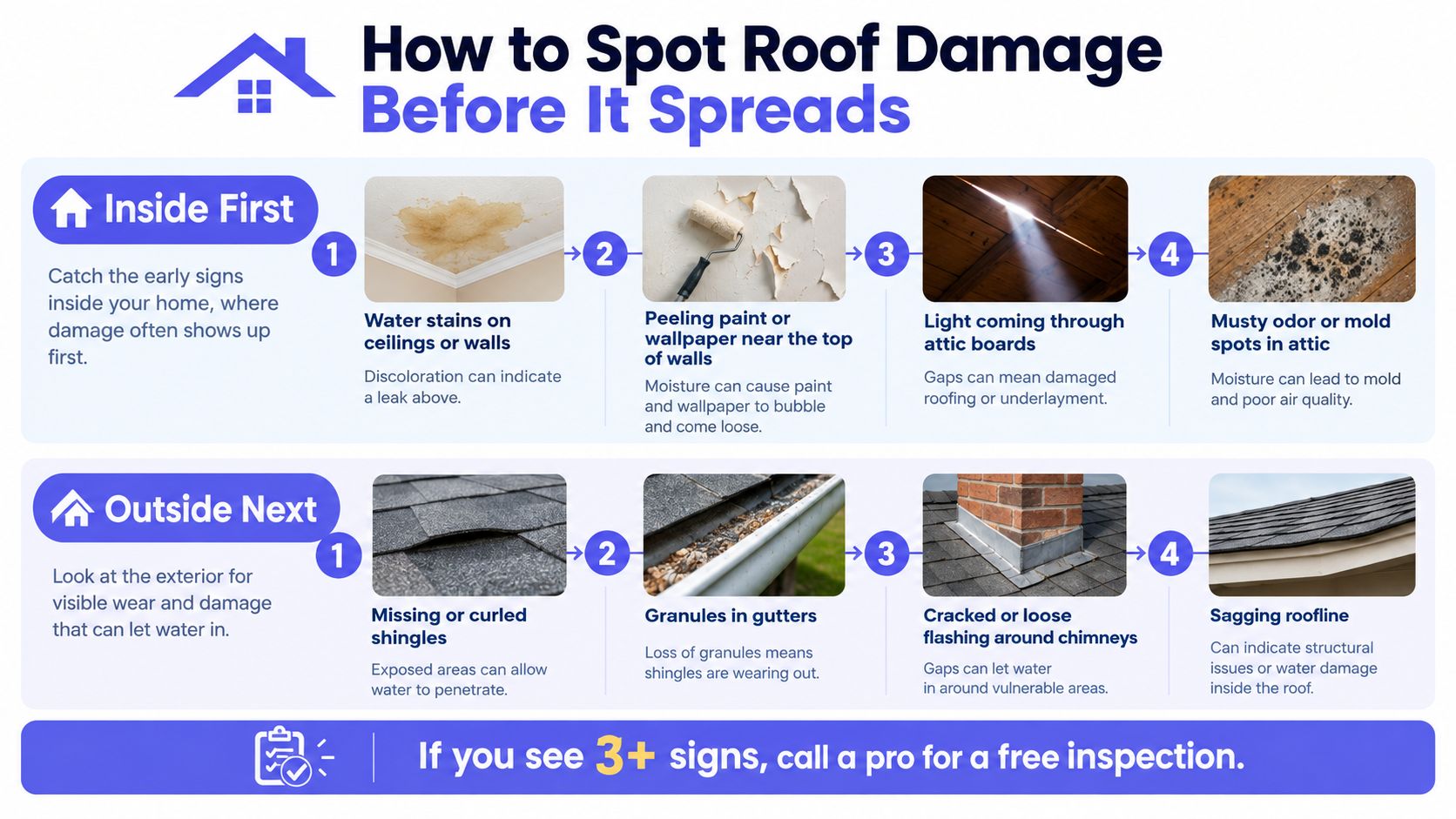
Start indoors. You don't need to climb a ladder to find useful clues, and interior evidence can help you describe the problem before a professional arrives.
Inside first
Look at ceilings, upper walls, and the attic if you can enter it safely.
- Water stains: Yellow, brown, or spreading marks on ceilings and walls often indicate water intrusion, even if the surface feels dry.
- Peeling paint or wallpaper: Blistering, bubbling, or flaking near the top of a wall can point to moisture behind the finish.
- Daylight in the attic: Light passing through roof boards means there's an opening that shouldn't be there.
- Musty odors or mold spots: A damp smell can reveal moisture that hasn't produced a visible ceiling stain yet.
Use a flashlight rather than relying on a phone light. Look for darkened wood, damp insulation, rusted fasteners, and trails that show where water may have traveled. Don't press on soft roof decking, and don't enter an attic if the floor structure is unsafe.
Outside next
A ground-level inspection can reveal obvious trouble without putting you at unnecessary risk. Walk around the property after the roof is dry and look for:
- Missing or curled shingles: Gaps, lifted edges, and curled tabs expose the layers beneath.
- Granules in gutters: Loose granules can indicate surface wear, especially when they appear alongside bare-looking shingle areas.
- Cracked or loose flashing: Check visible flashing around chimneys, roof edges, vents, and wall intersections.
- A sagging roofline: A dip or droop may indicate a structural or decking problem and deserves prompt professional attention.
Safety boundary: A visual check is useful. Walking a steep, wet, fragile, or visibly sagging roof is not.
A few loose shingles after one wind event may call for a focused inspection. Multiple signs, recurring leaks, widespread granule loss, or visible sagging justify a professional assessment. Take photographs from safe locations, record when you first noticed the issue, and keep storm dates or maintenance records with the file.
What Causes Roof Damage and How Long Your Roof Should Last
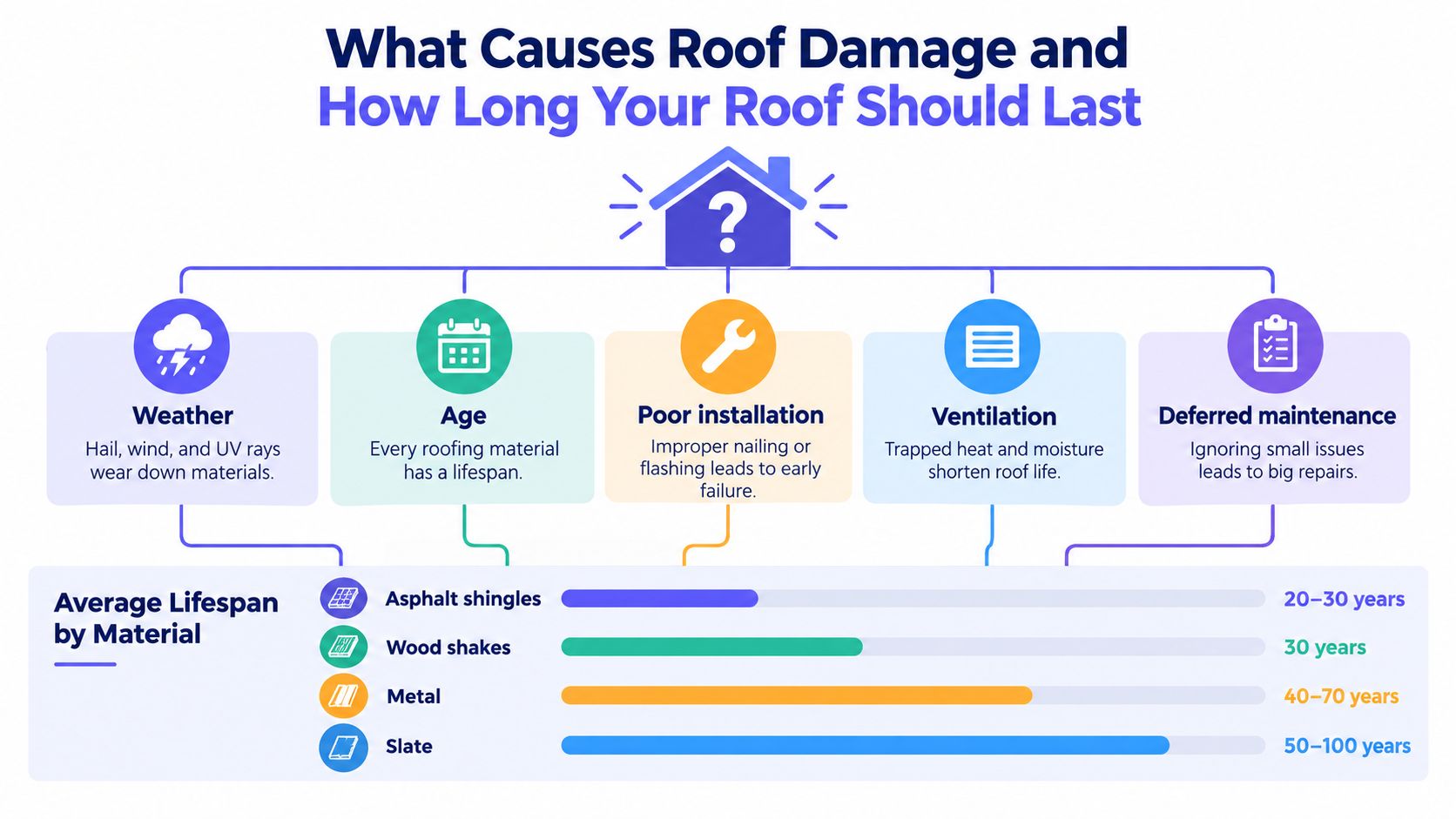
Roof failure usually has more than one cause. A storm may expose a weakness created by age, poor installation, trapped moisture, or deferred maintenance.
Five common drivers
Weather attacks the outer surface first. Hail can bruise shingles, wind can lift or remove them, and ultraviolet exposure gradually weakens roofing materials. Severe weather also creates insurance-related demand because one event can affect many properties in the same area.
Age changes the repair calculation. A replacement may be economically sensible on a roof that has already provided most of its expected service, while the same defect might justify repair on a newer roof.
Poor installation creates hidden weaknesses. Incorrect nailing, badly fitted flashing, poor underlayment details, and weak ventilation paths can cause leaks before the visible roofing material looks worn.
Ventilation problems trap heat and moisture. That environment can shorten material life and increase the likelihood of deterioration in the roof assembly.
Deferred maintenance allows small openings to become larger failures. A missing shingle, blocked drainage path, or deteriorated flashing may be manageable early and much more expensive after repeated wetting.
Material changes the answer
Standard 3-tab asphalt shingles are commonly assigned a service life of about 20 years, according to the roof lifespan summary referencing InterNACHI and the NAHB/Bank of America study. Architectural asphalt shingles are listed at about 30 years, while metal roofing is listed at 40 to 80 years, slate at 60 to 150 years, and clay or concrete tile at 100 years or more in Owens Corning's material lifespan guidance.
These figures aren't guarantees. Climate, installation quality, ventilation, maintenance, and storm exposure all change actual performance. Still, they provide a useful reference point: a localized leak on a younger architectural asphalt roof is a different financial problem from repeated leaks on an aging 3-tab roof.
Historically, roofing moved from materials such as thatch and clay tile toward asphalt shingles, fiberglass, slate, and metal. Asphalt shingles became the dominant modern residential standard during the 20th century, which helped formalize common inspection methods, repair techniques, and insurance documentation.
How Much Roof Repair Costs and When Replacement Makes More Sense
Roof repair has no single price because the word covers very different jobs. A spot fix may involve one damaged area, while structural work can require removal of roofing materials, replacement of decking, and correction of the underlying cause.
Current pricing guides place the national average around $1,150, with a typical range of about $350 to $1,900 for most repairs, according to HomeAdvisor's roof repair cost guide. Other repair-cost guidance places minor spot fixes around $150 to $500, while serious structural or emergency work can reach $3,000 or more, as described by Prequalify Roof's repair cost guide.
Roof Repair Cost Tiers and Replacement Comparison
| Repair Scope | Typical Cost Range | When It Fits |
|---|---|---|
| Minor spot fix | $150 to $500 | A localized issue such as limited shingle or flashing work, when surrounding materials remain sound |
| Typical repair | $350 to $1,900 | A contained leak or broader repair that doesn't require replacing the full roof system |
| National repair average | Around $1,150 | A planning benchmark, not a guaranteed quote |
| Structural or emergency repair | $3,000 or more | Damage involving decking, framing, difficult access, or urgent stabilization |
| Average residential roof repair | $4,699 in 2025 | A broader Verisk cost measure that reflects residential repair spending |
| Average residential roof replacement | $17,631 in 2025 | A comparison point when full replacement is under consideration |
The last two figures come from Verisk's roofing reality check. They describe average residential costs, not a promise that your project will match them. Local labor, materials, roof design, access, damage severity, and insurance conditions all affect a quote.
Use age and scope together
Repair usually makes more sense when damage is localized, the roof is comfortably within its expected service life, and the surrounding shingles, underlayment, decking, and flashing remain serviceable.
Replacement deserves serious consideration when leaks appear in several areas, materials are broadly deteriorated, the roof is near the end of its expected life, or repeated repairs keep addressing symptoms instead of the underlying system. A low repair quote isn't automatically good value if it only postpones a larger project.
For a focused comparison of the decision, use this roof repair versus replacement guide. Ask the professional to show you the damaged area, explain what remains sound, identify the cause, and price both the immediate repair and any recommended longer-term work.
What Happens During a Professional Roof Repair
A sound repair starts before anyone removes a shingle. The professional should establish what failed, record the condition, and explain whether the work addresses the source or only the visible symptom.
Inspection and documentation
The technician examines the roof surface, penetrations, flashing, drainage paths, attic conditions, and any interior damage. Photos should show both close-up defects and wider context, so you can connect the reported issue to the roof area and understand what the estimate covers.
For a potential insurance claim, keep your own photographs and notes. Record the date you noticed the damage, the weather event if relevant, temporary actions such as tarping, and any water damage inside the property.
Estimate and material matching
A useful estimate identifies the affected area, proposed materials, labor, cleanup, warranty terms, and exclusions. It should also explain whether the repair includes flashing, underlayment, decking, sealants, or ventilation corrections when those components contributed to the failure.
Matching matters for both appearance and performance. Roofing professionals may need to identify the existing shingle profile, color, manufacturer, and weathering level. A perfect visual match may not be possible on an older roof, so ask how the finished area will look and whether the proposal includes a practical transition.
Execution and verification
The crew removes damaged materials carefully, corrects the underlying issue, installs compatible replacement materials, and seals or fastens them according to the roof system. Cleanup should include loose debris, packaging, and a check of accessible gutters and surrounding areas.
Traditional on-site repairs are typical, but some companies use drone photographs, satellite measurements, and remote consultations for early assessment. These tools can help with documentation and measurement, but they don't eliminate the need for an on-site visit when the problem involves structural damage, concealed moisture, difficult details, or uncertain material condition.
What you should receive: A clear scope, dated photographs, material information, warranty details, and a final explanation of what was repaired.
DIY vs Professional Repair Insurance and Timeline Realities
You can handle observation and basic documentation yourself. You can photograph stains, collect fallen shingle pieces, clear leaves from accessible ground-level drainage areas, and place a container under an active interior drip. You shouldn't walk a steep or wet roof, disturb suspected structural damage, or attempt work that could affect a future claim or material warranty.
A professional is especially important when the roof is sagging, the leak keeps returning, damage is widespread, or the source isn't obvious. The risk isn't limited to the climb. An incorrect repair can redirect water, hide deterioration, or leave the actual entry point untouched.
Insurance changes the sequence
If a storm may have caused the damage, document the condition before making non-emergency changes. Take wide and close photographs, save invoices for temporary protection, and notify the insurer according to your policy. Don't authorize a full replacement solely because someone says the roof is damaged, and don't reject a claim based only on a contractor's opinion.
Recent industry reporting describes carriers retreating from high-risk hail and wind markets, which makes policy language, deductibles, exclusions, inspection records, and claim timing more consequential in storm-prone areas. You can review practical claim considerations in this guide to insurance claims for roof damage.
Build a realistic timeline
The process usually moves through inspection, documentation, estimate, approval, material sourcing, repair, and final verification. The exact timing depends on weather, access, damage severity, material availability, insurer involvement, and whether hidden damage appears after removal.
Ask three direct questions before approving work:
- What happens first: Will the professional inspect before recommending repair or replacement?
- What could change the quote: Does the estimate explain conditions that would add work, such as damaged decking?
- What protects the property meanwhile: Will the team provide temporary stabilization if the roof can't be repaired immediately?
That sequence keeps an urgent leak from turning into an unplanned financial commitment.
How to Find and Vet a Qualified Roofing Professional
Price matters, but it's only useful after you know who is offering the work. Start with four checks that protect both the project and your claim file.
- Active licensing: Verify the license with the relevant state or provincial authority, and confirm the license covers the work being proposed.
- Background screening: Ask whether the business screens owners and operators, not just temporary workers.
- Recent 4.5+ star ratings: Look for a meaningful pattern of recent reviews rather than one unusually positive comment.
- Human review: Confirm that someone has assessed the business and the project fit instead of sending your contact details through an automated lead exchange.
Ask for a written estimate that separates labor, materials, disposal, temporary protection, and possible exclusions. A professional should explain the cause of damage in plain language, show photographs, identify whether repair or replacement is being recommended, and provide warranty terms before work starts.
You can also check whether the company carries appropriate insurance and whether its proposal names the materials clearly. Avoid pressure to sign immediately, vague scopes, cash-only demands, and estimates that don't explain what happens if concealed damage appears.
Learn how to find a good roofer and compare the answers you receive. Hand Vetted Co. offers one verified professional match for a roofing project, with licensing, background screening, ratings, and human review completed before the introduction.
If you're dealing with a new leak, photograph it today, check the roof's age and material, and request an inspection that distinguishes localized damage from end-of-life deterioration. Visit Hand Vetted Co. to describe your roof repair needs and receive one exclusive match with the project details already shared.