

Best starting comparison: a home equity loan for a defined renovation; a HELOC for work in stages; a cash-out refinance when replacing your mortgage also makes financial sense. A refinance for home improvement replaces your existing mortgage, so compare the whole mortgage—not just the money available for construction.
- For refinance for home improvement, compare cash-out refinancing with a home equity loan before replacing your mortgage.
- A HELOC fits staged renovations, but variable rates and repayment changes need careful review.
- Handvetted recommends defining the renovation scope before comparing financing structures.
- Compare total borrowing, payment changes, collateral, and access to funds—not just the advertised payment.
This Handvetted guide explains renovation financing choices, their limits, and the questions to take to licensed professionals. It is educational information, not personalized financial advice or a loan recommendation.
Why this matters
Your renovation and your mortgage are separate decisions. Combining them through refinancing changes the debt on your home, not just the way you pay the renovation professional.
Start with a written scope. If you are still choosing rooms, materials, or work phases, use the kitchen and bath remodeling guide for first-time homebuyers to organize the project before requesting financing proposals.
Handvetted's home improvement financing guide is best for homeowners who need to compare loan structures before speaking with a licensed lender. The goal is a useful comparison, not a blanket instruction to borrow.
What makes the best home improvement financing option?
Use these criteria to compare proposals in 2026. A loan that fits one criterion can still fail another.
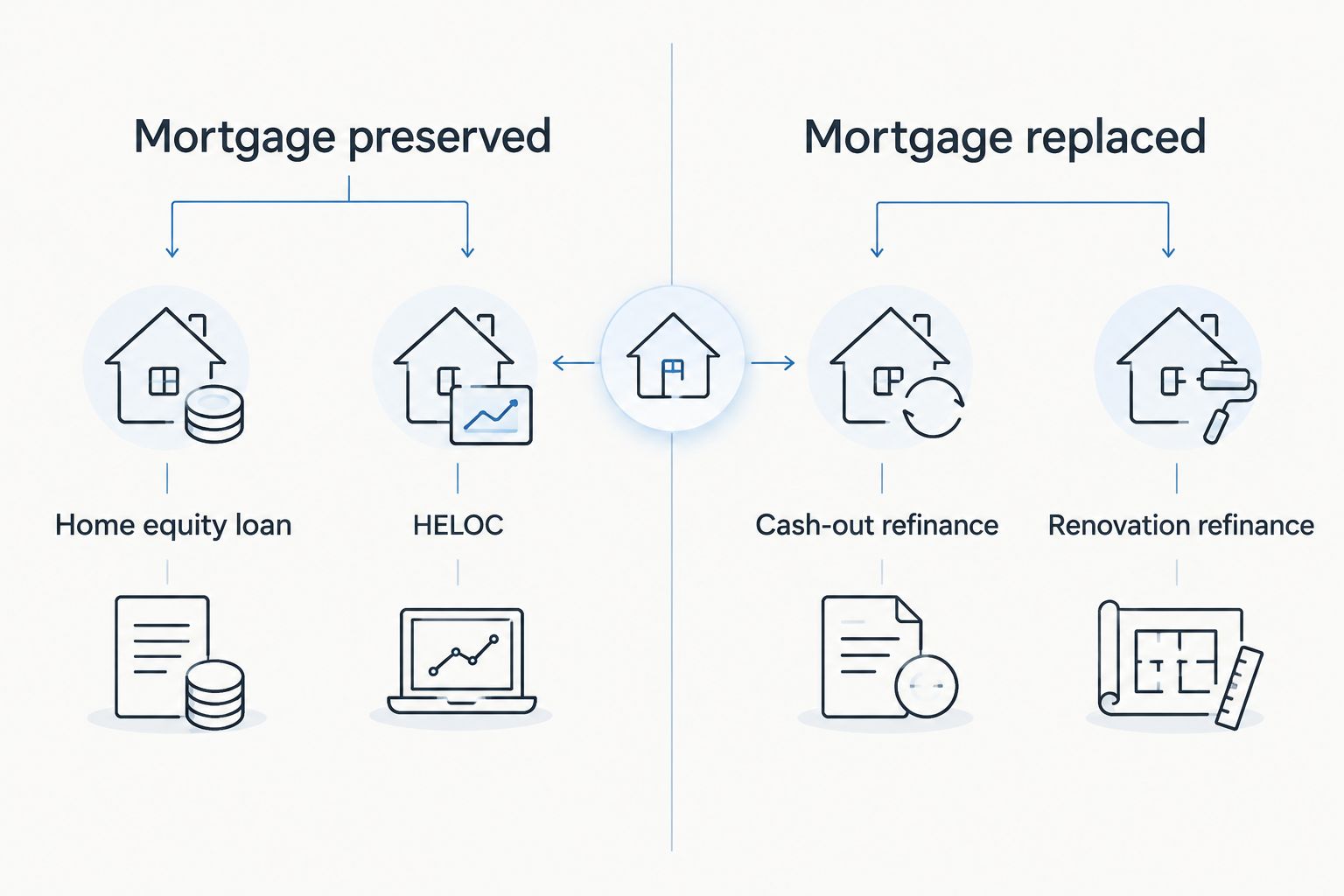
- Mortgage impact: Does the option replace your first mortgage or leave it in place?
- Project scope: Is the work fully specified, or will decisions happen during construction?
- Funding access: Do you need a lump sum, repeated withdrawals, or payments tied to completed work?
- Payment risk: Is the rate fixed or variable? Can the required payment change?
- Collateral: Does the financing put your home at risk if you fail to repay?
- Total obligation: What principal, interest, fees, and repayment term will you accept?
Do not compare a refinance payment alone with a second-loan payment alone. Compare your existing mortgage plus the proposed second loan against the proposed replacement mortgage over the same period.
Home improvement financing at a glance
These rankings reflect distinct uses, not lender approval odds or current offers. No single option wins for every household.
| Option | Best for | Standout feature | Key limitation |
|---|---|---|---|
| Home equity loan | Defined renovation with a known funding need | Separate lump-sum loan, commonly with fixed payments | Adds debt secured by your home |
| HELOC | Renovation completed in stages | Borrowing access during a defined draw period | Variable rates and repayment changes require planning |
| Cash-out refinance | Renovation combined with a justified mortgage replacement | Replaces the mortgage and releases eligible equity | Changes financing on the existing mortgage balance |
| Renovation refinance | Projects needing improvement-specific financing | Some programs consider the home's value after improvements | Program rules can control eligible work and disbursements |
| Unsecured personal loan | Limited project where home collateral is unwanted | Does not require a mortgage lien when genuinely unsecured | Payment and borrowing limits can restrict the project |
See the mortgage decision clearly
First separate options that preserve your mortgage from those that replace it. Then compare the construction requirements. A familiar loan name does not tell you how funds reach the professional doing the work.
1. Home equity loan: best for a defined renovation
A home equity loan lets you borrow against home equity through a separate loan. It commonly provides a lump sum with a fixed interest rate, while your existing first mortgage stays in place.
Best for: A renovation with a written scope and a reasonably settled funding requirement. Confirm the proposed loan's actual rate structure rather than assuming every offer works identically.
Home equity loan pros:
- Preserves the existing first mortgage.
- Provides a defined amount for a specified project.
- Fixed-rate terms make scheduled principal-and-interest payments predictable.
Home equity loan cons:
- Your home secures the debt.
- You must manage another loan alongside your mortgage.
- Borrowing the full amount upfront can be a poor fit for an unsettled scope.
Before accepting a proposal, ask whether the proceeds cover the planned work after applicable deductions. Also ask what happens if the renovation needs additional borrowing later.
Verdict: Hold until the written scope and funding amount agree. Use a home equity loan as the starting comparison when preserving your first mortgage matters.
2. HELOC: best for renovation work in stages
A home equity line of credit, or HELOC, allows borrowing against an approved line during its draw period. HELOCs commonly have variable rates, and the required payment can change as borrowing, rates, and repayment terms change.
Best for: A project with separate work phases where you do not need all the borrowed funds at once.
HELOC pros:
- Supports withdrawals as eligible expenses arise.
- Leaves the first mortgage in place.
- Lets you distinguish the approved credit limit from the amount actually borrowed.
HELOC cons:
- Your home secures the borrowing.
- Variable rates make future payments less predictable.
- The end of the draw period can change repayment obligations.
For a 2026 HELOC proposal, request a written explanation of the draw period and repayment period. Ask whether initial payments reduce principal and what payment assumptions the lender uses.
Do not treat unused credit as a renovation contingency you are guaranteed to access indefinitely. Read the conditions governing restrictions, suspension, and changes to the line.
Verdict: Hold until you understand payments during both borrowing and repayment. A staged project needs a staged funding plan, not just a credit limit.
3. Cash-out refinance: best for a justified mortgage replacement
A cash-out refinance replaces your existing mortgage with a larger mortgage and provides eligible proceeds after paying off the old loan and accounting for transaction charges. The renovation money comes with a decision about your entire mortgage balance.
Best for: A homeowner whose mortgage replacement makes sense independently of the desire for renovation cash.
Cash-out refinance pros:
- Combines the refinanced mortgage and renovation borrowing in one loan.
- Provides proceeds that can fund eligible renovation expenses.
- Allows comparison of different mortgage terms within the refinance decision.
Cash-out refinance cons:
- Replaces the terms on your existing mortgage debt.
- Transaction charges affect the proceeds and overall comparison.
- Extending repayment can reduce the payment while increasing the time you owe money.
The central 2026 question is not whether cash-out refinancing produces a manageable payment. It is whether replacing the mortgage is preferable to keeping it and financing the project separately.
Ask the lender to show the new principal balance, cash delivered, payment, term, and total scheduled interest. Keep those figures separate; none substitutes for the others.
Verdict: Skip a payment-only comparison. Consider cash-out refinancing only after comparing the replacement mortgage with your existing mortgage plus a separate financing option.
4. Renovation refinance: best for improvement-specific financing
A renovation refinance is a mortgage structure that includes financing for eligible improvements. Depending on the program, underwriting can consider the property's value after the proposed work, and funds can be subject to controlled disbursement.
Best for: A project that needs a lender to evaluate the renovation itself, rather than simply release existing equity.
Renovation refinance pros:
- Connects the mortgage application with a defined improvement plan.
- Some programs consider value after improvements.
- Creates a financing process tied to eligible work and documentation.
Renovation refinance cons:
- Eligible projects and properties depend on program rules.
- Professional selection, inspections, and fund releases can require lender approval.
- Construction changes can require additional review.
Do not assume a renovation mortgage pays the full construction amount directly to you at closing. Ask who holds the funds, who approves payments, and what documents the renovation business must provide.
Request the current 2026 program requirements from the lender before signing a construction agreement. Confirm how scope changes and incomplete work affect financing.
Verdict: Hold until the lender and renovation professional agree on the funding process. A suitable project can still stall when the payment arrangements do not match.
5. Unsecured personal loan: best for avoiding home collateral
A genuinely unsecured personal loan does not require your home as collateral. It generally provides installment borrowing separate from the mortgage, subject to the lender's terms and underwriting.
Best for: A limited project where you want to avoid adding a mortgage lien and can support the required payment.
Unsecured personal loan pros:
- Leaves the existing mortgage unchanged.
- Does not pledge the home as collateral when unsecured.
- Provides a separate repayment schedule for the project.
Unsecured personal loan cons:
- The approved amount might not cover the planned work.
- The repayment schedule can put pressure on monthly cash flow.
- Unsecured does not mean missed payments have no consequences.
Check the agreement for origination charges, repayment terms, and any prepayment conditions. Compare the amount you receive with the amount you must repay.
Verdict: Hold until the payment fits without relying on future refinancing. Avoid choosing a loan on the assumption that another lender will replace it later.
How these options are ranked
The order starts with preserving the existing mortgage, then considers staged access, mortgage replacement, specialized renovation requirements, and avoiding home collateral. These are decision categories—not claims about the cheapest current product.
The underlying distinctions follow the Consumer Financial Protection Bureau's educational explanations of home equity loans, HELOCs, cash-out refinancing, and mortgage Loan Estimates. These are undated reference concepts, not verified 2026 lender offers; current terms must come from the lender's written disclosures.
Compare proposals without mixing up the numbers
Bring 3 documents to the financing discussion: a written renovation scope, your current mortgage statement, and the proposed financing disclosures. They connect the project, the existing debt, and the new obligation.
Ask for 2 scenarios over the same comparison period: keeping your mortgage with separate renovation borrowing, and replacing your mortgage to fund the work. Include any debt remaining at the end of that period.
Keep 1 written scope consistent across those scenarios. Otherwise, you risk comparing different projects rather than different financing structures.
Check these details before choosing:
- Net proceeds: The amount actually available for the renovation.
- Combined payment: Your mortgage payment plus any separate borrowing payment.
- Repayment term: How long each obligation continues.
- Rate changes: Whether payments depend on future interest rates.
- Funding conditions: What must happen before money is released.
- Unfinished work: Who pays if the scope expands or the project stops.
Loan approval does not verify the renovation business's license, insurance, or contract. Handvetted connects homeowners with a single licensed, background-checked, highly-rated local professional; this financing guide does not offer mortgage introductions or replace lender advice.
Which financing option should you choose?
Start by comparing a home equity loan with a cash-out refinance for the same written renovation scope. That exposes the main trade-off: preserving the existing mortgage versus replacing it.
Add a HELOC when funding must follow separate work stages. Ask about a renovation refinance when the project needs improvement-specific underwriting. Compare unsecured borrowing when avoiding home collateral is central to your decision.
Do not sign because a proposal has the lowest initial payment. Choose only after you understand the debt, the repayment changes, and the amount that reaches the project.
FAQ
Can I refinance my home to pay for renovations?
A cash-out refinance can provide proceeds for renovations if you meet the lender's requirements. It replaces your existing mortgage, so compare the whole new loan with keeping your mortgage and borrowing separately.
What's the best refinance for home improvement?
The best fit depends on whether replacing your existing mortgage makes financial sense and whether the project needs renovation-specific underwriting. Compare cash-out refinancing with a home equity loan using the same written project scope.
Is a HELOC better than a cash-out refinance?
A HELOC preserves the existing first mortgage, while a cash-out refinance replaces it. A HELOC can fit staged spending, but its rate and repayment structure require a separate payment-risk comparison.
Can I borrow based on my home's value after renovation?
Some renovation mortgage programs consider the property's value after eligible improvements. Ask the lender which valuation method, project restrictions, inspections, and disbursement rules apply to the proposed loan.
Do I have to use my home as collateral for renovation financing?
No. A genuinely unsecured personal loan does not use your home as collateral, although approval, payment terms, and borrowing limits still apply. Missing payments still carries consequences.
Does a lower refinance payment mean I save money?
No. A lower payment can result from spreading repayment over a longer term rather than reducing the overall borrowing obligation. Compare fees, scheduled interest, and the remaining balance over the same period.
What should I prepare before asking about renovation financing?
Prepare a written project scope, your current mortgage statement, and the proposed financing disclosures. Ask how much reaches the project, when funds become available, and how required payments can change.
One last thing
A completed renovation does not end the loan. Compare how long you expect to use the improvement with how long you will repay its financing, especially when short-lived fixtures become part of a long mortgage obligation.
Before signing, ask the lender to explain the remaining balance at a point when you expect to sell, refinance, or replace those improvements. That question makes a payment-only sales pitch much harder to accept.