You're trying to hire a roofer while juggling a leak, a tarp, and a calendar that won't stop moving. That's exactly when bad decisions get expensive. The right move is to slow down just enough to verify the people, the paperwork, and the scope before anyone starts tearing off shingles.
Table of Contents
- First Steps Define Your Roofing Project Scope
- Finding and Shortlisting Potential Roofing Pros
- The Essential Vetting Checklist License Insurance and Reputation
- How to Compare Bids and Interview Candidates
- Reviewing the Contract and Warranty Fine Print
- Project Kickoff and Spotting Contractor Red Flags
First Steps Define Your Roofing Project Scope
Start with the roof you have, not the one you think you might need. A repair and a replacement are different jobs, with different risks, timelines, and ways to compare bids. If you skip this step, you'll invite vague estimates that sound similar but mean very different things, and that's where people get burned.
Know what you're asking for
Look at the roof type, the age, the visible damage, and the parts that matter most to you, like color, durability, or how long you plan to stay in the property. If the issue is localized damage, a targeted repair may be the right conversation. If the roof is failing in more than one area, replacement starts to make more sense.
Use the roof repair vs replacement guide to sharpen the conversation before you talk to anyone. You don't need to become a roofing specialist. You do need enough clarity to tell whether a bid is realistic or just broad enough to hide problems.
Set preferences before you request pricing
Decide whether you want to stay with similar materials or change the system. Asphalt shingles, metal, and other common options aren't interchangeable in price or installation demands, so be explicit about your preference. A roofer can only price what you describe clearly.
Practical rule: if you can't explain your project in two or three plain sentences, you're not ready for quotes yet.
Budget works the same way. You don't need an exact final number, but you do need a range that reflects the roof size and the material direction you're considering. That gives you a filter for spotting bids that are too vague, too low, or padded with extras you never asked for.
A good scope statement is simple. It says what you want fixed, what you want replaced, what material family you prefer, and what details must appear in every bid. That one page of clarity saves more money than you realize, because it prevents the contractor from filling in the blanks for you.
Finding and Shortlisting Potential Roofing Pros
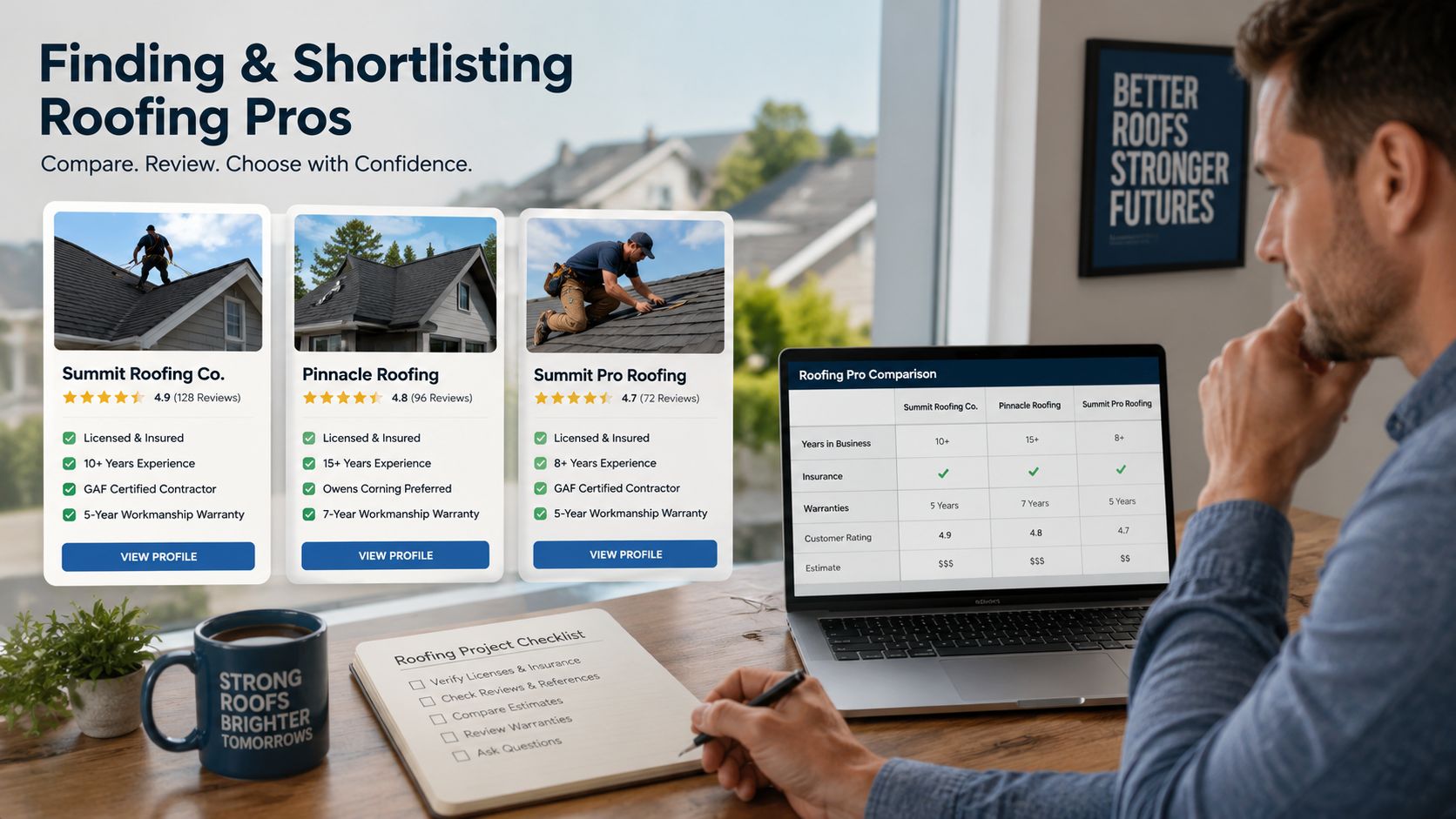
The old method was simple, ask around and trust whoever had been around the longest. That still matters, but it's not enough on its own. The smarter approach is to combine local referrals, recent online reviews, and a quick screening of credentials so you don't waste time on people who look busy but aren't a fit.
Build a short list from more than one source
Referrals from neighbors, friends, local suppliers, and trade groups still have value because they show real-world experience. Online searches add volume and speed, but they also add noise. A matching platform can reduce that noise further when you want one verified option instead of juggling a pile of unproven names.
I'd keep the shortlist tight, around 3 to 4 candidates, and treat that as enough. More than that usually turns into busywork, not better decision-making. You're trying to find the most reliable fit, not collect business cards.
Read reviews like a buyer, not a spectator
Recent reviews matter more than lifetime volume because current service is what you're buying. The most useful pattern is consistency, not a single burst of praise. If the last few months show steady, specific feedback, that tells you more than a long history padded by old reviews.
The best screening habits also include manufacturer credentials and operating history. Guidance points to looking at review recency, credentials such as GAF Master Elite, and a track record that shows the business has been operating for a meaningful stretch, not just showing up after a storm. That doesn't guarantee quality, but it does separate stable businesses from fly-by-night outfits. Inspectapedia's roofing contractor selection guide makes the shift clear, people are relying less on years in business alone and more on recent reviews and certifications.
If a business looks polished online but has no clear local footprint, keep moving.
Use a simple filter before you call
Look for a physical office, recent local work, and enough visible reputation to suggest they can still be reached after the job is done. That's especially important if warranty support matters to you. The point isn't to find the loudest marketing. The point is to find a real company you can hold accountable.
The Essential Vetting Checklist License Insurance and Reputation
This is the part homeowners rush, and it's the part that protects you most. A roofer can sound credible on the phone and still be a poor hire if the license is stale, the insurance is thin, or the review profile is weak. Don't treat those as formalities. Treat them as the minimum bar.
Verify the license yourself
Start with the state board, not the roofer's brochure. You want an active license, the right license type for residential roofing, and no obvious disciplinary issues. If the license can't be confirmed directly, stop there.
The reason is simple. A license tells you the business is visible to regulators, not just to sales staff. It also gives you a real identity to check if something goes wrong later. A contractor who resists that check is giving you a preview of how they handle accountability.
Check insurance like you mean it
Ask for proof of general liability and workers' compensation, then verify the certificate directly with the insurer. Don't accept a PDF as proof on its own. The certificate tells you what the contractor claims, not necessarily what's active today.
One practical benchmark used in industry guidance is at least $1 million per occurrence in general liability coverage, plus workers' comp. That matters because roofing is high-risk work, and underinsured crews can turn a routine project into a claims mess. A contractor who can't produce active coverage is not ready to be on your property. The Roofing Brief explains why license and policy verification should happen before hiring.
Judge reputation by proof, not slogans
A strong review profile should show more than a few glowing comments. One independent guide recommends looking for at least 50 verified reviews with a 4.5+ star average to show meaningful recent customer feedback. That's a useful screen because it signals enough volume to see patterns, not just lucky snapshots. RoofVista's contractor guide ties those benchmarks to basic professional and financial stability.
Use local references too. A real roofer should be able to point you to work that you can verify, and they should have a physical office you can confirm. Hand Vetted's contractor background check page fits well here if you want a faster way to narrow down a verified option without doing every check from scratch yourself.
Bottom line: no license, no active insurance, no serious review history, no hire.
How to Compare Bids and Interview Candidates
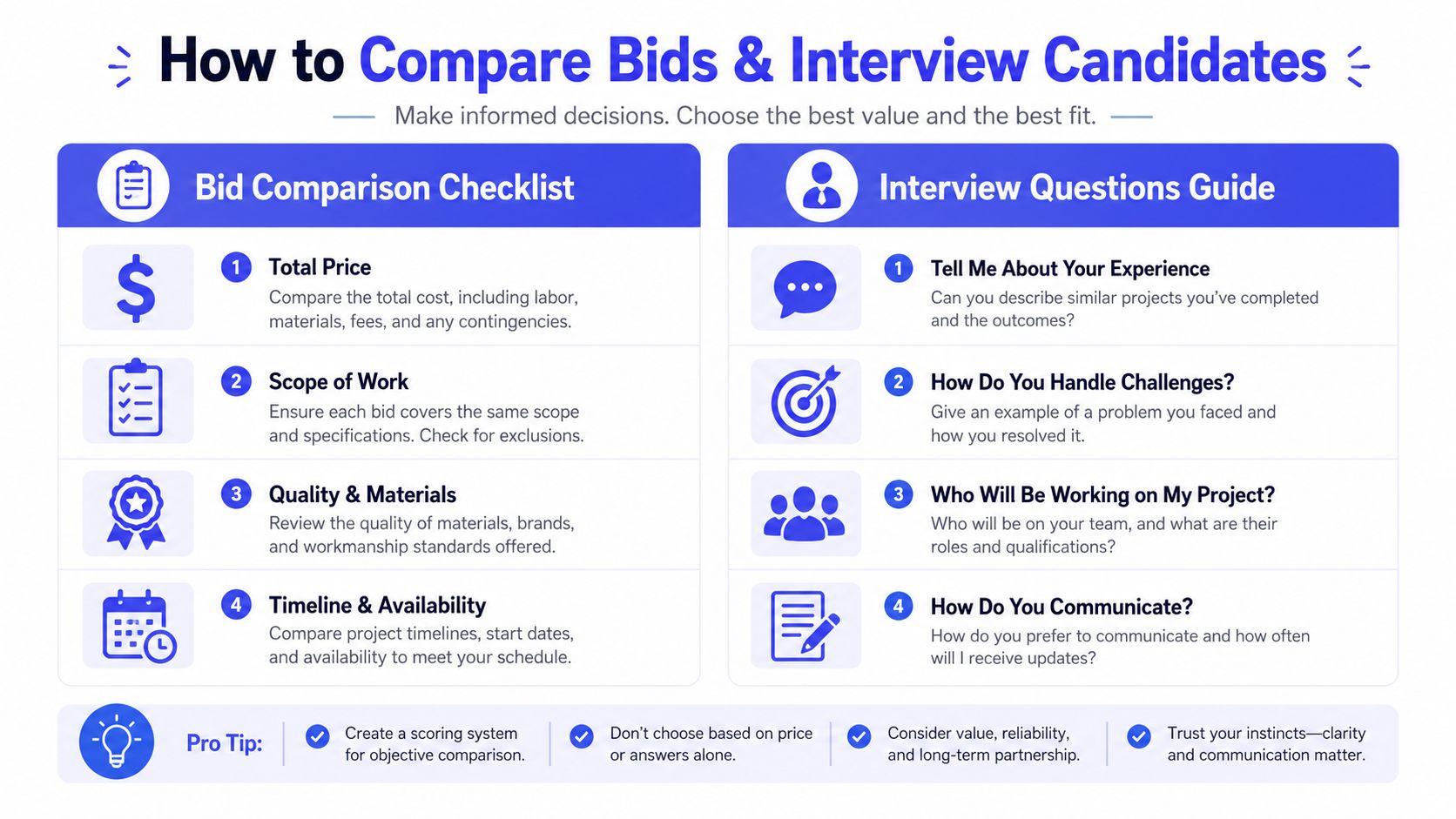
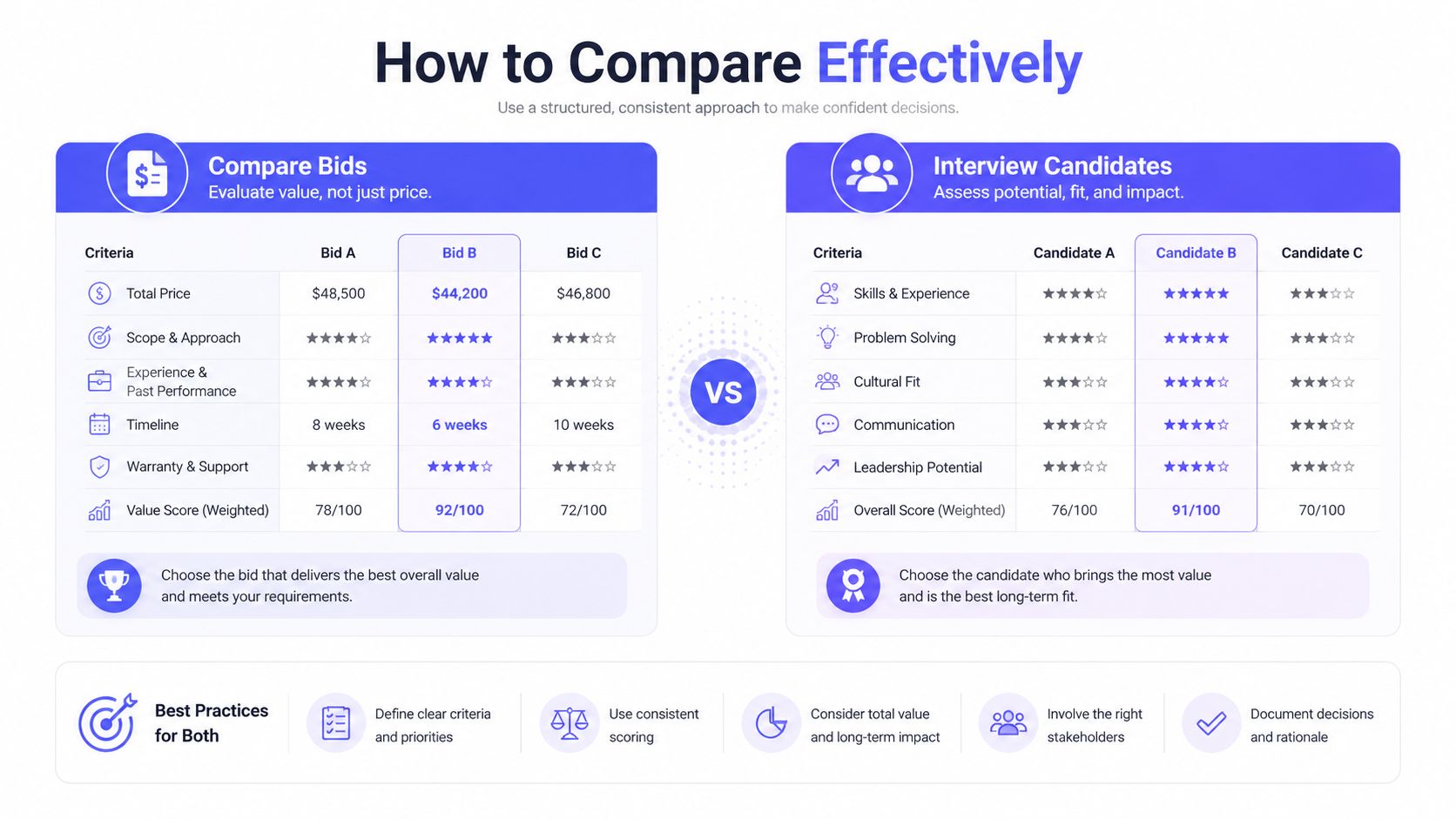
Once you've screened the obvious bad fits, the next mistake is chasing the lowest number. That is how people end up with missing line items, cheap materials, or surprise costs after work starts. You want three written bids, and you want them in a format you can compare without guessing.
Use the what to ask a contractor guide to prepare your interview questions before you start calling candidates.
Treat three bids as the baseline
California's Contractors State License Board says to compare at least three bids, and that is the right benchmark. With three written offers, you can see which one is oddly low, which one leaves out scope, and which one is clearer. The CSLB roofing contractor guide makes the logic plain, do not let one quote decide the job.
A good bid is more than a number. It should show the same scope, the same materials, and the same assumptions across all three offers. If one quote looks cheaper, the first question is never “Can they do it for less?” It is “What did they leave out?”
Ask direct questions in the interview
Ask who will supervise the crew, what brand and type of materials they use, how they handle cleanup, and what happens if they find damage under the existing roof. Ask how they protect landscaping, where they stage materials, and whether they use employees or subcontractors. These are practical questions, not small talk.
Practical rule: a solid roofer answers clearly without getting defensive or vague.
Use the conversation to test how they think, not just how they sell. A professional explains the work in plain language and can tell you where problems usually come up. A weak candidate talks around details and hopes the price distracts you.
Compare apples to apples
Line up the bids side by side and check for scope, materials, labor, cleanup, and schedule. If one bid is thin on detail, that is not efficiency, that is risk. The bid should tell you what is included and what is excluded so you can make a fair comparison.
The phrase “too good to be true” exists for a reason. CertainTeed warns that a suspiciously low estimate can hide fees or lower-quality materials, and that is exactly the trap to avoid. If a roofer will not write it down, do not assume they will honor it later.
Reviewing the Contract and Warranty Fine Print
A handshake is not a roof contract. If work starts before the agreement is signed, you've already given away your position. The contract is what turns a sales pitch into something you can enforce.
Demand the full written scope
The document should spell out the job in plain English. That means the materials, the labor, the cleanup, the payment amounts, the schedule, and the safety and liability terms. If it just says “roof replacement,” it's too weak to protect you.
Bob Vila is blunt on this point, and rightly so. Never allow work to begin without a signed, written contract that details the job, including safety procedures, liability, workers' compensation, clean-up methods, payment amounts, and a clear schedule. Bob Vila's roofing contractor guide puts the burden where it belongs, on paper before the first shingle comes off.
Read warranty language as a risk document
A warranty only matters if you know what it covers. Materials and labor are not the same thing, and they shouldn't be treated that way. A materials warranty may still leave you exposed if the installation was sloppy, while a workmanship warranty tells you what the roofer stands behind.
Look for language that names who handles claims, how long coverage lasts, and what voids the protection. If the wording is fuzzy, assume you'll have a hard time using it later. That's not pessimism, it's how warranty disputes usually start.
A written contract is useful only if it's specific enough to settle a disagreement without interpretation.
Watch for missing details before you sign
If the payment schedule is unclear, push back. If the cleanup plan is vague, push back. If the contract doesn't say exactly what's excluded, push back harder.
The best contract is boring. It leaves little room for surprise and even less room for argument. That's the kind of document you want when the weather shifts, the crew changes, or something under the old roof isn't what anyone expected.
Project Kickoff and Spotting Contractor Red Flags
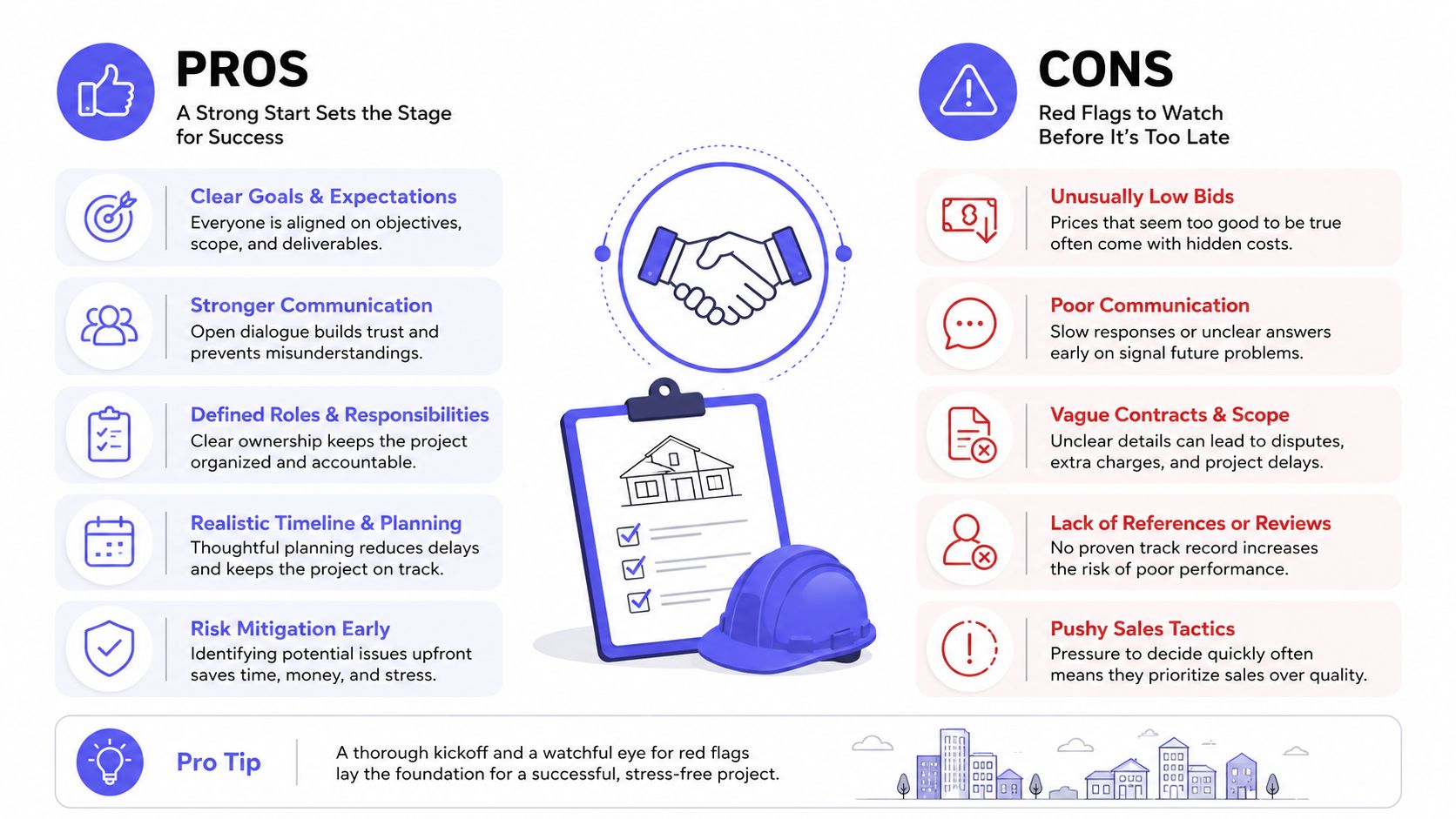
Signing the contract is not the finish line. It is the point where your oversight starts. From here on, you need to watch whether the crew does the work they promised, uses the materials listed in the agreement, and follows the schedule you approved.
Set expectations before the crew arrives
Ask who your main point of contact is, what time the crew starts, how debris gets handled, and how weather delays will be communicated. Those details prevent small problems from turning into arguments later. A solid roofer will answer those questions without attitude. They know it is normal project management.
The first day tells you a lot. If the crew shows up late with no call, drops materials in the wrong place, or seems unsure about the scope, treat that as a warning. You are not looking for flawless behavior. You are looking for discipline, organization, and follow-through.
Spot the red flags early
If someone asks for extra money before the work matches the agreement, stop and verify why. If the materials on site do not match the contract, stop and verify that too. If the person running the job cannot explain what is happening, you are dealing with poor control.
The contractor who stays pleasant until a problem appears is the one to watch most closely. Once trouble starts, some crews get vague, slow, or hard to reach. Local accountability matters because it gives you a real way to follow up. CertainTeed's contractor guidance points to a physical office and recent local jobs as better signs of long-term reach than online ratings alone.
Separate a local business from a storm chaser
Storm chasers rely on urgency. They show up fast, talk fast, and push you to commit before you can compare anything. A legitimate local business is easier to trace, easier to call back, and easier to hold responsible months or years later.
Practical rule: if you cannot find a real office, recent local work, and a stable contact person, do not trust the warranty.
That is the part many homeowners learn too late. A roof is not just a purchase, it is a long-term service relationship. If the company disappears after the job, the warranty is just paper.
If you want a cleaner way to start, use a verified matching service instead of sorting through random calls and storm-season flyers. Visit Hand Vetted Co. and compare that with how much time you would spend trying to prove every roofer's license, insurance, and local track record yourself.