You're probably staring at a rough renovation idea, a budget that feels too low, and a calculator that gives you a suspiciously neat number. That's normal. A home renovation cost calculator is useful, but only if you treat it as a starting point for planning, not a promise.
That matters because renovation demand is high. A 2023 Realtor.com report found that 70% of U.S. homeowners are considering renovation projects, and 18% are renovating to help sell their property (Realtor.com newsroom announcement on its renovation calculator). More people planning work means more people relying on estimates that can miss the hard parts.
Table of Contents
- Why Your Renovation Budget Is Probably Wrong
- The Engine Behind the Estimate
- Ballpark Renovation Costs for Common Projects
- From Abstract Numbers to a Real Project
- The Hidden Costs Calculators Always Miss
- How to Get a Renovation Quote You Can Trust
Why Your Renovation Budget Is Probably Wrong
Most budgets are wrong for one simple reason. People confuse a planning number with a job cost.
A home renovation cost calculator is built to give you a baseline. It helps you answer early questions like whether your project is in minor, mid-range, or major territory, and whether your idea fits your budget at all. That's useful. It's also limited.
The problem starts when that first estimate gets treated like a contractor quote. It isn't one. It can't see layout issues, site access problems, old wiring, hidden moisture, permit friction, or finish choices that look modest online and cost a lot in practice.
Why clean numbers feel more certain than they are
Calculators are attractive because they remove ambiguity. You enter square footage, pick a project type, choose a finish level, and get a number that looks precise enough to plan around.
Practical rule: Use the first estimate to decide whether to move forward, not to decide what the final contract will cost.
That shift matters. If your calculator says the project is broadly affordable, you're ready for the next step. If it already strains the budget, reality usually won't make it cheaper.
What a calculator is actually good at
A good home renovation cost calculator works best for:
- Early budgeting: It tells you whether you're likely planning a cosmetic refresh or a deeper remodel.
- Comparing options: A kitchen, bathroom, and whole-home refresh don't live in the same cost universe.
- Setting scope: It forces you to think about size, quality level, and location before you start calling businesses.
What it doesn't do well is predict the cost of your actual house, your actual walls, and your actual choices.
The estimate is useful because it's incomplete. It gives you a place to start asking better questions.
If you use it that way, it becomes a smart planning tool. If you use it like a fixed price, it becomes the first mistake in the project.
The Engine Behind the Estimate
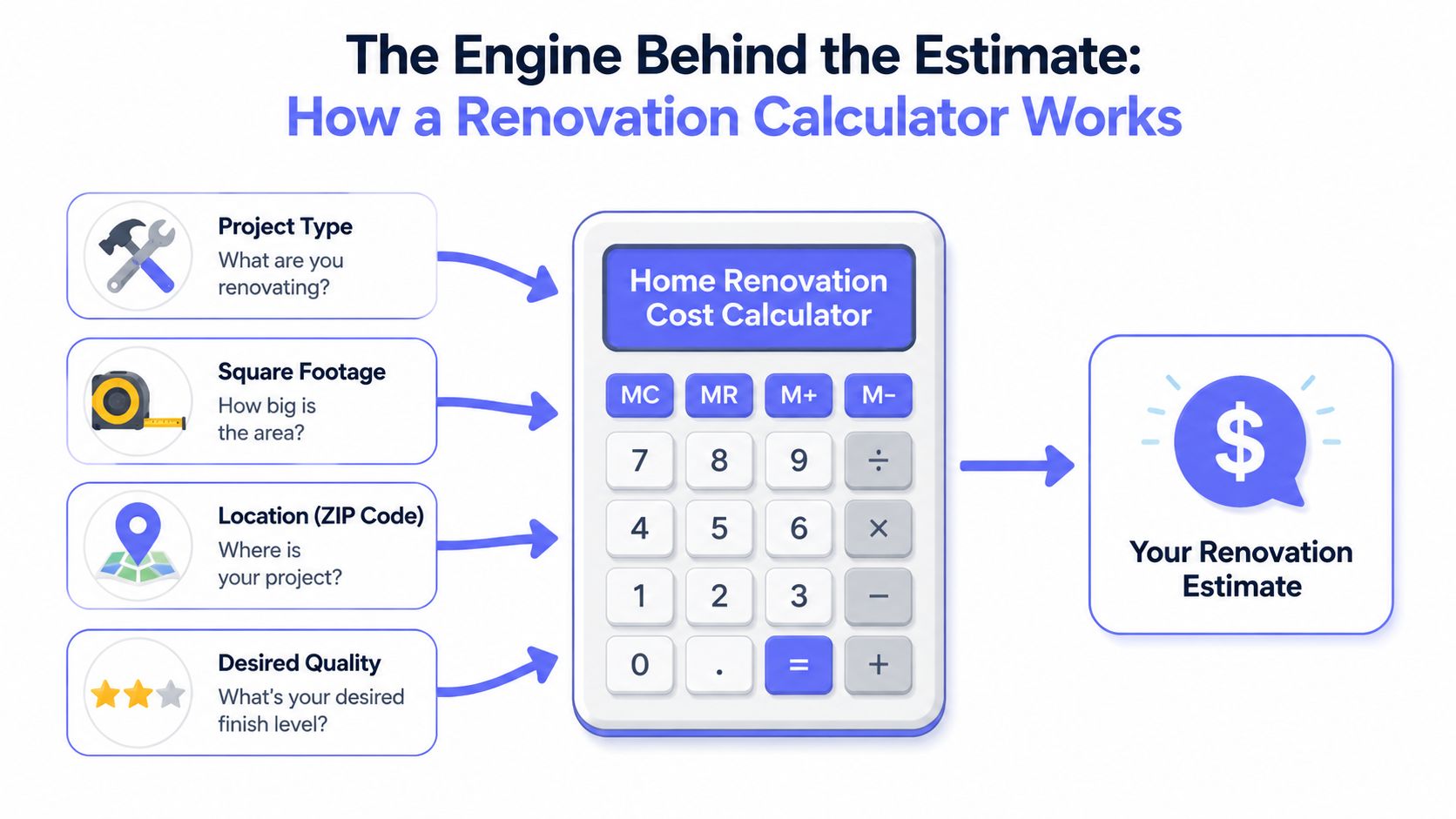
A renovation calculator isn't magic. It's more like a recipe.
You supply the ingredients. The tool combines them with local cost data and a pricing model. Then it gives you a rough total. The better your inputs, the more useful the output.
What the calculator needs from you
Most calculators ask for the same core information:
- Project type: Kitchen, bathroom, basement, flooring, roofing, or a general remodel
- Square footage: The size of the room or the overall area being updated
- Location: Usually ZIP code, because labor and material conditions change by market
- Quality level: Basic, mid-range, or high-end finishes
Those inputs shape the estimate more than people think. A small bathroom with standard fixtures is one job. The same footprint with tile upgrades, custom storage, and layout changes is a different budget entirely.
How better calculators sharpen the number
The strongest tools go beyond static averages. Next-generation renovation calculators use a dynamic zip-code-adjusted labor multiplier, a material volatility index, a scope-extent weighting algorithm for renovation tiers, and a contingency buffer of 10% to 15%. That's what makes them more useful than a generic spreadsheet.
Here's what those terms mean in plain language:
| Calculator feature | What it does in practice |
|---|---|
| ZIP-code-adjusted labor multiplier | Raises or lowers labor assumptions based on your local market |
| Material volatility index | Adjusts for changing material prices rather than relying on stale pricing |
| Scope-extent weighting | Prices a cosmetic refresh differently from a more complex, finish-heavy remodel |
| Contingency buffer | Builds in room for ordinary surprises before you ever speak to a professional |
That still won't make the estimate final. It just makes it less naive.
Better calculators don't eliminate uncertainty. They price some of it in before the project starts.
The output should tell you the rough budget lane your job belongs in. It should not convince you that your layout, structure, access, finish choices, and hidden conditions are already accounted for. They aren't.
Ballpark Renovation Costs for Common Projects
Before you trust any tool, you need a frame of reference. If the calculator gives you a result that's wildly outside normal ranges, you should catch that early.
NerdWallet reports that minor renovation projects range from $2,800 to $15,000, mid-level projects fall between $30,000 and $40,000, and major renovations typically cost from $65,000 to over $100,000. It also places general renovation costs at $7 to $23 per square foot (NerdWallet's renovation cost guide).
National cost bands that set expectations
Those ranges matter because they help you sort your project correctly.
A minor remodel usually means cosmetic work. Think paint, surface updates, fixture swaps, or limited finish replacement. A mid-range remodel often includes more coordinated work across labor and materials. A major renovation usually means deeper scope, higher finish level, or both.
That's also why square-foot pricing has to be handled carefully. A broad $7 to $23 per square foot range is helpful for orientation, but it won't tell you much by itself about kitchens, bathrooms, or projects with heavy plumbing, electrical, or custom finish work.
Average renovation costs by project scope
| Project Type | Minor Remodel (Avg. Cost) | Mid-Range Remodel (Avg. Cost) | Major/Upscale Remodel (Avg. Cost) |
|---|---|---|---|
| General renovation | $2,800 to $15,000 | $30,000 to $40,000 | $65,000 to over $100,000 |
That table is simple on purpose. It's a scope check.
If your plan is a light refresh and your estimate lands in major-renovation territory, something in the assumptions is off. If you're opening walls, replacing multiple systems, and choosing premium finishes, a “minor” result is probably fantasy.
For narrower project planning, room-specific benchmarks help. Roof work, for example, has its own cost logic around materials, pitch, access, and repair scope. If that's part of your project, a focused tool like this roof repair cost estimate guide gives a better project-specific starting point than a general remodel calculator.
A home renovation cost calculator works best when you use both views at once. First, check the broad renovation band. Then test whether your specific room or trade behaves differently.
If the estimate fits the category but not the job, trust the job.
That's the habit experienced project managers use. The national range gives you the lane. The actual scope tells you whether you belong in it.
From Abstract Numbers to a Real Project
A sample estimate makes the calculator easier to read.
Say you're pricing a kitchen remodel and the tool gives you around $30,000 for a mid-range result. That number makes sense as a benchmark because PNC places mid-range kitchen remodels around $30,000, with kitchen renovation costs ranging from $12,000 for minor updates to over $50,000 for major remodels with upscale finishes. The same PNC guide puts bathroom renovations at $6,600 on the low end and $28,000 or more on the high end (PNC's renovation cost calculator guide).
What a mid-range kitchen estimate usually includes
At that level, the calculator is probably assuming a pretty standard package. Not luxury. Not bargain-basement either.
A mid-range kitchen estimate often reflects things like:
- Standard cabinet replacement: Usually stock or straightforward semi-custom choices
- Common countertop selections: Practical surfaces, not the most expensive premium slab options
- Typical appliance package: Good functional replacements without pushing into luxury lines
- Basic flooring and finish work: Enough to refresh the room and make it feel complete
That's why calculators are useful. They help turn vague ideas into a realistic category.
If you're trying to organize decisions before talking to a professional, a planning worksheet helps more than another round of guesswork. This home renovation project planner is a practical way to define scope before you request quotes.
What it usually leaves out
The estimate gets shaky once your project stops being straightforward.
A calculator handles replacement work better than transformation work.
Moving plumbing, rerouting electrical, removing a wall, correcting an uneven floor, or upgrading ventilation can change the job fast. So can finish choices that seem like small upgrades but alter labor and install complexity.
That's the move from abstract number to real project. You stop asking, “What does a kitchen cost?” and start asking, “What does my kitchen require?”
Those are very different questions. The second one produces a budget you can use.
The Hidden Costs Calculators Always Miss
The biggest pricing misses don't come from math errors. They come from things the tool can't see, and choices it treats as if they're all equal.
What's behind the walls never shows up cleanly
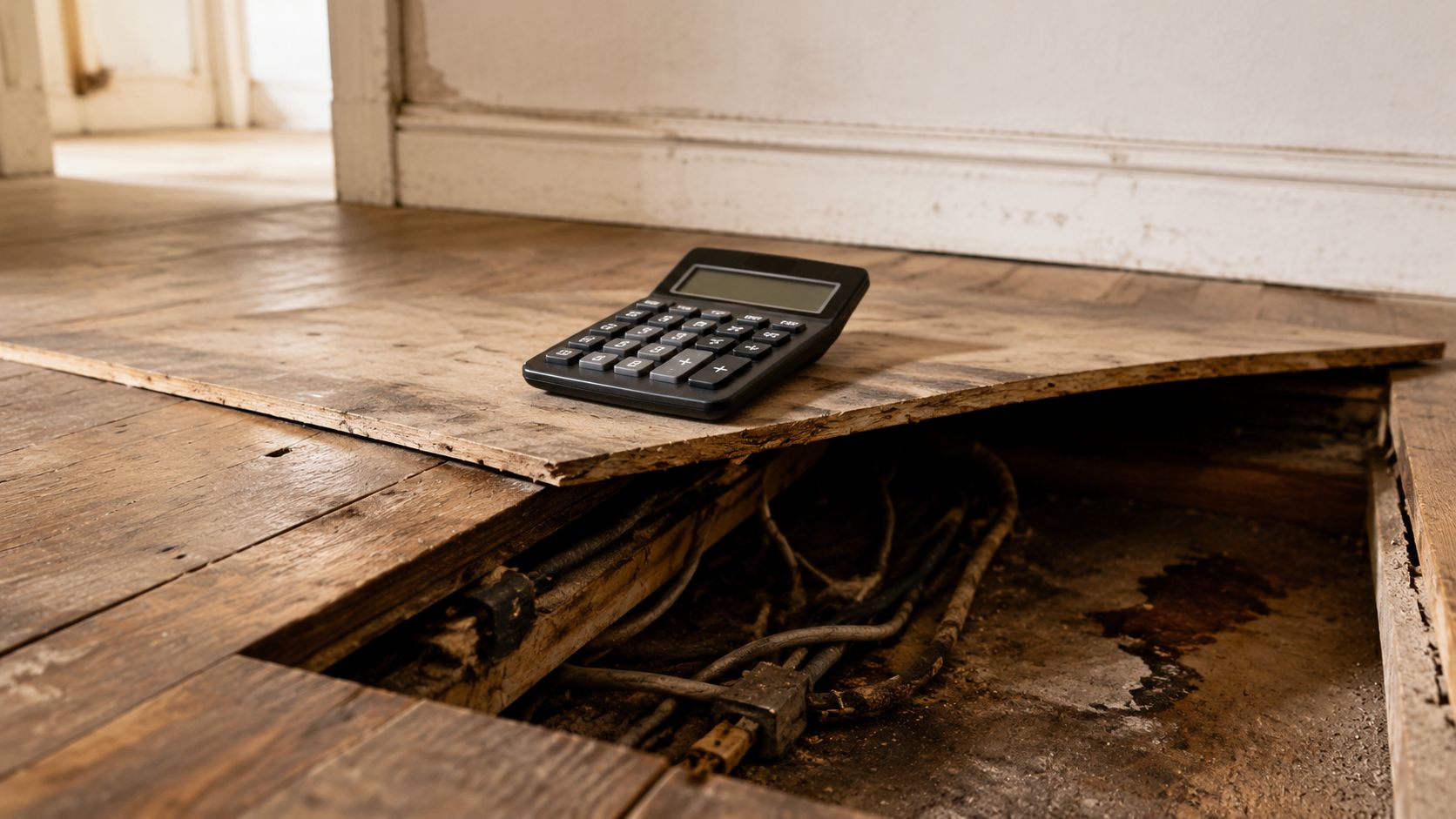
A home renovation cost calculator doesn't know whether the subfloor is solid, whether old wiring needs correction, or whether previous work was done properly. It also can't see the awkward realities that affect labor time, like tight access, occupied spaces, long material carry paths, or partial-day work windows.
These issues don't make the calculator useless. They explain why a clean digital estimate often gets messy after site review.
Common blind spots include:
- Hidden conditions: Water damage, old framing issues, outdated electrical, and similar discoveries
- Scope drift: Small add-ons that feel reasonable one by one and expensive when totaled
- Soft costs: Design work, permits, haul-away, protection, cleanup, and coordination effort
- Complex sequencing: Work that looks simple until one trade has to wait on another
The cost of exclusivity and fewer bad leads
There's another miss that is often not factored in at all. Generic calculators price labor and materials, but they usually ignore the difference between sending your information into a lead marketplace and working with one vetted professional.
Generic calculators ignore the hidden cost of exclusivity when hiring a single vetted pro. The gap matters because lead spam reduces project quality by 34%, and 72% of homeowners report frustration with unsolicited contractor calls after using lead marketplaces (Experts in Your Home on renovation costs and lead marketplace friction).
That doesn't mean the cheapest route is always wrong. It means “all pros are interchangeable” is a bad budgeting assumption.
The lowest-friction hiring process often costs more upfront and less in project damage.
A calculator can't measure responsiveness, preparation, communication quality, or whether the business quoting the work understands the scope before they call you. In practice, those factors shape the budget just as much as finish level does.
If you've ever seen two quotes with similar material lists and very different confidence levels, you already know this. One number buys work. The other buys work plus clarity, screening, and a smoother process. Generic tools usually price only the first part.
How to Get a Renovation Quote You Can Trust
A calculator should leave you with a usable baseline. The next step is turning that baseline into a quote that survives real conditions.

Turn the estimate into a working budget
Start by treating the calculator result as the floor, not the ceiling.
The most practical move is to add a 15% to 20% contingency fund to create a working budget. That doesn't guarantee every surprise is covered, but it gives your plan room to absorb normal renovation uncertainty without blowing up the entire project.
Then write down the scope in plain language. Be specific about finishes, fixtures, what stays, what goes, and what matters most if trade-offs become necessary.
Ask for a quote that can survive reality
Strong quotes come from strong scope. Weak scope creates vague pricing, and vague pricing turns into conflict later.
Use this checklist before you compare quotes:
List the actual work
Include demolition, replacement items, finish expectations, and any layout or system changes.Name the materials you care about
If countertop level, flooring type, or fixture quality matters, say so early.Separate must-haves from nice-to-haves
This keeps the quote grounded if pricing forces decisions.Check who you're hiring
Licensing, screening, and review quality matter. A quote is only as trustworthy as the business behind it. This contractor background check guide is a useful reference for what to verify.
A trustworthy quote is detailed enough that both sides can tell what is and isn't included.
That's the true goal. Not the lowest number. Not the fastest reply. A quote you can understand, compare, and sign without guessing.
Your next move is simple. Use a home renovation cost calculator to find the budget lane. Add contingency. Tighten the scope. Then get a detailed quote from a professional who's been properly screened.
If you want a cleaner way to make that last step happen, Hand Vetted Co. matches you with one licensed, background-checked, 4.5+ star rated professional instead of sending your project to a pile of businesses. If you want to see how the process works, review How It Works, the screening criteria in Our Standards, or the common questions covered in the FAQ.