Most local moves with a standard two-mover crew and truck cost about $100 to $200 per hour. If your quote sounds cheaper than that, there's a good chance you're looking at a per-mover number, not the full crew rate you will pay.
That's where people get burned. A mover says a rate that sounds reasonable, you mentally do some quick math, and then the final bill lands higher because the quote included a minimum, billed travel time, or wait time you never thought to ask about. Moving company rates per hour aren't exactly hidden, but they're often presented in the most confusing way possible.
If you want the honest version, here it is: the advertised hourly rate is only the starting point. Your real cost depends on whether the company is quoting per person or per crew, how long the move takes, and whether they bill for the dead time around the move just as aggressively as the lifting.
Table of Contents
- How Moving Company Hourly Rates Work
- Average Hourly Moving Costs in 2026
- The Top 7 Factors That Influence Your Rate
- Decoding Your Quote Hidden Fees and Fine Print
- Practical Ways to Lower Your Moving Bill
- How to Find and Vet a Reputable Mover
How Moving Company Hourly Rates Work
How can one company quote "$65 per mover" while another says "$180 for the crew," and both still leave you with a bigger bill than you expected?
Local moving quotes are typically based on an hourly rate for labor and truck time. Long-distance moves use a different pricing method, usually based on shipment weight, distance, or both. The Federal Motor Carrier Safety Administration explains that interstate movers follow different estimate and billing rules than local movers, which is why the quote format changes once your move crosses into long-distance territory.
Why local moves are billed by time
Hourly pricing is standard for local jobs because the company is selling crew time, truck time, and scheduling capacity. You are paying for the movers to show up, protect your furniture, load, drive, unload, and wrap up the job. That sounds simple. The quote usually is not.
The first thing to pin down is whether the rate is priced per mover or for the full crew. A company may advertise a low number that looks cheap at first glance, then reveal that the rate is charged for each mover on the job. Another company may quote one number for the entire crew and truck. If you do not clarify that upfront, you are not comparing quotes. You are comparing marketing.
What the minimum charge really means
Minimum charges are where small moves get expensive fast. Many local movers set a minimum number of billable hours and may also charge for travel time to your home and back to their office or service area, as the Consumer Affairs moving cost guide explains.
That means a "two-hour move" can easily turn into four billable hours on paper once dispatch time, drive time, stair carries, elevator waits, and unloading are counted. Wait time matters too. If the crew is stuck outside your building because management has not provided access to the freight elevator, your bill usually keeps running.
Use this checklist when you read an hourly quote:
- Ask whether the price is per mover or per crew. This is the pricing gap that confuses people the most.
- Ask when the clock starts and stops. Some companies bill from arrival at your home. Others bill from when the truck leaves their branch.
- Ask about the minimum charge. Your bill may start at that floor even if the move takes less time.
- Ask whether travel time, fuel, and waiting are billed separately. Those charges often inflate the final total more than the advertised hourly rate does.
Practical rule: Ask, "Is this rate for each mover or for the whole crew, what is the minimum, and do you charge for travel and wait time?"
That question cuts through a lot of nonsense and gets you much closer to the actual number.
Average Hourly Moving Costs in 2026
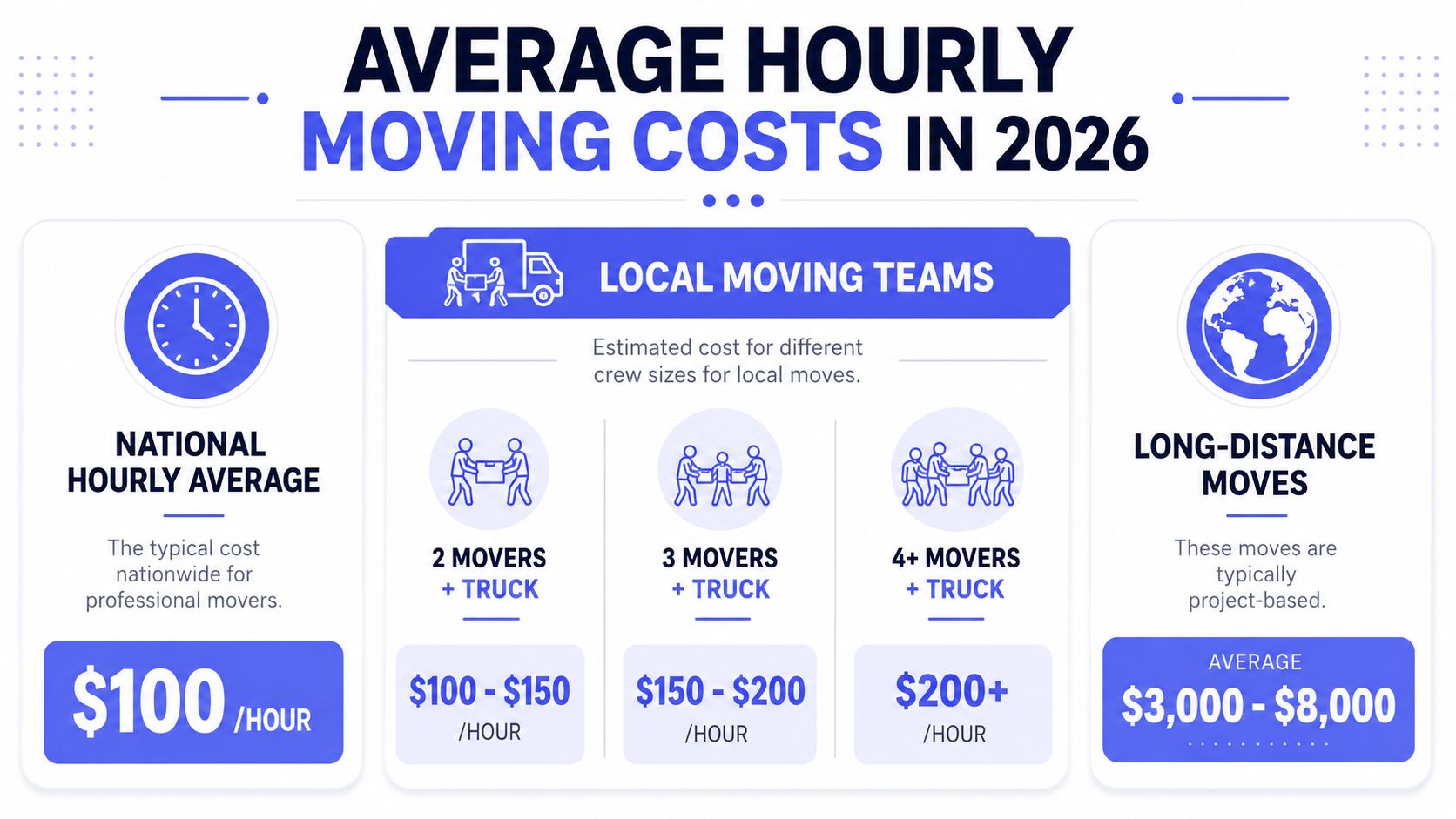
What should a local move cost once you stop looking at the ad and start looking at the crew? Use crew pricing as your baseline, because that is how the bill usually accumulates.
FreightWaves reports that a standard local moving crew of two movers and one truck typically costs $100 to $200 per hour, a three-mover crew runs $150 to $250 per hour, and a four-mover crew runs $200 to $350 per hour.
Use that range as your starting point when you compare quotes. A low number on a call means very little if it only covers one mover, skips the truck, or leaves out the time the crew spends getting to you.
What crews usually cost
The standard setup for a local move is a two-person crew with a truck. That is usually enough for a studio, a one-bedroom, or a small local move. Once the job gets bigger, the company adds movers, and the hourly rate rises with them.
MoveAdvisor's local moving cost guide puts two movers and a truck at about $160 per hour for local moves under 100 miles, and says a typical 1-bedroom apartment move takes about 4 hours for a total labor cost of roughly $640.
That benchmark is useful because it exposes bad quote math fast.
If someone quotes your one-bedroom at a bargain hourly rate, do the multiplication and ask one blunt question: is that price for the whole crew, or for each mover before travel, wait time, and other billed hours are added?
2026 Average Hourly Moving Rates by Crew Size
| Crew Size | Best For | Average Hourly Rate |
|---|---|---|
| 2 movers + truck | Studios, 1-bedroom apartments, smaller local moves | $100 to $200 per hour |
| 3 movers + truck | 2 to 3-bedroom moves with more furniture | $150 to $250 per hour |
| 4 movers + truck | Larger homes and heavier local moves | $200 to $350 per hour |
These are crew rates, and that distinction matters.
A separate national pricing breakdown from Angi's mover cost guide shows how prices are often presented by individual mover count, from $30 to $100 per hour for one mover, $60 to $200 for two movers, $90 to $300 for three, and $120 to $400 for four, with long-distance pricing handled differently at $0.50 to $0.80 per pound. That is exactly why shoppers get confused. One company advertises a per-mover number. Another quotes a full crew. Both sound comparable until travel time, truck fees, and waiting around at the building push the final total higher than expected.
The Top 7 Factors That Influence Your Rate
The hourly number on the quote isn't the final story. The final bill moves up or down based on how much labor the company thinks your move will need, and how much friction your home adds to the job.

The factors that change the bill fast
Here are the seven variables that matter most:
Distance
Local moves stay in the hourly model. Once the move becomes long-distance, the pricing structure changes and the quote is built differently.Volume of stuff
More boxes, more furniture, more loading time. This is obvious, but people still underestimate it constantly.Crew size
More movers means a higher hourly rate. It can still be worth it if the bigger crew cuts total time enough to balance the bill.Access problems
Tight hallways, long walks from the truck, stair-heavy buildings, and elevator delays all slow the work down.Specialty items
Fragile, bulky, awkward items take more care and more time.Packing help
If the crew is boxing your kitchen, wrapping breakables, or unpacking later, you're paying for more labor hours.Insurance and protection options
Coverage choices and protection terms can affect the final quote and what's included.
The big one people underestimate
The biggest cost driver is time. Moving.com's moving cost calculator makes that clear with home-size examples: a studio apartment local move typically costs $560 to $700, while a 4-bedroom house local move ranges from $3,332 to $3,500+. That spread exists because larger homes require more labor hours and larger crews.
You can see the same pattern in medium-size moves. To The Moon Moving's cost breakdown says a 1-bedroom apartment often takes about 4 hours with two movers for an average total of around $640, while a 3-bedroom house requiring 7 hours with a 4-person crew can reach about $2,240.
That doesn't mean every bigger crew is overpriced. Sometimes the opposite is true. A larger team can be the smarter choice if it shortens a long, furniture-heavy move enough to keep the total under control.
A few practical examples:
- Elevator building: If your move depends on elevator access, delays can drag the clock without moving much actual furniture.
- Walk-up apartment: Stairs don't just add effort. They slow every single trip.
- Well-prepped house: Boxes sealed, furniture disassembled, paths cleared. That setup usually keeps the crew moving instead of waiting on you.
The rate matters. The pace matters more.
Decoding Your Quote Hidden Fees and Fine Print
What does your “hourly rate” buy you?
Usually, less than you think. The number at the top of the quote grabs your attention, but the final bill gets shaped by how the company defines that rate, when the clock starts, and what extra time they decide counts as billable.

Per-mover pricing versus per-crew pricing
At this stage, quotes get slippery.
Some movers advertise a low hourly number that sounds reasonable because it is a per-mover rate, not the rate for the full job. Stack Moves explains that shoppers often see a single-mover rate of $25 to $75 per hour and assume they can roughly multiply from there, while the actual billed crew rate often lands at $160 to $250 per hour once the truck, labor, and equipment are bundled in.
That gap is why two quotes can sound similar on the phone and come out very different on move day.
Ask these questions right away:
- Is this rate per mover or for the full crew?
- How many movers does that quote include?
- Is the truck included?
- Are pads, dollies, shrink wrap, and basic equipment included?
- Is there a minimum number of billable hours?
- When does the clock start, and when does it stop?
If a company answers in generalities, do not reward that with your deposit.
You should also confirm the company is properly insured before you trust the rest of the paperwork. This guide to contractor insurance requirements is a useful reference for understanding the coverage questions any service business should answer clearly. If a mover gets vague about liability, cargo coverage, or worker protection, assume the paperwork will stay vague when something goes wrong.
The charges that inflate the total
The rate is only part of the bill. Travel time and wait time are where a lot of people get burned.
A quote can look fair until you learn the crew is billing from dispatch, billing the return trip, or charging full hourly labor while they wait for an elevator, a loading dock, or building approval. Those rules are often buried in terms like portal-to-portal, yard-to-yard, or travel time may apply.
Read those lines like a hawk.
The Federal Motor Carrier Safety Administration's consumer guidance says written estimates should spell out the services included and any extra charges, which is exactly why vague language around access delays and travel billing is a problem. If you want the rules in black and white, start with the FMCSA's Your Rights and Responsibilities When You Move.
Here's what to pin down before you book:
| Quote Item | What to Confirm |
|---|---|
| Hourly rate | Is it per mover or per crew |
| Crew size | How many people are included in that rate |
| Truck charge | Included or separate |
| Minimum | How many hours you pay even if the move runs short |
| Travel time | One-way, round-trip, dispatch to home, or none |
| Wait time | Billed during elevator, key, dock, or access delays |
| Equipment | Included or charged separately |
| Supplies | Are wrap, tape, mattress bags, or boxes extra |
The bottom line is simple. An hourly quote without crew definitions, travel rules, and wait-time terms is not a real quote. It is a sales number.
Practical Ways to Lower Your Moving Bill
Want the key to cutting a moving bill? Stop focusing on the advertised hourly rate and start attacking the hours that get billed.
This matters even more when quotes are hard to compare. A company can sound cheaper because it says "$X per mover," while another quotes a flat crew rate that looks higher at first glance. The final bill usually comes down to how fast the job moves, how prepared you are, and how much dead time gets charged anyway.
Cut labor time before the crew shows up
The simplest savings move is reducing how much work lands on the clock. If movers spend the first hour packing loose items, taking apart furniture, and sorting rooms, you are paying premium labor for prep work you could have handled earlier.
Use this checklist:
- Declutter hard: Get rid of anything you already know you do not want to move.
- Pack completely: Tape boxes, label them clearly, and keep small loose items out of drawers, counters, and closets.
- Disassemble easy furniture yourself: Beds, table legs, mirrors, and shelves can eat up paid crew time.
- Stage boxes near the exit when possible: That shortens carry time and keeps the crew moving.
- Label destination rooms: Fewer questions means faster unloading.
One overlooked money saver is handling insurance and property questions before move day. If there is any chance of a damage dispute, check your homeowners insurance coverage for damaged belongings or property issues before the truck arrives.
Remove the delays that quietly inflate the bill
The expensive part of an hourly move is often the time nobody talks about in the sales call. Waiting for elevator access. Waiting for a parking spot. Waiting for a building manager. Waiting while someone decides where the couch goes.
That time still counts.
Handle the friction early:
- Reserve the elevator or loading dock: Do it in writing if your building requires scheduling.
- Set up parking ahead of time: A long carry from a bad parking spot slows the whole crew.
- Clear walkways and doorways: Tight paths turn simple moves into slow ones.
- Keep keys, fobs, and gate codes ready: Do not make a paid crew stand around for access.
- Have one decision-maker on site: Movers should not wait while family members debate room placement.
A cheap-looking rate gets expensive fast when the clock keeps running and the truck is barely moving.
Use crew size strategically
Bigger crews are not always more expensive. They are often cheaper overall if they finish much faster.
If you have stairs, heavy furniture, a long carry, or a large home, ask each company how many movers are included in the quote and how that changes the expected move time. People often misread pricing in this scenario. A lower per-mover number can still lead to a higher total if the company sends too small a crew and stretches the job.
Ask one practical question: What crew size gets this job done in the fewest billed hours without creating idle time?
That question gets you closer to the final price than another round of rate haggling.
How to Find and Vet a Reputable Mover
The fastest way to overpay is hiring a mover with vague pricing and loose paperwork. Bad movers don't always look bad at first. They often sound flexible, casual, and easy to book right up until the bill changes.

Red flags that should end the conversation
Walk away if you hear any of this:
- A vague phone quote with no written breakdown
- No clear answer on whether the rate is per mover or per crew
- No explanation of minimum hours, travel billing, or wait time
- Pressure to book before you've reviewed the estimate
- Unclear licensing or insurance information
Screening the people behind the business matters too, not just the brand name. If you want a better sense of what that kind of vetting should look like, review this standard for a contractor background check.
What a solid mover should give you
A reputable mover should give you a quote that reads plainly. You should be able to see what crew is coming, what's included, what can change the final bill, and how extra time is billed.
Good companies also answer direct questions directly. If you ask whether elevator delays are billable, you should get a yes or no, not a speech.
The bottom line is simple. Don't choose a mover based on the lowest number you hear first. Choose the one that makes the total price easiest to understand.
If you're tired of sorting through vague quotes and trying to figure out who's legit, Hand Vetted Co. is a cleaner option. You get matched with one verified professional, not blasted out to a pile of businesses, and every match is exclusive. Start with their How It Works, review Our Standards, and check the FAQ if you want a simpler way to find a trustworthy pro.