Minor roof repairs often run $150 to $1,000, while repairs involving water damage commonly land around $1,000 to $6,000 or more. If you're staring at a ceiling stain or a few shingles in the yard, that's the honest starting range, but a key question is how a roofer decides where your job falls inside it.
Customers don't get ripped off because they ignored the price range. They get ripped off because they don't know how an estimate is built. One quote says “small repair.” Another says “flashing failure with deck damage.” Same roof. Very different bill.
A solid roof repair cost estimate isn't guesswork. It's a scope document. It should tell you what the roofer found, what they're fixing, what they expect to replace, and what could still change once damaged materials come off.
Table of Contents
- Your Roof Repair Cost Estimate Explained
- Typical Roof Repair Costs by Job Type
- The Six Key Drivers of Your Roof Repair Estimate
- How a Professional Creates Your Estimate
- Getting an Accurate Estimate and Spotting Red Flags
- The Smart Way to Find a Verified Roofer
Your Roof Repair Cost Estimate Explained
You notice a brown stain on the ceiling after a hard rain. By the time a roofer gets up there, the repair may be as simple as replacing a few failed shingles. It may also involve wet decking, damaged flashing, and a section that has to be opened up to see how far the water traveled. The duration of the problem often determines whether a repair is simple or expensive.
That is why a roof repair estimate is not just a price for the leak you spotted. It is a contractor's best judgment about the work that is visible now, the risk of hidden damage, and the labor needed to fix it without creating another leak two months later. If the roofer is being honest, the estimate should show both what is known and what could change once materials come off.
If you are already wondering whether patching still makes sense, it helps to understand the line between roof repair and full roof replacement before you compare quotes.
What an estimate is really measuring
A roof repair cost estimate usually prices four things at once:
- The repair itself: Missing shingles, cracked flashing, punctures, exposed fasteners, failed sealant
- Access and setup: Roof height, pitch, story count, landscaping, ladder placement, and safety requirements
- Hidden damage risk: Wet decking, soft spots, compromised underlayment, and moisture that spread beyond the visible stain
- Urgency: Active leaks, storm response, temporary tarping, and scheduling pressure before the next round of weather
A fair estimate makes those parts visible. A weak one lumps everything into a single number and leaves you guessing.
Practical rule: A quote based only on a few texted photos is a rough starting point, not a dependable repair price, unless the roofer clearly labels it as preliminary.
The question you should be asking
Do not ask only, “What does roof repair cost?”
Ask, “What is included in this estimate, what assumptions are you making, and what would cause the price to change?”
That question gets to the contractor's process. Good roofers can explain where the money is going, what they expect to find, and how they handle surprises. If someone skips past that and pushes for a fast signature, slow the conversation down.
Typical Roof Repair Costs by Job Type
A homeowner sees a brown ceiling spot, calls two roofers, and gets two very different numbers. That usually happens because the jobs are not being scoped the same way. One contractor is pricing the visible symptom. The other is pricing the work needed to open the area, fix the failure, and close the roof back up without leaving you with the same leak next month.
That is why job type matters more than a broad national average. A fair estimate starts with what failed, how far the damage likely goes, and how much roof has to be disturbed to repair it correctly.
Small visible repairs
Small repairs usually include a few missing or creased shingles, a popped nail, a short section of failed sealant, or a simple exposed flashing issue. These are often the lowest-cost jobs because the crew can get in, fix the problem, and leave without tearing into a large section of roof.
In practical terms, these repairs often stay near the low end when three things are true. The problem is easy to find, the surrounding roof is still sound, and the materials are easy to match.
Price starts climbing when the “small repair” is on a steep slope, tucked against a wall, or mixed into old roofing that no longer matches what is sold today. Leak tracing also adds time. A stain inside does not always sit directly under the failure.
Leaks that involve hidden moisture
Estimates separate fast.
A roof leak can still be a small repair if it was caught early and the water stayed near the entry point. Once moisture gets into the decking or spreads beyond the obvious hole, the contractor has to price exploratory tear-off, possible deck replacement, new underlayment, and reinstallation of the finished roofing.
The customer usually hears “it's just a leak.” The roofer is asking a different question: how much roof has to come apart to make this section watertight again?
That is also why two leak repairs with similar ceiling stains can come in at very different prices. One may need a localized patch. The other may require removing a larger area so the crew can replace soft wood and rebuild the roof system in the right sequence.
Emergency and service-call work
Some estimates include charges that are not really repair costs. They are access costs.
A minimum service-call charge covers showing up, diagnosing the issue, setting ladders, and making a small repair if the fix is straightforward. Emergency calls cost more because the roofer is shifting crews, working around weather, or doing temporary dry-in work before the permanent repair can happen.
That does not mean the price is unfair. It means you are paying for immediate response, not just shingles and labor time on the roof.
What different job types usually mean for pricing
| Repair Type | Asphalt Shingle Cost | Metal Roof Cost | Wood Shake Cost |
|---|---|---|---|
| Minor repair such as a few missing shingles or a small sealed leak | Often the lowest-cost category if access is straightforward and materials match | Usually higher than asphalt for comparable small-area specialty work | Usually higher than asphalt for comparable small-area specialty work |
| Water-damage repair | Can rise quickly once decking or underlayment needs replacement | Often higher when matching panels and specialized details are involved | Often higher when material matching and surrounding repairs are needed |
| Emergency add-on | Common when the repair needs same-day response, tarping, or after-hours scheduling | Common when the repair needs same-day response, tarping, or after-hours scheduling | Common when the repair needs same-day response, tarping, or after-hours scheduling |
| Minimum call-out fee before repairs | Common on small jobs where diagnosis and setup take nearly as long as the fix | Common on small jobs where diagnosis and setup take nearly as long as the fix | Common on small jobs where diagnosis and setup take nearly as long as the fix |
| Separate inspection | May be billed separately if the issue needs a dedicated diagnostic visit | May be billed separately if the issue needs a dedicated diagnostic visit | May be billed separately if the issue needs a dedicated diagnostic visit |
The point of the table is not to give you a price you can approve from the couch. It helps you see how contractors group work and why one category costs more than another.
Material matters, but scope matters more. I would rather see a higher quote that clearly explains replacement of wet decking and step flashing than a cheap quote that says only “repair leak” with no detail. Cheap roof repairs get expensive when the first fix does not address the underlying failure.
If you are comparing a bigger repair quote and wondering whether it still makes sense to fix the roof, this guide on roof repair versus full roof replacement can help you sort that out.
A fair estimate names the failed area, the materials being replaced, and the conditions that could change the final price.
The Six Key Drivers of Your Roof Repair Estimate
Two homeowners can point to the same leak stain and get very different quotes. That usually happens because the stain is only the symptom. The estimate is built around what the roofer expects to open up, replace, and make watertight again.
Here's the visual version of what drives the number:
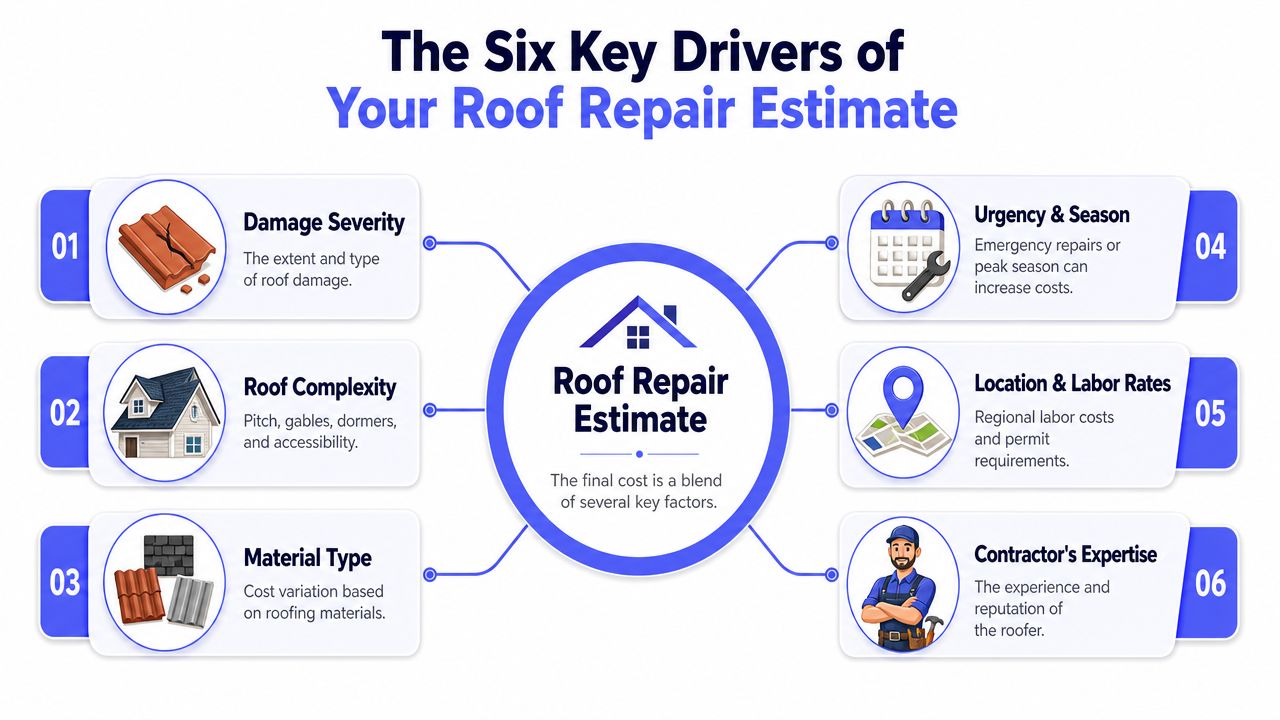
A good estimate is really a risk assessment. The more unknowns in the area being repaired, the more carefully you should read the scope.
1. Damage severity
This drives the price more than anything else.
Replacing a few torn shingles after wind damage is a contained repair. A leak that has been active for months can involve wet underlayment, rotted decking, damaged flashing, and insulation below. Those are very different jobs, even if the ceiling stain inside looks similar.
The estimate should reflect the full repair path, not a surface patch.
2. Roof complexity
Access and layout change labor fast. A single-story, walkable roof is quicker to work on than a steep roof with multiple valleys, dormers, skylights, and short tie-ins.
Complex roofs slow down tear-back, diagnosis, material handling, and installation. They also require more safety setup. That extra time shows up in the quote, and it should.
3. Material type
Some roofing systems are forgiving. Some are not.
Asphalt shingles are usually the most straightforward to repair because matching materials and replacing a small section is often manageable. Metal, tile, slate, cedar, and low-slope systems usually require more skill, more care around adjacent materials, and sometimes harder-to-source parts. On those roofs, a repair can be small in square footage and still take real time.
4. Urgency and season
Rush work costs more because the contractor is reshuffling labor, equipment, and schedule.
If the roof is actively leaking, the first step may be temporary protection instead of the final repair. Weather also matters. Busy storm periods, winter conditions, and short daylight hours can all raise labor time and complicate scheduling.
You are paying for response speed and disruption, not just the repair itself.
5. Local labor and job setup
Every market has its own labor rates, permit habits, disposal costs, and insurance burden. A small repair in a high-cost city can price out higher than a larger repair in a cheaper market.
There is also a floor below which a legitimate company usually cannot go. Trucks still roll. Crew members still spend time on diagnosis, ladder setup, material pickup, and cleanup. That is why tiny repairs can look expensive on a per-shingle basis.
6. Contractor expertise
Experience changes both the diagnosis and the scope.
A seasoned roofer looks for water entry points, failed flashing details, nail placement, previous bad repairs, and hidden deck damage. A less experienced contractor may quote only the visible symptom. That can produce a lower number up front, but it also increases the chance that the leak comes back or the bill grows once the job starts.
A low bid can signal an incomplete diagnosis, which often leads to added cost later.
What a fair estimate usually includes
A fair roof repair cost estimate usually includes some version of these details:
- Problem area identified: The quote should name the failed area, such as pipe boot, chimney flashing, valley, ridge, field shingles, or a low-slope seam.
- Repair method described: It should say whether the contractor plans to reseal, replace materials, remove and relay a section, or open the area to confirm hidden damage.
- Materials named: You should see the main components listed, such as shingles, flashing, underlayment, fasteners, sealant, or replacement decking.
- Labor approach explained: The estimate should make clear whether the contractor is charging a flat repair price, time and materials, or an allowance for exploratory work.
- Change conditions noted: Good estimates spell out what could raise the final cost, such as rotted decking, saturated insulation, or damage found after tear-back.
Bottom line: The clearest estimate is usually the safer one. If a quote is vague about the failure, the repair method, and what happens if hidden damage shows up, treat that as a pricing risk.
How a Professional Creates Your Estimate
A real estimate starts before anyone pulls out a calculator. It starts with diagnosis.

What happens before anyone writes a number down
The first phone call usually sounds simple. You describe a leak, missing shingles, storm damage, or a stain on the ceiling. A good roofer will ask where the problem shows up, when it started, whether it happens only during heavy rain, and whether anyone has repaired that area before.
Then comes the site visit. The estimate becomes concrete during this stage.
A competent roofer looks at the roof surface, but that's not enough on its own. They also look at transitions, penetrations, flashing details, and signs of water travel. If access allows, they may check the attic or underside of the roof deck to see whether the visible symptom lines up with the actual entry point.
Water often enters in one spot and shows up somewhere else. That's why experienced roofers don't quote leak repairs by ceiling stain alone.
How the written estimate gets built
After inspection, the roofer has to make a scope decision. Is this a contained repair with a known fix, or is it an exploratory repair where damaged materials have to come up before the full scope is clear?
That decision shapes the estimate.
A stronger estimate usually follows this sequence:
Measure the repair area
The roofer determines how much roofing has to be removed or reset, not just the size of the wet spot inside.List materials and matching needs
Matching shingles, flashing profile, sealant type, underlayment, and fasteners all matter. Material compatibility matters too.Assign labor and access time
Setup, ladder placement, safety gear, cleanup, and disposal all count. Hard access can change the whole job.Flag unknowns
Hidden deck damage, wet insulation, or concealed flashing failure may not be fully visible until tear-back begins.Write the proposal
The final estimate should describe the work in plain language, not hide behind a one-line total.
You can learn a lot from how a roofer handles uncertainty. Strong pros don't pretend every hidden condition is already known. They explain what they know, what they suspect, and how they'll handle discoveries if they open the roof and find more damage.
That's a sign of honesty, not weakness.
Getting an Accurate Estimate and Spotting Red Flags
You can help a roofer give you a better number. You can also make it harder for a bad one to bluff.
Here's the checklist version:
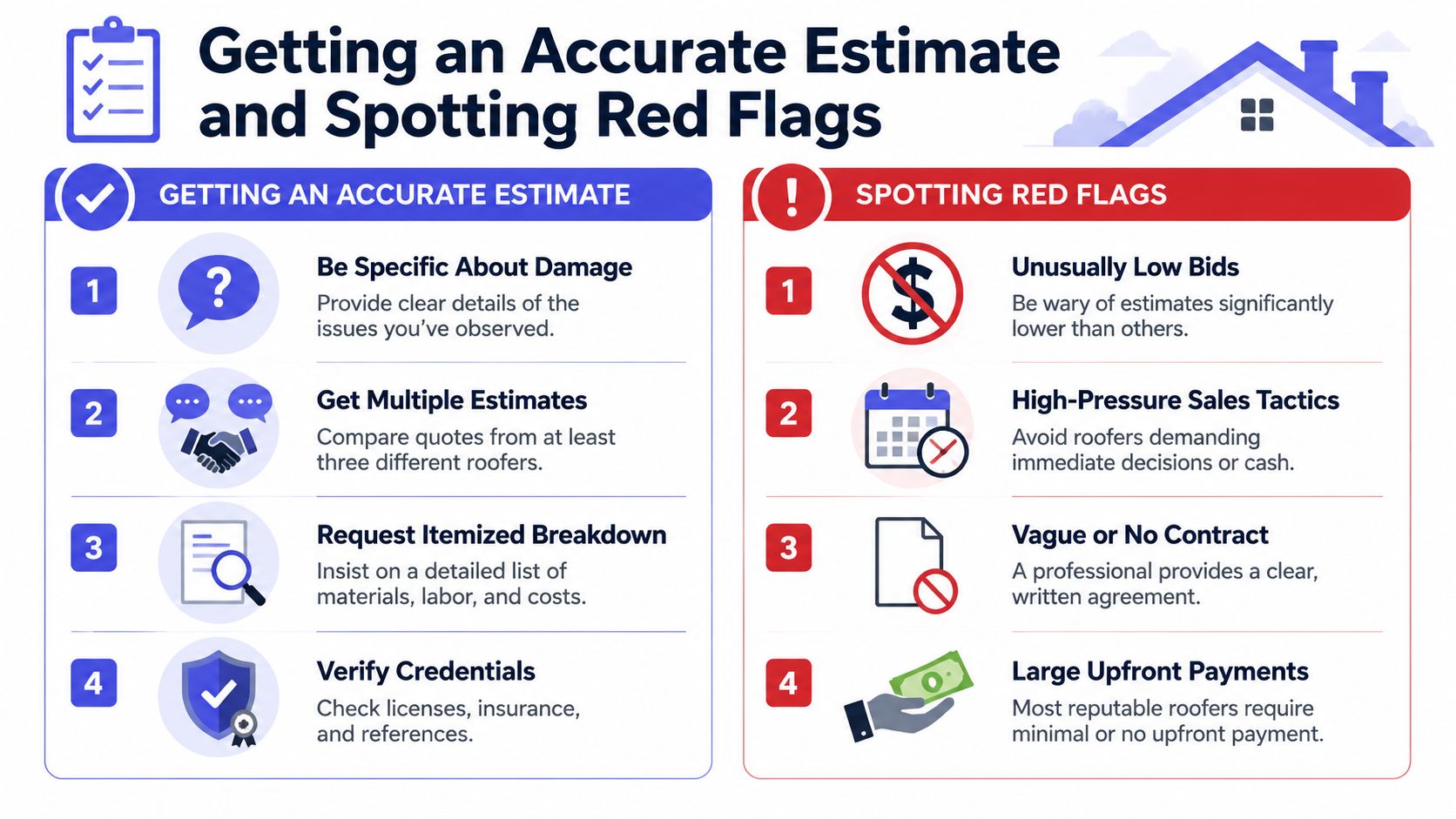
How to help a roofer quote the job correctly
Before the appointment, gather a few facts. Write down when you first noticed the problem, whether it happens only in certain weather, and whether the area has been repaired before.
Then do three practical things:
- Take photos: Capture ceiling stains, attic moisture, exterior damage, and anything that changes during rain.
- Ask for itemization: You want to see labor, materials, repair area, and any separate inspection or emergency charges if they apply.
- Ask about coverage: If the damage may be storm-related, read this guide on homeowners insurance coverage before you assume you're paying fully out of pocket.
Red flags that should slow you down
Not every bad roofer looks shady on first contact. Some sound polished and still hand over weak estimates.
Watch for these signs:
- Vague language: “Repair roof as needed” is not a scope.
- Pressure to sign now: Good roofers explain. They don't corner.
- Refusal to show license or insurance: That's not a paperwork issue. It's a trust issue.
- Large cash demand up front: A reputable business should be able to explain payment terms clearly and professionally.
- No discussion of hidden damage: Every roof repair has some uncertainty. Pretending otherwise is a red flag.
If two estimates are close in price, choose the one that explains the work better.
That's usually the safer job.
The Smart Way to Find a Verified Roofer
Finding the price range is the easy part. Finding the right person to trust with your roof is often where time is lost.
The old method is messy. You fill out a form, your phone lights up, several businesses call at once, and you still have to figure out who's licensed, insured, reputable, and paying attention to the problem you described.

A cleaner option is to use a service that screens the business before you ever talk to them. Handvetted matches people with one exclusive professional instead of blasting their project out to a crowd. That matters when you want a serious estimate, not a race to the bottom.
If you care about screening standards, review how contractor background checks are handled before you hand your roof project to anyone.
The best next step is simple. Get a written roof repair cost estimate from a roofer who will inspect the problem, explain the repair method, and put the scope in plain language. If you want to skip the spam and start with one verified match, Hand Vetted Co. is a practical place to begin.