
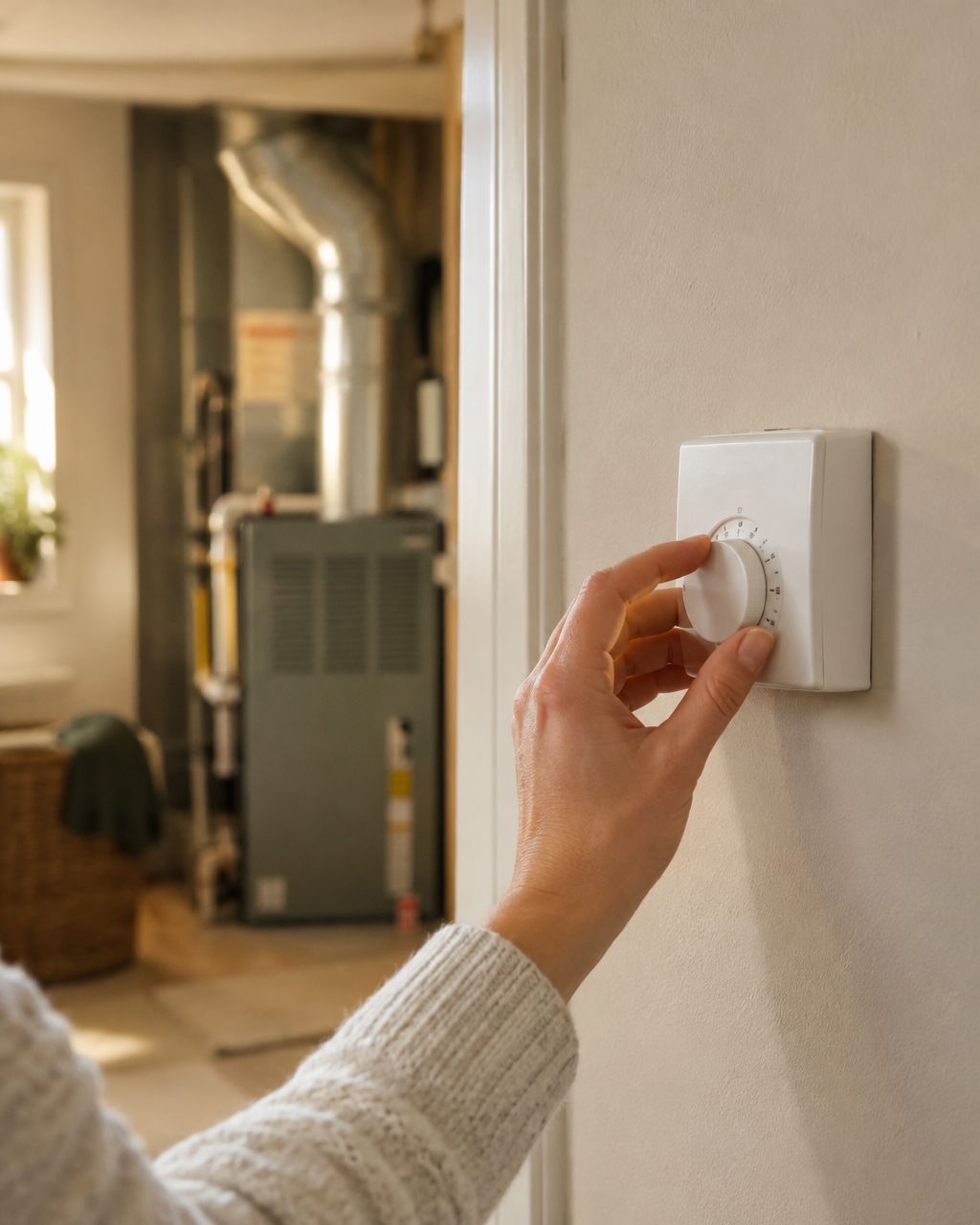
A short burst of cool air when the furnace starts is normal - the fan runs before the burners warm up. Cold air that keeps coming while the thermostat calls for heat is not. Nine times out of ten, the cause is one of a handful of settings and parts you can check yourself in under ten minutes.
- Thermostat fan set to ON instead of Auto is the most common cause - the blower runs room-temperature air between heating cycles.
- A clogged filter can overheat the furnace until a safety switch cuts the burners while the fan keeps blowing.
- A brief cool draft at startup is normal; continuous cold air means the burners are not staying lit.
- Smell gas? Turn the system off and call a professional immediately - that check is never DIY.
The five checks before you call anyone
- Thermostat: Heat mode, fan on Auto. Carrier lists the fan switch as the single most common cause: set to ON, the blower circulates room-temperature air even when the furnace is not heating. Switch it to Auto and see if the cold air stops between cycles.
- The air filter. Pull it out and hold it to a light. A clogged filter chokes airflow until the furnace overheats and its high-limit safety switch shuts the burners off - while the fan keeps running, pushing cold air. A fresh filter of the right size, with the airflow arrow pointing toward the blower, fixes this more often than any other single repair.
- Power. Check the furnace switch (often looks like a light switch near the unit), the breaker, and that the blower door panel is seated - many furnaces refuse to run with it loose.
- Fuel. Confirm the gas valve is open if you have gas heat. An empty propane tank or a closed valve turns a working furnace into a big fan.
- The vents and returns. Closed supply registers or blocked returns starve the system the same way a dirty filter does.
If all five check out and the furnace still blows cold after a full cycle, the problem is inside the furnace.
What is actually broken when heat stops but the fan keeps running
- Dirty flame sensor. On modern furnaces the flame sensor confirms the burners are lit; a film of carbon makes it read "no flame" and the control board closes the gas after a few seconds. The fan keeps going; the heat does not. Cleaning or replacing it is a technician job.
- Ignition failure. Hot-surface ignitors wear out and pilot assemblies on older furnaces go out - a faulty thermocouple that will not hold the gas valve open is the usual culprit. Either way, no ignition means no heat.
- Overheating and short cycling. Beyond the filter: a failing blower motor, blocked evaporator coil, or closed vents can trip the limit switch repeatedly. The furnace runs a minute or two, shuts down on safety, and blows cold until the next try.
- Clogged condensate drain. High-efficiency furnaces produce water; when the drain line plugs, a float switch locks out the burners to protect the unit. This is common in winter and often a quick fix for a technician.
- Cracked heat exchanger. The serious one. A crack can let combustion gases mix with household air, and the furnace may shut down on a safety control. This is not a repair you diagnose or patch yourself - it usually means furnace replacement, and it needs a professional evaluation right away.
When a technician, not a homeowner, should touch it
Replacing a filter, switching a thermostat to Auto, and restoring power are safe homeowner jobs. Everything involving gas valves, ignitors, flame sensors, limit switches, or the heat exchanger is combustion equipment - Bryant, Carrier, and Lennox all route those repairs to a licensed technician, and for good reason: a mis-set gas valve is a carbon monoxide risk, not just a comfort problem.
Call for service when the burners shut off within seconds of lighting, the furnace cycles on and off repeatedly, the filter is new and the settings are right but cold air persists, or you smell gas - in that last case, shut the system down and leave the house first.
How Handvetted matches HVAC professionals
Handvetted connects homeowners with one licensed, background-checked, highly rated local HVAC professional. The published standard is four checks: an active state license confirmed through official registries, background screening on every owner and operator, verified ratings of 4.5 stars or higher, and a human review of each application before approval.
You describe the symptom - cold air, the model and age of the furnace, what you have already checked - and Handvetted selects one verified professional for your ZIP code and briefs them before they call. The service is free for homeowners, and if the match is not right, a free rematch follows.
FAQ
Why is my furnace blowing cold air but running?
Usually the thermostat fan is set to ON instead of Auto, or a dirty filter has tripped the overheat limit switch - the burners stop but the blower keeps pushing room-temperature air.
Is it normal for a furnace to blow cold air at startup?
Yes, briefly. The fan starts before the heat exchanger warms up. Cold air that continues for several minutes while the thermostat calls for heat is a problem, not a warm-up.
Can a dirty air filter cause cold air?
Yes. A clogged filter restricts airflow until the furnace overheats and a safety switch cuts the burners while the fan keeps running. A fresh filter of the correct size often restores heat.
What is a flame sensor and why does it matter?
It confirms the burners are actually lit. A dirty sensor makes the furnace shut the gas off seconds after ignition, leaving the fan blowing cold air. Cleaning or replacing it is a technician job.
When should I stop troubleshooting and call a professional?
When cold air persists after checking the thermostat, filter, power and fuel - or immediately if you smell gas. Ignition, flame sensor, gas valve and heat exchanger work is not DIY.
Can a cracked heat exchanger cause cold air?
It can. A crack can trigger safety shutdowns and allows combustion gases to mix with household air. It needs a professional evaluation the same week, and often means replacing the furnace.
Related guides
Source note: Carrier, Why Is My Furnace Blowing Cold Air; Bryant, Furnace Blowing Cold Air Causes and Fixes; Filterbuy, House Furnace Blowing Cold Air (Oct 6, 2026); Lennox, How to Fix Furnace Blowing Cold Air. Checked October 9, 2026.
Get Matched
Tell us what you need. We will find your pro. Get Matched.