Flickering lights, a tripped breaker that won't stay reset, or a panel upgrade for a new EV charger can turn a normal week into a scramble. You need someone who can do the work safely, pass inspection, and not leave you with surprise costs after the walls are opened. That's why hiring an electrician isn't just about finding someone available. It's about finding the right person for a job that affects safety, code compliance, and the long-term value of your property.
Table of Contents
- The Real Stakes of Electrical Work
- Finding and Vetting Your Shortlist
- Conducting the Interview and Site Visit
- How to Compare Bids and Read the Contract
- Critical Red Flags to Watch Out For
- Making the Final Hire and Kicking Off the Project
The Real Stakes of Electrical Work
A client calls because half the kitchen lights blink when the microwave runs. Another wants a dedicated circuit for an EV charger before the car arrives. In both cases, the temptation is to pick the first available person who sounds confident. That's the wrong filter.

Electrical work sits in a different category from paint, drywall, or even many plumbing jobs. The work has to follow relevant codes, and electricians install, maintain, and repair wiring, equipment, and fixtures. That means the wrong hire can create safety issues that don't show up until later, often after the wall is closed and the bill is paid.
The labor market also tells you something practical. The U.S. Bureau of Labor Statistics counted about 818,700 electricians in 2024, and employment is projected to grow 9% from 2024 to 2034 (BLS electrician profile). A trade with that kind of demand usually stays busy, which affects scheduling and response times. If you wait until an outage or a half-finished remodel is already causing stress, you're often choosing under pressure.
Practical rule: if the job affects the panel, wiring, or permits, don't shop only on price. Shop on competence, documentation, and follow-through.
That's the mindset shift that saves money later. You're not buying a quick visit. You're hiring someone to make sure the work is safe, legal, and ready to pass inspection.
Finding and Vetting Your Shortlist
Start with people you trust, then narrow from there. Referrals still matter because they usually come with context, not just a star rating. A neighbor can tell you whether the electrician showed up on time, whether the crew protected the floors, and whether the final invoice matched the estimate.
Then tighten the list with proof. Many people stop at “licensed and insured,” but that's too vague. Get the license number, check it against the state authority's database, and confirm who will perform the work under that license. That extra step closes a common loophole where the person doing the selling is licensed, but the crew doing the work is not (NearMeTips guidance).
Verify before you ever schedule a site visit
Do the check in this order.
- Ask for the license number: Don't accept a verbal “yes, I'm licensed.”
- Look it up yourself: Use the state board or licensing authority, not just the company website.
- Confirm the scope: Make sure the license covers the type of work you need.
- Ask who will be showing up: The quoting person, the lead electrician, and the field crew may not be the same people.
- Confirm insurance and bonding: Ask for current proof, not an old certificate.
A solid verification workflow is simple, and it's more reliable than gut feel alone. Hiring guides recommend checking the license, confirming insurance or bonding, reviewing prior employers or role-specific safety history, and then using a hands-on skills test or scenario-based interview before making an offer (ZipRecruiter hiring guide). For a consumer, the equivalent is the same principle, just adapted to a project instead of a job posting.
The best filter is not charm. It's paperwork that matches reality.
If you want a cleaner screening process, a matched professional platform can reduce the noise. The key is still verification, not convenience. Use the service as a starting point, then confirm the license and insurance on your own. You can also review Handvetted's contractor background check process if you want to see how a more structured vetting flow looks in practice.
One more thing matters here. Licensing rules vary by state, and some markets are much stricter than others. Texas, for example, says anyone who performs electrical work must be licensed, while some states and cities are less uniform about licensing requirements (Texas electrician FAQ, state-by-state licensing overview). That's exactly why you check the issuing authority yourself instead of assuming a website badge means the person on site is qualified.
Conducting the Interview and Site Visit
The first conversation tells you more than the quote does. A good electrician asks questions before giving a number. They want to know what's behind the wall, what equipment is involved, and whether permits are needed. A rushed answer usually means a rushed estimate.
Ask whether they've done a project like yours before, but make it specific. “Have you installed a charger like this in a house with this panel type?” is better than “Do you do this kind of work?” The more precise the question, the easier it is to spot someone who's handled similar work.
Questions that surface real competence
Use the site visit to force clarity.
- What exactly is included: Materials, labor, permits, cleanup, and disposal should be spelled out.
- Who pulls the permit: Don't assume it's handled automatically.
- Who will be on site: Ask whether the quoting electrician will also manage the work.
- What could change the price: Old wiring, hidden damage, panel limits, and inspection corrections should all come up early.
- What happens if you find additional issues: A real pro has a process, not a shrug.
A common pitfall is under-specifying the job. Recruiting guides advise stating the exact project type and confirming who is responsible for permits in a written contract, because missing those details is a frequent source of disputes and delays (Work With Your Handz recruiting guide). That applies just as much to a panel upgrade as it does to a bathroom rewire.
Write the scope down before the estimate gets finalized. If the electrician says “we'll figure it out as we go,” that's not flexibility. That's a setup for misunderstandings. Use the conversation to pin down the exact work area, the equipment involved, and the result you expect at the end.
Practical rule: if you can't repeat the scope back in one clean sentence, the quote isn't ready yet.
You can also use Handvetted's contractor questions guide as a simple checklist if you want a tighter way to structure that first meeting. The value is not in asking more questions. It's in asking the right ones and making the answers specific enough to compare later.
How to Compare Bids and Read the Contract
A low bid looks good until you see what it leaves out. That's the trap. A vague estimate can hide drywall repair, permit fees, inspection corrections, and panel upgrades that show up only after the job starts. One detailed quote can look expensive next to a bare-bones number, but still cost less in the end.
The cleanest way to compare bids is line by line. If one electrician includes permits, cleanup, and a change-order process while another just writes a lump sum, you're not comparing the same thing. You're comparing certainty against guesswork.
Comparing Electrician Bids Side-by-Side
| Item | Bid A (Low Price) | Bid B (Detailed Price) |
|---|---|---|
| Scope description | General wording | Exact work listed |
| Materials | Not clearly broken out | Itemized |
| Labor | Lump sum | Clearly stated |
| Permits | Not mentioned | Included or assigned |
| Drywall repair | Excluded or unclear | Stated if included |
| Inspection corrections | Unclear | Covered or excluded in writing |
| Change orders | Not discussed | Written process |
| Final cleanup | Not specified | Defined |
The biggest pricing risk is hidden scope change. Estimates often exclude incidental costs like drywall repair or necessary panel upgrades triggered by new high-load devices like EV chargers (Pureفوyelectric estimate guide). If the electrician hasn't written down what's excluded, assume the missing pieces can become your problem later.
A contract should read like a working document, not a sales flyer. Look for the payment schedule, warranty terms, permit responsibility, the change-order process, and any lien waiver language. If the agreement doesn't explain what happens when the crew finds damaged wiring or a code issue, ask for that in writing before you sign.
What a complete bid usually makes clear
- Exact scope: Which rooms, circuits, fixtures, or panels are included.
- Excluded work: Drywall patching, repainting, or utility coordination.
- Permit handling: Who applies, who pays, and who schedules inspections.
- Change orders: How additional work gets approved and priced.
- Closeout documents: Final invoice, warranty info, and inspection sign-off.
If you want one more cross-check, look at the insurance language before the contract is signed. Handvetted's contractor insurance requirements page is a useful reference point for what a clearer documentation process tends to look like. The point is simple. A good bid reduces surprises because it states them up front.
Critical Red Flags to Watch Out For
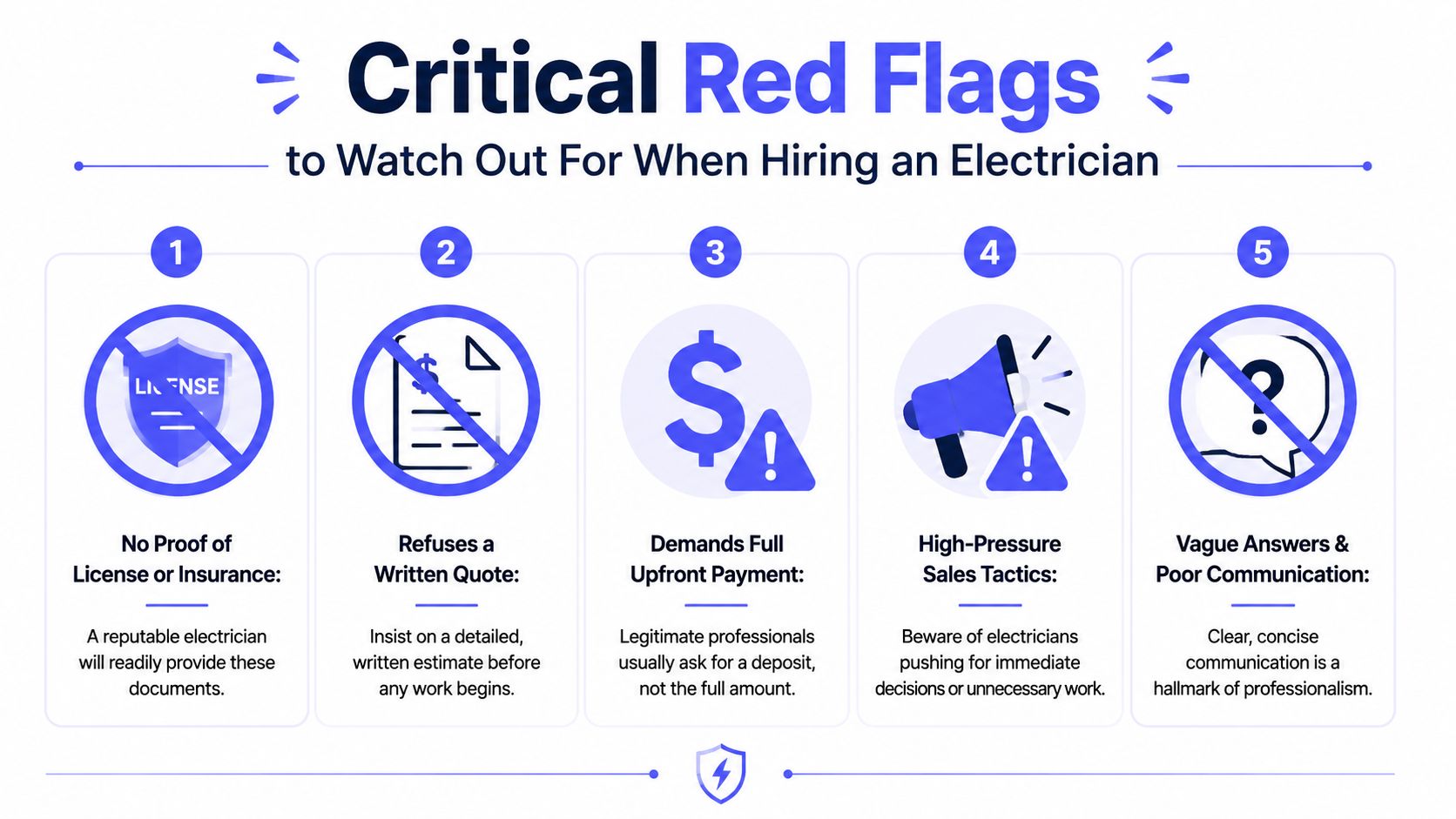
Some warning signs are small, but they matter fast. A person who won't give you a license number is telling you exactly how the rest of the job will go. A contractor who wants the full amount in cash before work starts is doing the same.
Becoming a licensed electrician is a rigorous process. In many states, it takes about 8,000 hours of supervised on-the-job training, roughly four years, plus classroom hours before the licensing exam (Housecall Pro licensing overview). If someone is unwilling to show credentials, that's not a minor annoyance. It's a major red flag.
Red flags that should stop the conversation
- No proof of license or insurance: A professional should produce documents without drama.
- Refuses a written quote: Verbal promises disappear the minute something goes wrong.
- Demands full upfront payment: A deposit may be normal. Full payment before work starts is not.
- Pushes you to decide immediately: Pressure is often used to skip your comparison process.
- Answers stay vague: If you can't get a straight answer about scope or permits, walk away.
A too-cheap bid deserves suspicion too. It can mean the scope is incomplete, the crew isn't properly insured, or the electrician plans to recover margin through change orders. That's where people get burned. They hire for the lowest number, then pay more after the job expands.
Trust your reaction when the conversation feels slippery. If the electrician won't put details in writing, won't name who's doing the work, or won't explain what could change the price, you already have enough information. The best move is to stop there and keep looking.
Making the Final Hire and Kicking Off the Project
Once you've chosen the electrician, lock the details down before the first tool comes out. Sign the contract. Confirm the start date. Make sure you know who your main contact is on site, and ask how updates will be handled if something changes. Those small points keep the job from drifting.
Keep every document together. Save the estimate, scope, proof of insurance, permit notes, the signed contract, change orders, inspection paperwork, and the final invoice. If a warranty issue comes up later, you'll want the whole paper trail in one place.
Before work starts, run one final checklist.
- Scope confirmed: The exact work matches the quote.
- Permits assigned: You know who is pulling them.
- Access arranged: Someone can let the crew in, if needed.
- Communication set: You know who to call with questions.
- Payment terms clear: You know what's due and when.
That's the point where the hire stops being a gamble and becomes a managed project. You've checked the license, verified the scope, compared bids properly, and filtered out the weak signals. Now the work can start with fewer surprises and a lot more control.
A CTA for Hand Vetted Co.. If you want a faster way to get matched with a verified professional without sifting through random leads, start with Handvetted and review How It Works, Our Standards, and the FAQ before you book your next project.