A storm just hit. Your roof may be open, water may be moving through walls, and your phone is filling up with advice you didn't ask for. This is the moment when small decisions turn into big costs.
It's often thought the hard part is cleaning up. It isn't. The hard part is making the right calls in the first few hours so you don't lose time, lose documentation, or give your insurer a reason to push back later. Good storm damage restoration services don't just fix damage. They protect your claim, your timeline, and your chance of getting the property back to normal without a second disaster unfolding inside the first one.
Table of Contents
- What Are Storm Damage Restoration Services
- Your First 24 Hours What to Do Immediately
- The Professional Restoration Process Step by Step
- Understanding Costs and Navigating Insurance Claims
- How to Choose a Restoration Contractor and Avoid Scams
- Common Questions About Storm Damage Restoration
What Are Storm Damage Restoration Services
Storm damage restoration services are the coordinated professional response used to stabilize, dry, clean, repair, and document a property after a storm. That includes immediate emergency work and the longer rebuild that follows.
That distinction matters. A lot of people call one roofer or one handyman and assume the rest will sort itself out. It usually doesn't. Storm loss is rarely one problem. It's a chain reaction. Wind opens the structure, water gets in, materials stay wet, contamination spreads, and then the insurance file gets complicated.
Here's the quick visual map.
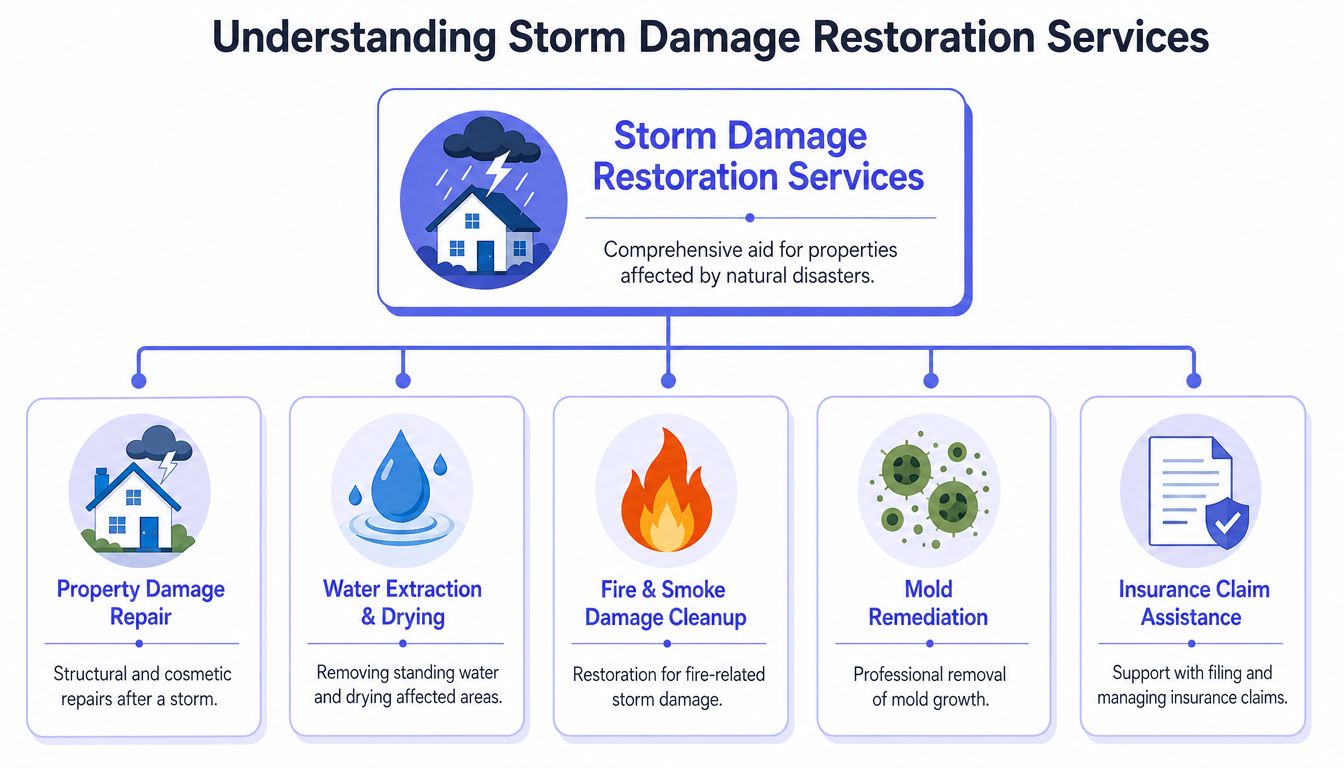
The five core service types
Emergency board-up and tarping come first when the structure is exposed. Broken windows, missing shingles, lifted flashing, and roof punctures need temporary protection right away so weather doesn't keep adding damage.
Water extraction and drying deal with what got inside. This is the biggest single service line in the broader market. Water damage restoration led the entire disaster restoration market by service type in 2025, accounting for a 38.56% share of total market volume, according to Restoration Inbound's restoration industry statistics.
Mold remediation becomes necessary if moisture wasn't removed fast enough or if contamination spread into porous materials. This then renders an already bad job much more expensive and disruptive.
Property repair and reconstruction handle the rebuild. That can include roofing, drywall, insulation, flooring, siding, trim, paint, and structural components.
Insurance claim support isn't fluff. It's part of the job. Good restoration teams document moisture readings, affected materials, emergency measures, and scope changes so your claim file matches what occurred.
Practical rule: Don't hire for the first visible problem only. Hire for the full sequence of problems the storm likely started.
Think of it like an emergency room team
The easiest way to understand storm damage restoration services is to think of them as an emergency room team for a building.
One group stops the bleeding. Another runs diagnostics. Another handles infection risk. Another takes the property through repair and recovery. If one part is missing, the rest gets harder.
That's why the first call matters so much. If your roof is open, you need stabilization first. If water has entered walls or ceilings, you need professional drying, not just fans from the garage. If smoke, electrical issues, or contamination are involved, you need specialists, not guesses.
A calm, methodical response always beats a rushed cleanup.
Your First 24 Hours What to Do Immediately
The first day after a storm feels noisy. People are texting. Neighbors are comparing damage. Insurance hold times are long. Ignore the noise and do the next right thing in order.
The clock starts immediately because wet materials don't wait. Structural materials exposed to moisture for longer than 48 to 72 hours face significantly increased mold risk, a relationship codified by the IICRC S500 Standard, which also requires immediate emergency stabilization, as explained by the Massachusetts Restoration Authority guide on storm damage restoration.
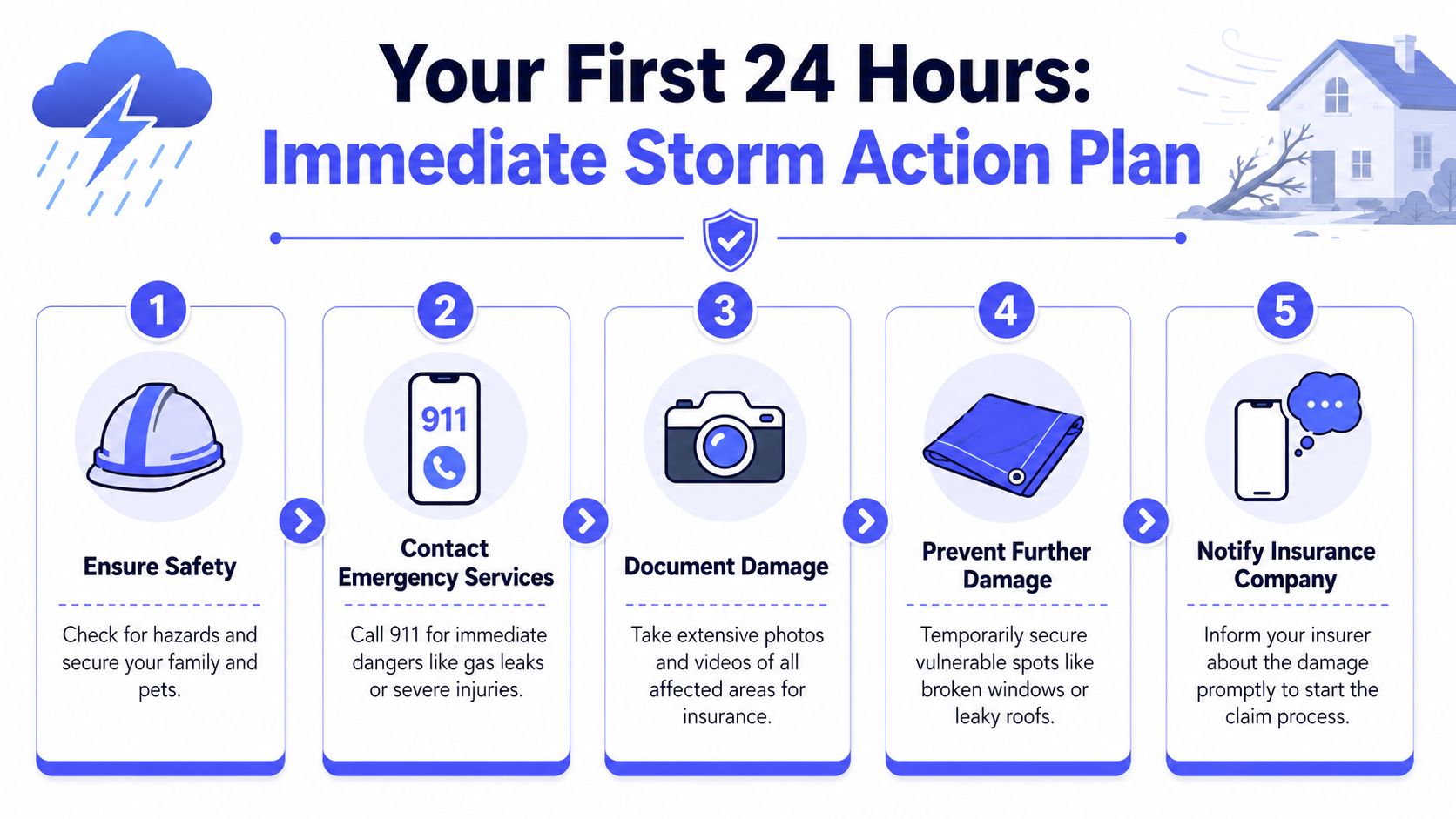
Safety comes before cleanup
If there's standing water near electrical systems, a gas smell, structural sagging, fallen lines, or active fire risk, stay out and call emergency services. Don't try to be brave. Storm-damaged buildings hide hazards well.
Once it's safe enough to enter or approach, do a slow visual check. Look up first. Ceilings, rooflines, and tree impact points tell you quickly whether this is a cleanup job or a stability problem.
Use this sequence:
- Protect people first: Move family, pets, and anyone vulnerable away from the hazard zone.
- Stop active damage if you can do it safely: Shut off water if a pipe broke. Avoid electrical panels if water is present.
- Don't start tearing things out yet: Premature cleanup destroys evidence and creates insurance arguments.
The first calls and first proof
Before you move furniture, pull soggy rugs, or throw out damaged contents, document everything. Wide shots first. Close-ups second. Video walk-through third. Capture exterior damage, interior damage, ceilings, walls, floors, windows, electronics, appliances, and personal property.
Then make these calls in this order:
- Insurance carrier: Open the claim early and get a claim number.
- Restoration company: Ask for emergency stabilization and drying, not just an estimate.
- Utility provider if needed: Especially for electrical, gas, or line issues.
Keep a simple log in your notes app.
- Who you spoke to
- Time and date
- What they told you
- What they approved
- What you were told to do next
If you take temporary measures like tarping or moving contents, photograph those steps too. Insurers want to see that you acted to prevent further loss, not that you waited and hoped for the best.
What you should not do in the first 24 hours is just as important.
| Do this | Avoid this |
|---|---|
| Photograph before moving items | Throwing damaged materials away too early |
| Tarp and board up exposed areas | Climbing on a storm-damaged roof yourself |
| Start a claim immediately | Waiting days to report obvious damage |
| Get professional drying underway | Assuming open windows and box fans are enough |
If you do only three things today, make them these: secure the structure, document the loss, and get professional mitigation moving.
The Professional Restoration Process Step by Step
Once the emergency phase is under control, the project needs to move through a disciplined sequence. Not a guess. Not a collection of random repairs. A sequence.
The standard workflow is formal for a reason. The storm restoration process follows a formal sequence: emergency stabilization, damage assessment, scope-of-work development referencing current code editions, permitted repair execution inspected by the authority having jurisdiction, and final closeout, as outlined by National Storm Repair's overview of storm restoration industry standards.
Here's what that looks like in practice.
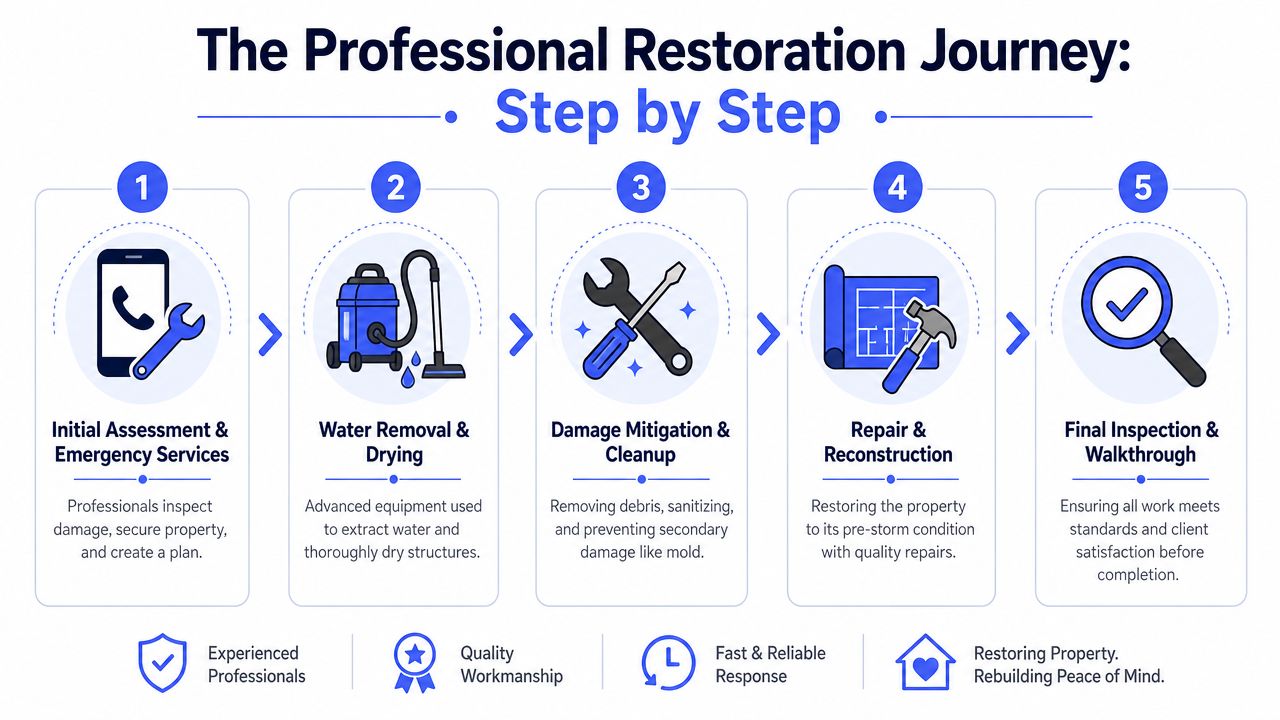
What mitigation actually means
A crew arrives after a severe wind and rain event. They're not there to make the place pretty on day one. They're there to stop the loss from growing.
Mitigation usually includes emergency tarping, board-up, water extraction, debris removal, moisture mapping, and equipment setup. You may see refrigerant dehumidifiers, desiccant systems, air movers, containment barriers, and meters used to track drying progress. This phase is about stabilizing conditions and preserving what can still be saved.
That's why “cleanup” is the wrong mental model. A serious team is measuring, documenting, and adjusting daily. If you want a plain-English breakdown of that workflow, this guide on water damage restoration steps is useful context.
The best restoration crews don't rush to rebuild wet materials. They prove the structure is dry enough first.
What restoration and reconstruction include
After mitigation comes the scope. At this point, people either stay organized or get buried in change orders.
The scope should identify affected materials, note what can be cleaned versus removed, and account for code-required repairs. If the damage is severe enough, code upgrades may be triggered during rebuild. That matters for roofing assemblies, structural repairs, electrical work, and insulation details.
A well-run job typically moves like this:
- Assessment and documentation: Moisture readings, photo records, and damaged-area mapping.
- Drying and environmental control: Equipment stays until target dryness is reached.
- Selective demolition and cleanup: Unsalvageable materials come out. Salvageable areas are cleaned and treated.
- Reconstruction: Drywall, trim, paint, roofing, flooring, and structural repairs go back in.
- Final closeout: Punch list, final documentation, and sign-off.
Not every storm loss needs full reconstruction. Some only need mitigation and localized repair. Others reveal hidden roof deck damage, soaked insulation, compromised sheathing, or interior wall cavities full of moisture. That's why a good assessment beats a quick verbal estimate every time.
If a company wants to skip moisture documentation, skip permits where needed, or skip final verification, that's not speed. That's sloppiness.
Understanding Costs and Navigating Insurance Claims
The price of storm damage restoration services depends on what the storm did, how long materials stayed wet, what has to be removed, and what code-compliant repair requires. Anyone who gives you a firm number from a few phone photos is guessing.
There's also a big difference between mitigation costs and reconstruction costs. Mitigation covers emergency work, drying, protection, and contamination control. Reconstruction covers putting the property back together. Those are often tracked separately, even when one company handles both.

What drives the estimate
A serious estimate usually reflects several moving parts, not one lump sum.
| Cost driver | Why it changes the estimate |
|---|---|
| Scope of water intrusion | More affected rooms and hidden cavities mean more drying, demo, and repair |
| Material type | Hardwood, insulation, plaster, tile assemblies, and custom finishes all behave differently |
| Access and safety conditions | Roof pitch, structural instability, and debris change labor needs |
| Contamination level | Clean water and contaminated water are not priced or handled the same way |
| Permit and code requirements | Some repairs require inspections and code-compliant upgrades |
The insurance side gets messy when your timeline and your documentation are weak. Your photos matter. Your call log matters. The restoration company's records matter. Moisture readings, drying logs, emergency service records, and photos of pre-mitigation conditions all help your file make sense.
If you need a plain-language reference for policy basics while you review your claim, this breakdown of homeowners insurance coverage can help you frame the conversation.
How secondary damage creates claim problems
This is the part too many guides skip. Insurers often separate the original storm event from damage that happened because the property wasn't protected or dried in time.
Data shows that a delay in professional intervention beyond 72 hours can lead to insurance claim denials for mold growth, according to the Georgia Restoration Authority storm damage restoration guide. That's a brutal outcome because people think they're saving money by waiting, when they're instead creating a coverage fight.
Ask direct questions when you speak to the adjuster:
- What emergency measures should I take now to protect the claim
- What documentation do you want before materials are removed
- Do you need your inspection before full demolition begins
- How should I submit mitigation invoices and moisture records
Don't argue from memory. Argue from records. Photos, dates, invoices, drying logs, and written approvals carry the conversation.
The deductible is one piece of your out-of-pocket exposure. It is not the whole story. If scope gets disputed, if code items aren't covered the way you expected, or if secondary damage is excluded, your cost can move. That's why speed and paperwork matter almost as much as the repair itself.
How to Choose a Restoration Contractor and Avoid Scams
After a storm, bad contractors get busy before good contractors even finish breakfast. They knock doors, promise priority service, and push people to sign before the property has even been properly assessed.
That's why vetting matters more than charisma. The pool is large and uneven. The number of damage restoration service businesses in the US reached 62,582 in 2025, and the industry also faces a persistent 25% skilled labor shortage, according to the 911 Restoration overview of the growing restoration industry. In plain English, there are plenty of businesses, and not enough experienced people inside many of them.
Why hiring fast and hiring well are not the same thing
Storm pressure makes people confuse responsiveness with competence. They're not the same.
A fast answer is good. A fast answer without licensing, insurance, supervision, documentation standards, and a clear process is a liability. You need a company that can stabilize the property immediately and still manage permits, drying records, insurance communication, and reconstruction correctly.
Watch for these red flags:
- Large upfront payment demands: Especially before materials, scope, or permits are clear.
- Pressure to sign everything on the spot: Good businesses explain. Scammers rush.
- No proof of license or insurance: If they get vague, walk away.
- No written scope: A verbal promise is not a project plan.
- Roofing-only mindset on a water loss: If water entered the structure, roofing alone won't solve it.
Questions that separate pros from opportunists
Ask pointed questions. A legitimate company won't be offended.
- Who handles emergency stabilization, drying, and reconstruction
- How do you document moisture and drying progress
- What parts of the job require permits
- Who communicates with the insurer and how often
- What happens if hidden damage is found after demo
- Can you show licensing, insurance, and screening information
If you want to verify whether a business has gone through meaningful screening, review what a proper contractor background check should cover. It's a good benchmark even if you're vetting on your own.
A contractor should also be honest about limitations. If they can't start mitigation quickly, they should say so. If they do roofing but subcontract all drying and mold work, they should say that too. Clear boundaries are a good sign. Vague confidence is not.
Storm recovery gets expensive when one company patches the roof, another dries badly, and a third comes back to remediate mold that shouldn't have happened in the first place.
Your best hire is usually the one who documents well, communicates clearly, and doesn't need to oversell.
Common Questions About Storm Damage Restoration
The broad process is one thing. The practical decisions in the middle of it are what keep people up at night.
Can you stay in the property during restoration
Sometimes yes. Sometimes absolutely not.
If the damage is limited to one area, utilities are safe, and there's no contamination or major structural issue, you may be able to remain in part of the property while work happens elsewhere. If there's widespread water intrusion, exposed framing, active mold concerns, electrical hazards, or major demolition, staying put can make the job slower and less safe.
Ask the restoration lead one direct question: Is this property safe to occupy today, and if only partly, which areas are off limits?
Do you need multiple estimates
Not always. If emergency mitigation is needed, waiting around for several bids can be the wrong move.
For urgent losses, the first priority is stabilizing the property and preventing additional damage. After that, you can review scope, compare reconstruction approaches if needed, and ask sharper questions. Multiple estimates are useful when the work is discretionary. Storm mitigation usually isn't.
What you do need is one estimate you can read. It should separate emergency work from rebuild work, note assumptions, and explain allowances or unknowns.
How long does the full process take
There isn't one answer because storm losses split into three clocks.
The first clock is emergency response. The second is drying and mitigation. The third is reconstruction, which can stretch if materials, permits, inspections, or insurer approvals slow down. A small localized loss may move quickly. A roof breach with hidden moisture, insulation removal, and code-triggered repairs takes longer.
The better question is this: What has to happen before the next phase can start? That keeps everyone honest.
What's the difference between your deductible and your real out-of-pocket cost
Your deductible is the amount your policy says you pay before coverage applies. Your total out-of-pocket cost can be different.
If parts of the claim are excluded, if betterments or upgrades fall outside coverage, or if late action creates disputed secondary damage, your cost can rise beyond the deductible. Read your scope carefully. Read your insurer's explanation carefully. Don't assume they mean the same thing.
What should you save and track during the job
Keep one folder, digital or paper, with everything.
- Claim number and adjuster contact
- Photos and videos from day one
- Emergency invoices
- Drying logs and moisture reports
- Permit records if applicable
- Change orders and revised scopes
- Emails, texts, and approvals
This one habit prevents a huge amount of confusion later.
What matters most if you want fewer surprises
Three things. Fast stabilization. Clean documentation. A contractor who treats mitigation, insurance records, and reconstruction as one connected process.
If you miss the first, damage spreads. If you miss the second, the claim gets shaky. If you miss the third, the whole project turns into handoff chaos.
The practical takeaway is simple. Don't wait for perfect clarity. Get the property secured, document everything before it moves, and hire a restoration company that can explain exactly what happens next and why.
If you want a simpler way to find the right pro without calling a dozen companies in a panic, Hand Vetted Co. is worth a look. You get one exclusive match to a licensed, background-checked, 4.5+ star rated professional, not your contact info blasted to a lead list. If you want more context before you start, their How It Works, Our Standards, and FAQ pages are the right place to begin.