A standard HVAC service call during normal daytime hours usually runs about $75 to $200, and $100 to $150 is the most common band for a straightforward visit. That number is only the door-opening price. It usually pays for diagnosis, not the repair.
That distinction is where people get burned. They hear a service call fee, assume that's the job price, then get blindsided when the actual repair quote lands a lot higher. If you want to understand HVAC service call cost, stop asking “what's the visit cost?” and start asking “what does that fee include, and what happens if the diagnosis turns into real work?”
Table of Contents
- What a Standard HVAC Service Call Actually Costs
- The Main Factors That Push Your Price Up or Down
- Daytime vs After-Hours and Emergency Pricing
- Three Real-World Cost Scenarios Homeowners Face
- Why Your Quote Can Differ From the National Average
- Smart Questions to Ask Before You Book the Visit
- How a Verified Match Protects You From Hidden Costs
- Your Next Steps Before Calling a Technician
What a Standard HVAC Service Call Actually Costs
A low trip fee fools people every day. Analysts at JobEstimator's 2026 HVAC service call pricing guide put a standard business-hours HVAC service call in the $75 to $200 range, with $100 to $150 showing up often for a basic residential visit. That number usually buys diagnosis only.
Here is the clean way to read the bill:
- Service call or diagnostic fee: the cost to send a tech, inspect the system, and identify the problem
- Repair labor: the charge to perform the fix after the problem is confirmed
- Parts: anything replaced, from a capacitor to a contactor or control board
That separation matters. A company can advertise a cheap visit fee and still hand you a high repair total once the cabinet is open.
What the service call fee should include
At minimum, the fee should cover the trip to your home, basic system testing, and a clear explanation of the fault. On a normal residential call, that often means checking the thermostat, power supply, disconnect, capacitor, contactor, control board signals, and the indoor and outdoor equipment tied to the complaint.
You should also expect a written repair quote before any billable repair work starts.
If a company refuses to say what the diagnostic fee includes, skip them.
Diagnosis and repair are billed separately
Homeowners get in trouble when they treat the service call as the job price. It is not. The service call opens the ticket. The repair closes it, and that second number is usually the one that matters.
A straightforward repair visit can climb well beyond the initial trip charge once labor and parts are added. The exact total depends on the fault, the system, and the company's pricing model.
Ask one question before you book
Some companies credit the diagnostic fee toward the repair if you approve the work on the spot. Some keep it no matter what. Consumer discussion collected in this Reddit thread about HVAC diagnostic fees shows how common that credit policy is, and how inconsistent companies are about explaining it upfront.
Use this script on the phone:
“What is your diagnostic fee, what does it include, and if I approve the repair today, is that fee applied to the final invoice?”
Ask it exactly that way. It forces a straight answer before the truck rolls.
The Main Factors That Push Your Price Up or Down
Most pricing swings come from four things. When you call. Where you live. What system you have. How ugly the diagnosis turns out. The diagnostic fee is only the starting point.
Timing changes the bill fast
After-hours pricing is where small problems get expensive. Independent benchmarks show standard daytime diagnostic or truck-roll fees around roughly $75 to $150, while emergency or holiday dispatch often rises to about $150 to $500. The same guide notes that hourly labor can jump from roughly $75 to $150 under normal conditions to about $140 to $600 in major metro emergency situations, based on Nearby Hunt's emergency HVAC cost benchmarks.
If your system quits at night, on a weekend, or during a weather spike, you're paying for priority dispatch and disrupted scheduling. That's normal. What isn't normal is refusing to tell you the rate structure before the truck leaves.
Market and travel matter more than people think
Regional pricing is all over the map. Recent benchmarks place rural or smaller markets around $79 to $99 for the diagnostic fee, while large metros like San Francisco, New York, Boston, and DC run roughly $149 to $249. Hard-to-access or more complex systems can add about $25 to $100 or more to the diagnostic fee, according to Crew Conductor's 2026 service call pricing guide.
That's why your cousin in a smaller town paid less than you did for what sounds like the same issue. The system may be similar. The market isn't.
Complexity changes the scope
A simple issue can end at the diagnostic. A bigger failure turns the call into a real repair ticket.
- Simple control problem: You might only owe the service call if the fix is minor or no repair is needed.
- Common electrical repair: Once labor and a common part get added, many jobs move into a normal repair range.
- Major mechanical failure: Compressor, refrigerant, blower, or repeat-visit issues push the final bill far beyond the original diagnostic fee.
| Cost Driver | Typical Dollar Impact | When It Applies |
|---|---|---|
| Standard daytime diagnostic | $75 to $150 | Weekday service window in many markets |
| Common residential diagnostic band | $100 to $150 | Straightforward visit with basic access |
| Premium metro diagnostic | $149 to $249 | Large, higher-cost urban markets |
| Travel surcharge | $30 to $100 | Longer-distance, suburban, or out-of-area calls |
| Accessibility or complexity add-on | $25 to $100 or more | Hard-to-access or more complex systems |
| Emergency or holiday dispatch | $150 to $500 | Urgent, after-hours, or holiday visits |
| Typical repair visit after diagnosis | $250 to $500 | Diagnosis plus labor and a common part |
If a company can't explain which of those line items applies to your job, don't book them yet.
Daytime vs After-Hours and Emergency Pricing
The same HVAC issue can cost very different amounts based only on the clock. That's not a theory. It's how most service pricing works.
The four scheduling tiers
During standard daytime hours, most service calls fall into the baseline range already covered. But once you move outside that window, the premium starts stacking.
One pricing guide puts evening and weekend diagnostic calls at about $150 to $300, while holiday or urgent emergency service can reach $200 to $400. Another 2026 guide shows dispatch fees rising from roughly $89 to $149 in standard hours to $275 to $500 on major holidays, based on RJ Groner's HVAC diagnostic fee guide.
Don't assume “after-hours” means the same thing everywhere
Some businesses count anything outside a typical weekday workday as after-hours. Others don't trigger that rate until later in the evening. You need their definition before you agree to a visit.
That one question matters because a “same-day” appointment late in the afternoon can turn into an after-hours ticket if the truck arrives outside the company's standard billing window.
| Scheduling Tier | Typical Total Range | Multiplier vs Standard |
|---|---|---|
| Standard weekday daytime | $75 to $200 | Baseline |
| Evening or weekend diagnostic | $150 to $300 | Higher than standard |
| Holiday or urgent emergency | $200 to $400 | Materially higher |
| Major holiday dispatch | $275 to $500 | Can be several times the base diagnostic |
My advice on emergency calls
If the issue is dangerous, book the call and deal with the premium. If the issue is uncomfortable but not urgent, waiting until normal business hours can save real money before any repair even starts.
Ask this exact question: “What will the total diagnostic fee be if the technician arrives at that time, including any after-hours, weekend, or dispatch surcharge?”
That forces a real number, not a bait rate.
Three Real-World Cost Scenarios Homeowners Face
A service call that starts around the low hundreds can end as a small bill, a mid-range repair, or a four-figure decision. The diagnostic fee gets the truck to your house. The final invoice is driven by what the technician finds and what time the work happens.
Scenario A with a minor furnace issue
A gas furnace will not ignite. The technician finds a dirty flame sensor, cleans it, confirms proper operation, and wraps up during a standard daytime visit.
This is the cheap outcome homeowners hope for. You still pay the service call, and you may pay a small labor charge, but there are no expensive parts hiding in the diagnosis.
Scenario B with a common AC electrical repair
A central AC system is blowing warm air. The technician traces the problem to a failed capacitor or contactor, replaces the part, and tests the system.
This is the most common middle ground. The diagnostic fee gets you the answer. The repair adds labor and parts. The total is no longer a basic service call, but it is still a routine fix in many markets.
Scenario C with refrigerant or compressor trouble
An older split system fails on a weekend. The technician finds a refrigerant leak, a locked compressor, or signs that the compressor is failing.
People overspend. The timing is expensive. The repair category is expensive. Older equipment also raises the odds that you approve a large bill on a system that should be replaced instead. Before you say yes to a major repair, compare the numbers against this guide on repair or replace your HVAC system.
| Scenario | System & Problem | Diagnostic Fee | Labor | Parts / Extras | Total Range |
|---|---|---|---|---|---|
| Minor heat issue | Furnace will not ignite, dirty flame sensor | $75 to $150 | $25 to $75 | $0 to $25 | $100 to $250 |
| Common cooling repair | AC blowing warm air, capacitor or contactor replacement | $75 to $150 | $100 to $200 | $75 to $150 | $250 to $500 |
| Older system, weekend problem | Refrigerant leak or compressor-related issue | $150 to $300 | $150 to $400 | $300 to $1,000+ | $600 to $1,700+ |
Use these scenarios the right way. Do not treat them as exact quotes. Treat them as a reality check before you approve work.
If your bill starts to look like Scenario C, slow down. Ask whether the quoted repair solves the whole problem, whether a second visit is likely, and whether the age of the equipment makes the repair a bad bet. That pause can save you hundreds.
Why Your Quote Can Differ From the National Average
National averages hide the part that decides whether your bill is fair. The line items.
Two companies can both sound “within average” on the phone and still land hundreds apart once the invoice is written. One quotes a $95 diagnostic fee, then credits it toward the repair. Another charges $149 for the visit, bills labor separately at $165 per hour, adds a truck or materials charge, and credits nothing. Both can claim they are competitive. Only one is giving you a clean price.
That is why you should normalize every quote before you compare it. Ask each company for the same four numbers.
| Quote Item to Compare | Common Range | What to Ask |
|---|---|---|
| Diagnostic or trip fee | $75 to $150 | “Is this fee only for diagnosis, or does it include any repair labor?” |
| After-hours diagnostic fee | $150 to $300 | “What is the exact visit fee tonight or this weekend?” |
| Labor rate after diagnosis | $75 to $110/hr in lower-cost markets, $140 to $200/hr in higher-cost metros | “What hourly rate applies if I approve repair?” |
| Diagnostic credit toward repair | $0 to full credit | “If I move ahead today, how much of the service call fee is applied to the repair bill?” |
Those four numbers expose the pricing trick that catches homeowners. A low advertised service call can still produce a high final bill if the company makes its margin on labor minimums, non-creditable diagnostics, or add-on fees that were never discussed up front.
Scope also gets muddied fast. One quote may include diagnosis, basic testing, and the first 30 minutes of repair labor. Another may stop at diagnosis only. If you compare those quotes as if they mean the same thing, you will pick the wrong company for the wrong reason.
Why your neighbor paid less
Your neighbor may not have gotten a better company. They may have gotten a better quote structure.
Here is a cleaner comparison:
| Invoice Structure | Example Charges | Total Before Parts |
|---|---|---|
| Lower entry fee, no credit | $89 diagnostic + $165 labor | $254 |
| Higher entry fee, full credit | $149 diagnostic, credited back + $165 labor | $165 |
| Premium after-hours visit | $225 after-hours diagnostic + $185 labor | $410 |
Same symptom. Very different math.
Ask for an itemized written estimate before the tech starts repair work. If the company will not break out the diagnostic fee, labor, parts, and any credit, do not guess. Keep calling.
A national average is a rough reference point. An itemized quote is what protects your wallet.
Smart Questions to Ask Before You Book the Visit
Most surprise charges could have been prevented with one good phone call. Not a long call. Just a disciplined one.
Use this script before anyone gets dispatched
Start with the money questions. Don't ask loosely. Ask in a way that forces a clear answer.
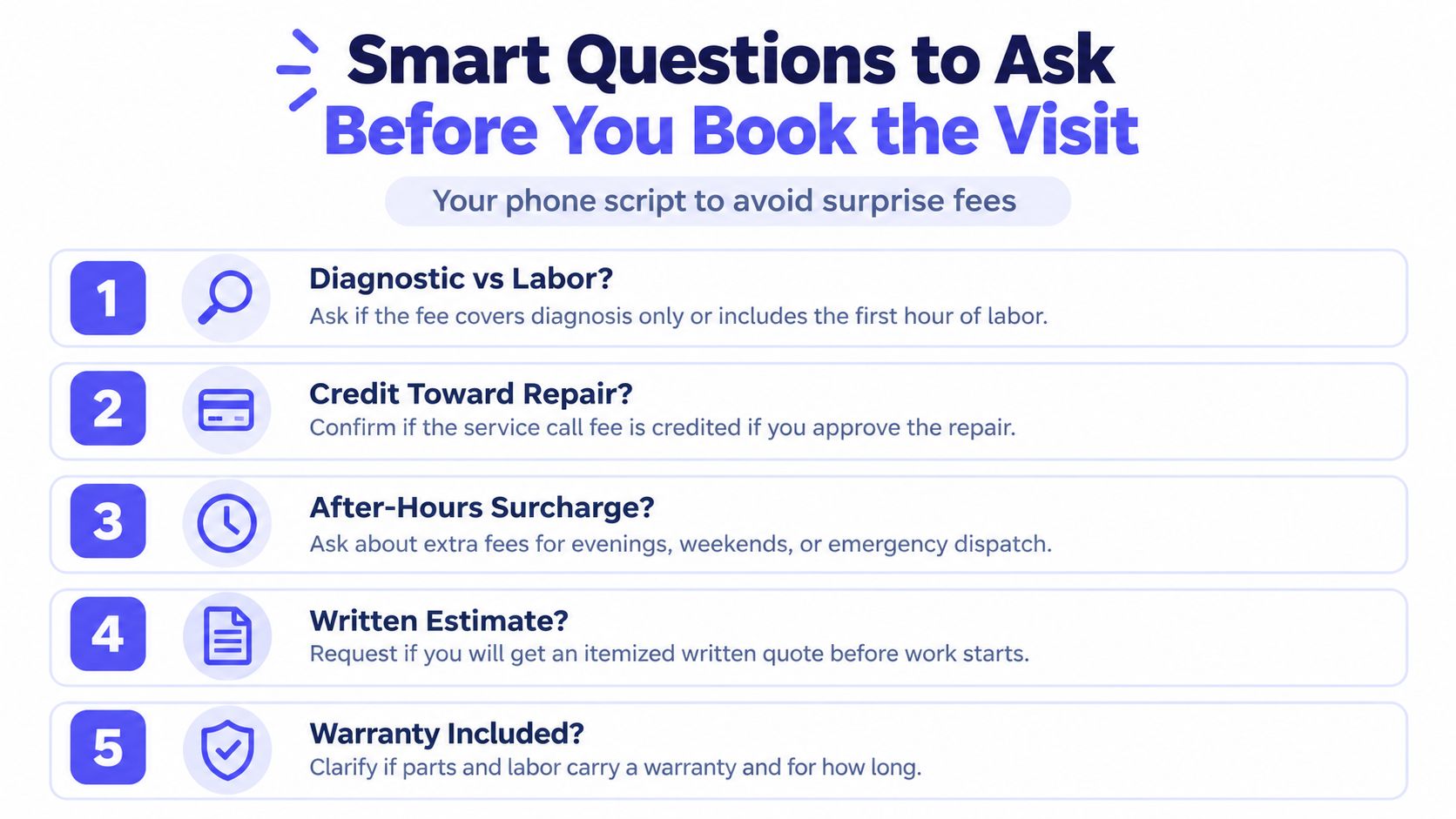
- “Is your quoted fee diagnostic only, or does it include any repair labor?” This tells you whether you're paying just for inspection or whether the first block of work is bundled.
- “If I approve the repair today, is the service call fee credited back?” Some companies do it. Some don't. Ask now.
- “What is the total fee if this visit happens after-hours, on a weekend, or as an emergency?” You want the full number, not the daytime teaser rate.
- “Will I get an itemized written estimate before work starts?” If they resist that, keep shopping.
- “What warranty applies to parts and labor?” Even a small repair should come with a clear answer.
For a longer pre-hire checklist, this guide on what to ask a contractor before hiring is worth keeping open while you call.
Red flags that should stop you cold
Three answers should make you walk.
- “It starts at…” That phrase usually means they want the truck in your driveway before they commit to pricing.
- “We can't quote the diagnostic over the phone.” They absolutely can quote the dispatch and diagnostic structure.
- “Just sign here and the tech will explain it onsite.” No. Get the rate by text or email first.
What a clean answer sounds like
A solid company should be able to tell you the diagnostic fee, whether it gets credited, what changes after-hours, and whether you'll see a written quote before repair work starts.
If they dodge any of that, they're not disorganized. They're keeping room open for fee creep.
How a Verified Match Protects You From Hidden Costs
Most hidden HVAC costs show up before the wrench turns. Vague trip fees. Unclear labor minimums. Parts pricing that appears out of nowhere. No accountability when the repair doesn't hold.
Why one accountable professional beats three random calls
Calling multiple search-result businesses sounds smart until each one charges a diagnostic fee, uses a different pricing model, and gives you a different story. You don't just lose time. You lose your bargaining power.
A verified match changes that because the expectations get set earlier. Licensing, insurance, and the visit structure should be clear before the appointment gets booked. That cuts down on the most common messes, especially double-trip charges and slippery estimate language.

What should be confirmed in writing
Before the truck rolls, you want four things pinned down:
- The diagnostic fee: Flat amount, not vague “starting at” language.
- The labor structure: Flat-rate repair book or clear hourly terms.
- The credential check: Active license and current insurance.
- The approval rule: No repair work starts until you say yes.
If you want to verify the credential side yourself, use a license-check process like this walkthrough on how to verify a contractor license.
One practical option is Handvetted, which matches people with one licensed, background-checked, 4.5+ star rated professional instead of sending the request to multiple businesses. The useful part here isn't hype. It's that an exclusive match reduces the comparison-shopping chaos that often shows up when an HVAC issue turns urgent.
You want one accountable person with clear pricing. Not three sales pitches and four different versions of the same problem.
Your Next Steps Before Calling a Technician
You can make your next service call cheaper, cleaner, and faster by doing a little prep before you pick up the phone.
Gather the details that shorten diagnosis
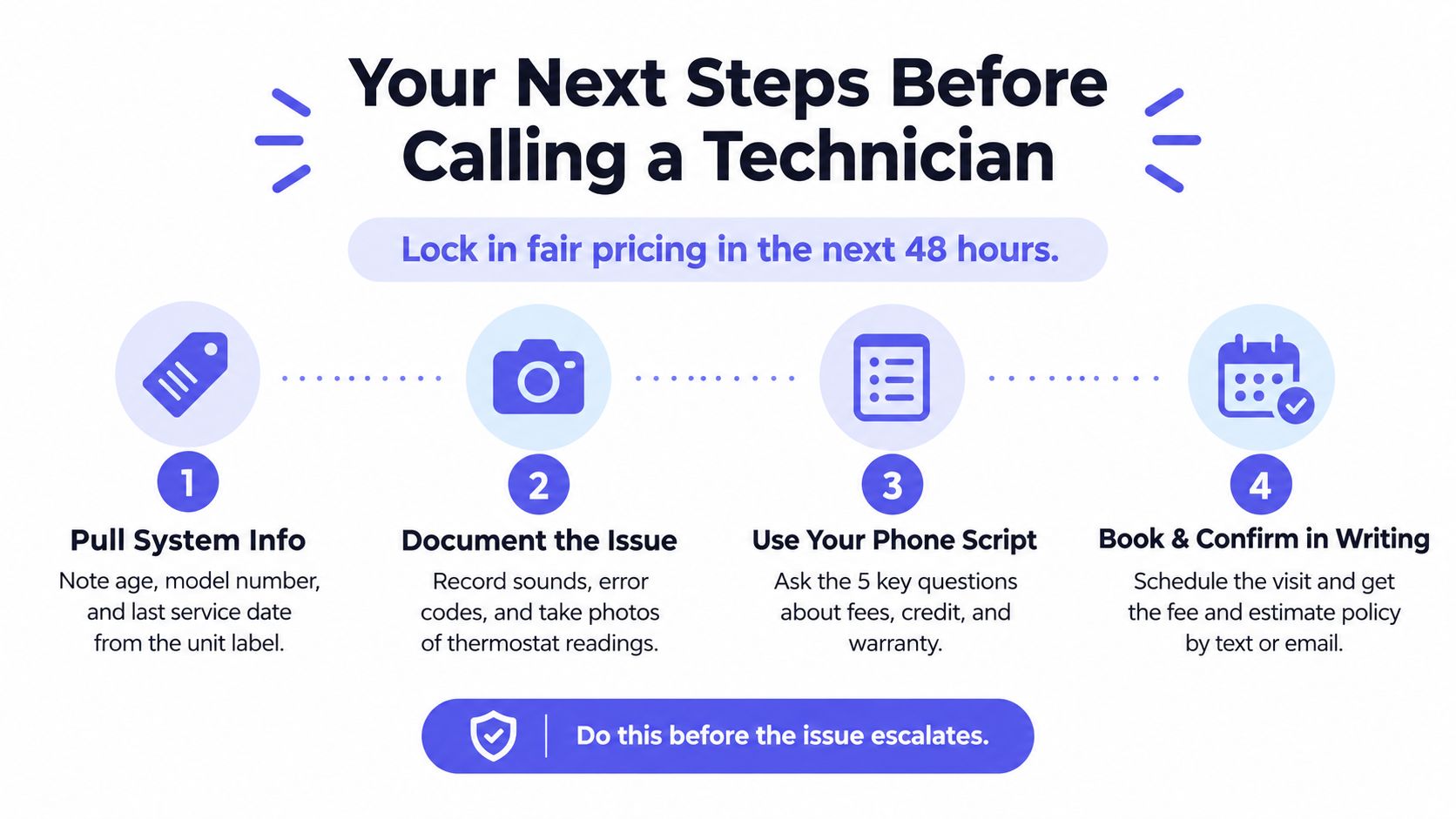
Start at the equipment. Pull the system age, model number, and last service date from the unit label if you can find it.
Then document the symptom. Take a photo of the thermostat, note any error codes, and write down what the system is doing. No cooling. No heat. Short cycling. Outdoor unit silent. Burning smell. Those details matter because vague calls waste diagnostic time.
Use a phone script that forces clarity
Keep it simple and direct:
“My system is doing X. Before I book, what is your flat diagnostic fee, does that fee get credited if I approve the repair, what changes if the appointment lands after-hours, and will you send the rate and estimate policy by text or email?”
That script works because it corners the parts of the pricing model that usually stay fuzzy. If they can answer it cleanly, good. If they can't, move on.
Make two smart moves this week
- Book in a normal service window when possible. If the issue can wait safely, don't volunteer for premium timing.
- Schedule maintenance before peak demand hits. Planned service gives you more choice and less pressure.
- Get confirmation in writing. Text or email is enough. Verbal pricing disappears when the invoice shows up.
- Use a vetted referral path if you don't already have a trusted pro. The goal is to avoid panic-booking a stranger when the system quits at the worst possible time.
Your best position is always before the truck rolls. After that, you're negotiating from discomfort.
If you want to skip the random search results and start with one accountable pro, Hand Vetted Co. matches you with a single licensed, background-checked professional instead of blasting your request to multiple businesses. For HVAC problems, that means less pricing confusion, fewer duplicate diagnostic fees, and a better shot at getting a clear answer before anyone shows up.