A pipe breaks overnight. By morning, water has reached the hallway, the drywall feels soft, and three contractors are calling because your information was passed around. You need help quickly, but the first company to answer isn't automatically the right one. The quality of the drying plan, the evidence collected, and the way the work is documented can affect both your property and your insurance claim.
Damage restoration companies handle the urgent work that stops a loss from spreading, removes contamination, and prepares the building for repair. This guide explains what they do, how the process works, what paperwork to request, and how to choose a qualified professional without getting trapped in contractor spam.
Table of Contents
- What Damage Restoration Companies Actually Do
- Types of Damage Restoration Services Explained
- How the Restoration Process Works From First Call to Rebuild
- What Restoration Really Costs and How Long It Takes
- Insurance Coordination and Paperwork You Should Demand
- Credentials Red Flags and Questions to Ask Before You Hire
- Choosing a Vetted Pro and Your Next Steps
What Damage Restoration Companies Actually Do
A damage restoration company responds when a property has been harmed by water, fire, smoke, mold, or a storm. The first priority usually isn't making the room look normal. It's making the property safe, stopping additional damage, and preserving information about what happened.
Think of the first visit as emergency-room triage. Medical staff stabilize the patient before planning long-term treatment. Restoration crews follow a similar order. They inspect the affected areas, identify active sources, secure unsafe conditions, remove standing water or debris, contain contamination, and record what they find. Cosmetic repairs come later.
Practical rule: A clean-looking surface doesn't prove that the building is dry or safe.
A general contractor may rebuild a wall, replace flooring, or install cabinets. A cleaning service may remove dirt or odors. A restoration company is trained to manage the conditions underneath those visible repairs, including trapped moisture, smoke residue, contaminated materials, and the evidence needed for an insurance file.
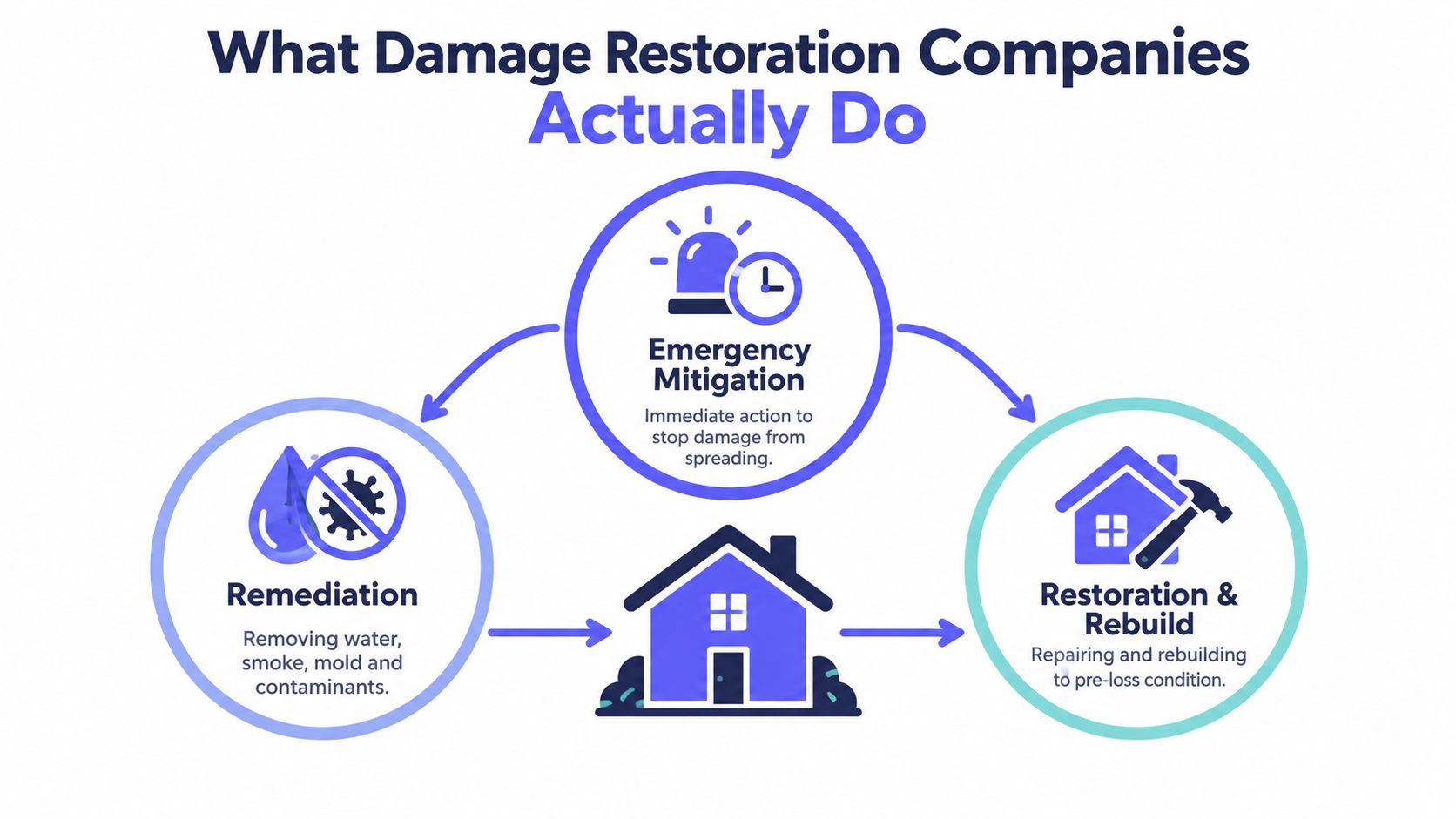
The three stages of recovery
Emergency mitigation means immediate action to stop the loss from getting worse. That may involve extraction, board-up work, temporary roof protection, controlled demolition, or barriers around affected areas.
Remediation removes water, smoke residue, mold, or other contaminants. The methods depend on the loss. Water requires measurement and controlled drying. Mold may require containment. Fire losses can involve soot cleaning and odor treatment.
Restoration and rebuild returns the property to its pre-loss condition. This can include drywall, flooring, paint, cabinetry, insulation, framing, or other structural repairs.
The U.S. damage restoration services industry is highly fragmented. An IBISWorld industry estimate projects $7.7 billion in 2026 revenue, with 57,615 businesses and 112,324 employees. That works out to roughly two employees per business on average, which helps explain why local availability, verification, and response capacity matter.
The same source estimates a 2.3% compound annual growth rate from 2021 to 2026, indicating steady expansion rather than explosive growth in mature U.S. markets. For you, the practical point is simple. You need a nearby firm that can mobilize, document the condition, and coordinate the right specialty, not just a recognizable national name.
Types of Damage Restoration Services Explained
The loss type determines the equipment, containment method, and technical standard a company should use. A restoration professional shouldn't treat a flooded room the same way as a smoke-damaged room or a mold-affected crawl space.
Water damage restoration
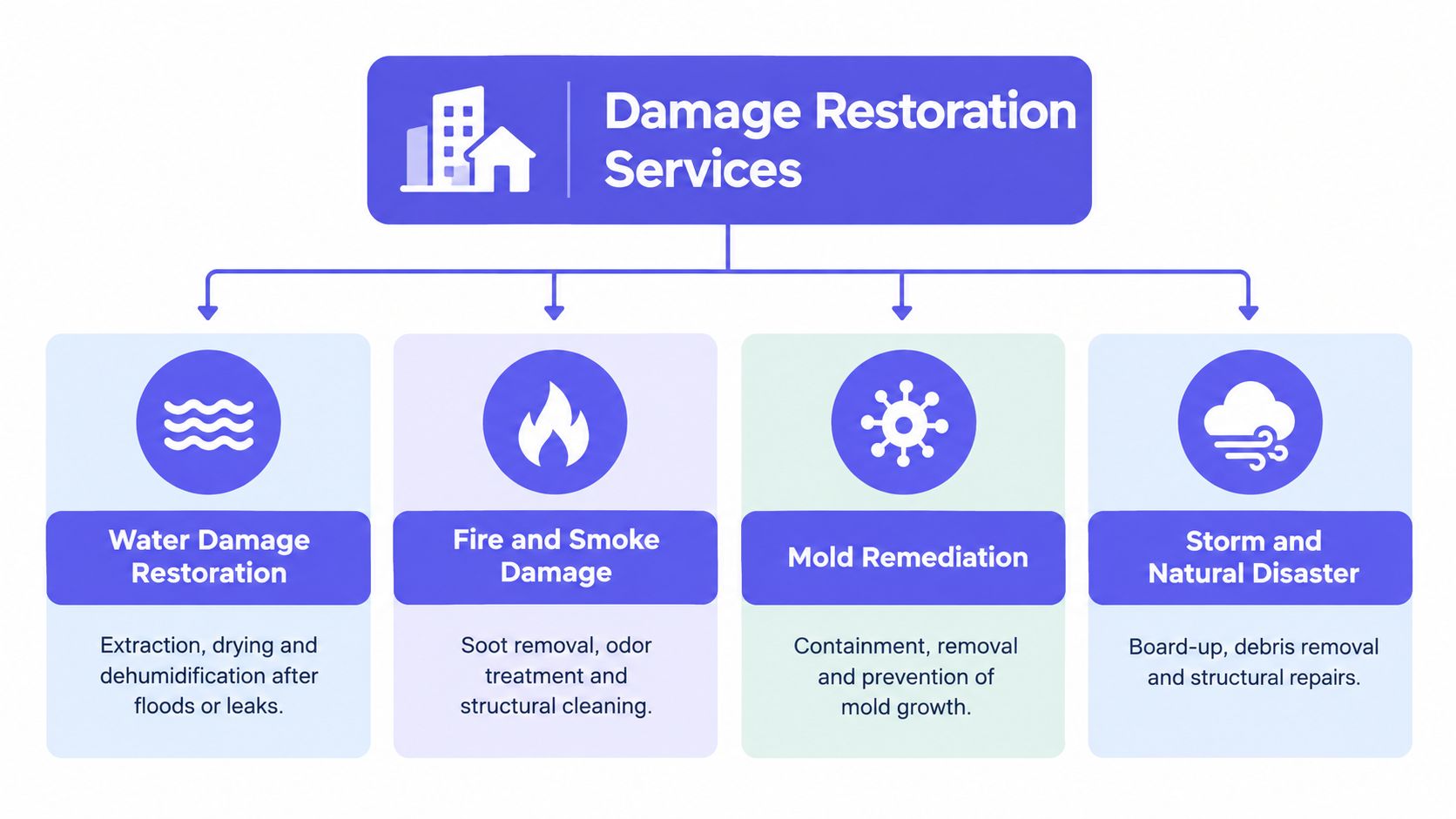
Water restoration usually begins with locating and stopping the source, followed by extraction and structural drying. Crews may use commercial air movers, dehumidifiers, moisture meters, and other measurement tools to determine whether water remains behind walls, beneath flooring, or inside framing.
Water is the largest segment in one global disaster restoration estimate, representing 39% of global revenue in 2022, according to Mordor Intelligence. The same report identifies fire and smoke at 27% and mold remediation at 11%. Those shares show why restoration work commonly involves everyday leaks, flooding, fire, and mold rather than only extraordinary disasters.
Fire and smoke damage
Fire restoration involves more than removing visibly burned materials. Soot can settle on surfaces away from the flames, while smoke odor can remain in porous materials. Professionals may clean structural surfaces, contents, HVAC-related areas, and salvageable belongings, then coordinate repairs after the property is stable.
Mold remediation
Mold work focuses on containment, removal, and preventing spores from spreading into occupied areas. The EPA's mold remediation guidance uses affected-area thresholds to guide containment: areas under 10 square feet generally don't require containment, areas from 10 to 100 square feet generally require limited containment, and areas over 100 square feet generally require full containment with double polyethylene barriers, negative air pressure, and usually a decontamination chamber or airlock.
Visible mold isn't the only issue. A musty odor, recurring moisture, or a wall cavity affected by a leak can justify further assessment even when the growth isn't obvious.
Storm and flood recovery
Storm losses can combine several service lines. A crew might board up broken openings, remove water, clear debris, contain damaged materials, and coordinate structural repairs. Floodwater can also raise contamination concerns that differ from a clean plumbing leak.
The right company may need to manage multiple specialties at once. Ask whether the proposed scope addresses the source, the affected materials, containment, drying or cleaning, and the repairs that follow.
How the Restoration Process Works From First Call to Rebuild
A professional response follows an order because each phase creates information needed for the next. Skipping inspection, measurements, or containment can leave you with a building that looks repaired but still holds moisture or contamination.
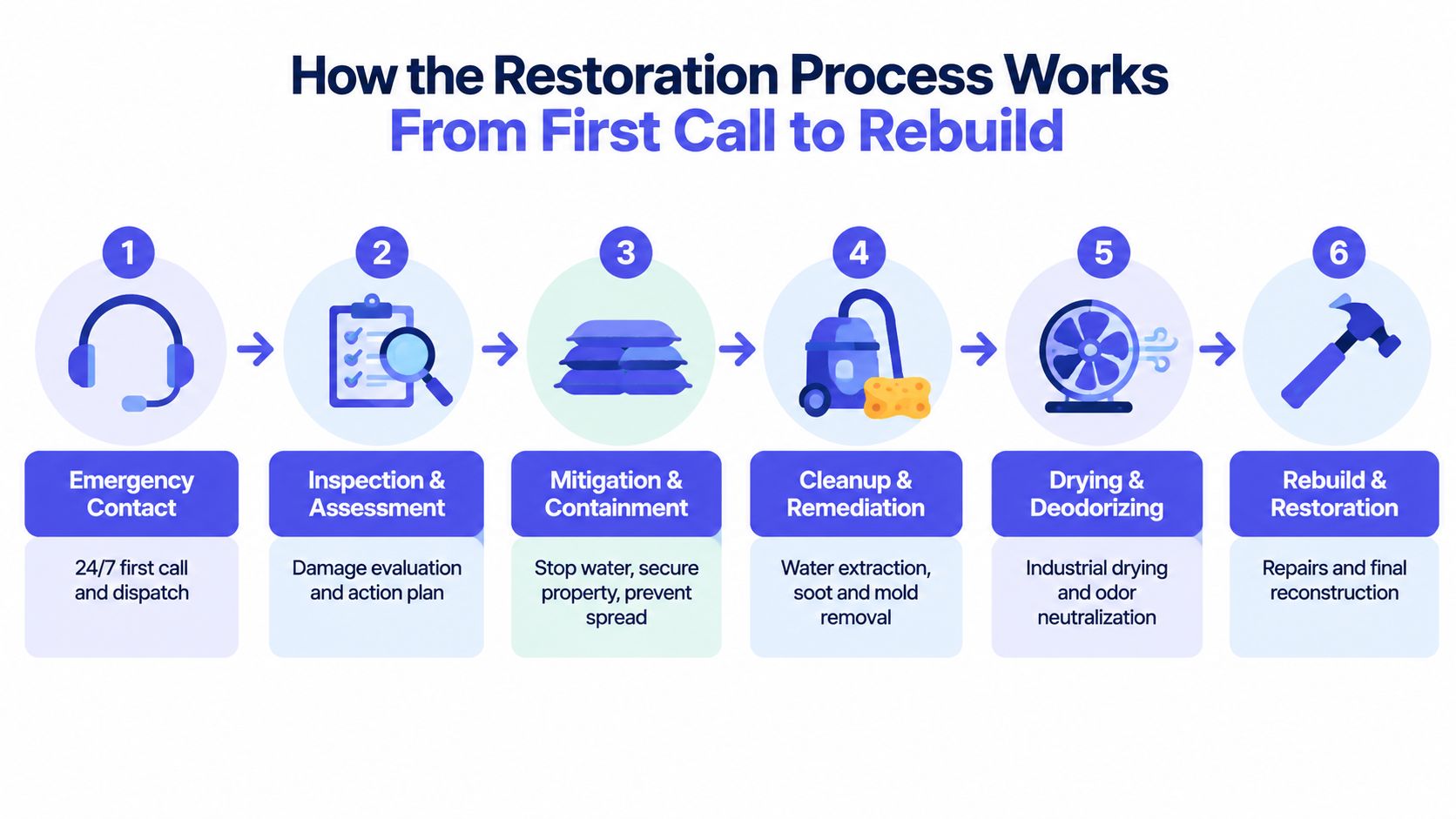
The first three phases
Emergency contact and dispatch begin when you report the loss. Give the dispatcher the location, known cause, affected rooms, visible hazards, and whether utilities are involved. Emergency response benchmarks commonly specify arrival within 2 to 4 hours for water losses and within 4 hours for fire losses, according to industry response-time guidance. Some companies target 60 to 90 minutes, while broader commercial windows can range from 30 minutes to 4 hours, depending on location, time, and capacity.
Inspection and assessment establish what happened and what must happen next. The technician should identify the source, inspect visible and potentially hidden damage, record photographs, and create an initial action plan.
Mitigation and containment stop the problem from spreading. That can mean extraction, barriers, negative air pressure, board-up work, temporary protection, or controlled removal of damaged materials.
A useful homeowner-facing explanation of the sequence appears in these water damage restoration steps, but the principle applies more broadly: stabilize first, clean or remediate second, rebuild last.
Cleanup, drying, and reconstruction
Water extraction removes standing water, but it doesn't finish the job. Technicians place drying equipment, measure moisture in affected materials, and monitor environmental conditions. The IICRC S500 standard treats drying as a controlled engineering process. Materials are considered ready for reconstruction only when the structure reaches appropriate ambient conditions, materials return toward equilibrium moisture content, and continued drying won't cause further damage.
Fire and smoke projects follow a different path. Crews may remove soot, clean salvageable contents, treat odors, and identify materials that require replacement. Mold projects prioritize containment and controlled removal so workers don't spread contamination through occupied areas.
The final phase is reconstruction. Once the drying or remediation goals are met, contractors can repair drywall, flooring, ceilings, cabinets, framing, and finishes. Your file should show why the crew moved from one phase to the next, not merely state that the work was completed.
What Restoration Really Costs and How Long It Takes
Restoration pricing depends on the loss, not just the room size. A small area with hidden moisture can require more investigation and equipment time than a visibly wet area that dries quickly. Fire residue, contaminated water, mold containment, demolition, specialty materials, and reconstruction all change the estimate.
The most useful way to evaluate a proposal is to separate mitigation from rebuild. Mitigation addresses the immediate condition. Reconstruction replaces or repairs what the loss damaged. A company that gives you a single vague figure makes it harder to compare bids and harder for an insurer to evaluate the work.
| Loss Type | Primary Cost Drivers | Typical Timeline Range |
|---|---|---|
| Water | Source, water condition, affected materials, extraction, drying equipment, monitoring, and reconstruction | Emergency response through controlled drying, followed by repairs if needed |
| Fire and smoke | Burned materials, soot cleaning, odor treatment, contents handling, structural repairs, and temporary protection | Initial securing and cleaning, followed by repair and reconstruction |
| Mold | Containment level, affected area, removal method, air-control equipment, disposal, and source correction | Assessment and containment, removal, verification, and repairs |
| Storm and flood | Water and debris removal, board-up, structural exposure, contamination concerns, drying, and rebuilding | Emergency stabilization followed by remediation and construction |
Four phases that drive the schedule
Emergency work begins with dispatch, safety checks, source control, and extraction or temporary protection.
Mitigation and monitoring continue while equipment runs and technicians track moisture or other conditions. This stage can't be shortened safely just because the surface appears dry.
Remediation addresses smoke, mold, contaminated materials, or remaining moisture. The method depends on the loss type and the materials involved.
Reconstruction starts after the property meets the applicable drying or remediation goals. A helpful water damage restoration timeline guide can help you understand why extraction and rebuilding are separate activities.
Insurance evidence affects the practical cost of each phase. A documented scope, time-stamped moisture mapping, equipment records, and daily monitoring notes give the adjuster a way to evaluate the work. Ask for those records before you approve a proposal.
Insurance Coordination and Paperwork You Should Demand
A restoration file should tell a clear story. It should show what caused the loss, what the crew found, what they did, how conditions changed, and why the work ended. Without that chain, you may understand the damage while the insurer sees an incomplete invoice.
The evidence chain
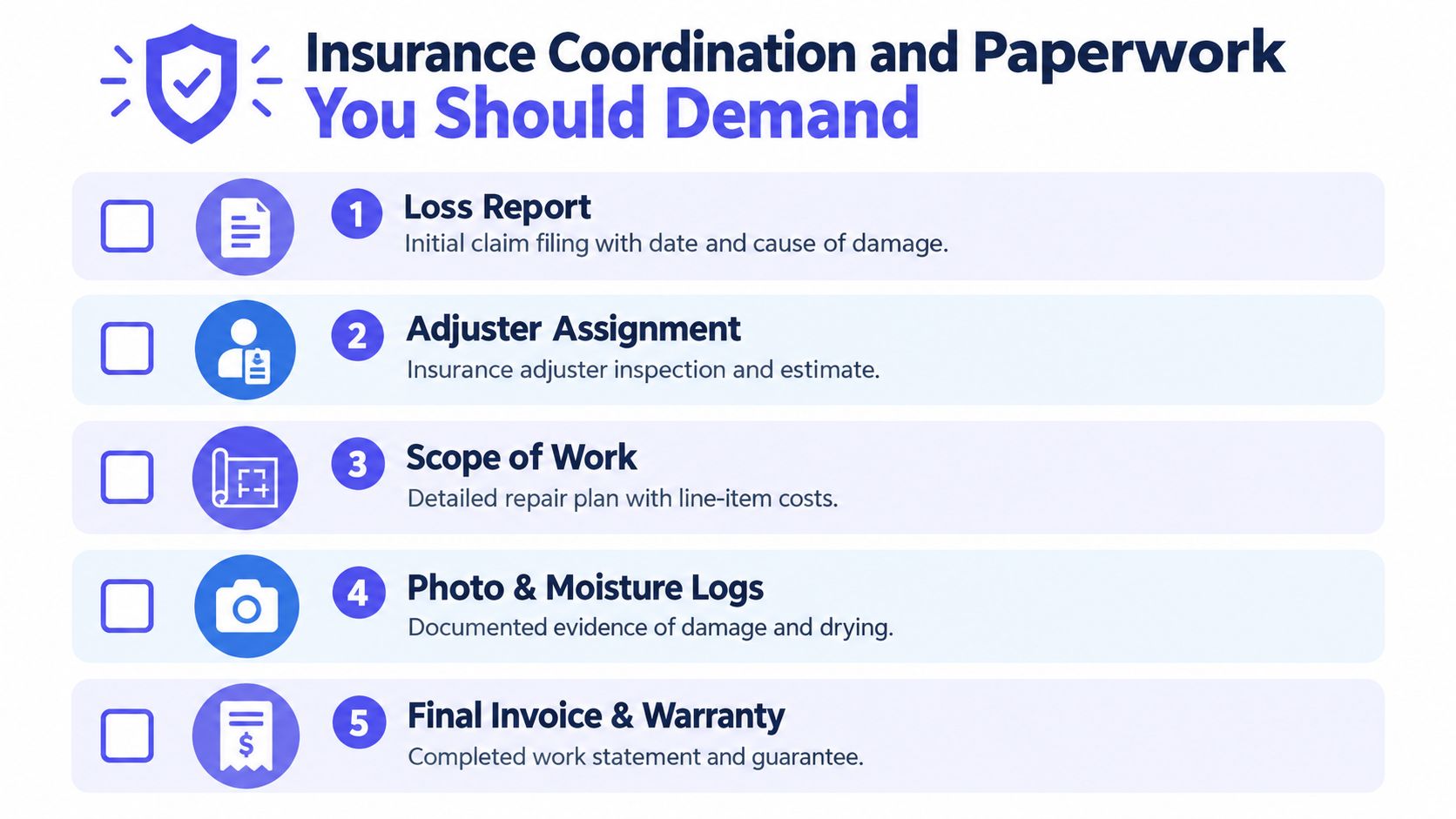
The typical mitigation claim begins when you report the loss and receive a claim number. An adjuster is assigned, the restoration company inspects the property, and the company prepares a scope based on the conditions and applicable procedures. The estimate is then submitted, while the crew performs emergency work and records ongoing measurements.
Industry coverage reports that carriers increasingly request daily drying logs, psychrometric readings, and equipment serial numbers before approving invoices. A 2024 consumer survey cited in industry statistics found that 71% of consumers expect moisture or measurement documentation during the repair process, according to Water Damage 365's industry trends coverage.
Psychrometric readings describe environmental conditions such as temperature and relative humidity. They help show whether the drying environment supports evaporation and whether equipment placement is producing progress. A daily log should connect those readings to specific rooms, materials, equipment, and dates.
Ask for records as the work happens. Reconstructing a drying file after the equipment is gone is much harder.
What to request
- Loss report: Keep the claim number, reported date, known cause, and initial photos.
- Inspection record: Request photographs, affected-area notes, moisture mapping, and identified safety concerns.
- Scope of work: Look for line items, affected materials, demolition assumptions, equipment, labor, and reconstruction responsibilities.
- Daily drying logs: Ask for readings by area, equipment placement, changes in conditions, and technician visits.
- Equipment records: Request equipment types, dates placed, dates removed, and serial numbers where available.
- Supplement documentation: If hidden damage appears during demolition or drying, ask for photographs, revised scope details, and the reason for the supplement.
- Final package: Keep the final invoice, completion notes, drying or remediation results, warranties, and any sign-off documents.
The IICRC standards list identifies separate standards for water damage restoration, mold remediation, and fire and smoke restoration. That distinction matters in your paperwork. The scope should make clear which type of loss is being addressed and what procedures guide the work.
Credentials Red Flags and Questions to Ask Before You Hire
A fast response doesn't prove competence. The better test is whether the company can explain its process, show how it measures conditions, and provide a written scope that matches the loss.
Licensing is more complicated than many homeowners expect. A neutral industry overview reports that most U.S. states don't require a specific license for ordinary water extraction, drying, and structural dry-out, while roughly seven to eleven states require a state mold license. Illinois requires third-party certification plus registration. California generally requires the appropriate CSLB contractor license for the work's scope, and asbestos work requires a separate ASB license, according to NISCR's licensing overview.
Ask these questions before signing
- Who will perform the work, and what license applies to this scope? A good answer distinguishes water mitigation from mold, asbestos, or reconstruction work.
- Which restoration standard guides the job? The company should understand that water, mold, and fire work use different standards.
- How will you prove the structure is dry? Look for moisture mapping, readings, equipment logs, and documented dry goals.
- What will you send my insurer? The answer should include a scope, photographs, monitoring records, invoices, and supplements if conditions change.
- What happens if hidden damage appears? The company should explain approval, documentation, and change-order procedures.
- Who is responsible for reconstruction? Some firms handle mitigation only, while others manage both mitigation and rebuilding.
- Can I review the contract before work begins? A clear agreement should identify scope, materials, schedule, payment terms, warranties, and exclusions.
Use the contractor background check guidance as part of your screening process, not as a substitute for reviewing the actual scope.
Warning signs that deserve caution
Be careful with pressure to sign immediately, requests for unexplained cash payments, vague estimates, missing local business information, and promises that everything will be fixed in a single visit. A company that won't explain its measurements or documentation process may leave you with a weak insurance file.
You also don't have to accept a shared-lead sales rush. If several businesses call within minutes and each claims urgency without inspecting the property, pause. Give your information to the professional you choose, not to every company that receives a lead.
Choosing a Vetted Pro and Your Next Steps
Start with the loss, not the brand name. Write down the source if known, affected rooms, visible hazards, time discovered, and any actions already taken. Photograph conditions before moving damaged contents, but don't enter unsafe areas or touch water near electrical equipment.
Use this short decision checklist:
- Confirm scope: Ask whether the company handles water, fire, mold, storm, and reconstruction work relevant to your loss.
- Verify credentials: Check licensing requirements for the task and location.
- Require documentation: Confirm that the company provides moisture readings, daily logs, photographs, equipment records, and a written scope.
- Separate mitigation from rebuild: Make sure the proposal explains what happens now and what happens later.
- Protect your contact information: Avoid marketplaces that distribute your request to multiple businesses if you want one accountable point of contact.
Hand Vetted Co. matches a homeowner with one verified professional, using active licensing, background screening, 4.5+ star ratings with recent volume, and human review as its stated checks. Its matching model keeps the request exclusive instead of sending the same contact details to multiple businesses.
If the first match isn't suitable, ask about the rematching process before work begins. The right arrangement should give you a clear contact, a documented plan, and enough information to make a decision without accepting pressure.
Hand Vetted Co. connects you with one verified restoration professional for water damage, fire, mold, or structural repair, with your request kept exclusive instead of shared across competing businesses. Visit Hand Vetted Co. to answer a few questions about your property and get a focused next step.