You notice a crack in the basement wall, then find a second one near a window. A contractor offers to seal and stabilize it for $3,500. Another recommends deeper structural work for $12,000. Both may be acting in good faith, because the cost of foundation repair depends less on the word “crack” than on what caused it and whether the foundation is still moving.
Table of Contents
- Introduction to Foundation Repair Costs
- Typical Price Ranges by Repair Method
- Factors That Influence Repair Cost
- Sample Regional Cost Estimates
- Inspection and Diagnostic Steps
- Financing and Insurance Considerations
- How to Vet Contractors Effectively
- Budgeting and Timeline Planning
Introduction to Foundation Repair Costs
Foundation repair can mean sealing a small crack, correcting drainage, stabilizing settlement, reinforcing a bowing wall, lifting a slab, or replacing damaged sections. The label alone says little about the work involved, so two estimates may differ by thousands without either being automatically wrong.
Across recent U.S. homeowner pricing datasets, the average project is near $5,000, while typical repairs often fall between about $2,200 and $8,100, according to NerdWallet's foundation repair cost guide. Treat those figures as orientation, not as approval for a specific proposal.
The hidden cost drivers are usually the repair method and the conditions around the house. A lower quote may cover visible crack sealing only. A higher one may include stabilization, excavation, drainage correction, engineering, permits, or difficult access. Regional soil, climate, and labor conditions can also affect the final scope.
Start by asking what problem each contractor is solving. Then confirm that every bid covers the same affected area, materials, warranties, permits, and exclusions. Compare those details before comparing totals. This simple rule prevents a limited cosmetic repair from being judged against a structural solution.
The figures that follow provide context for minor, moderate, and structural repair categories, helping you question a proposal before signing.
Typical Price Ranges by Repair Method
A crack injection and a pier system may both appear on a contractor's estimate as foundation repair, yet they solve different problems and carry very different costs. The method is often the clearest explanation for the bill.
Recent 2026 method-specific data lists these ranges for common repairs, as reported by FoundationSage's cost data:
| Repair Method | Typical Cost Range |
|---|---|
| Crack injection | $350 to $900 |
| Wall anchors or braces | $700 to $1,900 |
| Steel push piers | $1,250 to $2,400 |
| Helical piers | $1,400 to $3,100 |
| Slab lifting | $700 to $2,100 |
Crack injection addresses limited cracking
Crack injection is generally the least expensive method in this comparison. It may fit a defined crack that does not show continuing structural movement. Epoxy or polyurethane can seal the opening, reduce water entry, or restore continuity across the cracked area.
The lower price does not make injection suitable for every crack. It will not correct soil movement, a settling corner, a bowing wall, or a drainage problem. Ask the contractor to classify the crack as cosmetic, water-related, or evidence of displacement, and to explain what supports that conclusion.
Wall anchors and braces stabilize lateral pressure
Wall anchors and braces are used for basement walls that bow, lean, or resist pressure from surrounding soil. The final price depends on the length of wall involved, whether excavation is possible outside, and the system specified in the proposal.
Exterior anchors may disturb soil and require outside access. Interior braces can avoid excavation, but they remain visible in the basement. Compare appearance, installation conditions, warranty coverage, and whether the plan addresses water pressure or drainage as well as the wall.
Piers solve movement, not surface symptoms
Steel push piers and helical piers transfer structural loads into stronger soil or bearing strata. Contractors may recommend them when part of the home has settled or when a footing needs support below its existing level.
The table ranges help explain the cost of one pier, but a project may require several. One current guide says an average home often needs 10 to 15 piers, with helical or steel push piers priced around $1,500 to $3,000 each and total pier work roughly $15,000 to $45,000, according to HBG Civil's 2026 foundation repair guide. The engineer's or contractor's repair design should determine the count, rather than a generic package.
Slab lifting corrects uneven concrete
Slab lifting raises settled concrete through mudjacking or polyurethane injection. It can address an uneven slab, walkway, driveway, or floor area. The suitable material depends on void size, access, soil condition, and the finish you want.
The same HBG Civil guide places mudjacking at $2,000 to $5,000 and polyurethane injection at $3,000 to $8,000 for slab leveling. Those figures describe broader leveling work, so they should not be compared directly with a small crack-injection quote.
Replacement sits in a different financial category
Full foundation replacement can reach $20,000 to $100,000, according to NerdWallet's repair cost data. The work may include lifting the structure, removing failed materials, correcting the underlying condition, rebuilding, waterproofing, and restoring disturbed areas.
Use the national market average from earlier for initial planning, then leave room for findings that change the scope. Before accepting a low bid, confirm whether it covers only sealing or includes load-bearing correction, permits, engineering, drainage, cleanup, and warranty terms. A sealant job and a structural repair are different projects, so contractor vetting should begin with the proposed method, not the total alone.
Factors That Influence Repair Cost
A contractor can't price foundation work accurately from a photograph alone. The estimate changes as the professional learns more about the soil, structural system, damage pattern, and access route.
Soil changes the repair design
Expansive clay can swell and contract as moisture conditions change. Poor drainage can also keep soil saturated near the foundation or allow water to wash material away. Those conditions may require deeper support, drainage correction, grading, or a combination of repairs rather than a surface patch.
Ask what evidence supports the diagnosis. A useful inspection should identify whether the movement is settlement, heaving, lateral pressure, water intrusion, or another condition. It should also explain what happens if the drainage issue remains untreated.
Foundation type sets the available options
Basement walls, slabs, and pier-and-beam systems don't offer the same access or repair path. A current Angi foundation repair cost guide reports basement repairs averaging $2,300 to $7,600, while pier-and-beam repairs can range from $750 to $25,000.
That spread shows why a single average can mislead you. A crawl-space repair might expose framing and footings from below, while a slab repair may require specialized lifting or access through concrete.
Access adds labor before the repair begins
A narrow side yard, deck, porch, mature landscaping, or finished basement can make equipment placement difficult. Crews may need to remove and replace obstacles, excavate by hand, carry materials farther, or protect interior finishes.
Region matters too, but don't let a regional label replace a site-specific explanation. Ask for a written list of access assumptions, excavation needs, restoration work, permits, and cleanup. Those exclusions often explain why an attractive initial quote rises later.
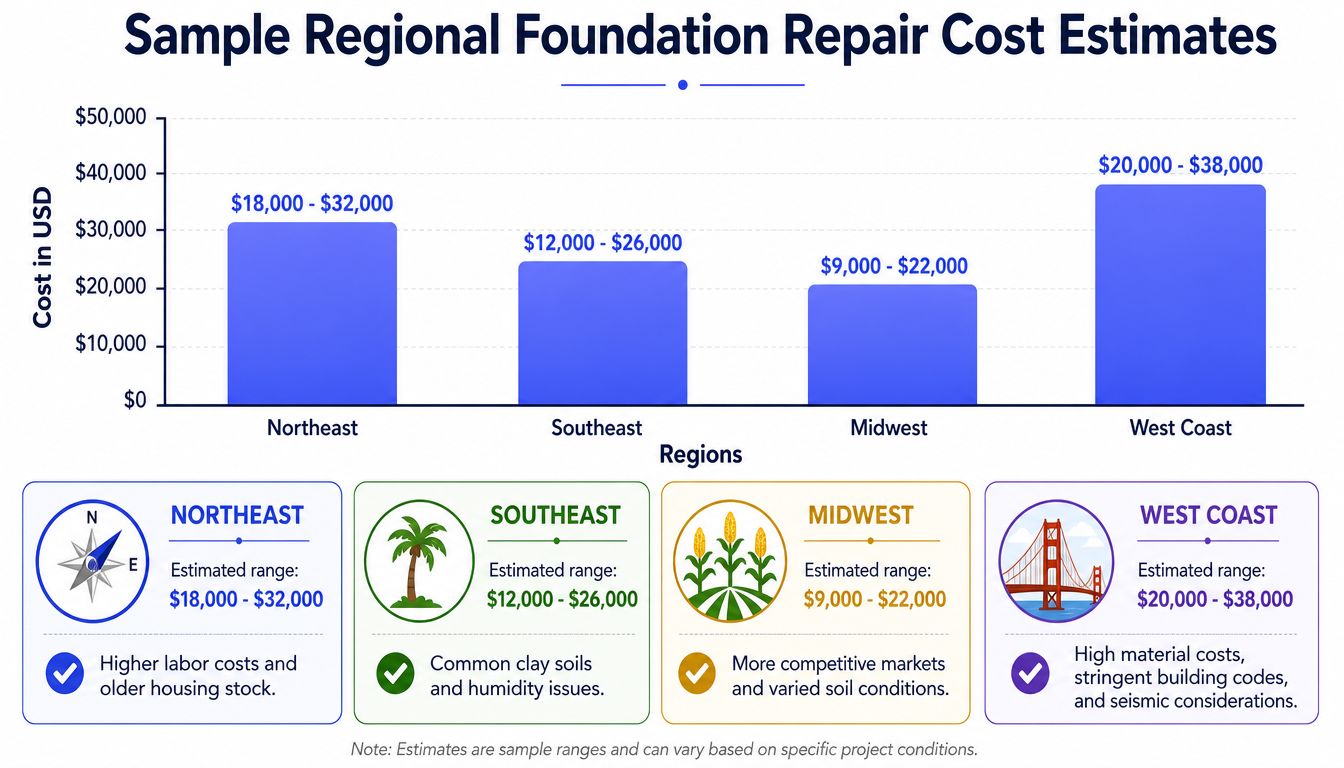
The regional visual shows sample estimates, not a universal price schedule. Use it to ask better questions, then rely on the actual soil report, foundation type, repair plan, and local scope.
Sample Regional Cost Estimates
Repair markets vary because labor availability, material costs, building requirements, soil, and competition differ by location. A contractor in an older Northeast neighborhood may face tight access and aging construction, while a West Coast project may involve stricter code requirements or seismic considerations.
The supplied regional estimates illustrate that variation:
| Region | Sample Estimate | Main Cost Drivers |
|---|---|---|
| Northeast | $18,000 to $32,000 | Higher labor costs and older housing stock |
| Southeast | $12,000 to $26,000 | Common clay soils and humidity issues |
| Midwest | $9,000 to $22,000 | More competitive markets and varied soil conditions |
| West Coast | $20,000 to $38,000 | High material costs, stringent building codes, and seismic considerations |
These figures shouldn't override a local inspection. They also shouldn't be used to demand that a contractor match a neighboring state's price. A project with deep excavation, difficult access, or multiple piers may cost more than a simpler project in the same region.
Use geography as a screening question
If your quote seems far above or below comparable local proposals, ask why. The answer may be reasonable, such as engineering requirements, difficult soil, specialized equipment, or substantial restoration. A vague answer is a reason to slow down.
The national market has also changed. Industry data cited by Two Bros Foundation Repair indicates that repair costs are up about 15% to 20% since 2020, with recent averages between $4,974 and $5,179 and per-square-foot guidance ranging from $1.50 to $12. Those figures reflect broad pricing conditions, while your property determines the actual scope.
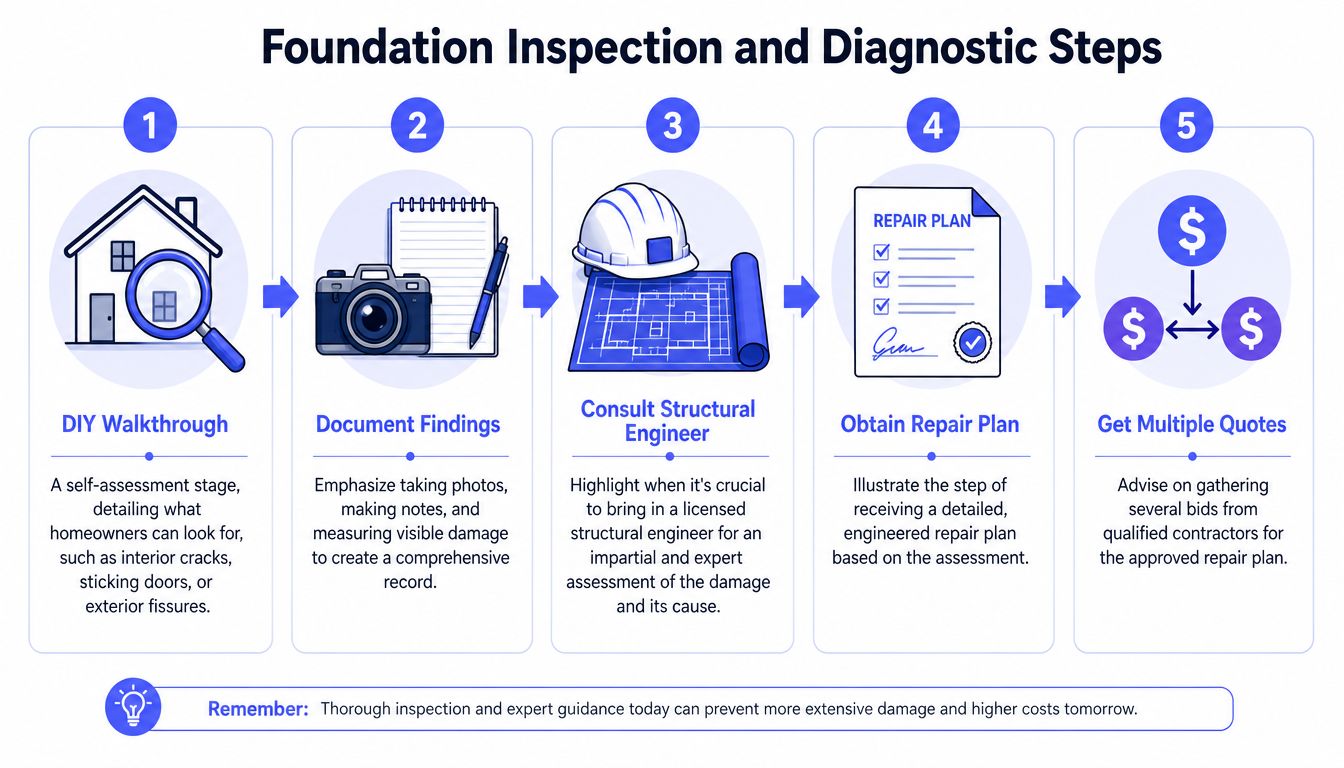
A better comparison starts with identical documents. Give each qualified professional the same inspection findings and ask each one to price the same repair plan. That approach makes geographic differences easier to separate from scope differences.
Inspection and Diagnostic Steps
A good repair decision begins with evidence, not urgency. You can gather useful observations yourself, but you shouldn't treat a walkthrough as a structural diagnosis.
Start with a careful walkthrough
Look for cracks in basement walls, drywall, masonry, floors, and exterior surfaces. Note doors or windows that stick, floors that feel uneven, water stains, damp areas, bowing walls, and places where soil slopes toward the structure.
Don't enlarge a crack or remove finishes just to inspect it. Photograph the area from a distance and up close, include a ruler for scale, and record where it appears. Revisit the location later so you can tell the professional whether the condition seems stable or changing.
Document water and site conditions
Walk the exterior after rain if it's safe. Look for pooling, blocked downspouts, damaged extensions, erosion, or soil that has pulled away from the foundation. Record whether water appears at the same interior location as the exterior problem.
A simple record helps contractors bid on the same facts. Include dates, photos, measurements, drainage observations, prior repairs, and any remodeling that may have changed water flow or structural loads.
Bring in an independent professional when the pattern is unclear
A structural engineer can provide an assessment that isn't tied to selling a repair system. Consider that route when cracks are horizontal or stair-step shaped, walls bow, floors are noticeably uneven, several symptoms appear together, or contractors recommend substantially different methods.
Ask for a written explanation of the suspected cause, areas requiring repair, urgency, and recommended method. Then request bids against that scope. For related property measurement questions, you can also review residential land survey cost information, although a land survey isn't a substitute for structural engineering.
Make every bid answer the same questions
Ask each bidder to identify the affected area, repair method, materials, excavation, drainage work, restoration, permits, warranty, payment schedule, and exclusions. Confirm whether the proposal assumes stable soil or includes provisions for unexpected conditions.
Don't accept “fix foundation” as a sufficient scope. You need to know what the crew will install, where it will go, what problem it addresses, and how completion will be verified.
Financing and Insurance Considerations
Funding should follow the diagnosis. Borrowing for a broad, undefined repair can leave you paying for work that doesn't address the cause, while delaying a necessary structural fix can create a more expensive financial decision later.
Recent market guides place the average U.S. repair near $5,000 to $5,200, with most projects between $2,200 and $8,400, according to Modernize's foundation repair cost benchmarks. Use that range to screen loan amounts, not to choose a product before you have a written scope.
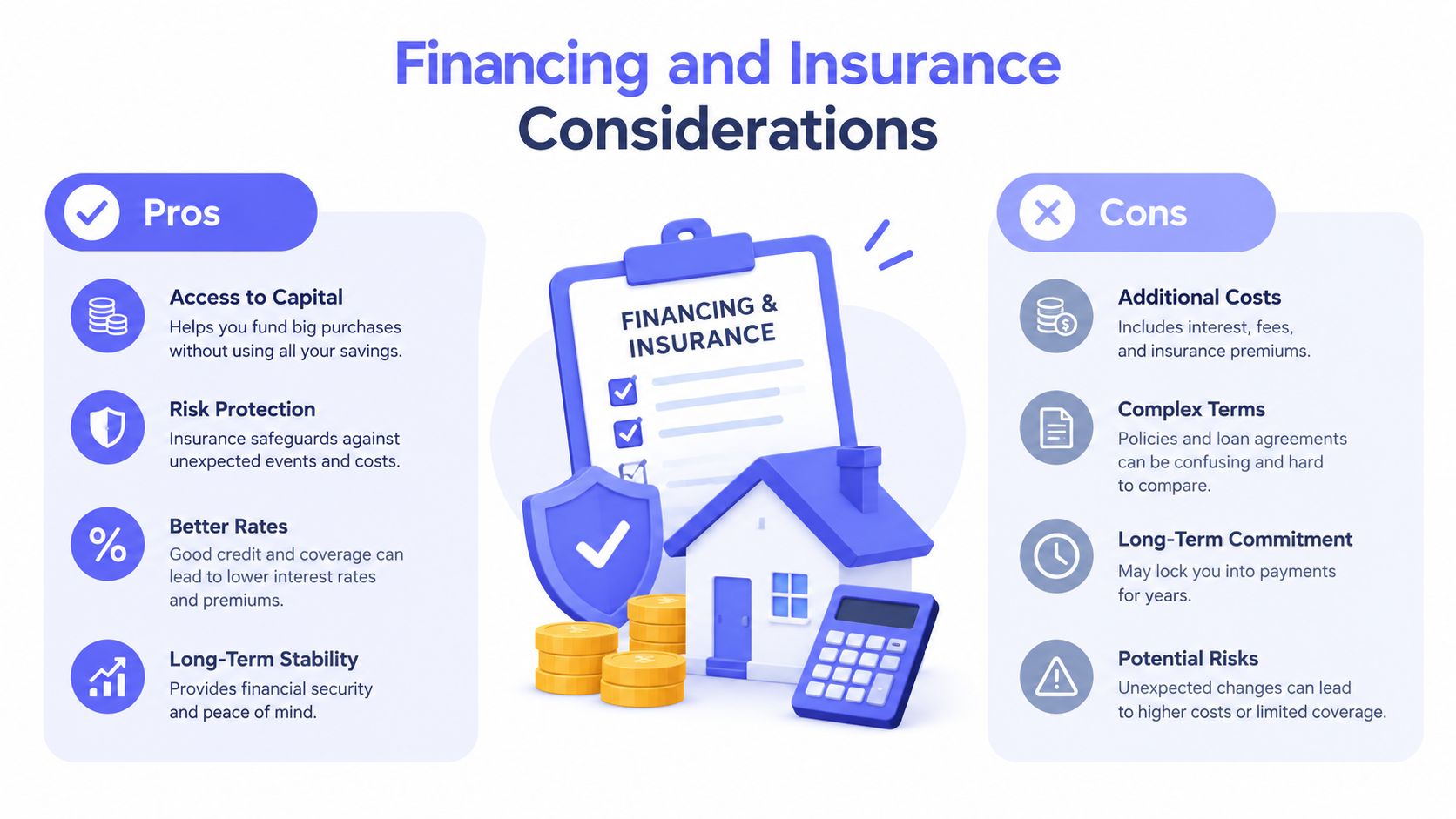
Compare the funding paths
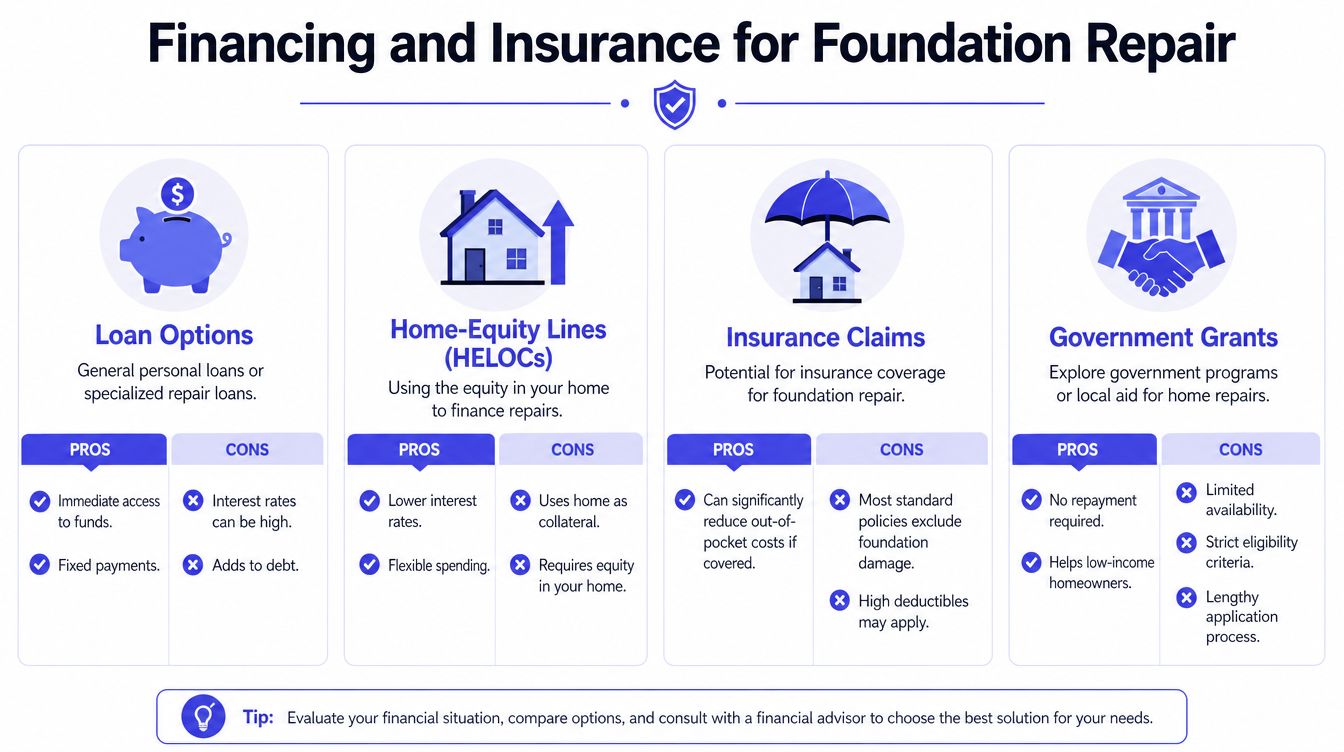
| Option | Potential Advantages | Main Risks |
|---|---|---|
| Personal or repair loan | Immediate access and fixed payments | Interest may be high, and debt increases |
| HELOC | Flexible spending and potentially lower interest | Your home serves as collateral, and equity is required |
| Insurance claim | May reduce out-of-pocket costs if the cause is covered | Standard policies commonly exclude foundation damage, and deductibles apply |
| Government grant | No repayment when available, with support for eligible applicants | Availability and eligibility are limited, and applications can take time |
Insurance decisions depend on the cause and policy language. Document the damage before repairs begin, keep inspection reports and photographs, and ask the insurer whether the event is covered, excluded, or subject to a special condition.
For a broader review of borrowing structures, see these home improvement financing options. Compare total repayment, fees, collateral, timing, and whether the lender will fund staged work.
Don't let a lender's approved amount become your repair scope. The contractor's written plan should determine the amount you need, and you should preserve a reserve for clearly defined contingencies.
How to Vet Contractors Effectively
The cheapest bid isn't necessarily the cheapest outcome. A contractor who misdiagnoses the problem can leave you paying twice, once for the original work and again for the repair that should have been done.
Start with licensing. Verify the business and the individual responsible for the work through your state's licensing system, then ask for proof of insurance and bonding where applicable. Confirm that the policy applies to the work being proposed.
Compare relevant experience
Ask whether the company has repaired your foundation type and the specific failure mode identified in the inspection. A business experienced with basement wall anchors may not be the right choice for slab settlement or pier-and-beam work.
Request references for similar projects, not just general remodeling. Read recent reviews closely for details about communication, change orders, cleanup, warranty handling, and whether the crew completed the promised scope.
Check the documents before the deposit
Your contract should identify the repair method, locations, materials, permits, payment milestones, start conditions, completion standard, warranty, and exclusions. It should also explain how the company handles concealed conditions and who approves additional work.
Avoid paying the full amount before work begins. Tie payments to observable milestones, and keep written records of every change.
Use a consistent verification process
Hand Vetted Co. is one matching option for finding a professional. Its stated checks include active state licensing, background screening of owners and operators, 4.5+ star ratings with recent review volume, and a final human review. You can also use the platform's contractor background check resource to build questions for any company you're considering.
The essential point isn't the platform. It's consistency. Verify credentials, compare relevant work, inspect the contract, and make sure the professional can explain why the proposed method fits the observed damage.
Budgeting and Timeline Planning
Build the budget around the repair scope, separating confirmed costs from uncertain ones. A small crack repair and a settlement problem require different reserves. Unstable soil, drainage failure, limited access, or concealed damage can turn a straightforward estimate into a larger project, so ask what conditions would trigger a change order.
Create a written project plan
List the inspection, engineering review if needed, permits, contractor selection, material ordering, excavation, installation, drainage correction, restoration, and final documentation. Confirm which steps depend on weather, inspections, or site access, and ask for an expected sequence rather than one broad completion promise.
Use milestone payments tied to work you can verify. Keep the approved scope, photos, invoices, permits, warranty, and engineer's report together. These records support future maintenance, insurance discussions, and a later sale.
Your next move: Document the condition, compare written scopes for similar work, verify each professional, and choose financing only after you understand the specific repair you are funding.
For a smoother final step, Hand Vetted Co. can connect you with one licensed, background-checked professional for a structural or restoration-related project instead of sending your request to multiple businesses. Describe the foundation issue, location, timing, and budget, then visit Hand Vetted Co. to review a verified matching option.