What is pay per lead? It's a performance-based pricing model where you pay only when a lead that meets agreed qualification criteria is delivered, not for clicks, impressions, or retainer time. In 2026, the median B2B cost per lead reached about $213, with the top quartile near $84 and the bottom quartile around $397 [Digital Applied 2026 lead generation statistics].
You're probably looking at ads, shared lead lists, or a vendor pitch that sounds good until you ask what counts as a real lead. That's where most programs break. The price isn't the core issue, the definition is.
If you've ever paid for traffic and felt like you bought a pile of curiosity instead of actual opportunities, you already understand the problem. Pay per lead exists to move the risk away from you and onto the supplier, but only if the lead definition is tight and the screening is real.
Table of Contents
- The Hidden Cost of Buying Clicks and Impressions
- How Pay Per Lead Actually Works
- Pay Per Lead Versus Other Pricing Models
- Why Lead Definition and Exclusivity Matter More Than Price
- What a Pre-Screened Exclusive Lead Looks Like in Practice
- How to Evaluate a Pay Per Lead Provider
- Your Next Step Toward Better Leads
The Hidden Cost of Buying Clicks and Impressions
A contractor can buy attention and still miss the pipeline. Spend on clicks, collect visits, maybe even a few form fills, and you can still end up with people who were just comparing quotes, window shopping, or clicking with no real intent. That is the core flaw in CPC and impression-based buying, you pay for access to eyeballs, not for a prospect who belongs in your sales process.
Why the math breaks so fast
Say a roofing contractor spends $1,200 on Google Ads, gets 340 clicks, and books three jobs. That leaves a rough $400 cost per acquisition, and for most service businesses that is a hard number to swallow once labor, materials, and scheduling costs hit the ledger. The platform still got paid.
Practical rule: if the billing event happens before qualification, you are financing uncertainty.
Broad ad buying feels slippery because the buyer carries all the waste. You pay for curious visitors, quote shoppers, and sometimes traffic that is not even human. The seller wins as long as the meter keeps running.
Why pay per lead changes the deal
Pay per lead changes the billing trigger. Payment happens only when a lead that matches agreed qualification criteria is delivered, so the supplier has to absorb the cost of filtering, routing, and rejecting weak inquiries.
That shift matters because the fight moves to definition, not volume. A sloppy lead definition lets bad inquiries through and makes the program look cheap while it performs badly. A tight definition usually costs more per lead, but it protects the sales team from junk and forces the central question: what counts as a usable lead, and who is accountable for that standard?
For local-service companies, exclusivity matters just as much. Shared leads often get sold to multiple buyers, which turns price shopping into a race to the bottom. Pre-screened exclusive leads give one buyer first access to a real opportunity, and that is usually where ROI starts to make sense.
If you are comparing local lead sources, a useful starting point is a real service-intent marketplace like Handvetted's lead generation near me page, because it puts exclusivity and screening in plain view instead of hiding them behind traffic metrics.
How Pay Per Lead Actually Works
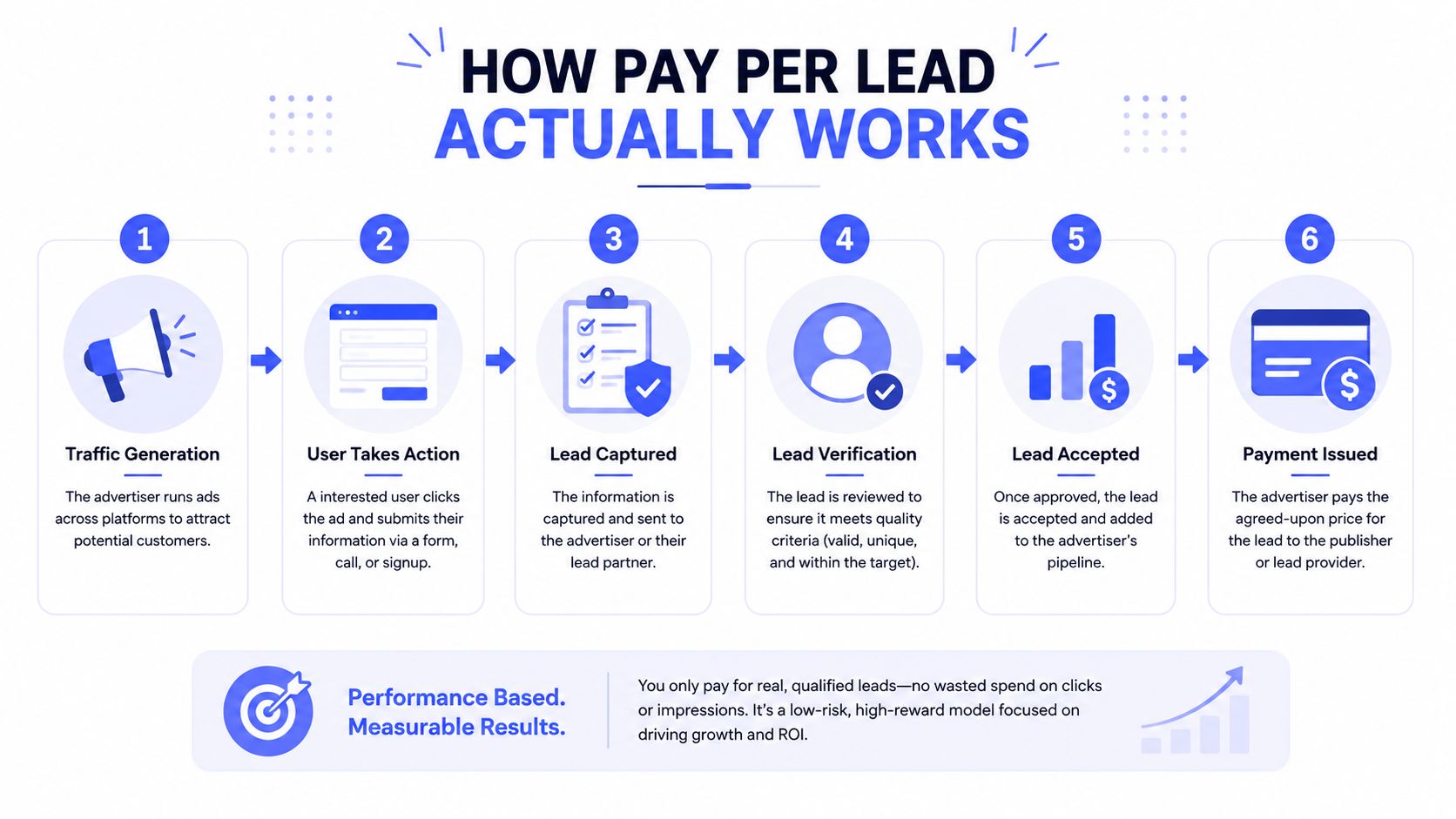
The mechanics are simple on paper and messy in practice. A provider captures interest, screens it against a buyer's rules, and bills only when the contact passes those rules. The whole model lives or dies on whether everyone agrees on what “qualified” means before the first lead is ever sent.
The billable event is the first decision
A billable lead is usually one of three things, a form submission, a phone call that clears a duration threshold, or a live chat interaction that includes contact details and a stated service need. The exact trigger matters because it defines when money changes hands. If that trigger is vague, arguments start immediately.
That's why sellers often want broad definitions and buyers want narrow ones. A loose trigger produces more volume. A tighter trigger produces better fit. The tension never goes away, it just gets priced differently.
Qualification criteria decide whether the lead is worth anything
This is the key control point. Good programs screen for geography, project type, homeowner status, timeline, and sometimes budget. For example, a contractor might want HVAC replacement requests inside a specific ZIP code, not a general “need help with heating” inquiry from three counties away.
The cleanest lead definitions are boring. They're specific, measurable, and hard to fake.
A useful HVAC example looks like this. A homeowner submits a request for a furnace replacement in a defined service area. The system checks the address, confirms the project scope, and verifies that the request matches the contractor's service profile. Only then does the lead become billable.
Routing rules determine who sees the lead
Routing is the last piece, and it shapes the economics just as much as screening. Some programs send leads to multiple businesses, some send them to one buyer only, and some tier them by intent level. The more businesses that receive the same lead, the more pressure there is to respond first instead of respond well.
That's why ambiguity is the main reason contractors get annoyed with pay-per-lead programs. It's not just the price. It's the feeling that the provider is calling almost anything a lead and then asking the buyer to sort it out later.
Pay Per Lead Versus Other Pricing Models
A contractor can buy demand in several ways, but each model shifts risk somewhere else. CPC buys clicks, CPA buys outcomes, and retainers buy access. Pay per lead sits between them, and whether it works depends on how tightly the lead is defined and whether the lead is sold to one buyer or many.
Here's the clean comparison. CPC can look cheap until weak traffic drives up the true cost per inquiry. Pay per lead only holds up when screening is strict and exclusivity is genuine. CPA pushes more risk to the seller, while retainer pricing pushes it back to the buyer.
| Model | Typical Cost Range | Risk Bearer | Quality Guarantee | Best For |
|---|---|---|---|---|
| Cost per click | Often feels cheap upfront, but the effective lead cost can climb fast when clicks don't convert | Buyer | None | Teams with strong landing pages and enough data to optimize fast |
| Pay per lead | Varies by source and qualification level | Shared, then shifted toward the supplier | Only if screening is tight | Businesses that need predictable inquiry cost tied to intent |
| Cost per acquisition | Usually priced higher because the seller absorbs more risk | Seller | Stronger on paper, but harder to see margin mechanics | Buyers who want to pay for closed business and can manage a longer sales cycle |
| Subscription or retainer | Flat monthly fee regardless of delivery | Buyer | Weak unless the contract is strict | Teams that value continuity over strict performance pricing |
The cost comparison is usually messier than the table suggests. EmailToolTester lead generation statistics shows how channel costs vary sharply across sources, while Digital Applied 2026 lead generation statistics points to wide swings in B2B lead pricing across common channels. The lesson is simple. A low sticker price means very little if the channel sends poor-fit inquiries or forces your team to waste time filtering junk.
For contractors, the question is not which model sounds cheapest. It is which one gives you the cleanest path from inquiry to booked work. A pay per lead program can do that, but only if the provider defines the lead the same way you do and does not spread the same inquiry across too many buyers.
That is why the setup matters. The contractor-focused structure in Handvetted for contractors shows how qualification and routing shape the economics more than raw traffic volume.
Why Lead Definition and Exclusivity Matter More Than Price
Most pay-per-lead programs fail because the lead definition is too loose, not because the price is too high. If a provider bills for any form fill, then wrong numbers, out-of-area requests, and low-intent browsers all get treated like revenue. That's how buyers end up paying for activity that never had a real chance of turning into work.
Shared leads are where the economics get ugly
Shared leads look affordable because the upfront price is lower. The catch is simple, the same inquiry gets sold to multiple businesses, which means every buyer is racing the others to answer first. One sale may happen, but the rest of the businesses still eat the cost.
A cheap shared lead can be expensive if your closing odds collapse.
The math gets worse when the intent is weak. If one lead is sold to five businesses, only one can win the job. The rest absorb the same acquisition cost without any offsetting revenue. That's why shared leads often feel busy on a dashboard and disappointing in a CRM.
Exclusivity changes the incentive
Exclusive leads create a different behavior pattern. The provider can't lean on quantity alone, because each lead has to stand on its own. A pre-screened exclusive lead is more likely to be verified, routed correctly, and given context before handoff.
The pricing gap reflects that. Neutral market guides commonly describe exclusive leads as costing about two to four times more than shared leads, or roughly two to three times more in some cases, because the buyer isn't competing with several other companies for the same prospect [Lead Search Pros on exclusive and shared leads].
That's not a markup for fun. It's the price of removing competition and improving the odds that the lead becomes a conversation. When buyers only look at the sticker price, they miss the issue: what did the seller have to do to earn that lead, and how many other people got the same name.
What a Pre-Screened Exclusive Lead Looks Like in Practice
A good exclusive lead doesn't feel like a raw contact dump. It feels like a handoff. By the time it reaches the contractor, the obvious mismatch problems have already been removed, and the buyer can spend time quoting instead of guessing.
A homeowner in suburban Dallas fills out an HVAC request. The first pass checks whether the phone number and email work. The second pass checks the service area. The third pass filters project scope, so a request for a minor thermostat swap doesn't get sent to someone who only handles full-system replacements.
Then comes intent confirmation. The provider asks about timing, budget range, and who's making the decision. That's where many programs get lazy, because it takes work to separate a serious buyer from a browser.
Only after those checks does the lead get routed to one contractor, with context attached. That context is the difference between a rushed callback and a useful sales conversation. It also explains why exclusive lead models usually feel calmer on the buyer side, fewer surprises, less duplication, and less time wasted chasing dead ends.
If you're trying to evaluate vendors, Hand Vetted's plumber lead generation page is a useful reference point because it makes exclusivity and screening visible instead of implied.
How to Evaluate a Pay Per Lead Provider
Don't start with price. Start with definitions. A provider can sound affordable and still hand you a mess if the rules around qualification, exclusivity, and replacement are sloppy.
The five questions that matter
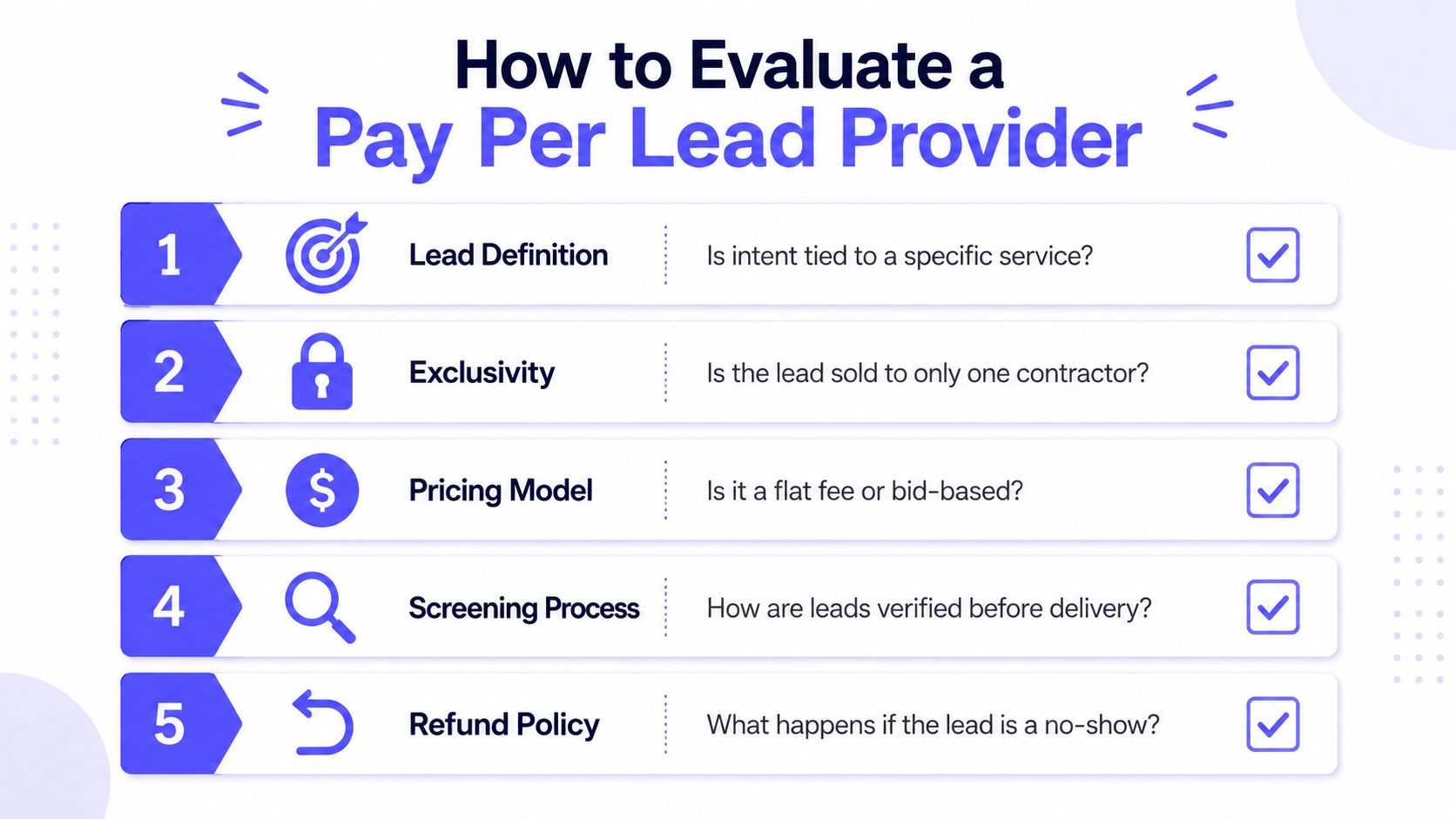
- Lead definition: What exactly makes a lead billable, and what disqualifies it before billing?
- Exclusivity: Is the lead sold to one business only, or shared across competitors?
- Rematching policy: If the number is wrong, duplicated, or out of area, how fast do you replace or credit it?
- Screening depth: Do you verify intent and project scope, or just forward form submissions?
- Performance transparency: Can you see source quality, conversion behavior, and acceptance patterns by channel?
If a provider can't answer those clearly, walk away. Vague answers usually mean the seller wants the freedom to count more leads while absorbing less responsibility. That sounds efficient until your sales team starts rejecting half the pipeline.
Red flags to treat seriously
Watch for providers who talk about “lead volume” before they talk about qualification rules. Be cautious if they won't define whether the lead is a contact form, a meeting, or a sales-qualified opportunity. And be skeptical if replacement policies are slow or hidden behind vague account management language.
Use this filter: if the provider can't explain how a bad lead gets removed from billing, you're not buying accountability.
One more thing. Buyers often focus on price per lead and ignore how the supplier makes money. That's backward. The seller's incentive structure tells you more about future quality than the initial quote does.
Your Next Step Toward Better Leads
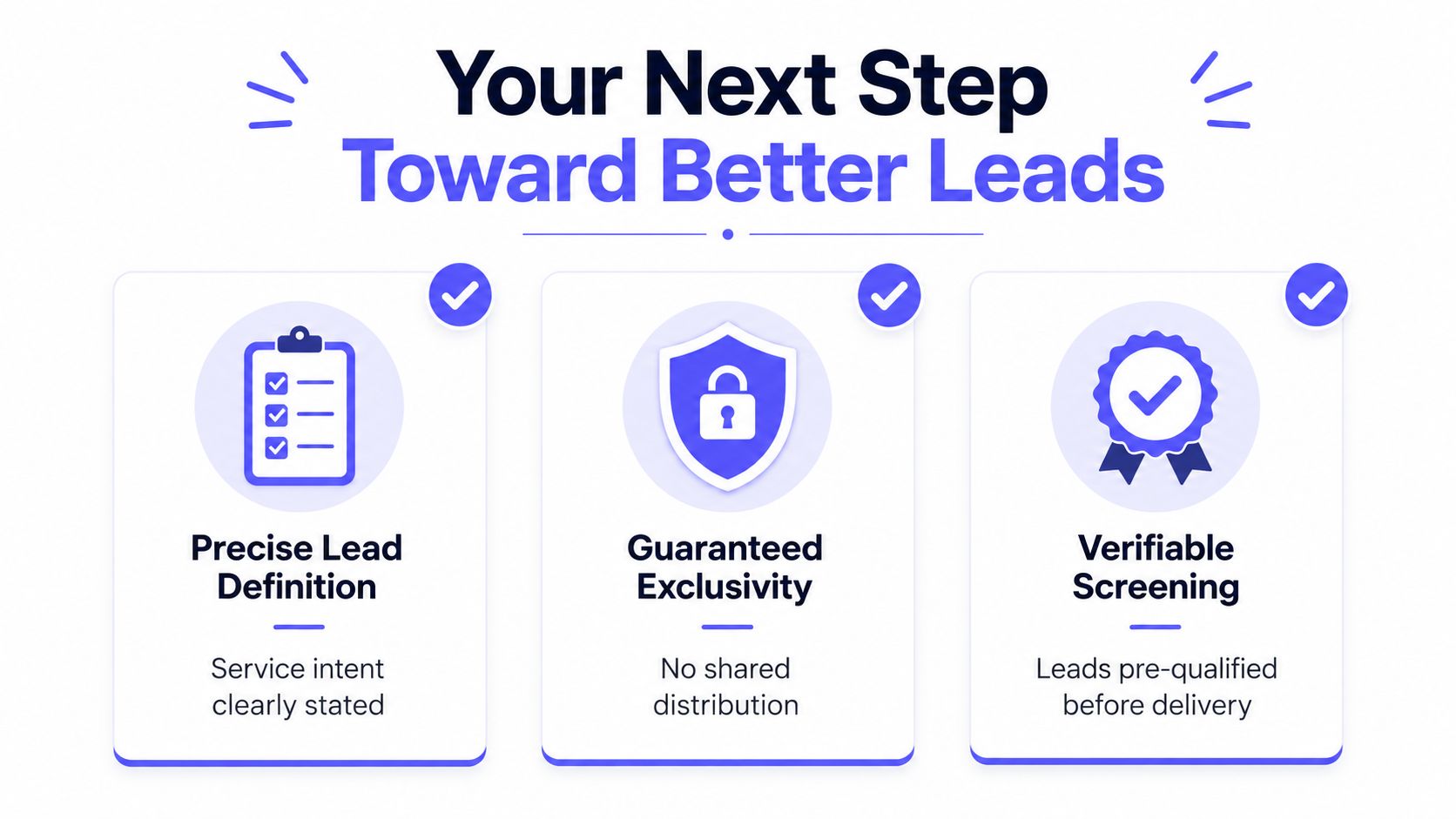
A cheap lead is expensive when the definition is loose. Start with three checks, a precise lead definition, guaranteed exclusivity, and a transparent rematch policy for bad contacts. If any one of those is missing, pay per lead turns into a volume game that looks efficient and performs badly.
Audit the last 90 days of lead spend against closed revenue, then calculate your real cost per acquisition. If the numbers are ugly, your sales team may not be the problem. The source may be sending weak or shared contacts. Exclusive pre-screened networks usually reply faster and give more context because they are not splitting the same request across competitors.
If you want a benchmark for accountable pay-per-lead structure, visit Hand Vetted and compare how the process is set up against the lead programs you use now.