In-ground sprinkler system cost usually lands between $1,500 and $4,500 for most U.S. residential installs, with $2,500 as a practical working midpoint. If the quote you got is much lower than that, you're probably not looking at a real in-ground system.
You're likely here because someone tossed you a number that felt fuzzy, and you want to know if it's fair before you sign anything. Good. That's the right instinct. The bill on these systems isn't driven by one neat average, it's driven by zones, soil, and trenching labor, and that's where the markup hides.
Table of Contents
- What an In-Ground Sprinkler System Actually Costs
- How Sprinkler Pricing Gets Calculated
- The Cost Drivers That Move Your Quote the Most
- Sample Costs for Three Common Yard Sizes
- DIY Installation Versus Hiring a Pro
- Operating Costs and Long-Term Maintenance
- How to Get an Accurate Quote and Vet the Installer
What an In-Ground Sprinkler System Actually Costs
The honest starting point is simple. Most U.S. residential in-ground sprinkler systems install in the $1,500 to $4,500 band, and plenty of people land around $2,500 to $2,800 once the yard size, zone count, and labor are counted properly. National cost guides cluster around that middle, with Angi showing an average of $2,540 and a range of $1,638 to $3,581, while NerdWallet also cites $2,539 on average in its guidance about sprinkler system pricing (Angi's 2025 sprinkler system cost guide).
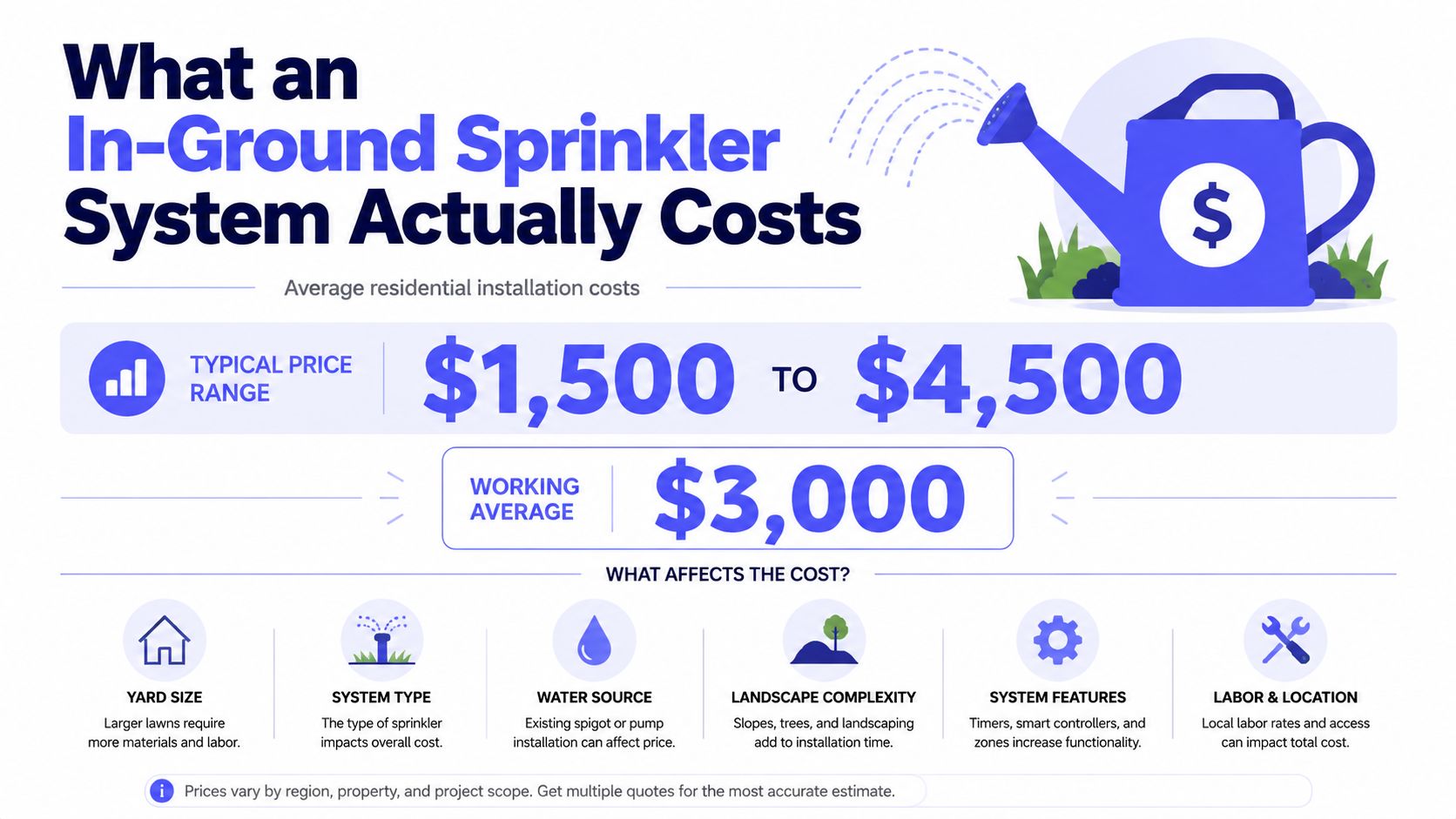
A quote near the low end usually means the yard is small, flat, and easy to trench. Once you get into more zones, tougher soil, or awkward access, the number climbs fast. That's why this isn't a one-price product.
Read the number the right way
If you're looking at a quote under $1,000, be skeptical. For a true buried system with valves, trenching, controller work, and installation labor, that number usually leaves out something real. It may be a partial job, a small add-on, or a quote that's going to grow once the crew starts digging.
Several guides also translate installed cost into square-foot terms, with estimates around $0.20 to $1.70 per square foot in the market references provided in the brief. That sounds cheap until you remember that trenching, valves, controllers, backflow protection, and labor are bundled into the total. The per-foot number helps you compare yards, but it doesn't protect you from layout complexity.
Practical rule: if your yard is modest, flat, and the water pressure is decent, you should expect the quote to sit near the middle of the band, not at the bottom.
By the time you finish comparing bids, your question shouldn't be “why isn't this cheaper,” it should be “what exactly is this price covering.” That's the only way to compare one installer to another without getting fooled by a low opening number.
How Sprinkler Pricing Gets Calculated
Installers usually price these systems three different ways, and each one shows a different part of the bill. A total-job quote is common, a per-zone quote is the cleanest way to compare bids, and a per-square-foot quote is mainly a check on whether the number is even in the right range.
The three pricing models you'll see
A per-zone quote is the one I trust first, because every zone needs its own valves, wiring, and hydraulic balancing. That is where the labor sits. The most useful way to read a bid is to break it into zones, then compare the price of each zone against the rest of the quote. That is also where a homeowner should keep an eye on the iron triangle of pricing trade-offs, because scope, labor, and speed all pull the number in different directions. Residential work commonly lands around $500 to $1,000 per zone, with broader estimates stretching to $600 to $2,000 per zone on more complicated installs, and one typical residential guide places a 6 to 10 zone system around $3,000 to $6,000 total (NerdWallet's sprinkler system cost guide, wellbuiltflorida's in-ground sprinkler system cost ranges).
A per-square-foot quote is only useful as a sanity check. The market references in the brief put installed coverage around $0.35 to $1.50 per square foot in one set of guides, while another broader guide puts the installed range at $0.20 to $1.70 per square foot. That spread exists because controller work and manifold work do not shrink just because the yard is larger. Once those fixed pieces are spread across more area, the per-foot number drops even if the job is harder in real life (Design Transition Studio's ground sprinkler system cost guide).
A single total can be fair if the scope is written out in plain language. It turns misleading fast when it hides zone count, head count, trenching, or backflow work.
| Pricing Model | Typical Range | Best Used For |
|---|---|---|
| Per zone | $500 to $1,000 per zone, sometimes higher for complex work | Comparing bids and spotting hidden labor |
| Per square foot | $0.20 to $1.70 per square foot | Quick yard-size sanity checks |
| Total job | Varies by scope | Final contracts with a written scope |
The smartest way to read any bid is to reverse-engineer it. Divide the total by the number of zones. Then ask what is included in trenching, valves, controller placement, and backflow protection. If the installer cannot explain the math, the number is not ready for your signature.
The Cost Drivers That Move Your Quote the Most
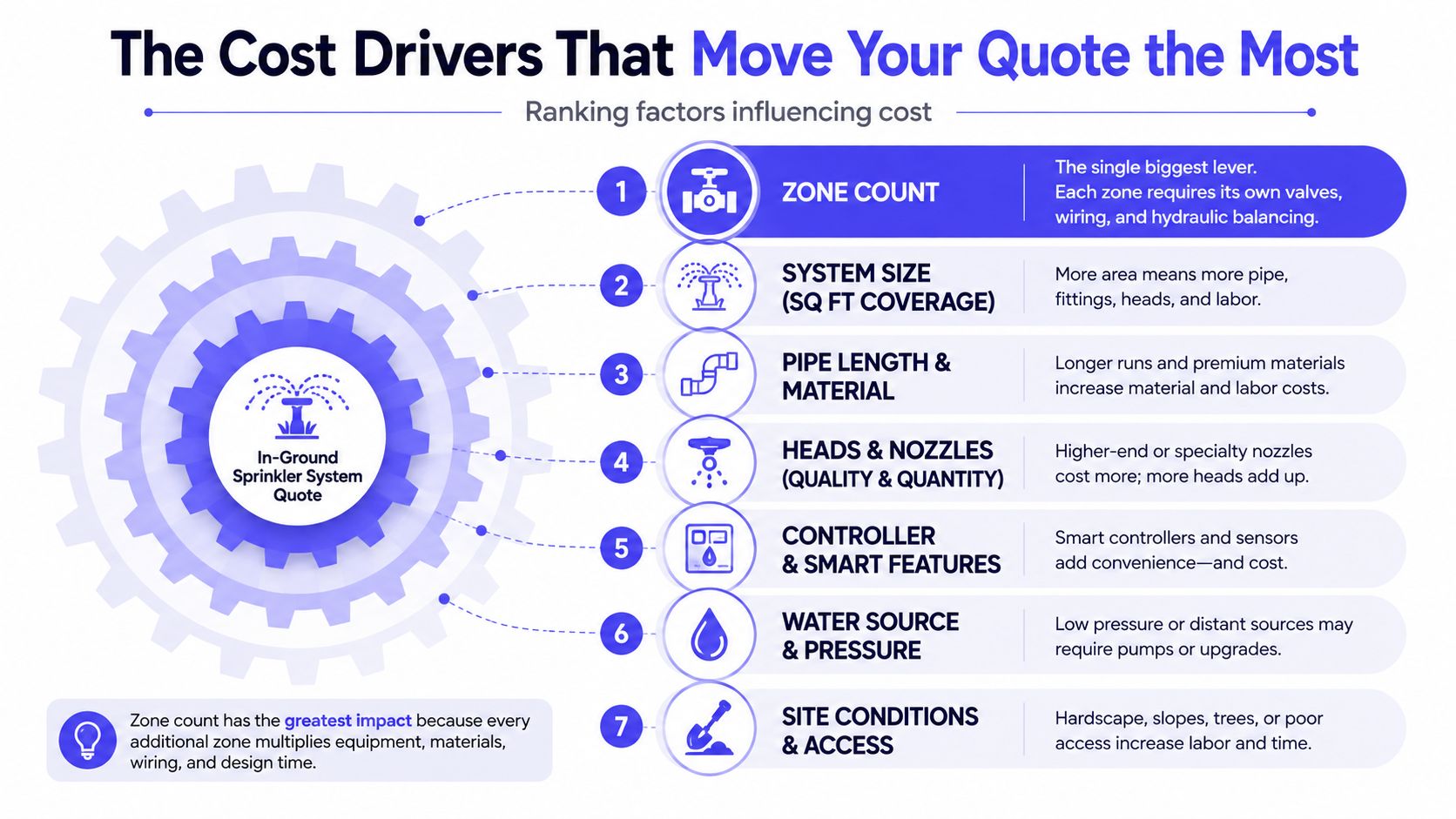
A sprinkler quote gets expensive fast for one simple reason, zone count drives the bill. Yard size matters, but it is not the first thing I look at. Every added zone means more valves, more wiring, more balancing, and more labor. That is where the markup hides, because the crew is not just laying pipe, they are building another working circuit.
What actually pushes the number up
Trenching and pipe work are the next big cost drivers. On a clean yard, that part is straightforward. Once the run gets longer, the labor climbs because the crew is digging more, carrying more material, and spending more time getting each line in place. Soil and access make that worse. Clay, rock, roots, slopes, and tight side yards slow everything down, and the labor line on the quote is where you pay for it.
A rocky yard is not a small nuisance. It changes the quote because every foot of trench takes longer to open and more effort to finish.
Water pressure and supply can force the installer to redraw the whole layout. If the system cannot run enough heads on one circuit, the answer is more zones or a different design. Either way, the price moves because the parts count changes and the labor changes with it.
Backflow prevention, smart controllers, and head selection add cost in a more modest way, but I would still watch them closely. The cheap-looking bid usually gets less cheap once the installer specs the right heads and the right control gear. If the quote includes specialty heads, better coverage patterns, or more advanced controls, expect the total to rise even if the yard size stays the same.
The cleanest way to read the number is this. A flat yard with average soil and normal pressure tends to sit near the lower end. A yard with poor access, slopes, rock, or several separate watering needs moves into the middle or upper end quickly.
My rule on the quote table: ask what happens to the price if the crew hits rock, finds pressure problems, or has to split a zone. If the answer is vague, the estimate is not finished.
Sample Costs for Three Common Yard Sizes
Small, medium, and large yards don't just differ in footage. They differ in how many zones the system needs, how much digging is involved, and how much of the work is spent solving layout problems instead of laying pipe.
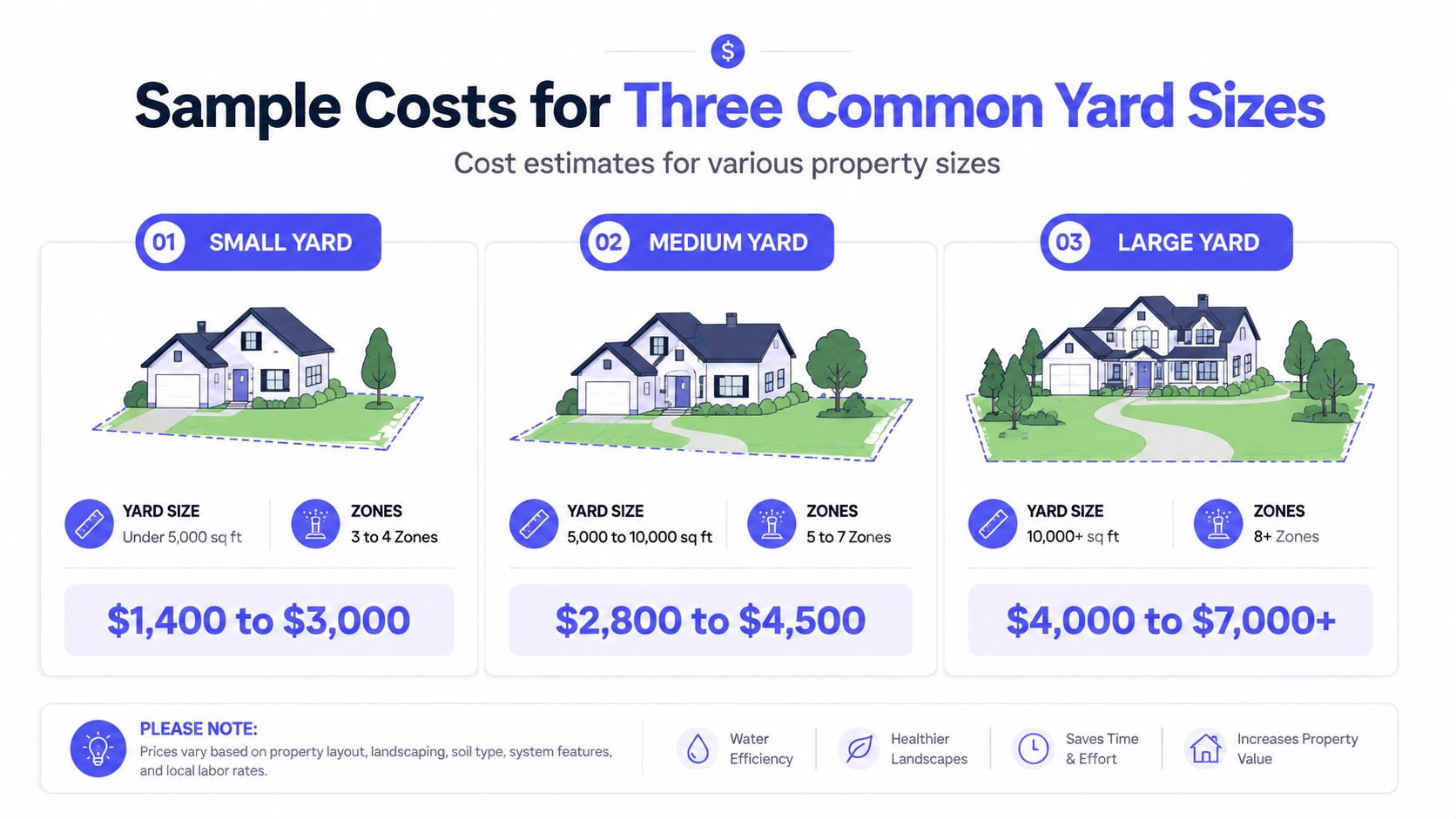
Small yard under 5,000 square feet
A small yard typically lands around $1,400 to $3,000, often with 3 to 4 zones. The lower end usually means easy access, short trench runs, and basic heads. The higher end shows up when the crew has to work around beds, slopes, or rough soil.
For a yard this size, the quote should be mostly about clean coverage, not fancy controls. If the system is designed well, you're paying for a sensible layout, not overbuilding.
Quarter-acre suburban lot
A typical quarter-acre property, roughly 10,000 square feet, often lands between $3,000 and $6,500, with many homeowners near $4,600 (DripWorks' inground sprinkler system cost guide). That size usually runs 6 to 8 zones in a practical residential layout.
At this scale, the bill starts to show where the money goes. More zones, more trenching, more balancing. The labor piece becomes more visible than the hardware piece.
Half-acre to acre-scale property
Larger properties usually run $6,000 to $10,000, and premium builds can reach $13,500 or more when smart controllers and drip-irrigation add-ons enter the plan (Fixr's sprinkler system cost guide). These systems often need 8 to 12 zones, sometimes more depending on shape and landscaping.
That's the point where the quote stops being about a “sprinkler system” and starts being about a full irrigation design. The system has to handle turf, beds, slopes, and separate watering needs without wasting water or leaving dry strips.
Here's the blunt version. If your property is small and simple, you should expect a manageable mid-thousands bill. If your yard is larger or segmented, the cost grows because the system has to do more work, not because installers are being dramatic.
DIY Installation Versus Hiring a Pro
DIY can save real money, but it only saves the labor line. It doesn't erase the hard parts of the job. If you're handy, patient, and working a small flat yard, the savings can make sense. If not, the cheap path gets expensive fast.
What DIY really puts on your plate
DIY homeowners are responsible for permits, rental equipment, utility locates, zone design, and code-compliant backflow prevention. That means you're not just digging and connecting pipe. You're also solving pressure, coverage, and inspection issues before the first head pops up.
Labor is the biggest place people hope to save, and DIY can shave meaningful money off that part of the project. But you also take on the risk of dry spots, water hammer, flooded valves, and bad coverage if the zone layout is off. Once that happens, you're buying corrections instead of savings.
A sprinkler system isn't hard because the parts are complicated. It's hard because the layout has to be right before the trench gets buried.
Why pro installs cost more and usually hurt less
Professional installation costs more upfront because it bundles design, parts, labor, warranty, and permit work into one number. That's the value. You're paying for someone to size the zones correctly, place the manifold, and test the system before they leave.
There's also a warranty angle people miss. Many controller and valve manufacturers won't stand behind bad installs. If the system is misbuilt, the cheapest quote can become the most expensive repair bill you own.
For anyone comparing contractor bids, the right question isn't “who's cheapest.” It's “who's documenting the scope.” A good checklist for that lives in what to ask a contractor, because the answers on permits, layout, and warranty terms tell you more than the final number does.
The honest recommendation is simple. DIY works for small, flat, predictable yards with good pressure and a confident installer. For sloped lots, rocky ground, larger properties, or marginal pressure, hire a pro and stop pretending the labor savings are free.
Operating Costs and Long-Term Maintenance
The install price is only half the story. The other half is what you'll keep paying every season to run and maintain the system. Most first-time buyers underbudget this part.
The ongoing bills that show up later
Water is the biggest recurring cost. A typical zone running 15 to 20 minutes per cycle can use 300 to 600 gallons each session, so a system running multiple days a week across a full growing season can push your bill higher than you expected. Electricity for the controller and valves is usually minor, and the brief in the source set notes it's often under $10 per month.
Maintenance is the part people forget until the first issue appears. Annual spring startup usually runs $75 to $200, winterization or blowout in colder climates runs $75 to $150, and repair visits often land around $50 to $150 over the life of the system. Valve replacements and head repairs are the common calls.
Budget rule: plan on roughly 10% to 20% of install price each year for long-term operation, water, and maintenance, especially if your system runs hard through the season.
The add-ons that pay you back
Smart controllers and rain sensors cost more upfront, but they usually earn their keep by cutting waste. You're not paying for a gadget. You're paying to avoid watering when the weather already did the job.
That matters because every extra cycle is money you don't need to spend. A simple rain sensor or better controller can reduce the nagging overwatering that most basic systems fall into.
The cleanest way to think about ownership is this. Installation gets you the system. Maintenance keeps it honest. If you ignore winterization, skip inspections, or let heads drift out of alignment, the system gets sloppy and your water bill follows.
How to Get an Accurate Quote and Vet the Installer
A serious quote starts with a site visit, not a guess. If someone gives you a price after a two-minute phone call, you're not getting a quote. You're getting a placeholder.
What the installer should measure
A real visit should include water pressure and flow at the meter, a soil assessment, a zone layout sketch, head count per zone, valve and manifold location, backflow preventer type, and controller location. Those are the details that turn a rough ballpark into a buildable scope.
If the installer skips those items, the bid is thin. The final bill usually isn't.
Red flags you should not ignore
A quote that comes in way below the others with no explanation is a warning sign. So is a proposal that never mentions permits, warranty terms, or model numbers. Vague phrases like “as needed” are where surprise charges live.
Look for these before you sign:
- License and insurance proof: If they can't show it quickly, move on.
- Recent local references: You want jobs in your area, not generic testimonials.
- Manufacturer certifications: Especially for the controller brand they're proposing.
- Written scope of work: Model numbers, head counts, valve locations, and backflow details should be on paper.
- Clear permit language: If they're doing the work legally, they should be able to explain the process without dancing around it.
A quote that spells out the details is worth more than a cheaper one that doesn't. That's especially true if you're comparing contractors who may quote different zones for the same yard.
If you'd rather not blast your project details out to a pile of strangers, use a service that pre-screens people before the first call. You can also review the basics of contractor background checks so you know what a real vetting process looks like before anyone starts digging.
Hand Vetted Co. matches you with one verified professional instead of sending your project to a list of random companies. If you're comparing in ground sprinkler system cost and want a cleaner way to get a serious quote, visit Hand Vetted Co. and start with a match that respects your time.