You finish a heat pump installation, leave the customer satisfied, and expect the next enquiry to follow. Instead, the phone stays quiet, while the leads you do receive have already been contacted by several competing businesses. That's the core heat pump lead problem. Demand exists, but quality, qualification, exclusivity, and response speed decide whether that demand becomes profitable work.
Table of Contents
- The Heat Pump Lead Generation Challenge
- Identifying Effective Lead Generation Channels
- Qualifying Heat Pump Leads for Higher Conversion
- Comparing Shared and Exclusive Lead Models
- Leveraging Vetted Lead Platforms for Growth
- Your Action Plan for Heat Pump Lead Generation
The Heat Pump Lead Generation Challenge
A heat pump enquiry can look promising in your inbox and still be a poor fit. The person may be a tenant, researching without a decision timeline, comparing quotes from several businesses, or asking for a system that the property can't support without further work. A contact form alone tells you very little.
The market opportunity is real. In the United Kingdom, government-supported heat pump installations reached 42,645 in the year ending December 2024, up 52% from 28,084 in the preceding 12 months and more than four times the volume recorded in the year ending December 2019, according to the UK heat pump deployment statistics for 2024. Air-source systems represented 98% of those installations, while the Boiler Upgrade Scheme funded 53% and the Energy Company Obligation funded 40%.
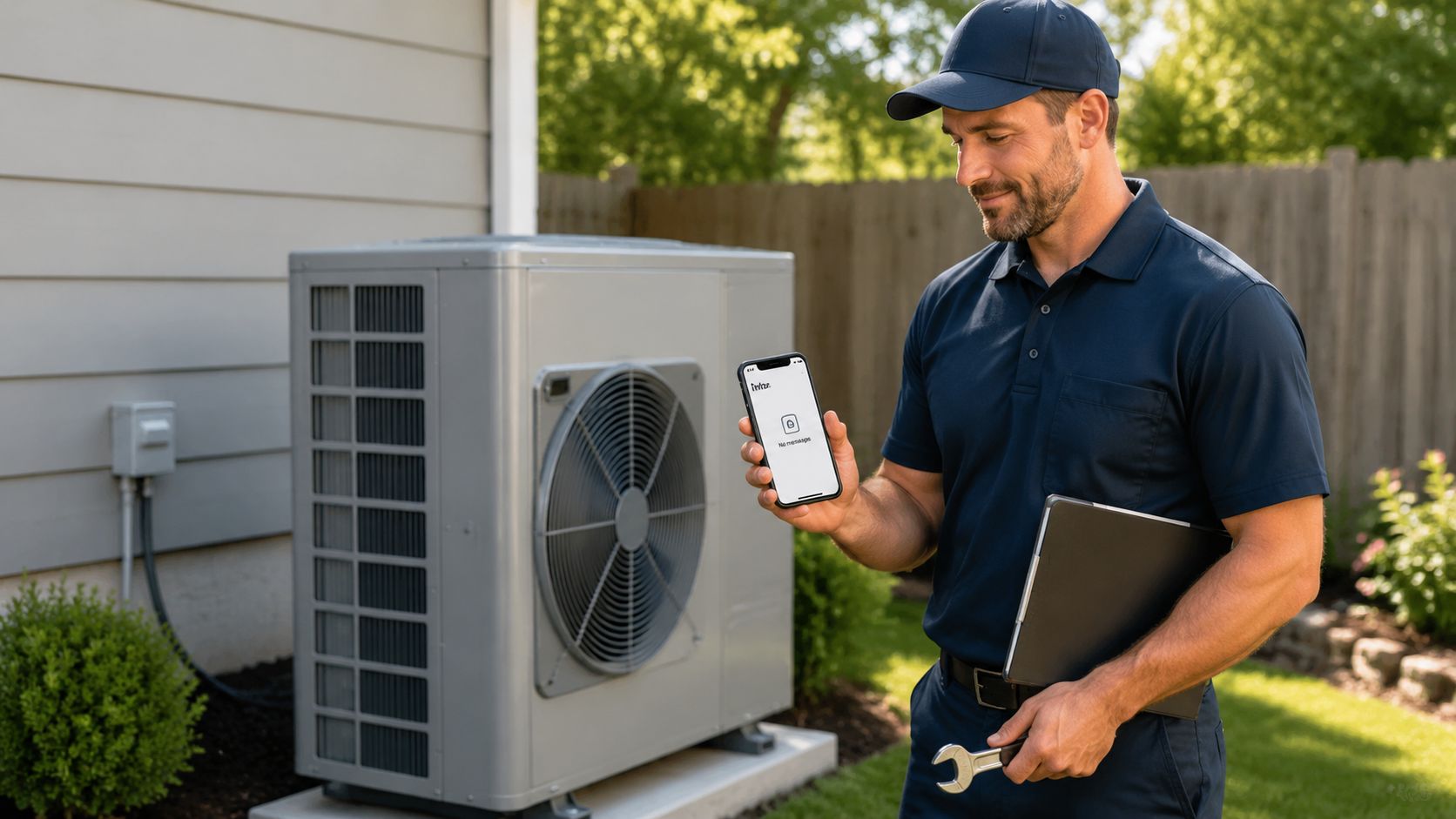
That funding mix matters. Incentives can move people from passive interest to active quote requests, but they can also bring in enquiries from people who haven't checked property suitability, budget, or installation requirements. More demand doesn't remove the need for disciplined screening. It increases it.
Why shared leads create friction
Shared lead platforms sell the same homeowner's details to several businesses. The homeowner may receive multiple calls within minutes, then stop answering altogether. Your team spends time racing competitors instead of diagnosing the project.
The problem isn't only conversion. It's customer experience. A homeowner who feels pursued by several companies may distrust every professional who calls, including the one most qualified to help.
Practical rule: A lead has value only when the project, timing, property, and contact experience make a productive conversation possible.
Exclusive leads change the starting point. One business receives the opportunity, so the first call can focus on suitability and education rather than trying to be the first of many voices. That doesn't guarantee a sale. It does create cleaner conditions for earning one.
Identifying Effective Lead Generation Channels
A sustainable pipeline rarely comes from one channel. The right mix depends on your service area, installation capacity, sales process, and ability to respond quickly. Start by separating channels into owned, earned, and paid sources, then judge each by lead quality rather than enquiry volume.
Build the owned foundation first
Your website and local search presence should answer the questions people ask before they request a survey. Create clear service pages for air-source and other systems you install, explain the suitability assessment, and show genuine project photographs. A useful page should help someone understand what happens next, not just repeat product features.
Content should address practical concerns such as:
- Operating costs: Explain which variables affect running costs, including property condition, system design, controls, tariff, and climate. Avoid promising a universal saving.
- Cold-weather performance: Discuss design temperature, emitter sizing, insulation, and backup arrangements in plain language.
- Incentive eligibility: Keep funding information current and distinguish eligibility questions from guarantees.
- Installation readiness: Explain what you inspect before recommending equipment, from heat loss to electrical and outdoor-unit requirements.
A local SEO page should also make your coverage clear. Include the places you serve, examples of local property types, and a simple route to request an assessment. Send finished customers a review request while the installation experience is still fresh.
Add trusted referral sources
Suppliers, electricians, solar professionals, architects, builders, energy assessors, and property managers often hear about heating projects before an installer does. A referral arrangement works when the partner knows exactly which projects fit your service and has a simple way to introduce them.
Give partners a short referral brief. Include your service area, the systems you install, the projects you don't take, and the information you need before calling. Fast follow-up protects the partner's reputation and prevents the prospect from drifting.
Use paid channels with a conversion checkpoint
Paid search and local social advertising can reach people actively researching heating upgrades. Direct the traffic to a specific offer, such as a suitability conversation or project assessment, rather than a generic homepage. Use real installation photographs and explain the next step clearly.
Track the journey from source to qualified appointment, survey, proposal, and completed installation. A cheap click or form submission means little if your team can't turn it into a suitable project.
For a broader view of local home-service acquisition, review lead generation near you as one possible channel alongside your own website, referrals, and advertising.
Qualifying Heat Pump Leads for Higher Conversion
Qualification protects your calendar. Before transferring an enquiry to a salesperson or booking a site visit, establish whether the project is viable and whether the person is ready for a serious conversation.
At minimum, screen for property ownership, building type, current heating source, budget, and decision timeline. These questions aren't designed to reject people. They help you route opportunities correctly. Someone who owns a detached property with an ageing oil system and a defined renovation date deserves a different follow-up path from someone casually browsing grant information.
Ask questions that change the next action
Use a short conversation rather than a long interrogation. Ask what prompted the enquiry, what heats the property now, whether the person owns it, and who else needs to approve the work. Then establish whether they're seeking an estimate, exploring feasibility, or actively comparing installation dates.
The property itself needs early attention. Building type, available external space, insulation condition, existing emitters, electrical capacity, and any planning or access constraints can affect design and cost. You don't need a full survey on the first call, but you do need enough context to avoid promising an unsuitable solution.
Budget deserves careful handling. Don't force a prospect to name a perfect figure before they understand the project. Instead, explain that the eventual recommendation depends on heat loss, equipment, emitters, controls, electrical work, building improvements, and applicable support. A transparent conversation filters unrealistic expectations without turning the call into a hard sell.
Use a structured lead score
A simple internal score can help your team prioritise without pretending to predict the sale. Mark each enquiry as ready, developing, or unsuitable for immediate transfer.
- Ready: The person owns the property, understands the project, has a plausible budget, and wants a defined next step.
- Developing: The property may fit, but the person needs education about suitability, operation, or incentives before booking.
- Unsuitable for now: Ownership, location, property constraints, or timing make an immediate survey impractical.
One independent lead qualification source reports that screening with 14 criteria before handover produced a 30% appointment-setting rate on warm-transferred leads, with an average connection time of 28 seconds. See the lead qualification findings for heat pump transfers for that benchmark and methodology.
The handoff should include the answers, not just a phone number. Record the heating source, property context, motivation, timing, and agreed next step. The installer then starts with relevant questions instead of making the prospect repeat the entire story.
For businesses building a broader home-improvement pipeline, contractor leads for home improvement offers another example of why project details matter before contact.
Comparing Shared and Exclusive Lead Models
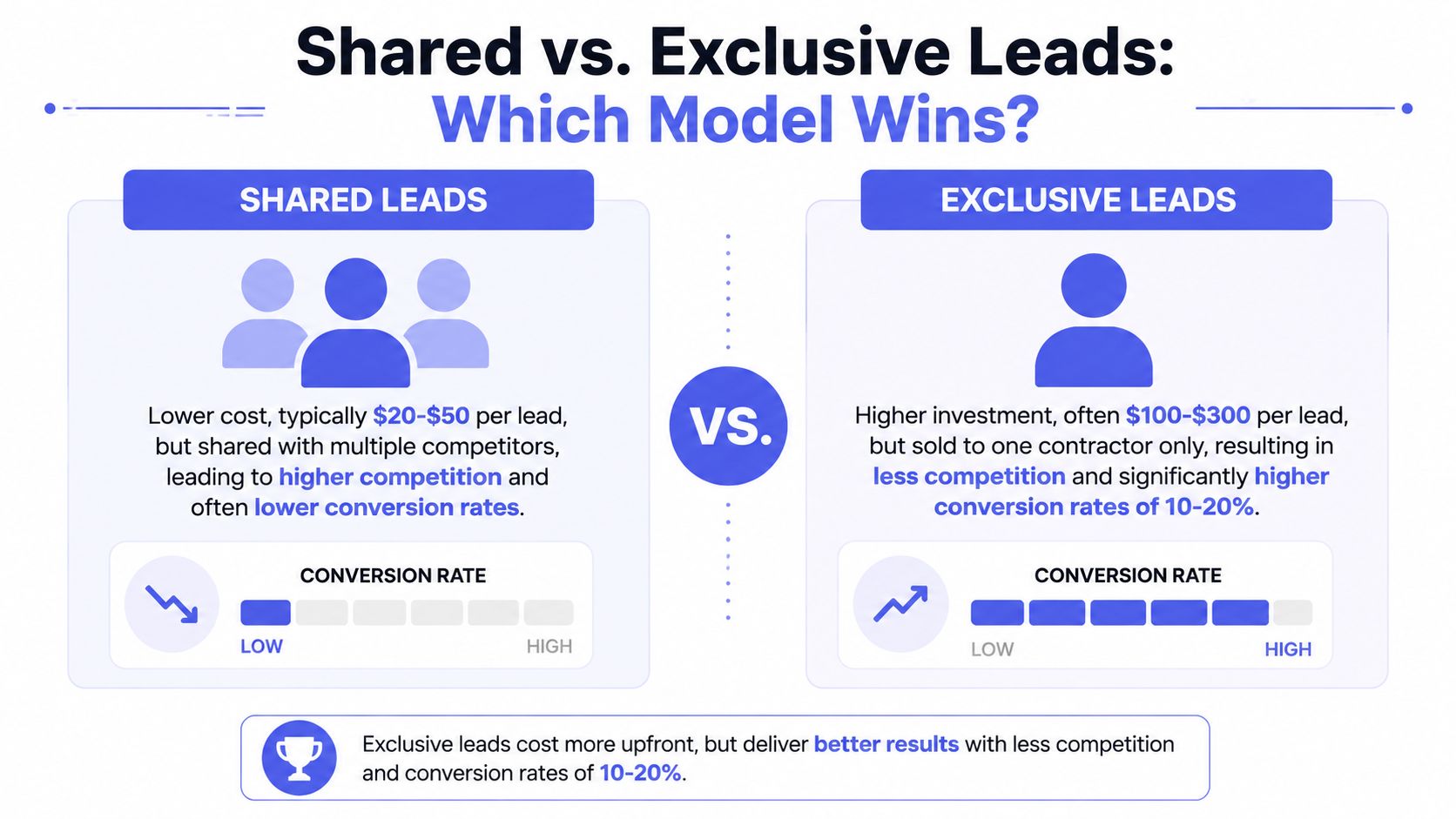
Shared and exclusive leads solve different commercial problems. Shared leads may provide a larger stream of contacts at a lower acquisition price, but the contractor accepts more competition and more uncertainty. Exclusive leads usually require a higher investment, yet they give your team a cleaner opportunity to build trust.
Independent HVAC benchmarks report that shared leads often convert to booked jobs at roughly 5% to 10%, while exclusive web leads commonly reach around 25% to 35% and exclusive live-transfer phone leads around 30% to 45%, as detailed in this HVAC lead benchmark comparison. The same source identifies response times under 5 minutes and automated follow-up as important operating benchmarks.
| Feature | Shared Leads | Exclusive Leads |
|---|---|---|
| Competition | Several businesses may contact the same person | One business receives the request |
| Customer experience | The prospect may receive repeated calls | The conversation starts with a single professional |
| Cost structure | Often lower upfront cost | Often higher investment per opportunity |
| Follow-up pressure | Speed becomes a race against other businesses | Speed still matters, but there's less direct competition |
| Qualification risk | Quality can vary widely by source | Pre-screening can provide more project context |
| Best fit | Teams optimising for volume and able to absorb waste | Firms prioritising focused sales conversations and service quality |
The correct model depends on your numbers. If your close rate is healthy, your response process is fast, and your team can handle volume, shared leads may work as a controlled test. If repeated contact, low intent, or poor-fit projects consume your sales capacity, exclusivity may produce a better return even when each opportunity costs more.
Don't compare providers by lead price alone. Compare cost per qualified appointment, cost per survey, proposal rate, close rate, cancellation rate, and gross profit per completed job. Those measures reveal whether a cheaper lead is actually cheaper.
Leveraging Vetted Lead Platforms for Growth
A vetted lead platform can remove several tasks from your internal process. Instead of buying an unfiltered contact record, you receive a project request that has already passed basic checks and is intended for one professional. That makes the platform a complement to local search, referrals, and paid advertising, not a replacement for them.
The distinction matters in heat pump work because suitability questions arise early. A useful request should identify the project type, timing, location, and relevant property details so your first call can move toward feasibility rather than basic discovery.
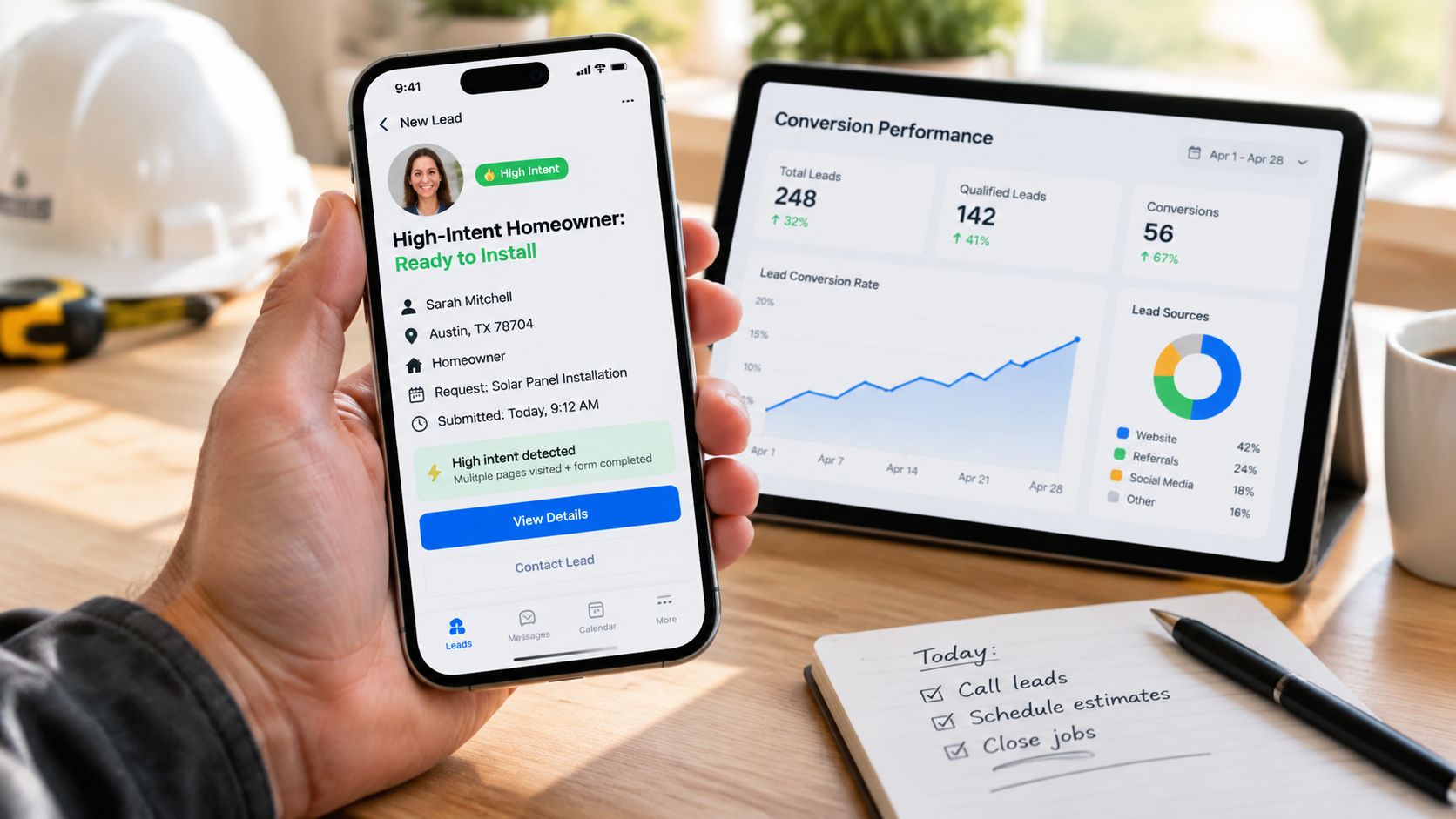
Handvetted matches people with one licensed, background-checked, 4.5+ star rated professional. Every match is exclusive and isn't shared with multiple businesses. For businesses, Handvetted delivers pre-screened, exclusive project requests, helping licensed firms stand out from unqualified competitors.
Fit the platform into your operating system
Set an immediate response process before accepting paid opportunities. Assign ownership to a person, define the first-call script, and record outcomes in your CRM or a simple pipeline sheet. If a lead arrives outside business hours, use an acknowledgement message that sets a realistic callback expectation.
Review the results by source and project stage. A platform that sends suitable enquiries but receives slow follow-up may appear weak when the issue sits inside your operation. Conversely, a fast team can expose poor qualification quickly and decide whether to adjust or stop the channel.
For contractors tightening their broader acquisition process, marketing for HVAC companies provides a relevant starting point. The practical test remains the same: does the channel produce conversations that your team can serve profitably?
Your Action Plan for Heat Pump Lead Generation
A good lead strategy is an operating system, not a campaign you launch once. It connects demand generation, qualification, response, delivery capacity, and review collection. Start with the parts you can control, then add paid or platform-based volume only when the fundamentals are working.
Audit the pipeline before buying more leads
Review recent enquiries and classify each by source, property ownership, heating system, timeline, appointment outcome, and final disposition. Look for patterns. You may find that one channel produces many contacts but few surveys, while another produces fewer enquiries with stronger project fit.
Check your response process at the same time. Decide who owns each new request, how the first call is handled, what information gets recorded, and when follow-up stops or changes channel. A qualified lead that waits in an inbox is still a lost opportunity.
Improve the message people see before contacting you
Your website, local profile, and advertising should answer the practical questions that block action:
- Suitability: Explain the checks you perform before recommending a system.
- Performance: Address cold weather, controls, emitters, and expected operation without making universal promises.
- Costs: Show what affects the total project and running-cost discussion.
- Support: Describe commissioning, handover, maintenance, and who the customer contacts after installation.
- Proof: Use real project images, clear service areas, credentials, and current customer feedback.
These topics matter because research into homeowner questions has found recurring interest in effectiveness compared with gas, expected bill reduction, system operation, cold-temperature performance, incentives, and whether the system is all-electric. The Illinois heat pump research study identifies those questions among the most common contractor concerns.
Test exclusivity with discipline
Run a controlled trial with one lead source or platform. Define the acceptable project area, minimum qualification details, response standard, and financial measures before the first lead arrives. Track the path from request to booked appointment, survey, proposal, and completed work.
Keep your own assets growing while you test. Publish useful answers, develop referral relationships, request reviews, and document completed installations. Exclusive leads can improve the sales environment, but a sustainable business still needs a recognisable local reputation and a clear customer experience.
The next practical move is simple. Audit your last batch of enquiries, remove the sources that create unproductive competition, tighten your qualification questions, and choose one exclusive channel to measure properly over the next operating cycle.
Hand Vetted Co. offers licensed businesses pre-screened, exclusive project requests, so your team can spend less time chasing shared contacts and more time assessing suitable heat pump work. Visit Hand Vetted Co. to review the matching model and decide whether it fits your lead generation process.