A full HVAC replacement in 2026 usually lands somewhere between $5,000 and $28,000, and most average-sized homes end up in the $11,590 to $14,100 band. Your job is to figure out where your home sits on that spread before you let anyone talk you into a clean-sounding but meaningless average.
That's the core question behind the cost to replace HVAC system. Not “What does HVAC cost?” but “What will your system cost, with your square footage, your climate, and your install complexity?”
Table of Contents
- What Most People Actually Pay to Replace an HVAC System
- What Is Actually Included in a Full HVAC Replacement
- Comparing HVAC System Types and Their Price Ranges
- How Home Size and Region Change Your Final Number
- The Six Levers That Move Your Quote Up or Down
- Getting Accurate Quotes and Vetting the Right Contractor
- Financing Options and Smart Ways to Save Without Cutting Corners
- Your Replacement Timeline and Questions to Ask Before Signing
What Most People Actually Pay to Replace an HVAC System
The first mistake people make is chasing one national number. There isn't one. A full replacement in major U.S. markets typically runs $5,000 to $28,000, and the middle of the road is narrower than that, with ConsumerAffairs reporting an average of about $11,500 in 2026 and Modernize putting a typical whole-home replacement at $11,590 to $14,100 based on 56,000 real homeowner projects in the prior six months. ConsumerAffairs HVAC replacement cost guide, Modernize HVAC cost calculator
For a practical planning number, I'd use the $11,590 to $14,100 band if you're replacing a combined system in an average-sized home. Bryant's 2026 pricing guide also frames complete replacement in a broad $5,000 to $28,000 range, with a narrower typical range of $5,000 to $20,000, which is exactly why a single average can mislead you. Bryant HVAC pricing guide
What to anchor on first
Start with the system type, then the square footage, then the install conditions. A 2,000 to 2,500 square foot home often lands around $13,430 for a combined air-conditioning and gas furnace setup, which is a useful middle benchmark if your house is in that size band. Budget Heating HVAC cost guide
Trane's national replacement ranges show why the total swings so hard, with air conditioners at $6,568 to $13,669, furnaces at $5,093 to $8,390, and heat pumps at $7,369 to $15,608. Those are not interchangeable jobs, and the bill changes as soon as you switch the equipment mix. ConsumerAffairs HVAC replacement cost guide
| Source | Average Cost | Typical Range | Sample Basis |
|---|---|---|---|
| ConsumerAffairs | About $11,500 | $5,000 to $28,000 | Major U.S. markets, 2026 |
| Modernize | $11,590 to $14,100 | $11,590 to $14,100 | 56,000 real homeowner projects |
| Bryant | Not stated | $5,000 to $28,000 | Full replacement estimate, 2026 |
| Budget Heating | $13,430 | Not stated | 2,000 to 2,500 sq ft home, combined AC and gas furnace |
What Is Actually Included in a Full HVAC Replacement
A real replacement quote is more than a box and a labor line. You're paying for the equipment itself, removal of the old unit, install labor, and usually some mix of ductwork adjustments, electrical work, permits, thermostat setup, and startup or commissioning. When a quote skips one of those pieces, it's not a bargain. It's incomplete.
The parts that should be on the page
The equipment can include a condenser, evaporator coil, furnace or air handler, and any heat pump components. The labor side covers pulling the old system, setting the new one, connecting refrigerant and drainage, and verifying that it starts and runs correctly.
A lot of the price spread comes from what the contractor has to correct along the way. Ductwork may need modifications, a code-required disconnect might be added, or the electrical setup may need upgrading before the system can pass inspection. If the job is older, the contractor may also need to deal with permits and site-specific code compliance.
Cheap quotes usually mean something was left out, not that the contractor is generous.
Why two quotes for the same model can differ
That difference usually comes down to scope. One contractor may include a new condensate line, controls, or refrigerant-related upgrades, while another leaves those items as change orders. If you're comparing numbers, you need the same scope on both sides or the cheaper bid is just a partial story.
The startup visit matters too. That's the part where the system is checked under real operating conditions, not just plugged in and left. If a quote doesn't say who is responsible for commissioning, ask before you sign.
Comparing HVAC System Types and Their Price Ranges
The system type drives the project, not the other way around. A basic central AC replacement can start around $3,000 to $7,900, while a heat pump typically runs $6,000 to $25,000 and geothermal systems can exceed $25,000 to $45,000 because of the ground-loop work and site-specific labor. Carrier HVAC replacement cost guide
What fits which kind of property
A gas furnace plus AC pairing is still the common choice in colder regions where gas is available and the winter load is real. It's usually the safest bet when low heating cost and straightforward serviceability matter more than chasing the newest technology.
A heat pump makes more sense in mild-to-moderate climates, or where a household wants an electric-only setup. The equipment range in the earlier section already showed how much that architecture can move the bill, which is why people should price it as its own system, not as an add-on after they've already settled on furnace plus AC.
A geothermal system is the premium play. It can make sense for people who plan to stay put long enough to justify the upfront cost, but it's the least forgiving option on budget because the install is built around the site, not just the house.
Cost and fit side by side
| System Type | Typical Cost Range | Best Climate | Best For |
|---|---|---|---|
| Central AC replacement | $3,000 to $7,900 | Warm or mixed climates | Straight cooling swap with lower upfront spend |
| Furnace-only replacement | $5,093 to $8,390 | Cold winters with gas service | People replacing heat without changing cooling |
| Heat pump | $6,000 to $25,000 | Mild to moderate climates | Electric-only homes and efficient all-in-one setups |
| Geothermal | $25,000 to $45,000+ | Site-dependent | Long-term owners focused on top-tier efficiency |
The cheaper system is only cheaper if it solves the same problem. If it leaves you with mismatched comfort, higher operating costs, or a second replacement later, the “savings” are fake.
How Home Size and Region Change Your Final Number
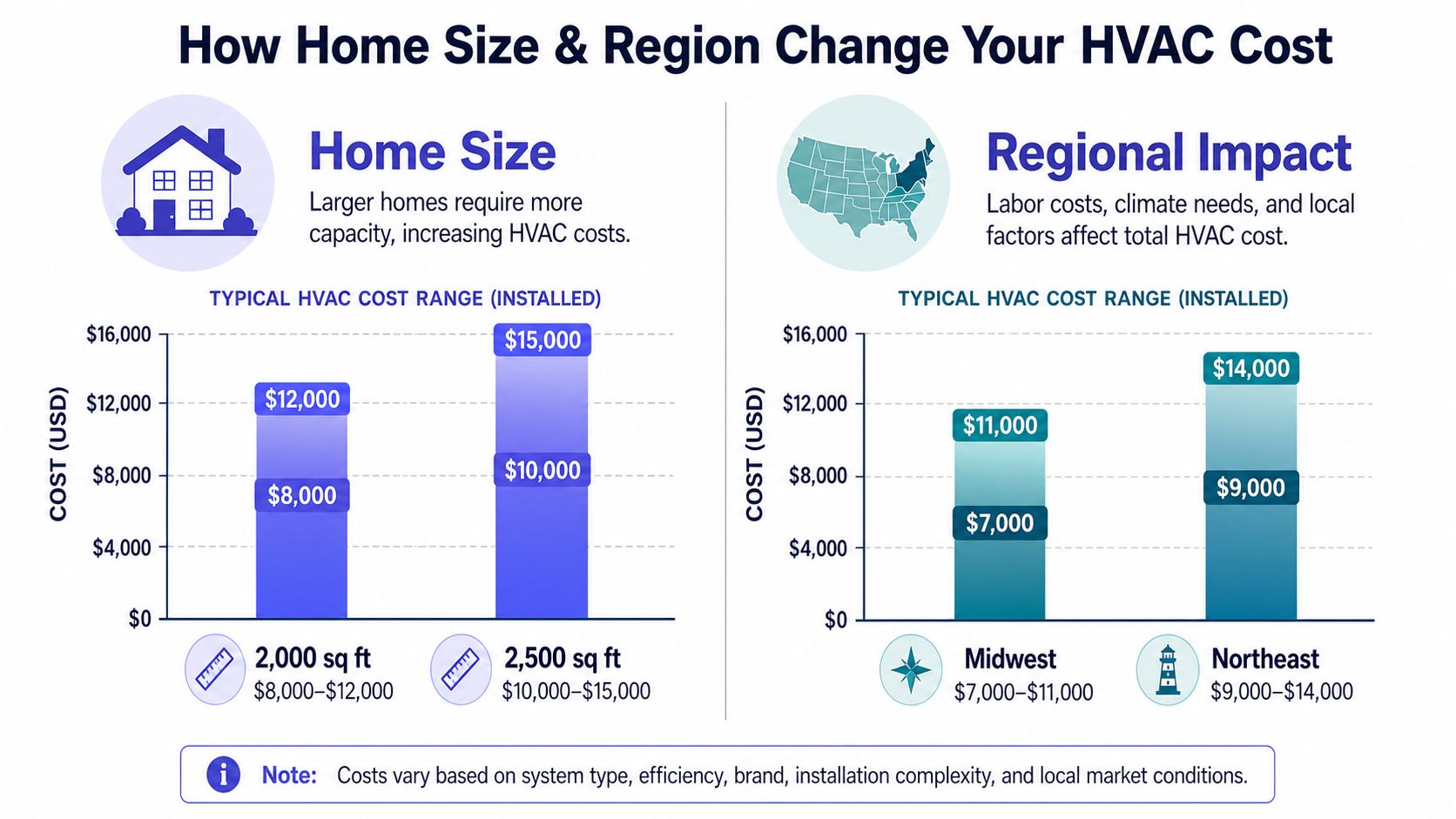
Home size is one of the few cost drivers you can measure before anyone visits. Modernize's dataset puts a 2,000 to 2,500 square foot home at about $13,430 for a combined AC and gas furnace setup, which gives you a real-world anchor instead of a fuzzy national average. Modernize HVAC cost calculator
Size pushes equipment and labor at the same time
Smaller homes usually need less capacity, fewer materials, and less duct correction. Larger homes push the quote up because the equipment has to move more air, the ductwork often has to be scaled or reworked, and install time goes up with complexity. That's why a 2,000 square foot house and a 2,500 square foot house can't be treated like the same job.
The regional side matters just as much. Labor tends to run higher in coastal and Northeast markets, while Sun Belt regions see more heat-pump activity, and colder plains markets still lean toward gas furnace plus AC pairings because that architecture fits the climate better.
How to place your own house on the band
Use two inputs, your square footage and your ZIP code. If you're in a lower-cost region with simpler access, you're closer to the low-middle of the spread. If you're in a stricter-code market with older ductwork or tighter access, expect the quote to drift upward fast.
The useful move is not comparing your place to a headline average. It's comparing it to homes of similar size in similar weather. That gets you much closer to the number a contractor should quote.
The Six Levers That Move Your Quote Up or Down
Every quote rises or falls on the same handful of decisions. If you understand these six levers, you can tell whether a price is fair, padded, or missing something important.
Equipment tier and efficiency
Entry-level systems cost less upfront. Variable-speed and communicating systems cost more because the hardware is smarter, quieter, and usually more efficient. James River Air's lineup reflects that tier gap clearly, with its basic package aimed at lower cost, its mid-tier package built around variable capacity, and its top tier pushing up to 24 SEER2 efficiency. James River Air HVAC replacement cost page
Labor, ductwork, permits, and sizing
The other four levers are where bad surprises live.
- Labor complexity: A straight swap is one thing, but duct redesign, framing changes, or an electrical panel upgrade change the job fast.
- Ductwork condition: Sealed and sized ducts keep the price controlled. Crushed, leaky, or undersized ducts don't.
- Permits and code: Older homes often need more compliance work before the system can be signed off.
- Sizing: Manual J load calculation beats eyeballing the square footage every time. A system that's too big or too small costs more over its life and usually feels worse day to day.
The most expensive mistake is sizing by square footage alone instead of running a proper load calculation.
A cheaper system tier can be the right move if the house is simple, the ductwork is sound, and the climate doesn't demand more. Once the job starts including electrical upgrades or duct correction, the cheapest-looking option often stops being the cheapest project.
Getting Accurate Quotes and Vetting the Right Contractor
Get at least three written quotes, and make them itemized. You want equipment, labor, ductwork, permits, warranty terms, and any add-ons listed separately so you can compare apples to apples.
What to verify before you sign
Check licensing and insurance directly. Don't trust a badge on a website. Ask for a Manual J load calculation before the system size is locked in, and confirm who pulls the permit.
Here's the practical filter:
- Compare the line items, not just the total. One low number can hide missing labor or permit work.
- Watch for same-day pressure. Good contractors don't need to bully you into a decision.
- Treat a dramatically low bid as a warning sign. There's usually a reason.

A matching service like this contractor background check process can save time if you don't want to run every verification yourself. The point isn't to collect the most quotes. It's to collect the right ones from people who can do the work.
Financing Options and Smart Ways to Save Without Cutting Corners
Homeowners don't write a check for a full replacement. They finance it, and that changes how you should think about the total cost.
The financing choices that actually make sense
Manufacturer or contractor financing can work if the promotional terms are real and you can pay it off before deferred interest kicks in. A home equity loan or HELOC can be a better move for larger projects if the rate beats card financing and you've got enough equity to use it responsibly.
Utility rebates and federal incentives matter most when you're looking at a high-efficiency heat pump. That kind of support can make the more expensive system manageable, especially if your current setup is old and you were already headed toward replacement.
If you want a clean breakdown of the trade-offs, this financing overview is a useful place to start.
The easiest way to save real money is to replace during shoulder season, not during the first hard cold snap when contractors are slammed and pricing tightens up.
Don't cut corners on equipment just to hit a monthly payment target. Save by timing the job well, choosing the right system for the house, and stacking financing with rebates where they fit.
Your Replacement Timeline and Questions to Ask Before Signing
A full replacement usually moves faster than people expect once you've chosen the contractor. A realistic timeline is often one to three weeks from first quote to install day, depending on scheduling, equipment availability, and whether anything hidden turns up during the site visit.

What to ask before you put your name on the quote
Ask for the total project price in writing. Get the model numbers, not just the brand name. Confirm the parts warranty and the labor warranty separately, because they are not the same thing.
You should also ask what happens if the contractor finds undersized ductwork mid-install. That answer tells you whether the quote was honest or optimistic. Then ask about the payment schedule so you know exactly when money changes hands.
The practical checklist is short:
- What exactly is included in the price?
- Who pulls the permit?
- What happens if the ducts need work?
- What warranty applies to labor?
- When does the crew show up, and who cleans up?
Two questions people ask most
A full HVAC system often lasts 15 to 20 years with maintenance. Replacing the furnace and AC at the same time is usually the smarter move because you avoid paying for two labor mobilizations and you keep the system matched.
If you're ready to price your own project, start with one verified pro instead of sorting through a pile of random contacts. You can also use what to ask a contractor as your final pre-signing checklist before anyone starts work.
Hand Vetted Co. helps people get matched with one verified HVAC professional instead of chasing a stack of competing bids. If you want a cleaner way to price your replacement and avoid the usual verification hassle, visit Hand Vetted Co. and start with a single, exclusive match.