$7.94–$12.17 per linear foot is the national average cost to install door trim in May 2026, and that usually lands around $150–$250 per standard interior door. The price swings because the install is only part of the job, finish work and material choice can move the bill fast.
Table of Contents
- National Average Costs for Door Trim Installation
- How Material Choice Changes Your Total Bill
- Factors That Push Your Price Higher or Lower
- Real Project Scenarios and What They Cost
- The Finish Work Cost Gap Most Guides Ignore
- How to Reduce Costs and Get Accurate Local Quotes
National Average Costs for Door Trim Installation
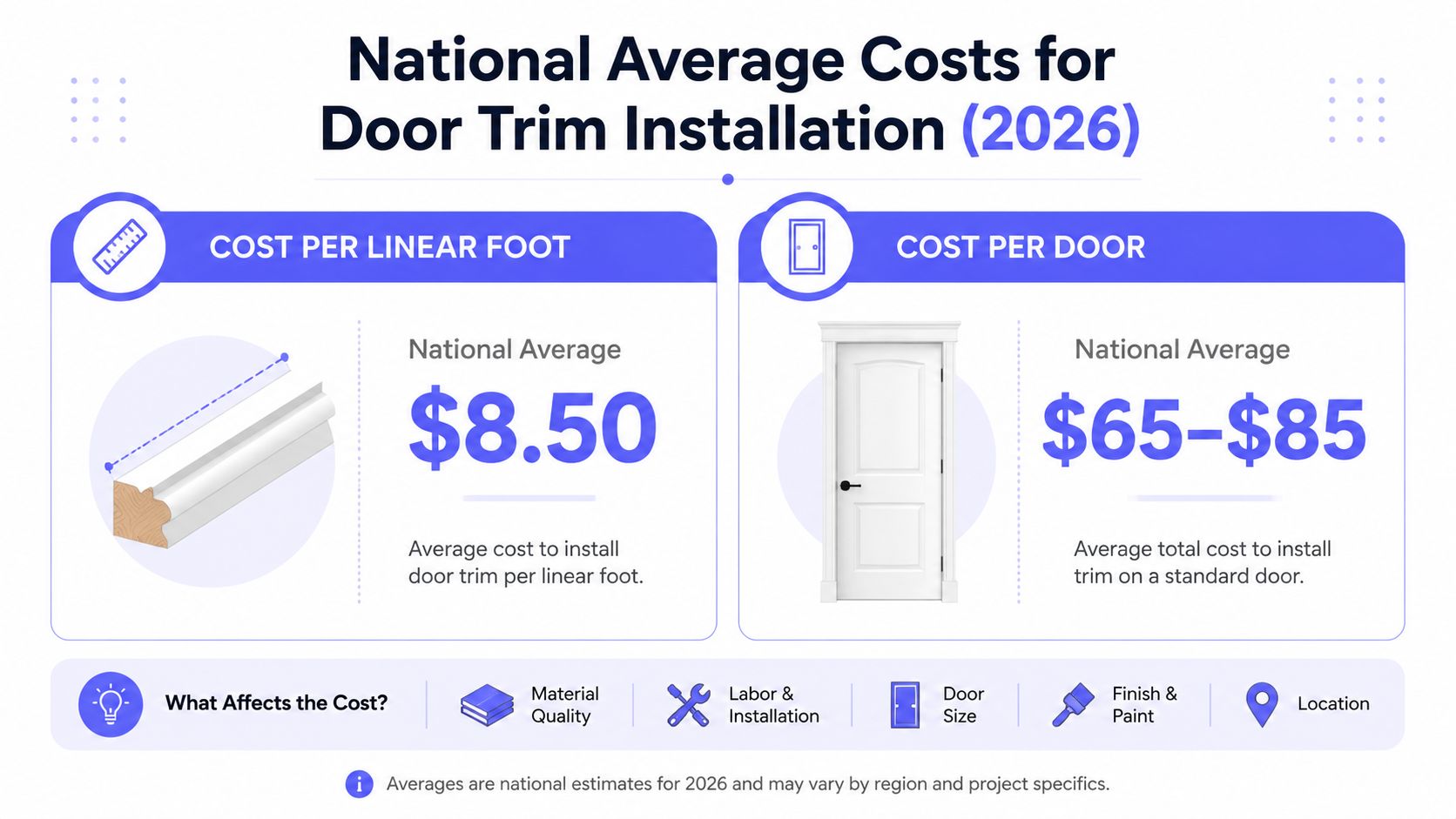
The cleanest baseline is this. Homewyse estimated the U.S. national average cost to install door trim at $7.94–$12.17 per linear foot in May 2026, which maps to about $150–$250 per door for a typical interior opening that uses roughly 19 linear feet of casing. That is the number I'd use if you want a realistic first-pass budget before you call anyone.
Why per-foot and per-door pricing both matter
Per-foot pricing shows what you are paying for material handling, cuts, fitting, and fastening. Per-door pricing is easier to use because it turns the job into a simple unit, and market guides often land in the same general range even when they use different math HomeGuide, Fixr. If a quote lands far below that, ask what is missing.
A standard doorway needs more trim than people expect. Once you count both sides and the header, the total usually reaches about 19 linear feet, so a small change in the per-foot rate adds up fast. On one opening, a few dollars either way may not feel dramatic. On a whole-house refresh, it does.
Practical rule: If a quote only gives you a per-door number, ask for the linear-foot rate too. It shows whether you are paying for a plain install or a padded estimate.
Interior and exterior trim don't price the same
Interior trim usually sits in a tighter band. HomeGuide reports $5–$10 per linear foot installed and $100–$200 per door for door trim or casing, while Fixr shows $6–$20 per linear foot for interior trim and $9–$25 per linear foot for exterior trim HomeGuide, Fixr. That wider exterior spread makes sense because exterior trim has to handle tougher site conditions and usually more durable materials.
If you are comparing multiple openings, use the per-foot number to sanity-check the door total. A quote at the high end of the band may still be fair if the profile is decorative or the install is more demanding. For a quick budget estimate, the Handvetted home renovation cost calculator can help you frame the project before you start collecting bids.
How Material Choice Changes Your Total Bill
Material choice is where a lot of people lose control of the budget. MDF is cheap to buy, hardwood is not, and labor climbs as the trim gets heavier, harder to cut, or more detailed Rising Sun Arts Centre. If you want the honest answer, the material often matters more than the doorway itself.
MDF, hardwood, and the labor behind them
MDF casing typically costs $0.50–$1.50 per linear foot in materials, while hardwood can run $3–$8 per linear foot or more Rising Sun Arts Centre. That gap is why one project feels modest and another suddenly looks custom. The lumber bill changes, but the labor changes too.
Labor for standard profiles is often $2–$6 per linear foot, but it can reach $7.50 or higher when the trim needs layout, kerfing, adhesive work, caulking, or decorative detailing Rising Sun Arts Centre. That is the part many people miss. You are not just buying wood, you are buying the time it takes to make the trim look right.
Plain truth: Cheap material does not always mean a cheap job. MDF can save money on the front end, but sloppy finishing wipes out the savings fast.
Best material by job type
MDF makes sense for simple interior doors where the room is dry and you want a clean painted finish. Hardwood is the better choice when you want a richer look, or when the trim has to stand up visually to a nicer door or more formal interior. For exterior work, durability and appearance usually justify the premium.
| Material | Material Cost/LF | Labor Cost/LF | Best For |
|---|---|---|---|
| MDF | $0.50–$1.50 | $2–$6 | Basic painted interior trim |
| Hardwood | $3–$8 or more | $2–$6, higher for detail work | Higher-end interiors, stain-grade work |
| Composite | Varies by project | Standard to moderate | Moisture-prone or exterior-leaning applications |
| Pine | Moderate | Standard to moderate | Mid-range interior refreshes |
The point is simple. Match the trim to the room, not to a fantasy budget. If you want the project to stay controlled, don't pay hardwood money for a room that only needs a clean painted casing.
Factors That Push Your Price Higher or Lower
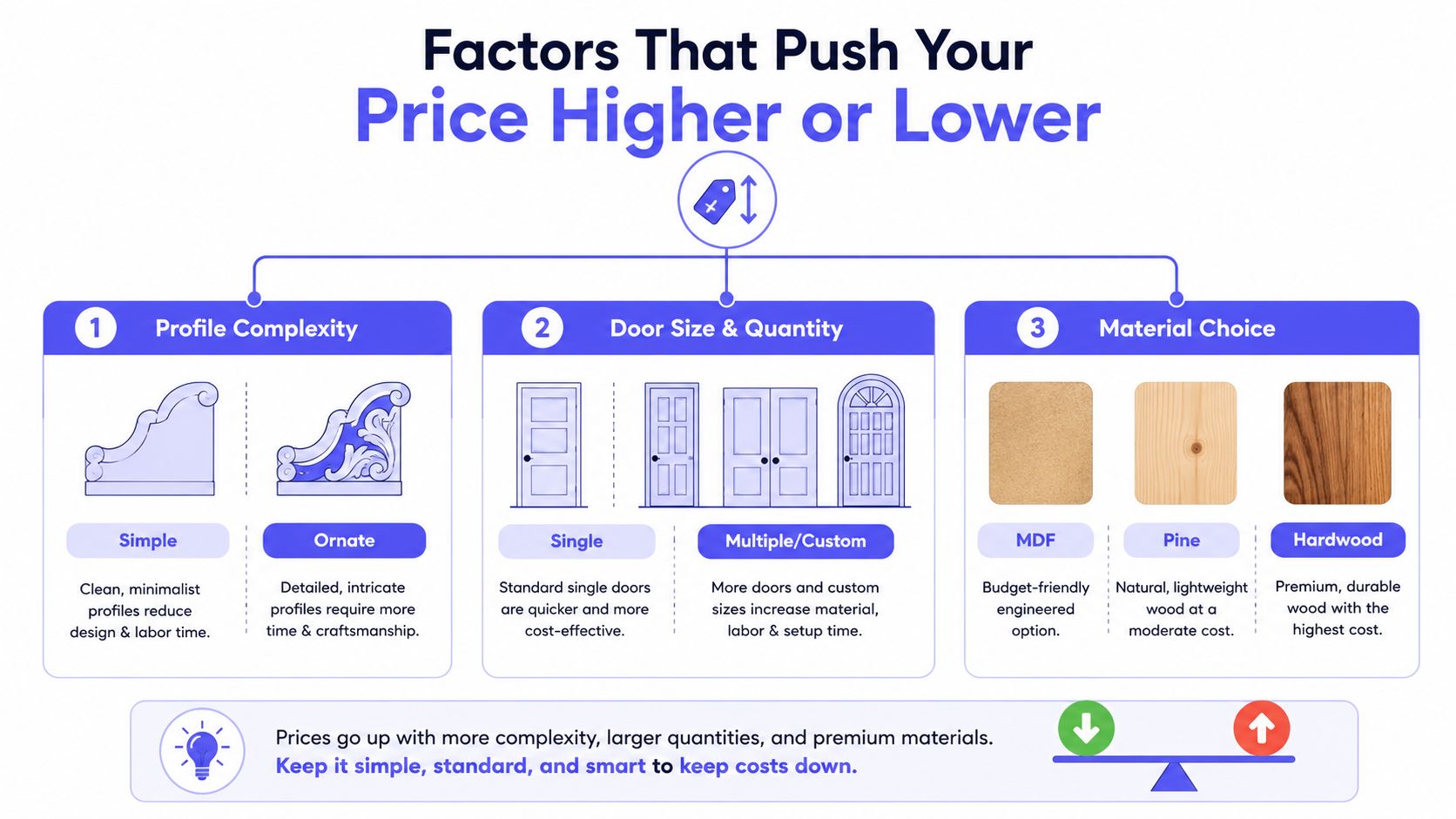
The biggest price swings come from the work nobody talks about first. Trim itself is only part of the bill. Caulking, patching, sanding, paint prep, and stain matching are what make two quotes for the same door look completely different.
Profile complexity drives labor the fastest. A flat-stock casing goes up quickly. A layered craftsman-style profile takes more layout, more mitering, and more patience at the corners, and ornate trim adds even more time because the installer has to keep every line clean.
Door size and quantity matter more than many homeowners expect. A single standard opening is straightforward. Multiple doors, double doors, or openings that need custom fitting stretch the schedule, and contractors often price that time by the door. If you want to know what to ask before you sign, the right contractor questions will tell you whether a bid is really covering the whole job or just the trim pieces.
Finish scope can move the quote just as much as the trim style. Paint-grade work is usually simpler to complete than stain-grade work, and stain matching in older rooms can eat up time fast. If the jambs are damaged, if the wall edge needs repair, or if old trim has to come off cleanly, the price goes up because the installer is doing cleanup as well as installation.
Regional labor also matters. Material pricing tends to stay fairly steady, but labor does not, so the same opening can look reasonable in one market and expensive in another. That is why quotes for door trim vary so much even when the trim profile looks nearly identical.
Real Project Scenarios and What They Cost
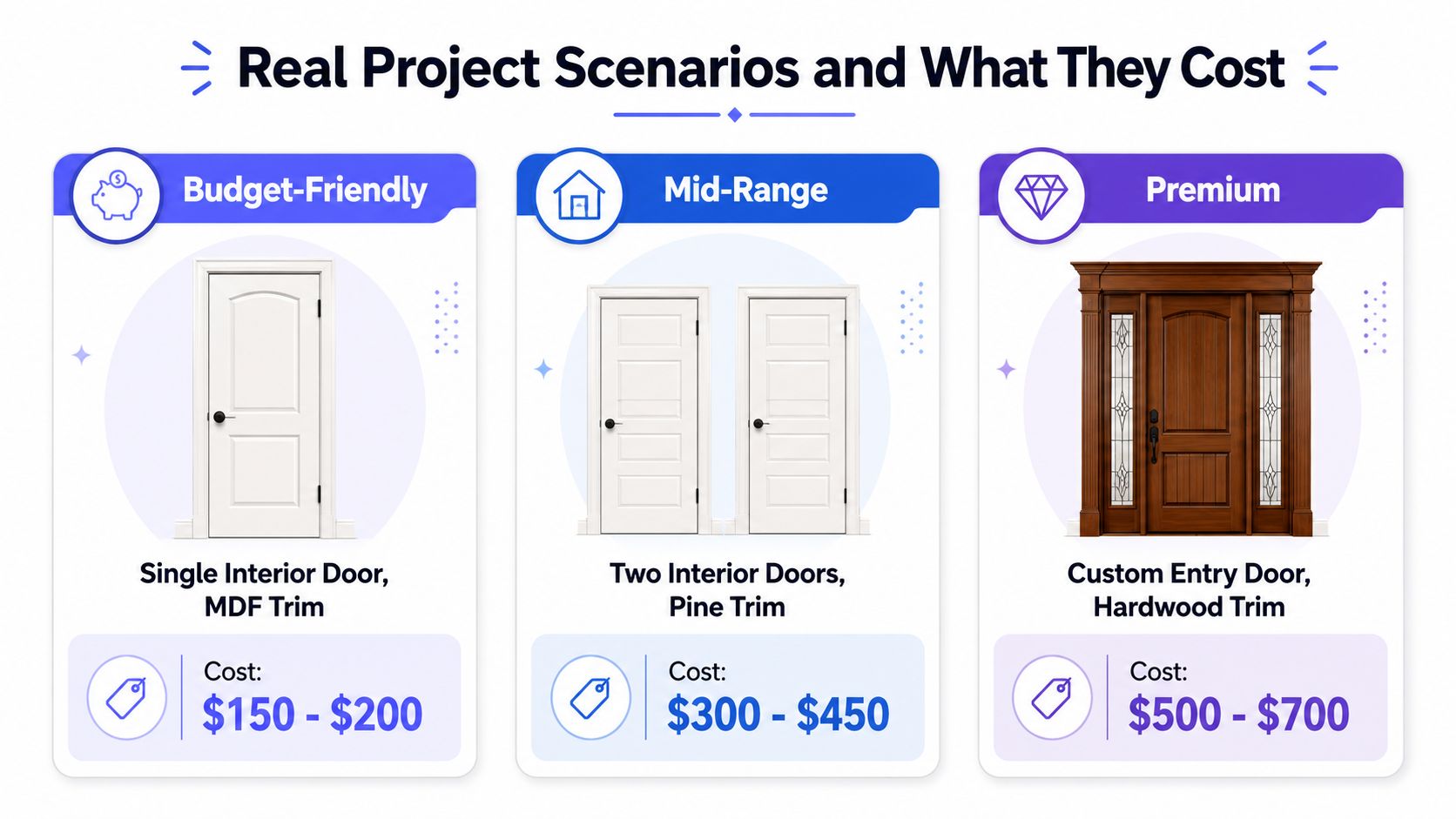
A quote makes more sense when you can see it as a real job, not a generic price. Contractors often simplify budgeting by quoting interior door trim at $100–$150 per interior door and $125–$175 per exterior door when the trim is more substantial, with a national average materials cost of $0.96 per linear foot Rooster Windows and Doors. That gives you a decent benchmark before you add finish work.
Budget-friendly single interior door
A basic single interior door with MDF trim is the cleanest low-cost scenario. Materials stay low because MDF is inexpensive, and labor stays controlled because the profile is simple. A sensible total usually lands near the lower end of the typical per-door range, especially if the opening is already in good shape.
Mid-range whole-house refresh
An eight-door interior refresh with pine casing sits in the middle of the market. Per-door pricing helps here, because you stop thinking in one-off installs and start seeing the total job as a package. If the rooms all get the same profile and finish, the crew can move efficiently and the pricing usually looks better than eight separate mini-projects.
Premium exterior entry
A custom hardwood entry with stain finish is where costs rise quickly. The material is more expensive, the fit has to be tighter, and the finish work has to look intentional from the curb. That's the kind of job where a cheap quote is often a warning sign, not a deal.
| Scenario | What You're Buying | Price Character |
|---|---|---|
| Budget-friendly | Single interior door, MDF trim | Lowest total, simplest scope |
| Mid-range | Multiple interior doors, pine trim | Balanced labor and materials |
| Premium | Custom entry door, hardwood trim | Highest finish expectations |
The lesson is simple. Don't compare your opening to someone else's casual quote unless the material, finish, and door type match. If they don't match, the numbers don't mean much.
The Finish Work Cost Gap Most Guides Ignore
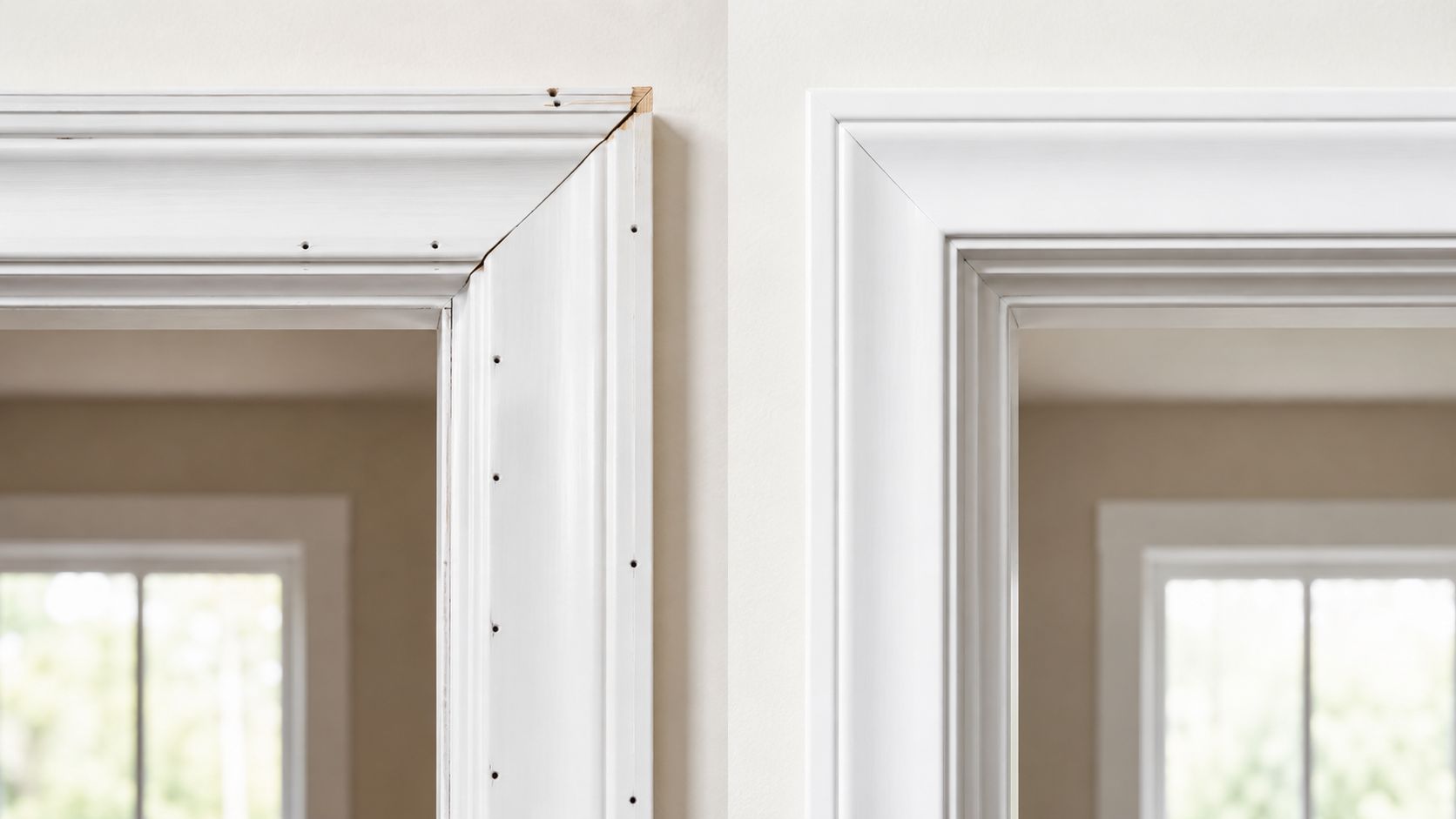
The hidden cost is usually finish work, not the trim itself. Painting alone can add real money to a door trim job, and finish-and-paint work is often billed as its own add-on. If you only compare installation prices, you are not comparing the full job.
What finish work usually includes
Finish work means the trim looks complete, not just installed. That usually includes caulking, filling nail holes, priming, painting, or stain matching. In older homes, it can also mean extra touch-up where the wall and jamb meet the new casing.
The pricing gap comes from how contractors write the bid. Some include finish work in the install price, while others separate it out. Ask before you hire, or you will end up comparing one contractor's bare install to another contractor's all-in quote.
If a quote says “install only,” expect the final bill to rise once paint or stain is added.
Why stain matching is the expensive headache
Paint is simpler than stain. Stain-grade trim has to blend with the surrounding wood tone closely enough that the repair does not stand out every time you walk past it. That takes time, judgment, and repeated touch-ups.
The trim itself may still be the cheaper part of the job. The labor is what gets expensive. Matching stain, cleaning up the edges, and making the finish disappear into the room takes more care than a basic painted install, and contractors price that time into the bid.
When you compare quotes, make every contractor spell out what is included. Ask about prep, caulking, filling, priming, painting, or stain matching. If the answer is vague, keep looking. A tidy quote is not the same thing as a complete quote. For a cleaner hiring process, review contractor background check standards before you choose who to bring in.
How to Reduce Costs and Get Accurate Local Quotes
The easiest way to save money is to stop paying for confusion. Decide whether you want paint-grade or stain-grade trim, count the openings, and tell every professional the same scope so the quotes are comparable. If you leave finish work vague, you will get vague pricing back.
Cut costs without cutting corners
DIY only the prep work you can handle cleanly. Removing old trim, clearing the work area, or buying materials yourself can help on simpler jobs, but the install still needs sharp cuts and solid fit. If the opening is warped or the finish has to be perfect, hire it out.
A good quote request should include the number of doors, the trim style you want, whether the finish is paint or stain, and whether you expect caulking and touch-up to be included. That level of detail saves everybody time and keeps the numbers honest. It also helps you see who is padding the bid and who is pricing the job correctly.
Ask the right questions before you hire
Start with the basics. Ask whether the quote covers removal of old trim, material, labor, finish work, and any wall repair. Then ask what happens if the jamb is out of square or the existing opening needs extra work.
If you want a cleaner hiring process, Handvetted background check standards are worth a look before you choose a professional. The point is not to overcomplicate the project. The point is to avoid hiring someone who leaves you sorting out missing details later.
Good quote, bad quote: The cheapest bid isn't the best one if it excludes painting, caulking, or stain matching.
The smartest move is to compare complete scopes, not just headline numbers. Once you do that, the cost to install door trim gets a lot easier to understand, and a lot harder for anyone to hide.
Hand Vetted Co. helps you find a single verified professional instead of sorting through a pile of random calls. If you want a cleaner way to get a real door trim quote, visit Hand Vetted Co. and start with a match that's licensed, background-checked, and briefed on your project before they reach out.