Concrete in 2026 usually runs about $160 to $220 per cubic yard for materials only, and that number still doesn't include delivery, labor, pouring, or finishing. If you're pricing a driveway, patio, or slab right now, that gap between material price and installed price is where most budgets go sideways.
A lot of people start with the per-yard price and assume they're close to the final number. They're usually not. The truck charge, the crew, the prep work, the finish, and the dreaded short-load fee can change a small project fast, especially if you only need a couple yards.
Table of Contents
- The Core Numbers Cost Per Yard and Per Square Foot
- What Drives Your Concrete Price Up or Down
- Labor vs Materials A Critical Cost Breakdown
- Real Project Cost Examples Driveways Patios and Slabs
- DIY Concrete vs Hiring a Professional
- How to Get an Accurate Concrete Quote
- Frequently Asked Questions About Concrete Costs
The Core Numbers Cost Per Yard and Per Square Foot
A lot of concrete budgets go sideways at the same point. The owner hears a price per yard, multiplies by a rough quantity, and assumes that is close to the final bill. Then the quote shows delivery, short-load charges, placing, finishing, and cleanup, and the number lands much higher.
What a cubic yard price covers
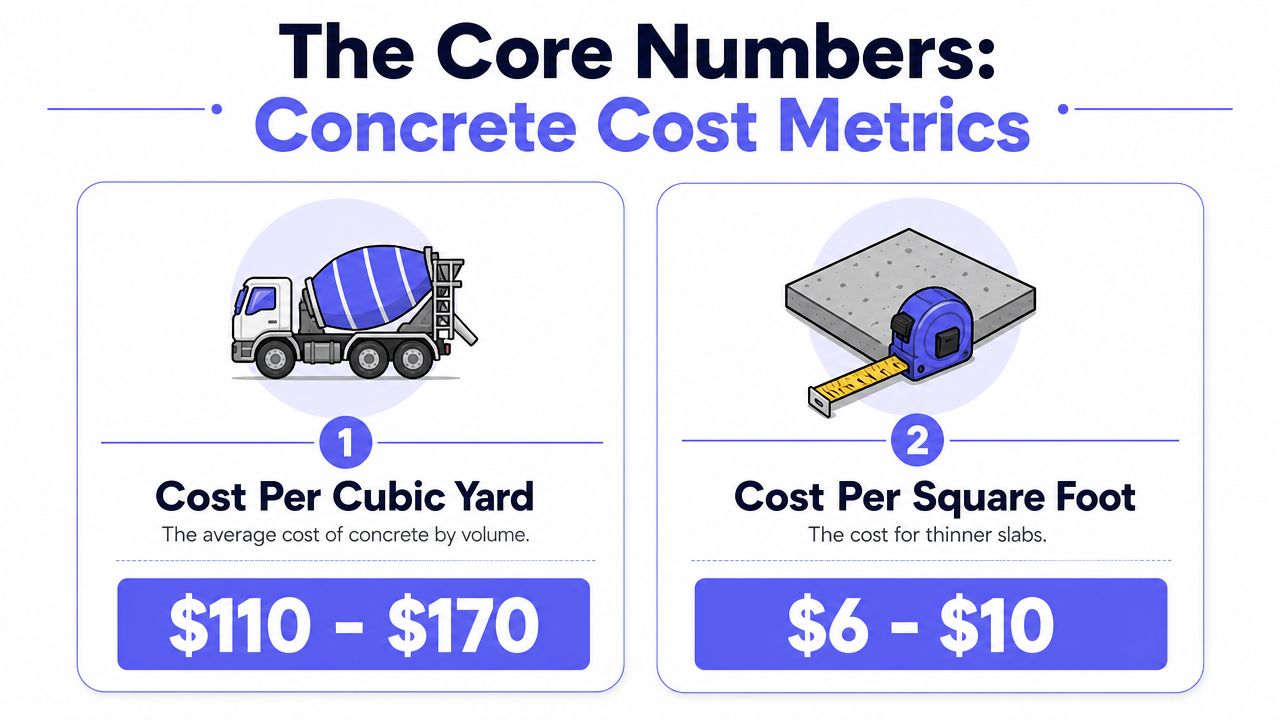
A cubic yard is how ready-mix suppliers price concrete. For standard 3,000 PSI concrete, the nationwide 2026 average ranges from $160 to $195 per cubic yard, and the documented 2024 average was $179.89 per yard, according to Concrete Network's 2026 concrete price guide.
Useful number. Incomplete budget.
That yard price usually covers the concrete in the truck. It does not usually cover site prep, forms, rebar or mesh, pumping, placing, finishing, saw cuts, or curing steps. On a large slab, the material price is still only one part of the job. On a small slab, it can be the least misleading part of the quote because extra fees hit harder.
Short loads are the classic example. If a supplier has a minimum order and your job only needs a fraction of a truck, the plant may add a short-load fee. On a tiny pad or small patio, that fee can push the delivered material cost per yard far above the headline rate. A two-yard order can end up feeling closer to double the advertised per-yard price by the time the fixed truck and delivery charges are spread across such a small volume.
Strength upgrades raise the material number too. Moving from 3,000 PSI to 4,000 PSI adds about $8 to $10 per yard, based on the same Concrete Network pricing breakdown. On a 10-yard pour, that increase is noticeable but manageable. On a 2-yard order with a short-load fee, it stacks onto an already expensive delivery.
Why square foot pricing matters more for finished projects
For budgeting a driveway, patio, or slab, square foot pricing is usually more useful because it reflects the installed job, not just the mix. It captures the part people miss when they only focus on the truck ticket.
Thickness is what connects the two numbers. A 4-inch slab uses less concrete than a 6-inch slab over the same footprint, and that changes both material quantity and labor effort. The same patio size can land in very different price ranges depending on thickness, reinforcement, finish, and access.
For that reason, installed concrete is often quoted qualitatively in a much higher range than the bare per-yard material number suggested earlier in the article. The labor, equipment, and delivery side of the job usually explains the gap.
Use the numbers this way:
- Per cubic yard helps estimate ready-mix material cost
- Per square foot helps estimate total installed cost
- Project size often decides whether the quote feels efficient or expensive
- Small orders deserve extra scrutiny because delivery minimums and short-load fees can distort the budget fast
If two contractors are pricing the same job, make sure both quotes are based on the same unit. A yard-only number and a fully installed square-foot number are not comparable. One prices concrete in the truck. The other prices the project you need built.
What Drives Your Concrete Price Up or Down
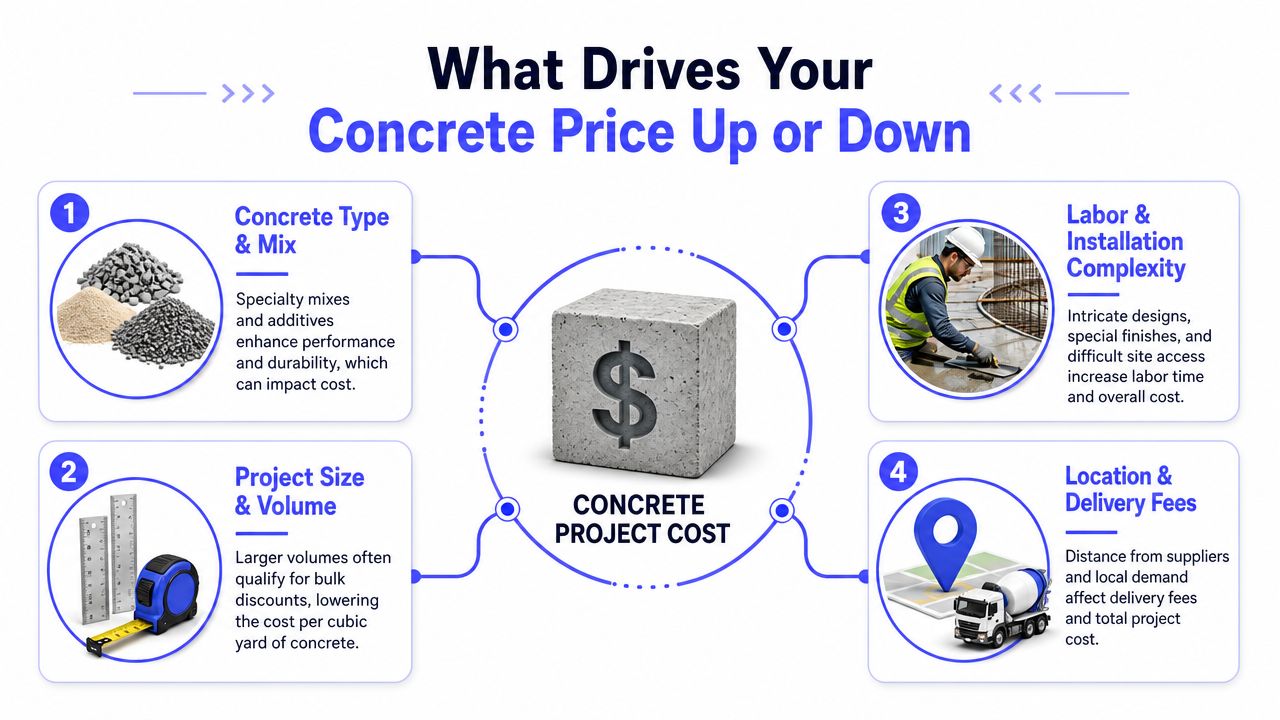
A quote can swing fast even when the project looks simple on paper. The biggest cost drivers are the mix you order, how much you order, how far the truck has to travel, and how hard the crew has to place and finish it once it arrives.
Mix strength and additives change the starting price
The first thing that moves your number is the spec. Standard residential concrete is usually the cheapest version of the job. Higher PSI mixes, fiber reinforcement, integral color, air entrainment, accelerators, and water reducers all add cost.
Some of those upgrades are smart. A driveway may need higher strength than a basic patio. Freeze-thaw conditions may justify air entrainment. Fiber can help with crack control on certain slabs. The problem is that owners often approve these changes without noticing how much they raise the delivered price before labor even starts.
That same pattern shows up in other repair categories. The base price gets attention, but the actual scope sets the final bill. The same logic applies when reviewing a roof repair cost estimate. Materials matter, but specification choices are what move a quote from basic to expensive.
Order size changes the effective price more than many people expect
This is the part that catches small projects.
A ready-mix supplier prices concrete by the yard, but the truck, driver, dispatch time, and batch plant still cost money whether you order two yards or ten. If your job is too small to fill a truck, the supplier may add a short-load fee or minimum delivery charge. That fee can make a small pad look wildly expensive on a per-yard basis.
Here is the key budgeting problem. A homeowner sees a material-only number per yard online, then orders a small amount for steps, a shed slab, or a narrow walkway. Once the short-load fee and delivery charges hit the ticket, the effective cost per yard can jump hard. On very small pours, that one line item can make the concrete cost feel almost doubled compared with the headline rate people expected.
That is why total installed cost matters more than the advertised price of the mix.
Location, access, and truck logistics often decide whether a quote feels fair
Concrete is local. Plant distance, fuel, traffic, union labor in some markets, permit rules, and disposal costs all affect the final number. Two identical slabs can price very differently in two zip codes.
Access matters just as much. If the truck can back up to the forms and discharge directly, the job moves faster and costs less. If the crew has to wheelbarrow concrete across a yard, pump it uphill, work around fencing, or pour in a tight side yard, labor and equipment costs rise quickly. A difficult site can erase any savings you thought you got on the mix itself.
Weather and scheduling can push pricing around too. Hot weather may require faster placement and extra crew coordination. Cold weather can require protection or additives. If the pour has to happen in a narrow time window, you may pay for that coordination.
The practical takeaway is simple. Concrete gets expensive when the job is small, the spec gets upgraded, or the site slows everyone down. If you want a realistic budget, ask what the quote includes beyond the yardage: delivery, short-load charges, pump fees, reinforcement, base prep, forms, finishing, and cleanup. That is where the actual number comes from.
Labor vs Materials A Critical Cost Breakdown
Material price is the number people remember. Installed cost is the number that hits the budget.
On many jobs, the concrete itself is only part of the invoice. The rest is the crew time and job setup needed to get a slab placed, finished, and left in good shape.
What labor includes
Labor covers the work before the truck arrives, during the pour, and after the finish work is done. That can include layout, excavation, base prep and compaction, form setting, reinforcement, truck coordination, placement, screeding, floating, edging, jointing, curing steps, and cleanup.
That list is why two slabs with the same square footage can price very differently. A basic rectangular pad on easy access ground is faster. A pour with tight access, extra forming, more hand work, or a demanding finish takes longer and needs a stronger crew.
The National Ready Mixed Concrete Association notes that concrete quality depends heavily on proper subgrade preparation, placement, finishing, and curing, not just the mix itself. That is the practical reason labor carries so much weight on the final number.
Labor also drives risk. If base prep is rushed or finishing is mistimed, the slab can crack early, drain poorly, or wear badly. Cheap labor is not cheap if you have to tear out and replace concrete later.
A simple way to protect yourself is to ask for an itemized scope and compare questions to ask a concrete contractor before you sign. Clear scope language helps you see whether one quote includes base work, reinforcement, and cleanup while another leaves them out.
Why small jobs feel expensive
Small pours are where people get tripped up. The crew still has to load up, drive out, set forms, prep the base, place the mix, finish it, and clean the site. The supplier still has to dispatch a truck.
That fixed effort gets spread over fewer square feet, so the installed price per square foot jumps.
Short-load fees make that worse. As noted earlier, suppliers often charge extra when the order is well below a full truck. On a small shed slab or narrow walkway, that fee can push the delivered concrete cost high enough that the total project price feels out of proportion to the size of the job.
That is why material-only math misses the true number. For a small project, the concrete may be the cheapest part of the job once you factor in delivery, crew time, forming, finishing, and cleanup.
Budget small pours from the full installed scope, not from a low per-yard headline. That is the difference between a realistic quote and a surprise invoice.
Real Project Cost Examples Driveways Patios and Slabs
A homeowner prices a small shed slab by the yard, expects a modest bill, and then gets a quote that feels wildly high for the size of the job. That usually happens because the concrete itself is only one line item. Delivery, crew time, forming, base prep, finishing, and short-load charges can push a small pour into a much higher installed cost than the raw yardage suggests.
Three common jobs and how to think about them
A driveway usually uses enough concrete that volume matters, but the total price still swings on removal, grading, thickness, reinforcement, and finish quality. Two driveway quotes with the same square footage can be far apart if one includes tear-out and base repair and the other does not.
A patio often starts as a simple square on paper. Cost goes up fast once the plan includes curves, steps, borders, slope corrections, drain work, or a decorative finish. The concrete may be the same mix, but the labor is not.
A shed slab is the clearest example of why installed cost matters more than a headline price per yard. The supplier still dispatches a truck. The crew still has to form it, place it, finish it, and clean up. On a small order, short-load fees can make the concrete portion expensive before labor is even added.
Here is a practical planning table for rough budgeting.
| Project | Typical Size | Estimated Total Cost Range |
|---|---|---|
| Driveway | Standard vehicle parking slab | Usually lands in a mid-to-high installed range because removal, base prep, thickness, and finish all affect price |
| Patio | Backyard sitting or dining area | Often starts in a moderate range, then rises with shape changes, decorative work, and drainage needs |
| Shed slab | Small outbuilding base | Commonly feels expensive for its size because fixed delivery and crew costs are spread over a very small pour |
A real-world estimating pattern from ready-mix suppliers explains the problem. Small loads often carry a separate fee when the order does not fill much of the truck, as shown in Concrete Network's guide to ready-mix pricing and short-load charges. On a shed slab or narrow walkway, that fee can move the effective cost per yard up sharply. On a driveway, the same fee may not apply at all because the order is large enough.
That is why a small 1.5 to 2 yard project can look overpriced next to a material-only yard price. It is not overpriced if the quote includes delivery, short-load charges, labor, forming, finishing, and cleanup. It is a different cost structure.
For driveways and patios, compare quotes line by line and budget from the full scope. For small slabs, assume the per-square-foot price will be less forgiving than the yardage suggests. If you want a fast ballpark before calling contractors, a home renovation cost calculator for concrete-related project budgeting can help you set a realistic starting number.
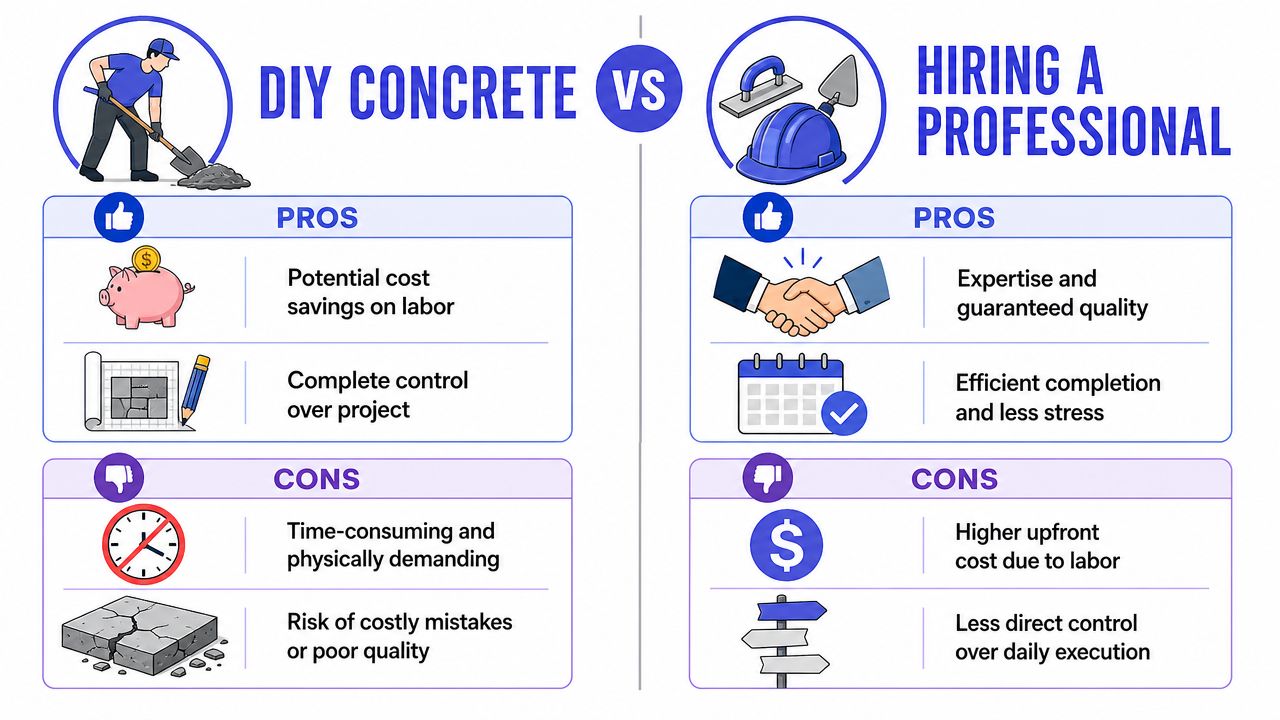
DIY Concrete vs Hiring a Professional
DIY concrete looks cheaper from a distance. Sometimes it is. Sometimes it becomes the most expensive version of the job once the pour goes wrong.
Where DIY makes sense
DIY usually makes the most sense on small, simple work with good access and very low finish expectations. A basic pad in an easy location is different from a driveway or a visible patio you'll look at every day.
The appeal is obvious:
- You can save on labor: If the job is manageable, labor is the one cost category you may reduce directly.
- You control the schedule: You can work around your own timing instead of waiting on a crew.
- You decide the finish standard: For utility work, perfect cosmetic results may not matter.
What doesn't work is underestimating how fast concrete sets and how physical the work becomes once the truck arrives. Screeding, floating, edging, and timing all matter. A slab doesn't care that it's your first try.
Where hiring a pro usually saves money
Professionals earn their keep on speed, coordination, and finish quality. They know how to prep the base, manage the pour window, and avoid mistakes that are hard to undo once the mix is down.
That's especially true if the slab is visible, load-bearing, or hard to access. A driveway with poor finish or drainage issues can become a long-term headache. A patio with bad slope can hold water every time it rains.
Bad concrete is expensive to remove, and removal is usually the part people never budget for.
If you're weighing the decision, this guide on what to ask a contractor before hiring helps separate a capable pro from someone who just gave a fast number. Ask about prep, finish method, timing, cleanup, and what happens if the surface doesn't cure as expected.
DIY saves money only when the job stays simple and the execution stays clean. Once either one slips, the bargain disappears.
How to Get an Accurate Concrete Quote
A concrete quote is only as good as the information behind it. If you give vague dimensions or skip site details, you'll get a vague number back.

What to have ready before you call
Before you ask anyone for pricing, gather the details that change the quote:
- Project dimensions: Length, width, and intended thickness.
- Site access: Can a truck get close, or will material need to move farther by wheelbarrow or pump?
- Surface conditions: Existing concrete, grass, slope, mud, fencing, or tight gates.
- Finish expectations: Plain broom finish, smooth finish, or decorative work.
- Timing: Fast-turn scheduling can affect availability and cost.
The goal isn't to sound technical. It's to remove guesswork. The more clearly you define the job, the more comparable your bids become.
What to ask so quotes are comparable
Use the same questions every time. Otherwise, you'll compare one complete quote against two partial ones and think the lowest number wins.
Ask each business:
- What exactly is included. Site prep, forms, pour, finish, cleanup, and disposal should be spelled out.
- What mix is being quoted. Strength and any additives should appear in plain language.
- How delivery is handled. Small jobs can get hit hardest by logistics.
- What access issues could change the number. Tight sites create labor problems fast.
- What isn't included. This answer is often more valuable than the headline price.
Regional pricing also changes more than many people realize. One useful example from material markets outside ready-mix itself shows how wide those gaps can get. Q1 2026 cement prices ranged from USD 54/MT in China to USD 250/MT in Germany, with the US premium segment at USD 140/MT, which underlines how strongly local supply chains and energy costs shape end pricing, according to this Q1 2026 cement market review.
That's why a calculator can help with first-pass budgeting, but it can't replace a scoped estimate. If you want a rough planning number before you start calling, a home renovation cost calculator can help frame the budget.
Frequently Asked Questions About Concrete Costs
Is decorative concrete more expensive
Yes. Decorative concrete raises the total installed price because it adds time, skill, and sometimes extra material. Color, stamping, exposed aggregate, and specialty finishes all increase labor, and labor is usually where the bigger jump happens.
The concrete itself may also cost more if the job uses pigments, fibers, sealers, or a higher-spec mix. On small projects, those upgrades can feel expensive fast because the fixed delivery and setup costs are being spread across fewer yards.
Is concrete more expensive in Canada
Usually, yes. Standard ready-mix concrete in Canada typically ranges from C$185 to C$240 per cubic yard, while high-strength structural concrete runs from C$230 to C$300+ per cubic yard, according to Yaat's Canada concrete cost guide.
If you're comparing US and Canadian quotes, convert the currency first, then compare the scope. A lower yard price can still turn into a higher final bill if one quote leaves out prep, base work, finishing, or delivery charges.
Why would a project need a pump truck
A pump truck is an access charge. It shows up when the ready-mix truck cannot back up close enough to the forms and the crew still needs to place the concrete cleanly and quickly.
That comes up on backyard pours, fenced properties, tight side yards, steep lots, and sites behind an existing house or garage. Pumping can add a meaningful cost, but it is often cheaper than trying to move concrete by wheelbarrow with extra labor and losing finish quality in the process.
Why is a small concrete job so expensive per yard
Small jobs get hit by fixed charges. The truck still has to roll. The batch plant still has to load it. The crew still has to form, place, and finish it.
That is why a short load fee matters so much. If you only need a couple of yards, that fee can push the effective cost per yard way above the headline material price. A homeowner sees a reasonable per-yard number, then gets surprised when delivery minimums and small-load charges make a tiny patio cost far more per square foot than a larger slab.
That is the part people miss most often. Concrete is rarely expensive because of the mud alone. It gets expensive when delivery logistics, crew time, access, and finishing are all packed into a small pour.
The practical takeaway is simple. Budget the full installed job, not just the ready-mix rate, and ask about short load fees before you schedule anything.
If you want a cleaner way to start your project, Hand Vetted Co. matches you with one verified professional instead of sending your info to a pile of businesses. You can also review How It Works, see Our Standards, and check the FAQ before you request a match.