Approximately 98% of basements in the United States will experience some form of water damage during their lifespan, and the average restoration cost is $4,250 per incident, according to basement water-damage statistics. That makes basement restoration a normal property-maintenance concern, not an unusual disaster reserved for someone else.
The critical question isn't whether you can make the floor look dry. It's whether you've stopped the source, removed hidden moisture, and made the space safe to rebuild. A one-time plumbing failure needs a different response from a foundation crack, failed sump system, or recurring condensation problem.
Table of Contents
- What Basement Restoration Really Means
- Signs of Damage and How to Assess Cause
- Professional Restoration Workflow Step by Step
- Crack Repair and Salvage Decisions
- Typical Costs and Drying Timelines
- Insurance Documentation and Contractor Vetting
- Prevention and Long Term Maintenance
What Basement Restoration Really Means
Basement restoration is more than pumping out water and replacing damaged carpet. A complete job combines water extraction, structural drying, material assessment, crack repair, cleaning, mold prevention, and waterproofing. Each step answers a different problem, and skipping one can leave the basement vulnerable to repeat damage.
Start with safety and source control. If standing water may be electrically energized, don't enter it. Stop the incoming water if you can do so safely, then document the affected areas before moving belongings or removing materials. A restoration professional should identify where the water came from before treating the visible damage.
Cleanup is only the first stage
Water can remain inside drywall, insulation, framing, subflooring, and flooring long after the surface appears dry. That hidden moisture can damage finishes, support mold growth, and compromise materials that look reusable. Proper restoration uses moisture meters and controlled dehumidification instead of relying on touch or appearance.
The work usually includes:
- Extraction: Removing standing water and water held in absorbent materials.
- Drying: Using air movement and dehumidification to dry wall cavities, framing, floors, and contents.
- Cleaning: Removing soil, residue, and contaminants after the area has dried.
- Repair: Addressing foundation cracks, sump failures, damaged finishes, or other entry paths.
- Prevention: Improving drainage and waterproofing so the same failure doesn't repeat.
The role of a restoration company should therefore be judged by the full process, not by how quickly someone removes visible water. A company that only extracts water may leave the actual failure untouched.
Practical rule: A dry-looking basement isn't necessarily a dry basement. Ask for documented moisture readings before reconstruction begins.
Restoration is reactive and preventative
Emergency cleanup protects the structure after an incident. Preventative work protects it from the next one. That may involve repairing a leaking wall crack, correcting exterior drainage, servicing a sump system, or controlling basement humidity.
Treat the first water event as diagnostic evidence. If you only restore the finishes, you may pay to rebuild the same area again. The right outcome is a basement that's clean, verifiably dry, and less exposed to the cause that created the damage.
Signs of Damage and How to Assess Cause
A basement that looks dry after one flood can still be failing. The decision point is whether the event was isolated or whether moisture keeps returning through the same route. Trace water from the visible damage to its entry point, then check whether it reached wall cavities, framing, or the space beneath flooring.

A failed appliance or pipe may produce one defined area of clean-water damage with no prior history. Dampness that returns at the same wall, a persistent musty odor, peeling paint, efflorescence, or repeated floor seepage indicates an ongoing moisture failure. Treat those signs as evidence that cleanup alone will not solve the cause.
Foundation cracks need specific diagnosis. Rain-linked leakage points to an exterior or foundation entry path, while condensation on a cold wall points to humidity and surface temperature. Water around a sump pit may result from pump failure, discharge problems, or groundwater pressure rather than a foundation defect.
Use this diagnostic map:
- Wall seepage: Inspect foundation cracks, exterior grading, gutters, and downspouts.
- Water near the sump: Test the pump, discharge route, and backup protection.
- Broad floor seepage: Check groundwater pressure, drainage failure, and the water table.
- Surface condensation: Measure humidity and inspect air circulation, insulation, and cold surfaces.
- Hidden dampness: Check wall bases, flooring edges, closets, and areas behind stored items.
Set a drying target before reconstruction. Moisture readings in affected materials should return to the surrounding dry areas or the applicable material standard, with readings documented across walls, floors, and cavities. A surface that feels dry is not proof that the structure is ready to close.
Independent restoration guidance supports source control, moisture mapping, and correction of intrusion paths before removal begins. Stop active entry before demolition. Otherwise, newly exposed materials can become wet while the original failure remains.
Map adjacent walls, framing, flooring, and concealed spaces, not only the obvious wet spot. Below-grade rooms can retain saturation behind walls and under floors, creating a false sense of completion after cosmetic cleanup.
Repeated basement damage requires correction of the building envelope, drainage, plumbing, or humidity conditions.
Bring in a professional if water is contaminated, electrical systems may be affected, porous materials are saturated, or the source remains unclear. A documented cause and drying result are more valuable than a quick cosmetic repair.
Professional Restoration Workflow Step by Step
A professional response follows a sequence because each stage prepares the structure for the next. Drying before removing trapped materials can leave wet insulation or wall cavities untouched. Cleaning before the area is dry can spread residue without addressing the conditions that caused it.
Start with safety and extraction
First, isolate electrical hazards and identify the water source. Remove undamaged belongings from the affected area, protect items that can be moved, and avoid equipment that isn't rated for water extraction.
The operational sequence is clear:
- Remove standing water within 24 hours. Fast extraction limits absorption and gives the drying process a clean starting point.
- Remove wet materials within 24 to 48 hours. Saturated porous materials can hold moisture where air movement can't reach it.
- Dry the structure for 3 to 7 days. Use industrial fans, commercial dehumidifiers, and moisture monitoring rather than household airflow alone.
- Clean and disinfect after drying. Cleaning too early can miss hidden moisture and complicate the assessment.
This staged response is documented in a flooded-basement drying and repair guide. The exact work depends on water type, material condition, and the building layout, but the order shouldn't be treated casually.
Selective demolition prevents hidden damage
Drywall often needs to be cut about 12 inches above the water line, and wet insulation should be removed. The purpose isn't to create unnecessary damage. It's to open the wall enough to expose and dry the cavity, remove materials that won't reliably recover, and prevent moisture from remaining sealed inside.
Carpet, paper backing, insulation, drywall, and other absorbent materials require careful salvage decisions. Solid, nonporous surfaces may be cleaned and dried. Repeatedly saturated or colonized porous materials may need removal instead of surface treatment.
Use water-damage restoration steps as a practical reference for the order of operations, but don't treat a checklist as a substitute for a site assessment. A professional should record moisture readings throughout the drying period and verify affected materials before closing walls.
Verify dryness before reconstruction
Visible dryness is only an appearance. The restoration team should monitor the structure, maintain controlled humidity, and confirm that framing, subfloors, and other materials have reached appropriate conditions before insulation, drywall, flooring, and finishes go back.
If a contractor wants to rebuild immediately after extraction, ask how they verified the wall cavities and framing. The answer should involve measurement, not confidence.
Crack Repair and Salvage Decisions
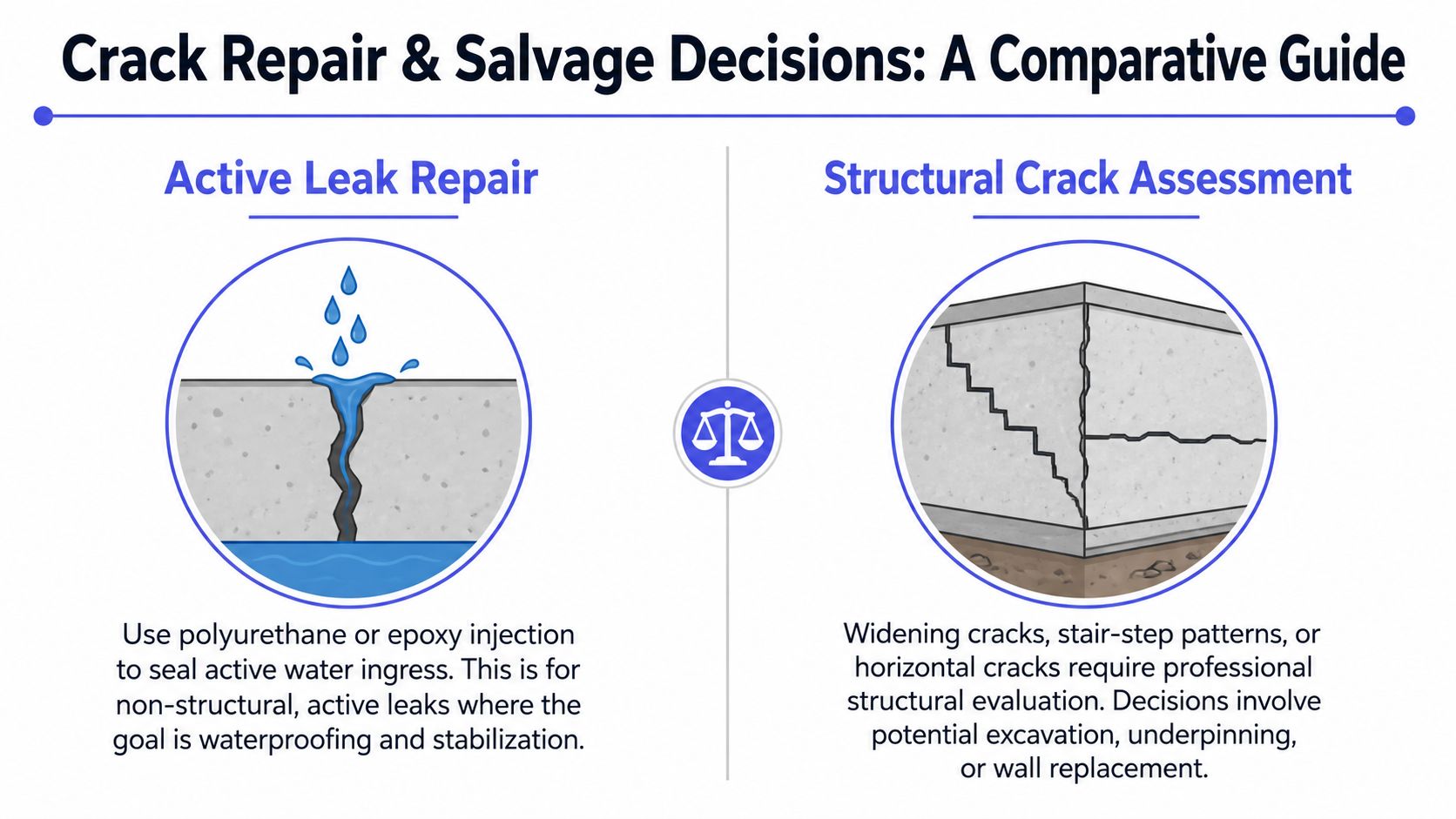
Crack repair depends on two questions: Is the crack wet, and is it stable? The wrong material can fail to stop water or fail to restore the intended bond between concrete surfaces.
For poured-concrete walls, active wet leaks are typically repaired with polyurethane injection. Polyurethane remains suited to waterproofing moving or wet leakage paths because it reacts with water and fills the leak route. Dry, stable, non-moving cracks are better candidates for epoxy, which bonds to concrete and helps restore structural continuity.
Epoxy and polyurethane serve different purposes
| Condition | Typical approach | Primary purpose |
|---|---|---|
| Active wet leak | Polyurethane injection | Seal water intrusion |
| Dry, stable, non-moving crack | Epoxy injection | Bond concrete and restore continuity |
The comparison of epoxies and polyurethanes for concrete crack injection describes the placement method as well as the material choice. Technicians install injection ports along the crack, begin at the lowest port, and inject resin upward until material reaches the next port. That progression helps fill the crack through the wall thickness rather than merely coating its surface.
Don't treat every crack as a structural emergency, but don't dismiss every crack as cosmetic either. A widening crack, displacement, or pattern that suggests wall movement calls for structural evaluation rather than a basic seal.
Decide what can be salvaged
The salvage line is material condition, not sentiment. A hard, nonporous surface that has been cleaned and dried may be recoverable. Porous materials that have been repeatedly saturated or colonized can retain moisture and contamination, making removal the more dependable choice.
Use these questions:
- Was the material saturated repeatedly? Repeated exposure makes reliable drying and recovery less likely.
- Is contamination involved? Sewage or polluted water changes the safety and disposal requirements.
- Can the material be dried throughout? If moisture is trapped behind a surface, treatment may only hide the problem.
- Has the material lost its function? Warping, swelling, delamination, or deterioration usually supports replacement.
The best repair isn't the one that preserves the most visible material. It's the one that leaves no concealed source of moisture or contamination behind the finished wall.
Typical Costs and Drying Timelines
The average water-damage restoration incident is $4,250, according to basement water-damage cost and incidence data. Use that figure for planning, not as a guaranteed quote. The final cost depends on the water source, affected materials, contamination, access, structural repairs, and whether prevention work is included.
The key decision is whether this was a one-time flood or evidence of chronic moisture failure. A single event may require extraction, drying, and limited replacement. Recurring seepage, high humidity, or moisture behind finished walls requires source correction before reconstruction. Paying to rebuild without fixing that pattern repeats the expense.
Restoration drying guidance places controlled flooded-basement drying at about 3 to 5 days, with an average structural dry-out around 4.5 days. Keep the basement below 50% relative humidity and document moisture readings every 24 hours.
Cost and Drying Decision Points
| Metric | Target or planning value |
|---|---|
| Average restoration incident | $4,250 |
| Typical flooded-basement drying | About 3 to 5 days |
| Average structural dry-out | About 4.5 days |
| Relative humidity | Below 50% |
| Moisture checks | Every 24 hours |
| Carpet and backing | Dry within 24 to 48 hours |
The EPA water-damage reference table identifies the short drying window for carpet and backing. If porous materials remain wet, the project can shift from extraction to removal, cleaning, and reconstruction.
Require a written scope separating emergency services, demolition, drying, cleaning, structural repair, and prevention. That breakdown exposes whether the contractor is correcting the moisture source or only restoring the visible finish.
Insurance Documentation and Contractor Vetting
Insurance claims become harder to support when the record is incomplete. Before cleanup changes the scene, photograph standing water, damaged walls, flooring, belongings, appliances, foundation cracks, and the suspected source. Capture wide views and close details, then organize files by room or area.
Build the claim record immediately
Record when the water was discovered, when the source was stopped, and when extraction and drying began. Save receipts for emergency supplies, temporary protection, equipment, professional services, and replaced items. Ask the insurer or adjuster whether damaged materials require inspection before disposal. Remove them first only when safety conditions demand it.
Your documentation should include:
- Photos and video: Show the full affected area and individual damaged materials.
- A written timeline: Record discovery, source control, extraction, demolition, and drying activity.
- Moisture records: Keep readings and drying logs supplied by the restoration team.
- Receipts and estimates: Save every expense connected to emergency response and repair.
- Communication history: Keep claim numbers, emails, adjuster notes, and contractor reports together.
Use this homeowners insurance coverage resource to frame questions about coverage, but your policy and insurer control the claim decision. Ask what documentation they require before reconstruction and whether they want to inspect the damage. If the project crosses from one-time cleanup into recurring moisture correction, ask how source repairs, drying verification, and reconstruction will be handled under the claim.
Vet the restoration professional
Request written proof of licensing and insurance before signing any agreement. Also ask whether the business has basement water-intrusion experience, records moisture readings, and can explain what it will remove, clean, dry, repair, or salvage. The contractor should show how the work will meet the drying targets already established for the project, rather than treating visible surface dryness as completion.
A useful checklist includes:
- Licensing: Ask for applicable state or local licensing details.
- Background screening: Confirm whether owners and operators are screened.
- Ratings: Review whether the business has a 4.5+ star rating and recent review volume.
- Scope: Require extraction, drying, cleaning, repairs, and prevention to be listed separately.
- Communication: Ask who will document the work and communicate with the insurer.
Handvetted provides one professional match rather than sharing the same request with multiple businesses. Its stated checks include licensing, background screening, 4.5+ star ratings, and human review. Use it as one search option, then verify the contractor's qualifications and require a job-specific written scope before work begins.
Prevention and Long Term Maintenance
A basement remains dry only when several systems work together. Drainage, pumps, membranes, barriers, exterior grading, and humidity control each address a different path water can take. An interior coating cannot correct a blocked downspout, failed sump discharge, or foundation crack.
Correct the exterior first
Start where water reaches the property. Keep gutters clean, extend downspouts 4 to 6 feet from the foundation, and regrade soil so it slopes away 6 inches over 10 feet, as described in basement waterproofing system guidance. These steps reduce standing water beside the foundation and lower hydrostatic pressure against the basement enclosure.
Inspect the below-grade system after correcting surface drainage. Recurring moisture may require interior drain tile, a sump system, pump replacement, battery backup, an exterior waterproofing membrane, or foundation crack repair. Select the remedy from the documented water source, not from a product a salesperson recommends.
Build for the conditions you actually have
Recurring groundwater demands resilient materials and verifiable drying. Use vapor barriers, closed-cell insulation, waterproof materials, and controlled drainage where the exposure requires them. Independent clearance testing adds evidence that the space is ready for finishes.
A practical maintenance routine should include:
- Inspect drainage: Check gutters, downspouts, discharge paths, and soil movement.
- Check the sump system: Look for obstruction, unusual operation, and backup risk.
- Scan vulnerable areas: Examine wall bases, cracks, floor edges, and storage zones for odor or dampness.
- Monitor humidity: Use a reliable hygrometer and respond before condensation persists.
- Review after major storms: Check for new seepage, pooling, cracks, or foundation changes.
Set a measurable drying endpoint before reconstruction. Confirm that affected materials meet the project's documented moisture targets, and record readings by area rather than accepting a surface that merely feels dry. A single flood cleanup ends when the source is corrected and drying is verified. Repeated readings, odor, or seepage indicate chronic moisture failure and require source correction before cosmetic work.
The strongest restoration project does more than return the basement to its previous condition. It removes the conditions that caused the failure.
Do not finish a basement until the moisture source is controlled and the structure is demonstrably dry. Document the condition, maintain the systems that control water, and choose a professional who can support the rebuild with recorded drying results.