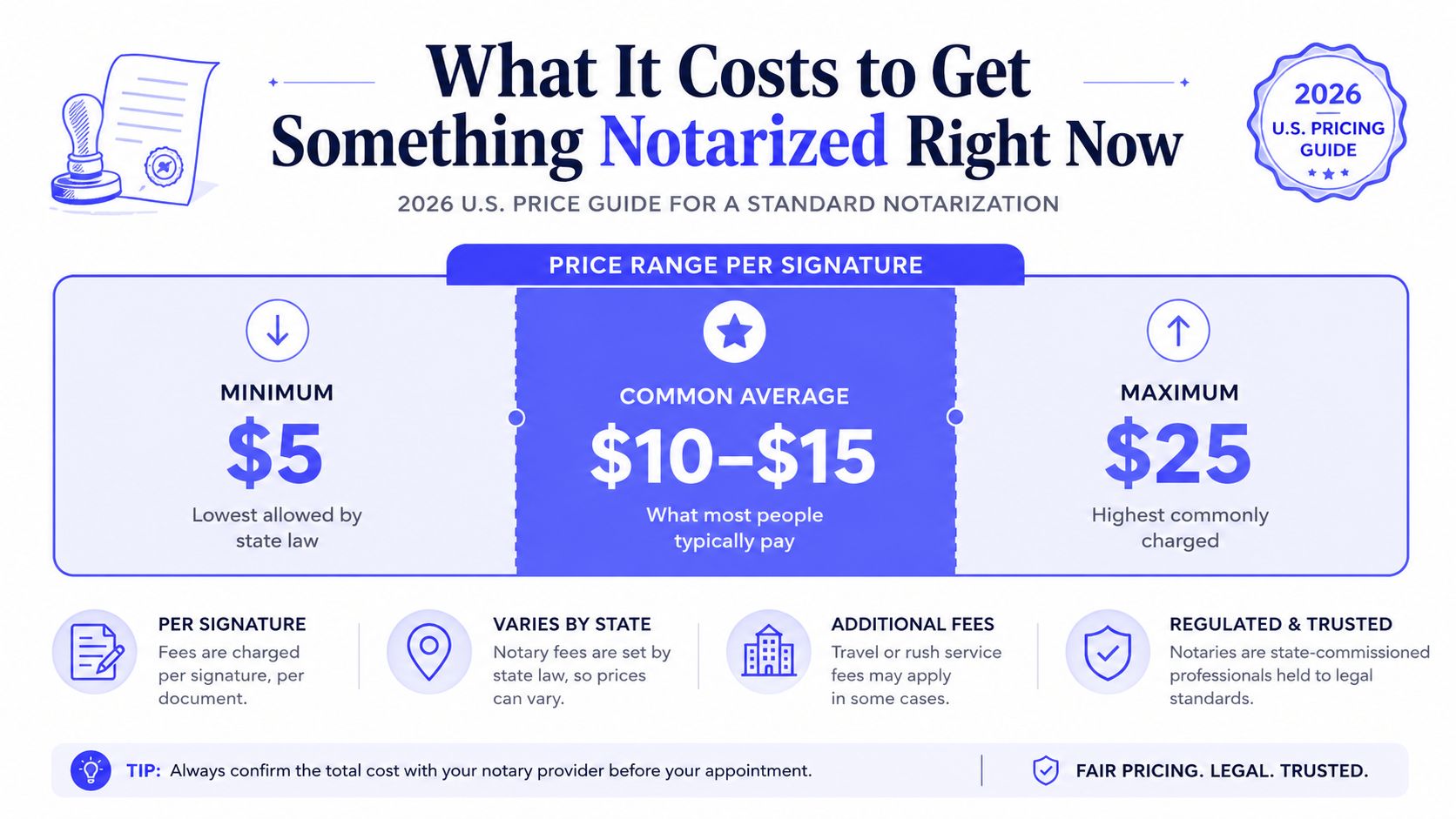
A state-capped in-person notary act typically costs $2 to $25 per signature, while mobile visits add about $40 to $150 and remote online notarization sessions usually run $15 to $50. The cheapest stamp is rarely the cheapest total.
The number printed in a search result usually covers only the notarial act. Your real bill can also include travel, extra signers, witnesses, after-hours scheduling, platform technology, apostilles, translation, recording, or transfer charges. If you're asking how much to get something notarized, start by identifying the service format, then request the full out-of-pocket total before you book.
Table of Contents
- What It Costs to Get Something Notarized Right Now
- How Notaries Actually Charge for Their Services
- Typical Prices for Common Notary Services
- Real Estate, Loan Signings, and Mobile Visits
- Remote Online Notarization and Hidden Platform Fees
- Where to Get Documents Notarized for Free or Cheap
- How to Prepare So You Don't Get Charged Twice
- Your Next Step to Lock In a Fair Notary Price
What It Costs to Get Something Notarized Right Now
A state-capped in-person notarial act generally costs $2 to $25 per act in the United States, with many states setting about $5 for common acknowledgments, oaths, signatures, and certified copies. The National Notary Association's state fee guide shows why the price depends on the state rather than one national rate.
That posted fee covers only the notarial act. Your final bill depends on how the appointment happens. A bank walk-in may charge the statutory fee, while a mobile notary adds travel, appointment, or after-hours charges. Remote online notarization can add technology and platform fees.
Compare the base fee with the real total
Break every quote into three parts:
- Base act fee: The charge for the acknowledgment, jurat, oath, signature witnessing, or copy certification.
- Access fee: Travel, mobile service, urgent scheduling, or after-hours availability.
- Completion costs: Extra signers, witnesses, additional seals, platform charges, apostilles, translations, recording, or transaction-related fees.
A local office may charge only the base amount. A same-day home visit can cost much more because the quote includes access and convenience. Ask for the complete out-of-pocket total before booking, including witness and travel charges.
Rules also change outside the United States. Metro Manila's 2026 IBP schedule uses flat fees for some acts and value-based pricing for certain property transactions. Turkey's 2026 tariff charges vehicle transfers at 2 per thousand, or 0.2%, of the sale price, subject to a minimum fee. The Metro Manila notarial fee reference and Turkey tariff details show why location and document type can change the bill.
How Notaries Actually Charge for Their Services
Notaries price the work unit, not just “the document.” Depending on the jurisdiction and appointment, the unit may be per act, per signer, per individual, per signature, per page, or one bundled service. Confirming that unit explains why two quotes for the same paperwork can differ.
Pennsylvania shows how quickly the base fee can multiply. Its official notary fee schedule sets $5 per named individual for acknowledgments, oaths, affirmations, witness signatures, certified copies, and protests. If several people appear before the notary, each person can create a separate charge, even when everyone signs the same document.
Colorado uses another method. Its fee includes the duties and functions required to complete the notarial act. A multi-page document can therefore produce different quotes because notaries may count the acts and related work differently while following state rules.

Ask what the quote includes
Get answers before you book:
- Is the amount per signer or for the entire appointment?
- How many notarial acts does the document require?
- Are witnesses included, or must I provide them?
- Does the quote include every seal, certificate, and required journal entry?
- Are travel, parking, evening, or urgent-service charges separate?
A one-page affidavit with one signer is usually simple. A deed with several signers, certificates, and witnesses requires more work. Page count alone does not set the price, but a longer document often contains multiple acts. Witnesses, travel, and after-hours availability can turn a low base fee into a much higher out-of-pocket total.
Practical rule: Compare quotes only after confirming that both notaries are charging for the same unit of work and listing the same added costs.
Loan packages and real-estate documents deserve extra scrutiny. Multiple signatures and certificates may be only the starting point. Appointment length, travel, document handling, and specialized signing work can all appear in the final bill, so request the complete total before agreeing.
Typical Prices for Common Notary Services
A notarial act may cost only a few dollars, yet the final bill can rise once travel, witnesses, timing, or remote technology enters the appointment. The table below shows common base-service benchmarks, not the amount every customer will pay.
| Notary Service | Typical Price | What It Covers |
|---|---|---|
| Acknowledgment | State-capped fee per act | Confirms that the signer acknowledged signing voluntarily |
| Jurat | State-capped fee per act | Covers signing in the notary's presence and taking an oath or affirmation |
| Certified copy | State-capped fee per act | Certifies a copy when the jurisdiction permits that service |
| Oath or affirmation | State-capped fee per act | Administers the spoken oath or affirmation connected to the document |
| Signature witnessing | State-capped fee per act | Witnesses or attests to the signer's execution where permitted |
Arizona, for example, allows traditional notaries to charge from no fee up to $10 for common acts such as acknowledgments, jurats, copy certifications, and oaths or affirmations under its official fee schedule.
Washington sets a $15 maximum for several standard acts, including signature witnessing, acknowledgments, oath-based verifications, copy certification, and administering an oath. The state separately allows up to $25 for a remote notarial act, according to its Washington administrative rule.
Those caps describe the notarial act itself. A notary may quote travel, witness coordination, after-hours availability, parking, or technology charges separately, where permitted. Ask for the complete out-of-pocket total before booking, especially if the appointment is away from the notary's office or outside normal hours.
Match the service to the document
A parent signing a permission letter may need an acknowledgment or a witness-related act. A person signing a sworn affidavit may need a jurat. A deed transfer can involve multiple signers and certificates, so each required act can affect the base total.
Confirm the exact act with the organization receiving the document. Banks, courts, government agencies, lenders, and foreign authorities may reject paperwork with the wrong certificate or a missing witness. The cheapest listing saves money only when it performs the service the recipient accepts.
Real Estate, Loan Signings, and Mobile Visits
Real-estate closings and loan signings often produce the widest gap between the advertised act fee and the amount you pay. Several signers, a large document package, witnesses, travel, parking, and an inconvenient location can all raise the final bill.
A mobile notary visit commonly adds about $40 to $150 beyond the act fee, according to NotaryLive's pricing overview. Distance is only one factor. Evening or weekend timing, same-day requests, waiting, parking, and a complicated signing package may each affect the quote.

For a mortgage or refinance appointment, request a written all-in price before anyone travels. Confirm whether it covers every signer and required document, or only the listed notarial acts. Ask who supplies witnesses, whether witness coordination costs extra, and whether the quote includes travel, parking, waiting time, after-hours service, weekend appointments, same-day booking, and cancellation.
The document package matters, too. A loan signing may require more review and coordination than a single acknowledgment. If one signature is missed, you may pay for another visit. For a refinance-related appointment, review the mortgage and refinance service option and verify that the provider understands the lender's signing instructions.
A low act fee does not reduce the bill if an incomplete appointment creates a second travel charge.
Mobile service remains a sensible choice when you cannot travel, need a specific location, or face a time-sensitive closing. Treat travel, witnesses, timing, and technology as part of the price from the start. The headline fee is only the base.
Remote Online Notarization and Hidden Platform Fees
Remote online notarization is a separate pricing channel, not just a cheaper office visit. A typical U.S. online session runs around $15 to $50, according to Notaries.com's fee reference. That advertised amount may cover only the notarial act, with a platform or technology charge added at checkout.
Oregon draws a clear line between the notary fee and technology costs. Its Secretary of State says the maximum fee for remote notarizations is $25, while platform providers may charge separate technology fees based on the transaction or subscription arrangement. Review the Oregon remote notarization FAQ before accepting a low headline price.
Washington also permits up to $25 for a remote notarial act, compared with the $15 maximum for several listed standard acts under its Washington rule. The difference matters when comparing online and in-person quotes.
The full online total can include the base notary fee, platform access, identity verification, document handling, and extra signer or act charges. Ask for the final amount before uploading anything.
- Is the advertised amount the notary fee or the complete session price?
- Is there a separate platform or technology charge?
- Does the price cover one document, one signer, or multiple acts?
- Will additional signatures create another charge?
- Can the receiving agency accept a remotely notarized document?
Remote service suits an eligible document when speed and convenience matter. You avoid travel and waiting, but the signer still needs acceptable identification, suitable technology, and a receiving organization that accepts remote notarization. It can cost less than an urgent mobile appointment, yet a free bank or credit-union service may remain cheaper for an ordinary visit. Compare the complete out-of-pocket total, not the headline fee.
Where to Get Documents Notarized for Free or Cheap
Start with places that already have a relationship with you. Banks and credit unions may provide notary access to account holders, but policies vary by branch. Call first, ask whether the notary is available, and confirm that the branch accepts your document type.
Shipping and office-service locations can be practical for routine paperwork. UPS Store locations commonly offer notary services, but availability, appointment rules, and fees differ by location. AAA offices may provide notary services for members in some regions, while public libraries, county clerk offices, courthouses, or other government offices may offer low-cost access where the service operates.

Use this call-ahead shortlist
- Bank or credit union: Ask whether the service is reserved for account holders and whether an appointment is required.
- UPS Store or shipping center: Confirm the notary is working that day and ask about per-signature pricing.
- AAA office: Check member eligibility and local availability before driving over.
- County clerk, courthouse, or library: Ask whether the office notarizes private documents and whether walk-ins are accepted.
- Online notary: Check the complete session price, technology charge, document eligibility, and identification requirements.
Free or low-cost locations often have narrower boundaries. A bank may decline a real-estate closing, power of attorney, or other document because of internal policy, even if the notary is otherwise qualified. Libraries and government offices may have limited hours or require residents, appointments, or specific paperwork.
Bring the unsigned document and valid government-issued photo identification. If witnesses are required, confirm whether the location provides them. A five-minute phone call can prevent a wasted trip and a rushed mobile booking.
How to Prepare So You Don't Get Charged Twice
The cheapest notarization is the one you complete correctly the first time. Preparation prevents the failures that trigger a second appointment, a second travel charge, or a rejected document.
Use this checklist before you leave home or open an online session:
- Leave the document unsigned: Sign only when the notary tells you to. Some acts require the notary to witness the signature.
- Bring valid identification: Confirm in advance which ID the notary accepts.
- Count every signer: Tell the notary how many people must appear and sign.
- Arrange witnesses: Don't assume the notary supplies them. Ask whether witnesses are required and who may serve.
- Confirm the full price: Get travel, after-hours, platform, extra-signer, and witness charges in writing.
For a professional appointment, you can use this script:
“I have [document type], [number of signers], and [number of witnesses]. Is this an acknowledgment, jurat, oath, or another act? Please send me the complete price, including travel, timing, extra seals, witnesses, and any technology fee.”
Don't fill in legal wording or choose a certificate just to make the appointment easier. The person or organization receiving the document usually determines what kind of notarization is required.
If the paperwork relates to a home project or contract, verify the professional handling the broader transaction before you schedule the notary. A contractor background check can help you review licensing and screening considerations separately from the notarization itself.
Your Next Step to Lock In a Fair Notary Price
Today, send the notary a clear description of the document, the number of signers, the location, the required witnesses, and your preferred appointment time. Ask for the all-in total, not just the statutory act fee.
Confirm three things before you book:
- The exact notarial act required.
- Every travel, witness, after-hours, extra-signer, and technology charge.
- Whether the receiving organization accepts the completed document.
Then book once, prepare the paperwork correctly, and keep the written quote.
For time-sensitive home and property transactions, a matching service such as professional home services can reduce the back-and-forth involved in finding an appropriate professional. The same principle applies here: clarity about the scope and total price matters more than chasing the lowest advertised stamp fee.
Hand Vetted Co. connects you with one verified professional instead of sending your request to multiple businesses. Visit Hand Vetted Co. to find a screened match, confirm the scope of work, and move forward without competing calls or unclear expectations.